Category Archives: Screen

Playing the victim

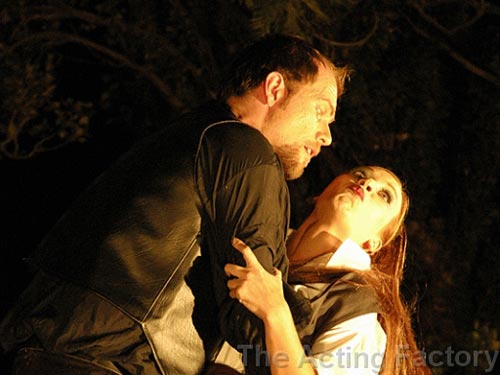
JUST ACTING Petruchio victimises Katharina, played by Gabrielle DeCelis (Photo: The Acting Factory).
JUST ACTING Petruchio victimises Katherina, played by Gabrielle DeCelis (Photo: The Acting Factory).

IN independent theatre circles, there’s long been an urban myth that if you manage to attract a casting agent to see your production, you’re in with a chance of scoring an audition for something bigger and better.

Securing the attendance of a casting agent is no mean feat.

It takes a great deal of networking (read: bothering) and a heavy dose of self belief (read: ambition).

The only time I ever managed it was during a production of The Taming of the Shrew, part of the annual Shakespeare by the River in the Penrith Valley, produced by the Acting Factory.

I’d met an assistant at an agency in the city during a previous casting. She was young, very inexperienced, and she revealed that she was from Penrith, allowing me to casually mention Shakespeare by the River…

I bothered. She came.

Maybe it was karma, but playing Petruchio, Shakespeare’s misogynist shrew-taming victimiser, somehow suggested I’d be perfect for playing a victim.

Generally in the ‘fifty-worder’ zone (roles of fifty words or less, defining them in an Equity pay bracket), victim roles are notoriously difficult to cast, because no serious (read: ambitious) actor wants to play them.

But I didn’t know any better, when I leapt at the chance of a casting session for the role of David Begg in an episode of Australia’s hottest hospital drama of the day: All Saints.

I donned my regulation neutral black T-shirt, which ensured I looked as much like my headshot as possible. I arrived slightly ahead of time to avoid the waiting room nerves, which was a good thing, because the noises coming from inside the casting room sounded like I was waiting to see a doctor at an amputation clinic: Mr Begg was the victim of a machete attack by his wife.

Listening to actors emulate the pain levels of machete attack is a little like tuning-into your neighbours having sex. When the casting agent asks for the actor to “please do it again, but make the pain levels nine out of 10” the intimacy escalates and diminishes in an amusingly familiar cadence, because, as they say, there’s a fine line between pleasure and pain.

Casting sessions and auditions are artificial situations that most actors relate as agonising. They are a chance to show that you’re a directable actor (read: you listen), and an opportunity to secure that ten-second moment in which the casting agency staff make up their minds about you, regardless of the performance you’re about to give.

I told my agent I’d gotten a casting for All Saints, and asked her to look out for a call about the result. Yes, you read correctly – I got the casting session independently of my agent, and I was willing to give her ten per cent of the fee should I get the job. If you can work out why actors always do this, you’ll make a million bucks.

A week later, she called, which meant I’d got the job. Agents never call otherwise.

HAND IT TO HIM a prosthetic hand was matched to my real one.

A script followed. David Begg had five words (“Bitch cut my hand off”) and a maximum of 45 howls of pain, as he was wheeled into the Emergency ward of All Saints’ hospital, his hand-in-a-bag at his thigh, blood spraying everywhere.

At the read through early the next week, the familiar faces (read: stars) of All Saints sat on one side of the room, flanked by a wall of slightly familiar faces (read: guest stars), and a wall of nobodies (read: fifty-worders) by the door.

David Begg’s violent argument with his wife, of course, was background to looming hospital administration issues, and the sudden arrival of an emergency case was a way to see careworn and jaded hospital workers at their level best, but I spoke my lines (and expressed my pain) with the best of them.

A production assistant showed me to the props department, where my hand was matched with a latex dummy and an entire fake arm with a grisly stump wrist. The props team were having too much fun working out how to make an arterial spray.

Then the big day. Call sheets, early morning catering, quiet on the set, and plenty of waiting in the off-set zone of the studio, where I got chatting with the regular featured extras, those people you see in the background of the All Saints wards: nurses, doctors, and patients, none of them “serious” actors, but everyday people in well-paid regular work.

My call came and I was strapped onto the gurney with my good arm underneath me, in a position for which I would quickly become grateful for occasional yoga classes. The prosthetics were put into action and tested, and a nice, arterial spray was created by the props guy, cramped into the gurney below me.

No direction from the young director, then all of a sudden we were off …

Several takes of crashing through the plastic double doors resulted in a message from the director that there was “not enough blood!”. He put in a brief appearance and demonstrated to the prosthetics team, by wildly gesticulating, how he wanted the slaughter to appear.

They wheeled me back, the team tested a few angles, and we went through a few more takes.

Another message came through: my five words not being delivered clearly enough.

Now, I had my back story worked out. My imaginary wife had a name, and if you’d asked me anything about how we’d come to such a momentous argument, I’d have been able to tell you.

But, locked onto a gurney with my real arm numb below me, teams of creatives arguing about how to get the best out of the bloody stump, and me having to deliver my five words in the middle of the stars’ lines, I determined to go up a gear on the next take …

“That’s great!” the director yelled from his hidey-hole straight afterwards, “but MORE blood please!” he added.

The next take I sat up and grabbed the latex stump, aware of the proximity of the camera over the stars’ shoulders, and gave them all a liberal spraying.

“Better, but higher next time please,” was the response.
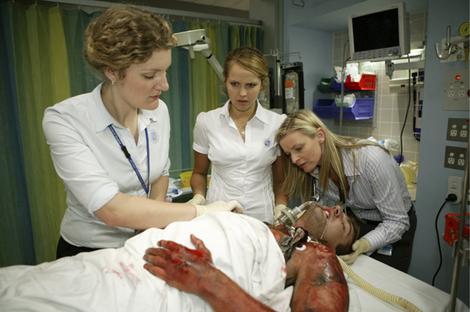
ALL STARS Some of the cast of medical drama All Saints (1998-2009).

We had to wait while they replaced surgical gloves and cleaned-up the spray from the stars’ hospital scrubs, then, emboldened by creative ambition, and also wishing to get it right so my real arm could get real blood supplied to it as quickly as possible, I sat up higher, shouted my words to the boom, and sprayed a wall of Logie award winners with as much fake blood as they were ever likely to cop outside of a hammer horror remake of the Brides of Dracula. Acting method went out the window.

“Got it!” came the cry from behind the flats. “Thankyou to Michael,” a production assistant encouraged. The stars clapped unenthusiastically while costume attendants saw to the fake blood dripping from their brows.

Friends and family waited with great anticipation for the broadcast of my ten-second appearance weeks later. I missed it, working at my day job across town, but also because I was waiting for another call from fostering effective relations with a casting agency. Perhaps next time I’d graduate to more than 50 words?

But I’m still waiting, which is, I suppose, why serious actors never play the victim.

© Michael Burge, all rights reserved.
Tea for three, with viagra

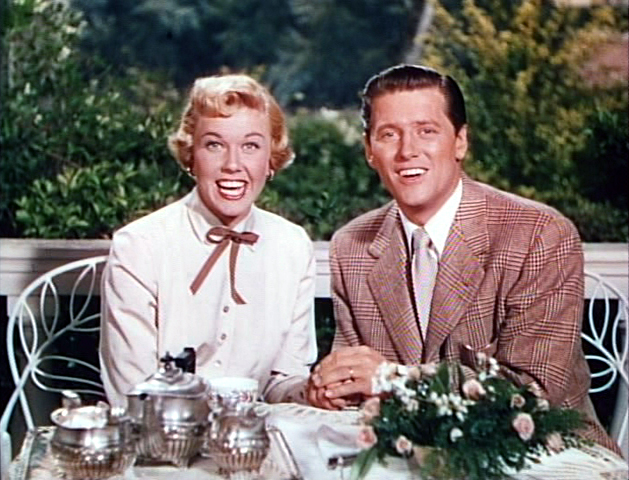
TEA FOR TWO Doris Day and Gordon MacRea in the 1950 film.

A Writer’s saviours.

IT TAKES a very bleak outlook for me to feel like giving up writing, but once I very nearly did.

Living by myself in a friend’s granny flat, my partner having died, my best friend having dropped me, my car having burst an engine gasket and been sold at bottom dollar for scrap, I was at a low ebb.

The idea of writing anything was the last thing on my mind.

Enter two dear friends – Yvonne and D’arcy – with a plan. Yvonne is a writer, having taken it up relatively late in life, and D’arcy knows the English language backwards, a natural editor like no other.

They wanted to enter a national TV screenwriting competition with an adaptation of one of Yvonne’s short stories. They knew I had experience in screenwriting. They were also wise enough to realise I needed something to keep my mind off the dreadful turn of events my life had produced.

I was a little dubious about how effective I’d be collaborating on a storyline, but after reading Yvonne’s story, Tea for Two, I could see immediately how this tale of revenge and bad behaviour amongst older people could be made into a riveting 30-minute drama.

So I said I was interested, as long as Yvonne and D’arcy agreed to tell me honestly if they thought it was no good. We’d only enter the competition, as a team, if we were all happy with the result.

Over cake and tea, we shook hands on it.

The competition had strict production criteria that submitted scripts needed to adhere to or get knocked out – limited numbers of characters, no scenes set at night (meaning no expensive night shoots), and a strong dramatic twist in the plot.

Yvonne’s story needed some adjustments to make it work as a screenplay – one location, and stronger character motivations to allow the story to take place in the 30-minute format – but it was fundamentally a brilliant tale about passion, poison, and older people, with a great ring of truth, because both Yvonne and D’arcy were well into their seventies when they wrote it.

I came up with a first draft in a few days and sent it off to them. This began a series of phone conversations and notes sessions, the likes of which I had not before (and have never since) been part of even with the most experienced collaborators.

All delivered, I hasten to add, with the kind of honesty, good manners and intelligence that all writers crave.

But these two went the extra mile. During one phone call, Yvonne’s voice sounded a little odd, like she’d been out jogging. When I suggested she sit down and let me call her back, she explained that she and D’arcy were entangled on their sofa reenacting the dramatic cliffhanging denouement of our script, with her dangling by a thread over the edge of the furniture, and D’arcy holding her.

CLIFFHANGER Alfred Hitchcock's Vertigo.
CLIFFHANGER Alfred Hitchcock’s Vertigo.

“It won’t work, luvvie,” Yvonne said, sure and to-the-point. “We’ve tried it and there’s no way that character could see anyone up above the cliff while they’re holding on by their fingertips. Can we change it?”

There was no refusing such commitment . I duly rewrote with her notes in mind.

The poisoning element of Yvonne’s storyline was pivotal, and I was keen on having an overdose of viagra as the means by which the murder was executed, something I assumed would be in good supply in an independent living nursing home, where we’d set our screenplay.

But I needed some facts on it, and thought to ask Yvonne.

“We don’t know luvvie, D’arcy doesn’t need it,” she said, completely without guile. “I could ask down at the Chemist’s, shall I do that?”

Priceless, unquestioning support.

Within a fortnight we’d researched all the facts we needed and collaborated on a series of drafts, and after a month had our script on the page in a state we were all very happy with.

Tea for Two was a very Australian, very timely exploration of older characters who were three-dimensional and hungry for their last-ditch, last-chance grabs at life.

We were extremely proud when we got through the first round, mainly because we knew we’d artfully worked within the production parameters requested; but ultimately our collaboration got rejected. The TV series was made that year, replete with stories focussed on younger people dealing with perhaps less realistic issues.

I’d dared D’arcy to place one single hair inside the 3rd page of the screenplay – an old writers’ technique for finding out if your screenplay had even been read before rejection. When it came back to us, yes, the strand of hair was still there.

But Tea for Two made one bereaved writer and two older collaborators feel very relevant for one Autumn. We still laugh about it. I will never forget Yvonne and D’arcy for the gift of their collaboration, and because they kept me writing despite the odds.

© Michael Burge, all rights reserved.

On the Board at Fox Studios

Hi res Fox Colour_0How a Writer’s op-shop jacket got him cast in a commercial.

Towards the end of my acting training my class appeared in The Legend of King O’Malley by Bob Ellis and Michael Boddy. In preparation for the title role, I scoured the local op-shops for weeks in search of my costume.

Having been an inveterate op-shopper for years, I knew the chances of finding anything my size were slim, so when I discovered a light green plaid jacket, the sleeves of which covered my long arms right to my knuckles, I rushed to pay the hefty $5.

But hey, I had an outfit that didn’t pinch me in the shoulders or make me look like Frankenstein, wrists exposed from cuffs halfway up my forearms. I felt able to play the man (“The King”) who had such an impact on the formation of modern Australia.

About a fortnight after the show, I was rehearsing for a production of The Popular Mechanicals by Keith Robinson, Tony Taylor and William Shakespeare, at Penrith’s Q-Theatre, when I got a call from the only agent I’ve ever had (who recruited models and actors through letterbox drops), asking me to attend a casting session for a car commercial at Fox Studios in Sydney. “Dress corporate,” she said.

My only smart jacket was King O’Malley’s. Matched with a business shirt (I had to fork out another $2), I looked about as corporate I was ever going to get, and plonked myself down in the casting office waiting room, surrounded by people in black and grey.

We were seen in groups, seated in a mock boardroom complete with a whiteboard, and launched into a board meeting improvisation. I was asked to stand and play the boss, whiteboard marker in hand.

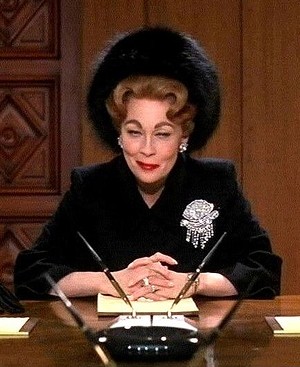
BOARDROOM BITCH Faye Dunaway as Joan Crawford in Mommie Dearest.

Having spent months in theatre training, I was used to playing to the car park, so I was drawn to channel Faye Dunaway playing Joan Crawford in the Pepsi Cola scene in Mommie Dearest, (“Don’t f#%k with me fellas!”), and launched into sacking the whole lot of my motley staffers.

A note from the big wigs in the shadows, behind the camera, asked me to “Do it again, but tone it down.”

So I changed gears, made it quieter, colder, figuring they might be framing my head and shoulders. My fellow actors looked back at me with fear. Before I knew whether they were acting or not, we were shuffled out.

At the callback we had to imagine, on cue, a wonderful new car driving past our meeting, which was so innovative and attractive that it stopped us, and all our corporate musings, in shock. The result was several rounds of dreadful face pulling, and a bit of inappropriate chuckling.

But I got the gig!

Marched before the director at the costume fitting, “The Board” all looked at me when he asked “Where’s your green jacket?”.

“At home,” I muttered, feeling like I’d worn the wrong gear to sports class. “Can you bring it to the shoot? Can he bring it to the shoot?” he asked, not allowing me to say anything to the first part of his question. The costume designer looked at me with daggers in her eyes, nodded, and marched us out.

There was me thinking it was my well-honed acting skills which got me the job!

On the day, “The Board” waited in a bland green room at Fox Studios, where we worked out very quickly that only one of us could be defined as a “proper” actor – the NIDA graduate cast in the role of “The Boss”. The rest of us were ring-ins, really – a film festival producer, an accountant, an ad sales-rep – all earning far more in one day than we’d ever get in our day jobs.

If we made the final cut, that is. Word got around the set that the director was speculating on too many scenes for his Asian-screened commercial, and if we got cut we might get nothing.

No-one said it, but everyone on “The Board” thought “Don’t f#%k this up, people”.

We were fetched by a man with five mobile phones on his belt, seated in front of a blue screen with a small black track across it, given two quick rehearsals to aid in focussing on the fluorescent taped mark as it sped by (indicating where the “car” would be keyed-in by the editors) and then we were on.

I was seated with my back to the “car”. After the first take, they asked us to take our cue from the NIDA graduate, who was to take his from the director. We were all to be amazed by the “car” at different moments.

After a few more takes, a message came through to the NIDA graduate that he needed to do his turn, his “discovery” of the “car”, “less Broadway, please”. Everyone chuckled, because he had, actually, been having far too much fun with it.

A few more takes later, I shoved some papers off the table, on purpose. “Upstager!” I imagined the NIDA graduate say under his breath. But they liked it, “Keep the papers falling, please.”

A few takes later, they asked for me to take my green jacket off and put in behind me on the chair and roll up my shirt sleeves. No problem, it was getting warm anyway.

Then things started to go a little awry. The NIDA graduate was turning early, which put us all off. The message came through to “Stick to the cue, please”.

Bemused, sweat trickling down his temples, the NIDA graduate looked as though he really was earning his extra dollars for being slightly more featured in this commercial than us ring-ins. While they reset the marker, he leant across to me and whispered: “What’s my cue again?”

“When the director says ‘action’,” I whispered, as reassuringly as I could.

A few more takes later and it was all over. “The Board” was marched off the set to loud applause from the clients, clustered around a mock living room at the edge of the sound stage.

THE BORED MEMBERS Corporate grey is good, but green is better.
BORED MEMBERS Corporate grey is good, but green is better.

“When do you think we’ll get paid?” one of “The Board” asked back in the green room. “Don’t be so cynical,” the guy with five mobile phones said, calling-in the two models cast in the scene where the secretary gets ravished on the photocopier by some random office guy, after seeing the “car”, or course.

We cynical non-actors laughed, exchanged business cards, raided the fabulous leftover catering, and departed.

I drove back to Penrith for the technical rehearsal of The Popular Mechanicals, which was to open in only a few days. After all the blood, sweat and tears that goes into putting anything onto the stage, we played to some houses comprising fewer people, showing less enthusiasm, than the ad execs after “The Board’s” gripping performance at Fox Studios.

And we got paid nix. Welcome to Showbusiness, Mike.

I kept the green jacket for a few more years, but ditched in a hurried move, and I have never acted since I gave it up. Maybe it was my Good Luck Jacket?

© Michael Burge, all rights reserved.