Category Archives: Write regardless!

Stand up, citizen journalists

TRY
CALLING CARD Citizen journalism does not open every door.

IN May, 2014, a very simple tweet went out on the afternoon before Fairfax journalists agreed to strike in protest at the company’s plan to cut 80 jobs, mainly in production (layout and sub-editing) and photography.

Since the Independent Commission Against Corruption (ICAC) hearings would continue through the strike, a citizen journalist (CJ) asked whether any CJs were available to cover the following day’s ICAC events in lieu of Fairfax. After all, the hearings were only getting more interesting with every new day.

I was mentioned in the tweet, so got swept-up in the replies, but my tweeted suggestions that CJs and the MSM work together during the strike fell on many deaf ears.

“Stand down CJs,” one tweeter advised.

“Don’t cross the picket line,” another warned.

Which posed the question – are citizen journalists comrades of mainstream media journalists, or are we not?

When the Fairfax redundancy announcement was made, it didn’t register at my workplace – a Fairfax title in Queensland – where I was a part-time sub-editor, because we had our heads down meeting our deadline.

I say “we” about citizen journalists because my paid employment as a part-time sub was nothing like my unpaid output as a citizen journalist, which took up a huge chunk of my week as a sub-editor and writer for No Fibs, my own blogs and other sites.

No Fibs’ editor-in-chief, Margo Kingston, a former Fairfax employee, also identifies as a citizen journalist, most recently in her self-funded reports from the Leard and Bentley blockades, mainly via Twitter.

No Fibs ‘pages’ are filled with articles by academics, public servants, corporate employees, authors, carers, business people, welfare recipients, estate agents and many others who identify as CJs, and a few trained journalists.

We journos amongst them are a mish-mash of survivors from the wash-up of the mainstream media, the shipwreck of which occurred long before this week’s latest round of redundancies within Fairfax.

Which tempered my response to the strike. I empathised, but the axe has been hanging over my journalist’s head for years. It’s become almost impossible to secure gainful full-time work with my subbing skills, and I work alongside plenty of highly-skilled, under-employed journalists.

That day’s strike in the south barely registered up here.
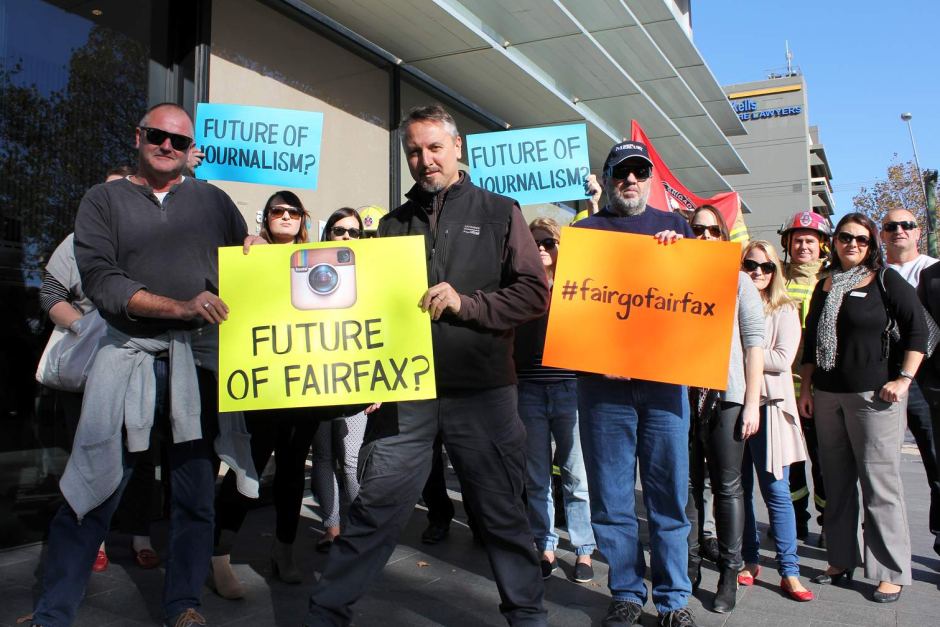
FAIRFAX STRIKE Photographer Kirk Gilmour and union representative Andy Zakeli lead editorial staff striking outside offices of the Illawarra Mercury in Wollongong, May 8, 2014.
FAIRFAX STRIKE Photographer Kirk Gilmour and union representative Andy Zakeli led editorial staff striking outside offices of the Illawarra Mercury in Wollongong, May 8, 2014.

Because many of those who were shocked by Fairfax’s job cuts placed the strike at the very centre of journalism as we know it, and, far more surreal, they were expecting readers to notice Fairfax journos wouldn’t be reporting that day.

I weighed into the Twitter debate about whether a CJ could be described as a rat for reporting from ICAC that day, citing lack of pay and lack of affiliation as reasons why it would not be the end of the world if one had.

In the process I was turned into some apologist for the ‘dark forces’ ending our careers, but it has not washed, that argument, ever since I came to terms with why I believe the media has been killed by every single user of the social media’s Publish Button. Journalism will survive, but the media as we knew it is already dead.

It’s very confronting, this moment of realisation, for all journalists – seasoned, emergent, and student. I feel most for the students about to begin a lifetime of HECS debt in return for a degree which will not sustain them with a career. They have been lied to by institutions out of touch with the reality of a dying industry. Savvy 18-year-old tweeters already have more of an audience than most media graduates.

Citizen journalists are perhaps more in touch with the point of journalism – as one tweeter pointed out, journalism is ultimately about communicating to an audience, without whom the job is a one-way street leading nowhere.

We know the role requires much more of individuals than mainstream journalism ever did – taking photographs in addition to writing; creating headlines in addition to stories; proofing our own work and not just writing it; and uploading it onto the largest distribution network the world has ever seen: the social media.

Many citizen journalists struggle with this workload, and there is very, very rarely a pay cheque at the end of weeks of research and/or travel.

Some mainstream journalists have taken to the social media via blogs to complain, and the plethora of spelling errors, layout mistakes and grammatical knots reveal an embedded reliance on production colleagues that may not find sympathy in the wider workplace. Journalists need to be match-fit and multi-skilled, not merely insightful writers.

There is also the issue of access: try blagging your way into a press conference without a mainstream media logo on your lapel, yet citizen journalists manage to get in and report.

For one of us to turn up at ICAC that day and live tweet would not be an onerous task. Twitter has provided easy access to our audience, and journalists of all stripes, including Fairfax staff, have rushed to capitalise on Twitter in a way which outstrips mainstream media circulation by an unlimited degree.

That mainstream journalists want the right to access that free distribution network through live tweeting, and get paid, opens them to accusations of having a foot in both the problem and the solution for journalists worldwide.

write-regardless-cover
BUY NOW

I defend my colleagues’ right to strike and I understand why they did so, but I will also defend any unpaid, unaffiliated citizen journalist who live tweets during a mainstream media strike, as long as they report the truth and they hashtag properly. Crorcet silplneg is oatpnoil.

And in the end, the only journo who crossed the picket line that day was a Fairfax employee.

An extract from Write, regardless!

© Michael Burge, all rights reserved.
How to write wrong

READY TO POUNCE Survuvung feedback can feel like a game of cat and mouse.
READY TO POUNCE Surviving negative feedback can feel like a game of cat and mouse.

AFTER dabbling on and off ever since I could articulate words, in mid-2009 I started writing full time and haven’t stopped.

Working through plenty of strong emotions (and day jobs), I blasted through my blocks to self-expression and found my voice in fiction, plays, journalism and memoir – genres I had tried but given up hope on long ago.

Along the way I’ve collected a little wisdom about how the world reacts to what writers write.

It’s not always pretty – there are plenty of detractors out there waiting at their keyboards to knock writers into silence.

Writers are generally very observant beings – our art reveals an ability to dig deep inside and tell the stories we find. The easier we make it look, the more it drives people who have trouble expressing themselves into fits of jealousy.

So, ‘you’re wrong about that, you know’, is a very common response to the courage it takes to write.

You’ll get it at social gatherings, on the social media, and sometimes from friends.

But one person you’ll very, very rarely hear it from is another prolific writer. We know the hard slog that goes into the job.

Here are my tips to writing ‘wrong’ …

Use the criticism

After your first few ‘you’re wrong’ experiences, you may find yourself getting a bit upset at someone making a point of being negative. A good way to remedy the shock is to write about it. That’s exactly what I am doing right here, right now. Never go silent for fear of someone deciding you’re wrong. Just keep writing.

Check your sources

Then check them again. This is not just the job of the journalist. Often, an accusation of ‘wrong’ comes from a readers’ need to highlight an inaccuracy, sometimes very publicly. But you’ll be surprised how often you go back to your research material only to find you were more correct than you originally realised. ‘Wrong’ is an easy accusation to make, but it’s harder to wear with confidence in mixed company unless you’ve gone over your sources properly.

Self correct 

Online publishing allows instantaneous correction of just about anything. If you’ve made an error, from a typo to a mistaken claim, correct it! Across the heavily political history of publishing, this ability is an incredible luxury that a writer could argue people lost their lives for. Use it.

Subject ‘experts’

Many have invested time and money into becoming experts in certain fields, and they sometimes feel they have cornered the subject against every other writer. Expect little support from such people – they’ll get upset and angry if you write on ‘their’ subject, or close-up altogether. Explain your use of their source material, sure, but never be afraid to add to the story without their approval or permission. They’ll tell you you’re ‘wrong’, of course, but you’re getting used to that now, right?

SSSS
IT’S EASY to knock others from behind your keyboard.

Old fashioned knockers

There are few things more hurtful for writers who use the social media than the throwaway dismissal or casual drubbing from one of our ‘peeps’. Facebook has become a tender trap for their ‘friendly’ fire. Knockers are the hardest critics to recognise, because their message can be slow to dawn on us if delivered in a sustained manner over a long period of time. Deleting a few of their condescending, corrective comments is usually all it takes to deliver firm return fire about their lack of form.

The right of reply

Pieces I’ve written have attracted polar feedback. The same works have been called ‘uplifting’ and ‘undisciplined’; ‘powerful’ and ‘hurtful’; ‘insightful’ and ‘misguided’. I try not to soak up either praise or criticism, which is easy to say and hard to put into action. In the fine balance between listening to a reader’s feelings and honouring my own, I tend to listen to myself, because to assimilate the opposites in my readership might end in this writer silencing himself, and I stayed silent for long enough.

write-regardless-cover
BUY NOW

If all else fails …

What I am still learning is how to adopt that iron-clad ego it takes to put my work into the public domain, and leave it there despite the wall of wrong. But I am developing a suspicion that all a good writer needs is the brio of a damned good judge. Objection? Overruled!

An extract from Write, Regardless!

© Michael Burge, all rights reserved.

You cannot burn a mummy blog

BOOK BURNING Nazis burning works of Jewish authors, and other works considered "un-German" in 1933.
BOOK BURNING Nazis burning works by Jewish authors, and other works considered “un-German” in 1933.

OVER one weekend in April, 2014, a ripple of panic went through the social media in Australia. I was alerted to it by one of my Twitter friends.

Word was that Vanessa Powell, described on her Twitter profile as a “refugee supporter”, had been sent two anonymous tweets by the federal Department of Immigration and Border Protection. They could have been generated by anyone, from lowly staffer to the top man, Immigration Minister Scott Morrison.

In vague legal terms, the tweets asked for Powell to remove a post from her Facebook which the department found “offensive”.

I don’t know what Powell’s Facebook post was about, and I don’t want to know. That is not the point.

“If criticism of the government on the social media comes with legal threats, the next step is to put the same pressure on anyone who reads it.”

As I checked the story to see if the accounts were real and the issue was not some Twitter spook-fest, I noticed a smattering of tweets in my feed from big tweeters – those amongst us who have large followings and make no secret of their stance on the incumbent government.

“Cleaning my Twitter feed” was a common thread, as what the cry “fascists!”.

“First they came for the mummy bloggers, now they’re coming for us,” was another, referring to the announcement last week of a crackdown on public servants’ use of social media to express personally held beliefs about politics, which had gone as far as suggesting people dob in friends who are critical of the government.

Storify was quickly posted, using very emotional language, but the message was clear – very soon after the Abbott government oversaw legislation broadening freedom of speech and the right to be a bigot, these government tweets were asking for less freedom of speech and bigotry from Vanessa Powell, if indeed her Facebook post was bigoted.

I thought back to my own tweets, and considered, for a moment, whether I should be worried.

Anyone who follows me on Twitter would know I am critical of the Abbott government. I participated in and reported on March in March, which was a nationwide vote of no confidence in Mr Abbott and his policy directions.

I voraciously tweeted my anger about Julia Gillard’s indefensible stance against marriage equality.

I tweeted my thanks to the Liberal Party’s Senator Sue Boyce for crossing the Senate floor last year in support of it.

I tweeted my support for the Liberal Party’s member for Murray, Dr Sharman Stone, when she stood against her own cabinet with her constituents during the SPC-Ardmona negotiations.

No-one who read all of my No Fibs interviews for the 2013 federal election would have grounds to accuse me of bias. I interviewed every candidate who agreed to be interviewed. That my local sitting Liberal MP Andrew Laming refused cannot be construed as bias. I reported factually when he reneged on a deal to speak with me, I reported his public appearances during the campaign, and was pleased to find it was not difficult to find something positive to write about his policy approaches.

At the Bowman candidates’ forum, he announced his support for civil unions for same-sex couples. This is a step which has seen the eventual legislation of gay marriage in other countries, such as New Zealand and the United Kingdom, one which I believe we will need to take here. My local member supports it. Tick.

I don’t need to delete my tweets, because I am politically fair.

Mr Abbott and his ministers cop a heavier load of my ire, sure, but as far as I am concerned, it’s the government which gets the big magnifying glass over its head. Mr Abbott said much to this effect while he was in opposition.

I can see why social media users step up and fill the gaps they observe in the ALP’s commentary on the Abbott government, particularly where Lib-Lab have policy overlaps. I have seen more brilliant one liners on Twitter than I have from the opposition benches at question time.

I can see why social media users become a de-facto media, especially in the wake of such events as March in March.

MARCH IN MARCH Briabane, March 2014.
MARCH IN MARCH Brisbane, March 2014.

The aftermath of March in March has been fascinating from a media perspective. First-time and seasoned protestors came out of the woodwork, and when there was a glimpse of the mainstream media (roving news camera operators, mainly), it felt like an affirmation.

When my partner asked why it was significant to see commercial networks at the Brisbane march, I replied that all our social media friends who might be perplexed, offended, or concerned about our involvement would see the images on the evening news and the messages of the event might sink in a little more.

But the mainstream media dropped the ball on March in March. The Sydney event, in particular, may as well not have happened, or been a ‘stinking lefty hippy fest, with very, very rude signs’ as far as the mainstream media was concerned.

I have spent the past two years saying to anyone who will listen that the mainstream media is no longer resourced to cover such events, particularly on weekends. Fairfax journalist John Birmingham of The Brisbane Times captured the fallout perfectly.

The effect of this media failure cuts both ways. Australians who expected to see themselves marching on the evening news started coming to terms with the death of the mainstream media. Australians who expected the march would go unnoticed because they have some control over media output started coming to terms with the fact that the social media is the only widely distributed media left, and it’s well beyond their control.

Which is why I think the government wants to send fear messages through the social media, and is demanding absolute loyalty from public servants, even in their private social media.

If criticism of the government on the social media comes with legal threats, the next step is to put the same pressure on anyone who reads it.

write-regardless-cover
BUY NOW

They used to burn books they didn’t like so that people couldn’t read them.

But you cannot burn a tweet. You cannot burn a mummy blog. You cannot burn the internet.

Isn’t that great?

© Michael Burge, all rights reserved.

An extract from Write, regardless!