Category Archives: Write regardless!

You cannot burn a mummy blog

BOOK BURNING Nazis burning works of Jewish authors, and other works considered "un-German" in 1933.
BOOK BURNING Nazis burning works by Jewish authors, and other works considered “un-German” in 1933.

OVER one weekend in April, 2014, a ripple of panic went through the social media in Australia. I was alerted to it by one of my Twitter friends.

Word was that Vanessa Powell, described on her Twitter profile as a “refugee supporter”, had been sent two anonymous tweets by the federal Department of Immigration and Border Protection. They could have been generated by anyone, from lowly staffer to the top man, Immigration Minister Scott Morrison.

In vague legal terms, the tweets asked for Powell to remove a post from her Facebook which the department found “offensive”.

I don’t know what Powell’s Facebook post was about, and I don’t want to know. That is not the point.

“If criticism of the government on the social media comes with legal threats, the next step is to put the same pressure on anyone who reads it.”

As I checked the story to see if the accounts were real and the issue was not some Twitter spook-fest, I noticed a smattering of tweets in my feed from big tweeters – those amongst us who have large followings and make no secret of their stance on the incumbent government.

“Cleaning my Twitter feed” was a common thread, as what the cry “fascists!”.

“First they came for the mummy bloggers, now they’re coming for us,” was another, referring to the announcement last week of a crackdown on public servants’ use of social media to express personally held beliefs about politics, which had gone as far as suggesting people dob in friends who are critical of the government.

Storify was quickly posted, using very emotional language, but the message was clear – very soon after the Abbott government oversaw legislation broadening freedom of speech and the right to be a bigot, these government tweets were asking for less freedom of speech and bigotry from Vanessa Powell, if indeed her Facebook post was bigoted.

I thought back to my own tweets, and considered, for a moment, whether I should be worried.

Anyone who follows me on Twitter would know I am critical of the Abbott government. I participated in and reported on March in March, which was a nationwide vote of no confidence in Mr Abbott and his policy directions.

I voraciously tweeted my anger about Julia Gillard’s indefensible stance against marriage equality.

I tweeted my thanks to the Liberal Party’s Senator Sue Boyce for crossing the Senate floor last year in support of it.

I tweeted my support for the Liberal Party’s member for Murray, Dr Sharman Stone, when she stood against her own cabinet with her constituents during the SPC-Ardmona negotiations.

No-one who read all of my No Fibs interviews for the 2013 federal election would have grounds to accuse me of bias. I interviewed every candidate who agreed to be interviewed. That my local sitting Liberal MP Andrew Laming refused cannot be construed as bias. I reported factually when he reneged on a deal to speak with me, I reported his public appearances during the campaign, and was pleased to find it was not difficult to find something positive to write about his policy approaches.

At the Bowman candidates’ forum, he announced his support for civil unions for same-sex couples. This is a step which has seen the eventual legislation of gay marriage in other countries, such as New Zealand and the United Kingdom, one which I believe we will need to take here. My local member supports it. Tick.

I don’t need to delete my tweets, because I am politically fair.

Mr Abbott and his ministers cop a heavier load of my ire, sure, but as far as I am concerned, it’s the government which gets the big magnifying glass over its head. Mr Abbott said much to this effect while he was in opposition.

I can see why social media users step up and fill the gaps they observe in the ALP’s commentary on the Abbott government, particularly where Lib-Lab have policy overlaps. I have seen more brilliant one liners on Twitter than I have from the opposition benches at question time.

I can see why social media users become a de-facto media, especially in the wake of such events as March in March.

MARCH IN MARCH Briabane, March 2014.
MARCH IN MARCH Brisbane, March 2014.

The aftermath of March in March has been fascinating from a media perspective. First-time and seasoned protestors came out of the woodwork, and when there was a glimpse of the mainstream media (roving news camera operators, mainly), it felt like an affirmation.

When my partner asked why it was significant to see commercial networks at the Brisbane march, I replied that all our social media friends who might be perplexed, offended, or concerned about our involvement would see the images on the evening news and the messages of the event might sink in a little more.

But the mainstream media dropped the ball on March in March. The Sydney event, in particular, may as well not have happened, or been a ‘stinking lefty hippy fest, with very, very rude signs’ as far as the mainstream media was concerned.

I have spent the past two years saying to anyone who will listen that the mainstream media is no longer resourced to cover such events, particularly on weekends. Fairfax journalist John Birmingham of The Brisbane Times captured the fallout perfectly.

The effect of this media failure cuts both ways. Australians who expected to see themselves marching on the evening news started coming to terms with the death of the mainstream media. Australians who expected the march would go unnoticed because they have some control over media output started coming to terms with the fact that the social media is the only widely distributed media left, and it’s well beyond their control.

Which is why I think the government wants to send fear messages through the social media, and is demanding absolute loyalty from public servants, even in their private social media.

If criticism of the government on the social media comes with legal threats, the next step is to put the same pressure on anyone who reads it.
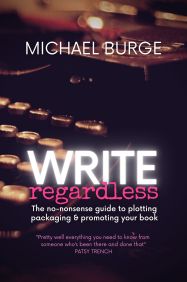
write-regardless-cover
BUY NOW

They used to burn books they didn’t like so that people couldn’t read them.

But you cannot burn a tweet. You cannot burn a mummy blog. You cannot burn the internet.

Isn’t that great?

© Michael Burge, all rights reserved.

An extract from Write, regardless!
The publish button killed the media

THE cancellation of the funding behind Australia’s flagship online news source The Global Mail sent shock waves through the local media, because many journalists were watching to see if the rise of the independent online media hub was a viable career lifeboat.

The demeanour of journalist Mike Seccombe said it all, when he fronted-up for an interview on Friday’s ABC Breakfast News.

Virginia Trioli asked him whether there were other ways of funding The Global Mail. He exhaled, shrugged and replied that he is a journalist, not a money man.

I felt for him, because if 20,000 subscribers, a stable of top-notch journos, and private backing are not good enough to make The Global Mail work, what the hell is?

Before things got too depressing, technical problems meant the interview had to be wrapped-up fast, and the inexpressible did not get articulated.

The inexpressible being, of course, that the media as we know it is in its death throes. It’s on the mat. The death rattle has begun. Wake up peeps, it’s happening, it’s really happening.

WHERE IT'S AT The Publish Button, we've all got one now!
WHERE IT’S AT The Publish Button, we’ve all got one now!

I could rail at the media moguls who have sold us out, but I’m calling The Publish Button the main culprit, that powerful little hyperlink which emerged on online blogging platforms a decade ago.

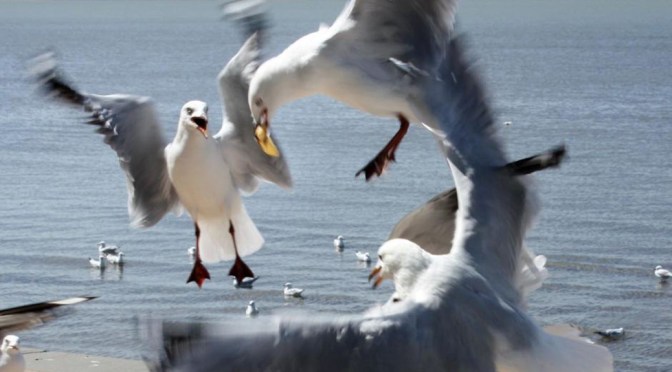
We flocked to it like gulls at a rubbish bin, and since digital technology was able to count the uptake, advertisers followed in an equally frenzied manner, until there were simply more pecks on The Publish Button than there were on all the print floors combined.

Twitter, Facebook and various forms of blogging now fulfill the very strong desire to be ‘published’ and ‘posted’, ‘liked’ and have our status ‘updated’ and ‘shared’.

Now, I’m not saying what we blog/post/tweet about is necessarily rubbish, but the bin is where it’s at peeps, the gulls are just not flocking to the mainstream media, which has been stripped, flogged and hung out to dry, journalistic job security with it.

The companies who made The Publish Button have become the new media moguls. They have no need to invest in ink, paper, print floors, newsagents, transport, and the tens of thousands of people who once staffed the media.

And without us even noticing, they have managed extremely well without journalists. A media which has no need to pay for content is every CEO’s dream.

Content flows freely to them, because The Publish Button is such effective bait.

Its lightning fast distribution is a stimulant like no other to wordsmiths. No barrier to participation, no editors to chase us, no pesky sub-editors to keep us nice, no delay in reaching our audience, and the ability to correct errors instantaneously… if we care about any of that, and there’s no requirement to.

If I StumbleUpon it I can Storify it, and I can say I’ve Reddit. I can Press my Words, I can show my Pinterest, I can Inst a Gram, I can meme like a Tumblr.

It’s all so liberating and wonderful… “Content is King!”, they say, to exhort us into creating great content, but it’s also free, and it’s left journalism with virtually no currency.

The social media’s advertising and subscription revenue, which is placing the corporations behind The Publish Button in stockmarket positions that have Rupert Murdoch worried, is not shared with the content creators of this new world media.

To complain any further about the mainstream media is just like a new government blaming the old: after a while, it just doesn’t hold true anymore.

So, where does journalism stand now the media is flatlining?

ARRESTING JOURNO Margo Kingston under arrest at the Leard Blockade. (Photo: Georgina Woods).

In February, 2014, No Fibs citizen journalist Margo Kingston showed by example what journalists can do with The Publish Button, by relocating to north-west NSW and reporting on the #leardblockade, where a group of activists held back the progress of the Maules Creek Mine.

Margo self-funded her Storify reports, put together by Tony ‘The Geek’ Yegles, which were uploaded onto No Fibs with a regularity that a mainstream news site would be envious of.

Twitter was utilised to distribute these short interviews, news items and reports to a growing audience.

What made it relevant was the depth of engagement, participation, and the provision of opportunities for the subject to contribute to the report.

This is possibly the true meaning of ‘social’ in social media, and it’s possibly what makes very tasty bits for the gulls to peck at.

If The Global Mail had attracted a few gulls to the edge of the bin they might not have reached this point. Their low-level social media engagement may well have been their Achilles heel, or was it their propensity to pay their journalists a decent salary?

I’m not in a position to answer that. What’s clear to me now is that the social media is the only media.

There, I’ve said it. As a journalist, all I have to do is find a way to come to terms with it.

An extract from Write, Regardless!

© Michael Burge, all rights reserved.


Critiquing basics for armchair critics

SINCE the dawn of blogging, a full spectrum of critics, from armchair experts to celebrities, has flocked to the free platforms allowing free-rein to quite publicly appraise, rate and critique popular culture.

But it’s a singular form of writing, the role of the critic, one in which angels should fear to dabble.

If anyone’s of a mind to heed a few tips on how to critique (and I am really not anticipating there are too many who will pause before hitting the publish button on their thoughts) here are my ideas on what makes good criticism.

If you don’t have anything nice to say…

Mother said it best – be nice. The best way to give something zero stars is to give it no oxygen whatsoever, but so often snippy critics will revel in blasting something which has every right to take its place in cultural history. Unless life (via some bizarre cultural Interpol) forces you to review something you don’t like, just forget it and move on to something you are more keen on.

Artists who can, do, artists who can’t, critique

Whilst an audience is an essential part of any creative process (art doesn’t exist in a vacuum, right?), being a reader or viewer does not necessarily qualify anyone to be a critic. Like cleaners, who routinely get the blame for office thefts, so critics are blasted for being amateurs who never ‘made it’. The smart critics know this and critique accordingly – either as an extension of their own arts practice (think Clive James) or from decades of experience in the field they’re critiquing (think David Stratton).  The first time I was required to review a play, the knowledge of the passion, time and energy required to ‘raise the curtain’ every night made me look for positives. Anything else would be hypocritical (note the appearance of ‘critic’ in that word).

Watch for spoilers

Critics need to adhere to this maxim more than the average punter. You might have loved the third-act turning point in the latest movie, but if you tell everyone the outcome, they ain’t gonna get a surprise when they go, are they now? If you’re a critic and you’re not sure what a third-act turning point is, read my post about the storytelling basics.

It’s not about liking it

So you didn’t like the play, the movie, the book, the whatever, that doesn’t mean others won’t love it. It’s my assertion that if you put your cultural dislikes into print, you’re only going to end up looking snippy and unhappy. To critique something means to put it in context, to observe what came before it, to attempt to see what makes it unique, even if it doesn’t succeed as a piece of art in your estimation.

They’re not hanging on your opinion

It’s tempting to emulate the great critics – those who could ‘close the show’ on Broadway. But that world is long gone, subsumed by the international opening weekend for new movies, the lack of geographic boundaries on the internet, and the end of paid work in the mainstream media for all but the big-name critics. The social media is where word of mouth, the oldest form of criticism, is happening. It’s free, fast and beyond the control of artists. If you get any attention in that mass of distraction, don’t flatter yourself that your opinion means anything. Try to leave the medium better than you found it, even just a little.

Critics also get rated

WRITE REGARDLESSBritish actress Diana Rigg compiled a collection of the most famous reviews given to actors, as far back as Ancient Greece, in her book No Turn Unstoned, which she subsequently turned into a one-woman show. Critic beware – you’re not immune from getting slated yourself.

An extract from Write, Regardless!

© Michael Burge, all rights reserved.