Category Archives: Write regardless!

Proof that you can read!

A Writer drowning in words.

I’M proofreading my first two publications right now, and I’m aiming to complete around 140,000 words in under a week.

It’s an ambitious task and thankfully I have some assistance, however, as an independent publisher (a fancy way of saying ‘self-published’, which carries a terrible stigma), this is my self-inflicted creative penance.

Cue the violins! Independent publishing is not all it’s cracked up to be!

“It’s no wonder everyone’s avoiding checking their own work – it was always a relatively crap job.”

Sure, it’s liberating when you don’t have to run decisions past anyone, but when it comes time to hit that publish button, where the quality of the finished product is concerned the buck stops with you. What’s worse it that although they pay very little for our books, quality has very high value placed on it by our readers.

If you’ve ever watched TV talent shows you know how risky stepping into the limelight can be for singers who have not been massaged into the public gaze by management and stage training. Quality comes across only when contestants have a decent amount of singing ability.

How cringeworthy is it when wobbly performers compete week after week slightly off pitch or rough on the high notes? It doesn’t mean they’re not talented, but it’s almost a relief when they get voted out, leaving the stage to more assured vocalists.

Art is a bitch that way, and writers have all the same potential to seem extremely unattractive in the public domain. No matter how schmick our book’s cover or what publicists we’re tempted to pay, we are prone to get voted off in the first paragraph.

Part of being match fit is ensuring our words are the best they can be, which means either paying for copy editing and proofreading, or doing it ourselves.

I’ve chosen the latter, because I have the skills, but this week I have wondered if this was the wisest course of action.

All writers have patterns. We use language in wildly different ways, and, despite appearances, there is no one language standard when it comes to the written word.

My particular weakness is hyphenation. If I can manage to slip-in an inappropriate or un-necessary hyphen, I will.

Yes, we have spell check and grammar guides in our word processing software, but do you know which standard of which language yours is set on, and have you ever tried to change it?

Yes, there are dictionaries, but have you ever wondered how many?

5113847621_10e4cbdb2e_bThe factual answer is nobody knows, but that doesn’t stay the judgmental hand of the average Grammar Nazi, who I imagine scanning free samples of eBooks instead of buying them, seeking out the errors as a form of bloodsport.

Language is an organic, ever-changing entity. To successfully proofread something, writers need to accept that they’ll capture the language they’re using for a brief moment before it continues its evolution.

If you decide to DIY your book’s proofreading, doing so consistently within that moment is your job, and that’s the really hard part, especially for the generations of writers who were not taught grammar at Australian primary or secondary schools from the 1970s, when it was deemed unnecessary, a directive that continues to this day.

I know several writers who claim to be unable to proofread their own output – journalists, mainly, who’ve had the luxury of sub-editors for decades.

But sub-editors are being shafted by media organisations across the English-speaking world, leaving journalists to proof our own articles.

It’s no wonder everyone’s avoiding checking their own work – it was always a relatively crap job that should be royally paid for, when at its core it’s basically clearing up the shit written by others.
write-regardless-cover
BUY NOW

I have one tip for writer-proofreaders aware of the reality that self publishing is expensive – shut the windows, put the cat out, tell your partner not to come knocking, and simply read your work so damned well it’s like the last time you’ll ever read it.

And I have one tip for writers willing to pay for proofreading – no matter how much you pay, it’ll never be perfect.

© Michael Burge, all rights reserved.

Check out Michael’s book on indie publishing.

Stand up, citizen journalists

TRY
CALLING CARD Citizen journalism does not open every door.

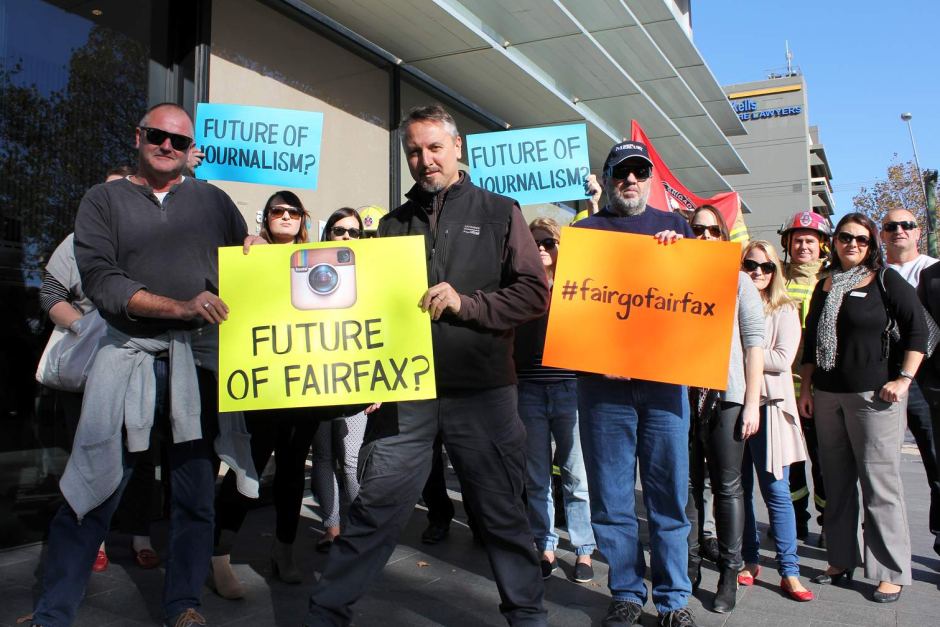
IN May, 2014, a very simple tweet went out on the afternoon before Fairfax journalists agreed to strike in protest at the company’s plan to cut 80 jobs, mainly in production (layout and sub-editing) and photography.

Since the Independent Commission Against Corruption (ICAC) hearings would continue through the strike, a citizen journalist (CJ) asked whether any CJs were available to cover the following day’s ICAC events in lieu of Fairfax. After all, the hearings were only getting more interesting with every new day.

I was mentioned in the tweet, so got swept-up in the replies, but my tweeted suggestions that CJs and the MSM work together during the strike fell on many deaf ears.

“Stand down CJs,” one tweeter advised.

“Don’t cross the picket line,” another warned.

Which posed the question – are citizen journalists comrades of mainstream media journalists, or are we not?

When the Fairfax redundancy announcement was made, it didn’t register at my workplace – a Fairfax title in Queensland – where I was a part-time sub-editor, because we had our heads down meeting our deadline.

I say “we” about citizen journalists because my paid employment as a part-time sub was nothing like my unpaid output as a citizen journalist, which took up a huge chunk of my week as a sub-editor and writer for No Fibs, my own blogs and other sites.

No Fibs’ editor-in-chief, Margo Kingston, a former Fairfax employee, also identifies as a citizen journalist, most recently in her self-funded reports from the Leard and Bentley blockades, mainly via Twitter.

No Fibs ‘pages’ are filled with articles by academics, public servants, corporate employees, authors, carers, business people, welfare recipients, estate agents and many others who identify as CJs, and a few trained journalists.

We journos amongst them are a mish-mash of survivors from the wash-up of the mainstream media, the shipwreck of which occurred long before this week’s latest round of redundancies within Fairfax.

Which tempered my response to the strike. I empathised, but the axe has been hanging over my journalist’s head for years. It’s become almost impossible to secure gainful full-time work with my subbing skills, and I work alongside plenty of highly-skilled, under-employed journalists.

That day’s strike in the south barely registered up here.

FAIRFAX STRIKE Photographer Kirk Gilmour and union representative Andy Zakeli lead editorial staff striking outside offices of the Illawarra Mercury in Wollongong, May 8, 2014.
FAIRFAX STRIKE Photographer Kirk Gilmour and union representative Andy Zakeli led editorial staff striking outside offices of the Illawarra Mercury in Wollongong, May 8, 2014.

Because many of those who were shocked by Fairfax’s job cuts placed the strike at the very centre of journalism as we know it, and, far more surreal, they were expecting readers to notice Fairfax journos wouldn’t be reporting that day.

I weighed into the Twitter debate about whether a CJ could be described as a rat for reporting from ICAC that day, citing lack of pay and lack of affiliation as reasons why it would not be the end of the world if one had.

In the process I was turned into some apologist for the ‘dark forces’ ending our careers, but it has not washed, that argument, ever since I came to terms with why I believe the media has been killed by every single user of the social media’s Publish Button. Journalism will survive, but the media as we knew it is already dead.

It’s very confronting, this moment of realisation, for all journalists – seasoned, emergent, and student. I feel most for the students about to begin a lifetime of HECS debt in return for a degree which will not sustain them with a career. They have been lied to by institutions out of touch with the reality of a dying industry. Savvy 18-year-old tweeters already have more of an audience than most media graduates.

Citizen journalists are perhaps more in touch with the point of journalism – as one tweeter pointed out, journalism is ultimately about communicating to an audience, without whom the job is a one-way street leading nowhere.

We know the role requires much more of individuals than mainstream journalism ever did – taking photographs in addition to writing; creating headlines in addition to stories; proofing our own work and not just writing it; and uploading it onto the largest distribution network the world has ever seen: the social media.

Many citizen journalists struggle with this workload, and there is very, very rarely a pay cheque at the end of weeks of research and/or travel.

Some mainstream journalists have taken to the social media via blogs to complain, and the plethora of spelling errors, layout mistakes and grammatical knots reveal an embedded reliance on production colleagues that may not find sympathy in the wider workplace. Journalists need to be match-fit and multi-skilled, not merely insightful writers.

There is also the issue of access: try blagging your way into a press conference without a mainstream media logo on your lapel, yet citizen journalists manage to get in and report.

For one of us to turn up at ICAC that day and live tweet would not be an onerous task. Twitter has provided easy access to our audience, and journalists of all stripes, including Fairfax staff, have rushed to capitalise on Twitter in a way which outstrips mainstream media circulation by an unlimited degree.

That mainstream journalists want the right to access that free distribution network through live tweeting, and get paid, opens them to accusations of having a foot in both the problem and the solution for journalists worldwide.

write-regardless-cover
BUY NOW

I defend my colleagues’ right to strike and I understand why they did so, but I will also defend any unpaid, unaffiliated citizen journalist who live tweets during a mainstream media strike, as long as they report the truth and they hashtag properly. Crorcet silplneg is oatpnoil.

And in the end, the only journo who crossed the picket line that day was a Fairfax employee.

An extract from Write, regardless!

© Michael Burge, all rights reserved.

How to write wrong

READY TO POUNCE Survuvung feedback can feel like a game of cat and mouse.
READY TO POUNCE Surviving negative feedback can feel like a game of cat and mouse.

AFTER dabbling on and off ever since I could articulate words, in mid-2009 I started writing full time and haven’t stopped.

Working through plenty of strong emotions (and day jobs), I blasted through my blocks to self-expression and found my voice in fiction, plays, journalism and memoir – genres I had tried but given up hope on long ago.

Along the way I’ve collected a little wisdom about how the world reacts to what writers write.

It’s not always pretty – there are plenty of detractors out there waiting at their keyboards to knock writers into silence.

Writers are generally very observant beings – our art reveals an ability to dig deep inside and tell the stories we find. The easier we make it look, the more it drives people who have trouble expressing themselves into fits of jealousy.

So, ‘you’re wrong about that, you know’, is a very common response to the courage it takes to write.

You’ll get it at social gatherings, on the social media, and sometimes from friends.

But one person you’ll very, very rarely hear it from is another prolific writer. We know the hard slog that goes into the job.

Here are my tips to writing ‘wrong’ …

Use the criticism

After your first few ‘you’re wrong’ experiences, you may find yourself getting a bit upset at someone making a point of being negative. A good way to remedy the shock is to write about it. That’s exactly what I am doing right here, right now. Never go silent for fear of someone deciding you’re wrong. Just keep writing.

Check your sources

Then check them again. This is not just the job of the journalist. Often, an accusation of ‘wrong’ comes from a readers’ need to highlight an inaccuracy, sometimes very publicly. But you’ll be surprised how often you go back to your research material only to find you were more correct than you originally realised. ‘Wrong’ is an easy accusation to make, but it’s harder to wear with confidence in mixed company unless you’ve gone over your sources properly.

Self correct 

Online publishing allows instantaneous correction of just about anything. If you’ve made an error, from a typo to a mistaken claim, correct it! Across the heavily political history of publishing, this ability is an incredible luxury that a writer could argue people lost their lives for. Use it.

Subject ‘experts’

Many have invested time and money into becoming experts in certain fields, and they sometimes feel they have cornered the subject against every other writer. Expect little support from such people – they’ll get upset and angry if you write on ‘their’ subject, or close-up altogether. Explain your use of their source material, sure, but never be afraid to add to the story without their approval or permission. They’ll tell you you’re ‘wrong’, of course, but you’re getting used to that now, right?

SSSS
IT’S EASY to knock others from behind your keyboard.

Old fashioned knockers

There are few things more hurtful for writers who use the social media than the throwaway dismissal or casual drubbing from one of our ‘peeps’. Facebook has become a tender trap for their ‘friendly’ fire. Knockers are the hardest critics to recognise, because their message can be slow to dawn on us if delivered in a sustained manner over a long period of time. Deleting a few of their condescending, corrective comments is usually all it takes to deliver firm return fire about their lack of form.

The right of reply

Pieces I’ve written have attracted polar feedback. The same works have been called ‘uplifting’ and ‘undisciplined’; ‘powerful’ and ‘hurtful’; ‘insightful’ and ‘misguided’. I try not to soak up either praise or criticism, which is easy to say and hard to put into action. In the fine balance between listening to a reader’s feelings and honouring my own, I tend to listen to myself, because to assimilate the opposites in my readership might end in this writer silencing himself, and I stayed silent for long enough.

write-regardless-cover
BUY NOW

If all else fails …

What I am still learning is how to adopt that iron-clad ego it takes to put my work into the public domain, and leave it there despite the wall of wrong. But I am developing a suspicion that all a good writer needs is the brio of a damned good judge. Objection? Overruled!

An extract from Write, Regardless!

© Michael Burge, all rights reserved.