Category Archives: Writers

Take the plunge: Diving Into Deep Water

WHAT captivating works can writers produce when given a random phrase? This multi-genre collection of 300-word micro stories, penned by the eclectic High Country Writers of the NSW New England region, shows just how far the smallest inspiration can flow. With courage and curiosity, these wordsmiths gathered once a month to read their work and encourage one another, before randomly selecting the next writing trigger. Take the plunge!


The prologue of Diving Into Deep Water

The High Country Writers group is an informal gathering of wordsmiths who started meeting at The Makers Shed, a small corrugated-iron shop at the southern end of the high street of Glen Innes in northern inland New South Wales, in mid-2019.

In 2024, the group moved with that business to a century-old former butcher shop on the New England Highway at Deepwater, at the heart of the traditional lands of the Ngarrabul people. 

Participants from Glen Innes, Inverell, Bingara, Grafton, Ashford and Deepwater regularly discussed the art of writing until one member – Anna Russell – suggested the group start to write 300-word responses to a prompt, one word or a short phrase selected at random from the High Country Books shelves in the lounge area where we meet.

This ‘homework’ was then read out to the group at the next session, leading to many wonderful listening experiences for all those within earshot. 

Somewhere along the line, High Country Books decided these moments were too good to leave hanging invisible in the air, and offered to publish the work with each writer’s permission.

This collection has been minimally edited, preserving each writer’s response to every prompt (which appear as chapter headings), and their writing style. The 13 prompts appear in order of them being set, but there is no strict order to the 300-word stories within the chapters, I have simply curated them by feel so that readers can enjoy the way the literary responses vary so widely.

The result captures an incredible breadth of storytelling which the writers workshopped into the promotional materials for this collection, sessions that were guided by D’Arcy Lloyd.

High Country Books is delighted that the group developed a title with more than one meaning. Diving Into Deep Water is both a reference to the township where The Makers Shed operates, and the act of creative courage that these writers threw themselves into.

That level of personal bravery is what our artisanal business is all about: creating despite the odds of success, regardless of opinions and in collaboration with like-minded artists. 

I thoroughly commend all these stories to you and encourage you to embrace the third meaning of this collection’s title, which is all about you, the reader, experiencing the depths of writers’ imaginations when handed a theme and asked to explore the infinite within such a disciplined word count.

On that note, let me fill you in on the various “rules” of this project and how some were broken, of course!

Any reader counting words will find the odd infraction of the group agreement, but none of the contributors thought this should be cause for any culling. 

Not every writer wrote to every prompt. Hey, life gets busy and you can’t do everything! Some wrote more than one response to a prompt. Let’s not discourage them!

Not every prompt was extracted from another piece of writing. Some were specific challenges: to write without using the letter E (‘Sans E’), to pen a short autobiography (‘Memoir’) and the account of someone else, from biological or chosen family (‘Biography’).

Some of the works are part of larger storytelling projects, details of which you’ll find in the author biographies at the back of this book; but the vast majority are standalone pieces.

Between these covers you’ll find multiple genres: crime, horror, historical fiction, humour, fantasy, poetry, experimental fiction and non-fiction. Some may find themes and terms they find offensive, used in historical context or otherwise. There is no content warning apart from this advice: skip any parts you find challenging, but don’t let a little literature scare you!

Thanks to all the participants who contributed their work, and to those who took on leadership roles at key times of this process, facilitating sessions and keeping the project moving along. Kris Nissam and D’Arcy Lloyd put their hands up for proofreading; Brydie O’Shea hosted a session at her beautiful garden, and Deepwater’s Top Pub made our group welcome while The Makers Shed was being renovated.

Big gratitude to all the writers for entrusting their work to an emergent publisher. As an acknowledgement of their contribution, High Country Books at The Makers Shed will donate ten per cent of all sales of Diving Into Deep Water to our region’s Westpac Rescue Helicopter Service, for as long as the title is in print.

Dive in … and keep an eye out for our other titles!

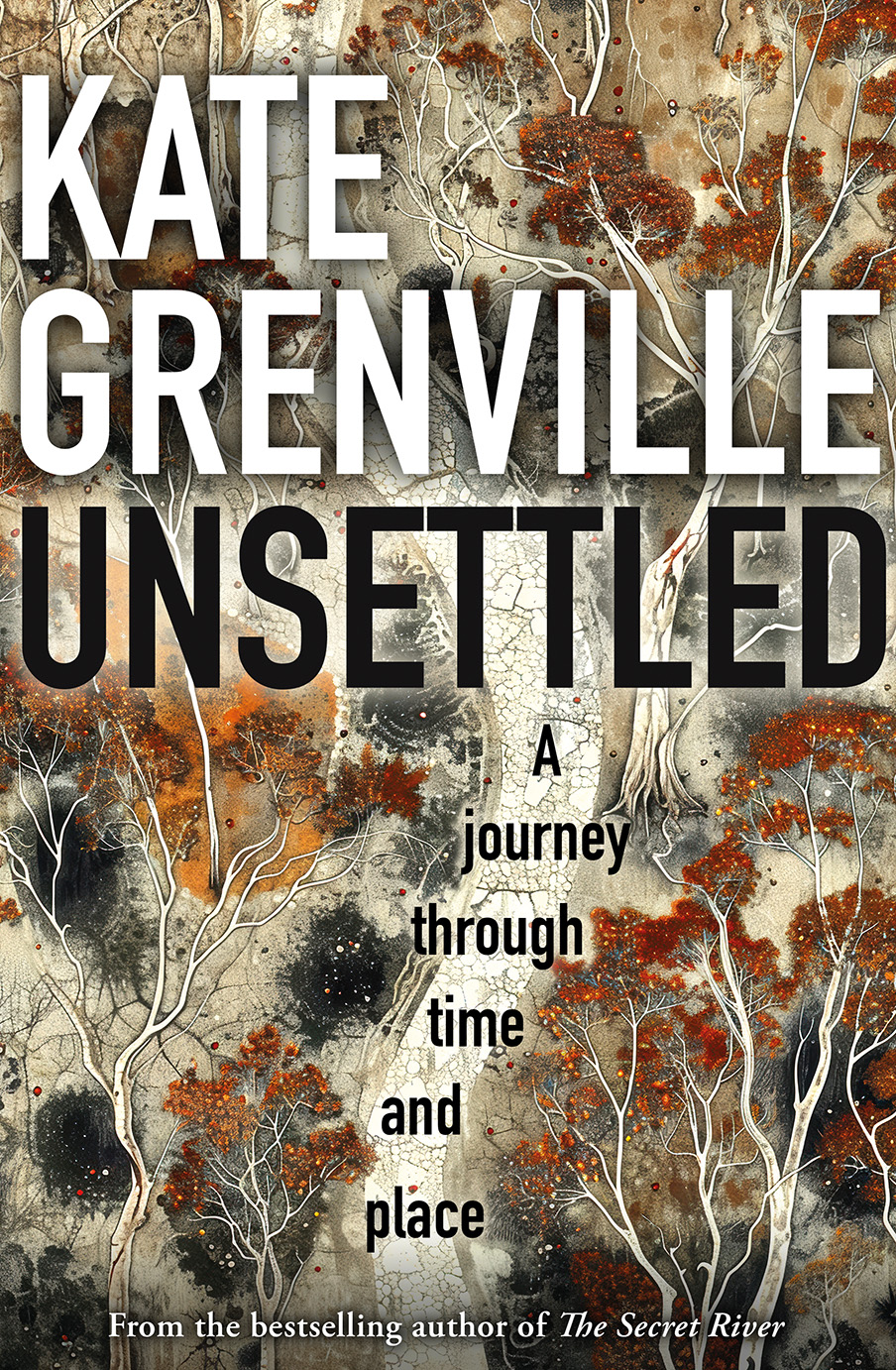
Kate Grenville’s cranky road trip to reconciliation

PROLIFIC HISTORICAL AUTHOR Kate Grenville’s latest book Unsettled: A journey through time and place (Black Inc.) documents her gutsy journey ‘up country’ into northern inland New South Wales, serving up excellent fodder for city slickers intent on reading about reconciliation between First Nations and settler Australians.

As she ruminates on colonial blindspots at country town memorials, pubs, farm gates and creeks, Grenville delivers her signature inner dialogue, heartfelt and tense; but as the discoveries about her ancestors mount up, she gets increasingly tetchy and judges the current locals at every step.

I found myself wincing at her portrayal of some who would be easily identifiable to residents of various towns. These scenes are replete with assumptions that require journalistic triangulation to achieve any objectivity, and the solution was always just a few interviews away.

Yet the author often describes accelerating away from encounters she finds fearful, such as a farmer wondering why she’s parked on his driveway. It makes the author’s road trip less about discovery (heck, he might have just been wondering if Grenville had a flat tyre) and more of a drive-by trolling, like the Greens bussing to Queensland’s mining heartland from Melbourne expecting to bring ideologies together.

The old saying about catching more flies with honey instead of vinegar applies, particularly in the country. Dialogue would have led the author to places where reconciliation grows beyond the libraries and the cenotaphs, driven by passionate people making a difference at the coalface. Instead, this book stands to alienate many in the regions Grenville travelled through.

Where Unsettled achieves for metro readers is its roadmap, literal and emotional. Still, I’m baffled about who Grenville hopes to inspire as she exhorts the reader to take up the necessary process of looking back, particularly at our forbears and finding out what they did. This is where the lasting message of this book (that when you know about something, you know) hits a roadblock, because who wants to replicate such a lonely rural getaway, chasing ghosts who very likely did bad things?

I do, and I recognise a lot of myself in Grenville, because I often haunt the landscapes of my ancestors. They are my heartlands, and they certainly saw Frontier War crimes. The driveway to the property where my parents farmed in the 1970s marks the eastern boundary of the Myall Creek district, site of the 1838 massacre of Indigenous people, infamous because some of its white perpetrators were tried and hanged.

My family didn’t settle there until long after the Gamilaroi people had been almost dispossessed of their country. We were among the many generations to benefit from the clearances, yet the crime and my knowledge of it since childhood has always been the source of my reconciliation actions.

Sometimes my efforts are public, such as campaigning for the Yes vote in the 2023 Voice Referendum. Sometimes they are private, but certainly they would have been invisible to Grenville on her quick turnaround in my region.

What I was expecting her to do in Unsettled is that thing most journalists dread: a death knock. This requires door-stopping people, raising awkward questions with those who likely don’t want to talk, yet listening without judgement.

Rural journos also know there is no point stopping halfway up any driveway. A few words leaning on a farm gate while you declare your intentions, or over a cuppa and a scone at the kitchen table, have the potential to bridge pretty big divides.

The death knocks for Myall Creek have been done across three centuries, predominantly by locals for locals. All that is left is for more Australians to listen, and had Grenville attended the annual Myall Creek Memorial weekend in June, instead of her solo walk at the site, her book would have undoubtedly been informed by this vibrant, living reconciliation action now in its 25th year. The sight of so many New Englanders showing up at the ceremony and simply listening is a quiet balm that must be experienced in person.

It should, by now, be inspiring more such rural events nationally. Instead, a growing city/country divide in this country sees more and more outsiders baffled by places like the New England, and Unsettled does little to build bridges.

Grenville deserves credit for attempting to see the colonised landscape for what it is and pushing against the lies within the language rural Australian in particular has used since the Frontier Wars. Her acts of quietly and privately thinking her way through the pervasive de-humanising that was wrought in Australia are extremely powerful, and in many ways justify the lonely nature of the trip.

She absolutely nails her strongest argument when she observes the jingoistic habit of professing love for a stolen country, and how the depth of that ardour can never erase the fact that it was stolen. In my travels, I see just as many signs of that in city suburbs as I do in the bush.

Unsettled is one of many journeys the author has taken following the trails of her ancestors, and her explorer’s observations are deeply meaningful to her. Whether Grenville unearthed any larger truths – the note that she reaches for at the end – is on the rest of us.

It takes more than one person visiting a place to settle anything about it.

Beyond every dead body

I NEVER SET out to be a crime writer, it was something that crept up on me like the growing awareness of the killer in a whodunnit, and it all started with my early love of Agatha Christie novels.

The prospect of my debut novel Tank Water being consigned to the crime section of major bookshops was a little unsettling; but considering I was a debutante at the age of 51, I had little time to dissemble and embraced my place in one of the world’s highest-selling genres.

Crime has opened doors, not least the invitation to join the board of BAD Sydney, the writer’s festival that platforms journalists, academics, podcasters, broadcasters, film-makers and a myriad of professionals from the justice system.

It’s also led to reporting one of the more heinous crime waves that gripped the suburbs of Newcastle, Sydney and Wollongong from the 1970s to the 2010s, an era known as the Gay-hate Decades.

I’m often asked whether I struggle with the brutality of murder when reporting or writing fiction in which the body count mounts up. Consideration around this is so common (and empathic) that I thought it wise to put myself through a challenge a few years ago, to check if I was becoming desensitised.

Pain and trauma

I sought the most disturbing real-life crime I could find, and it didn’t take long to land on Helter Skelter, the seminal book on the Sharon Tate and La Bianca family murders in California in 1969, said to be the highest-selling true-crime publication ever.

Written by trial prosecutor Vincent Bugliosi and Curt Gentry, this incredible work lays bare the sad and sordid case in a manner that did spark anxiety in me, mainly because the killers – the so-called Manson family – had been part of the popular hippie counterculture of the era.

But I got through it intact, in some ways relieved that I was still able to be shocked by exploring shocking crimes, yet not stymied in my own work.

What drives my interest in crime writing and interviewing crime authors, is that crimes – murders in particular – rarely exist in a vacuum without other themes of grief and justice.

Dead bodies do more than throw up murder suspects, they cause pain and trauma to loved ones and communities. For me, the best crime writing delves into this territory with sensitivity and courage, because it can lift a crime novel’s significance above mere entertainment.

The exploration of grief in crime novels is rare, and although they say order needs to be restored by the end of a classic whodunnit, life is rarely as neat.

I’m also captivated by those aspects of victim/survivor’s lives that show resilience and endurance, where the hope of justice can sometimes be stronger than justice itself, posing the question: is justice ever really attainable?

It’s a fascinating concept, justice, a word with almost no effective synonym, one that means different things to different people.

It meant something to Doris Tate, Sharon Tate’s mother, who worked tirelessly to ensure the voices of surviving families were heard in the Californian judicial system. Her statements during the parole hearings for the convicted former members of the Manson family stand as a critical enduring addendum to Helter Skelter.

Restoring order

Agatha Christie loved a little order restoration at the conclusion of her books, although she didn’t always wrap things up neatly. In her works, lovers survive death and destruction while impatient philanderers get their just desserts. Family members are reunited even while others are split asunder. Most baddies get it in the neck, but some get off scot-free.

This tension between crime and punishment is one of the hallmarks that drives BAD Sydney, the festival that explores what crime can tell us about ourselves.

For this year’s event I’m delighted to be hosting two sessions: Bush Justice and Queer Crossroads, both explorations of how law and due process have been lacking in some of Australia’s marginalised and remote communities.

See you there!

BAD Sydney takes place at the State Library of NSW from August 11-14, 2024. Book now.