Category Archives: Writers

Jonathan Rosten – spirited dancer

DANCER Jonathan Rosten rehearsing for Song and Dance (Photo: Branco Gaica).
LANGUAGE OF DANCE Jonathan Rosten rehearsing for Song and Dance (Photo: Branco Gaica).

Jonathan Rosten (1960-2004).

JONATHAN Rosten knew how to dance – it was the language he expressed himself best in. His dance career included some magnificent highlights – solo parts for The Australian Ballet Company, and roles in Andrew Lloyd Webber’s Song and Dance (Cameron Mackintosh) and An Evening (Sydney Dance Company).

Jono also made his mark in commercial dance, from variety television appearances, to iconic dance-based commercials, and his various spots in the opening of the NSW Royal Bicentennial Concert.

After 20 years as a dancer, Jono began a new career path when he found himself writing, directing and choreographing his first show – A Really Off Off Broadway Show. Jono’s program notes for this end-of-year student performance at Jester’s Acting School in 1986 describe himself as, “One who has been thrust into directing and is better equipped to handle toasted cheese sandwiches”.

Just why he made this move seemed to be a combination of things – too many hours spent bitching about the quality of productions on offer at the time; a desire to turn his burgeoning ideas into reality; and seeing a now renowned production of an entire musical in a garage in North Sydney, which inspired Jono with it’s ‘Let’s Just Do It’ approach to entertainment.

Once this door was open, Jono spent the next ten years in a showbiz no-man’s-land, taking dance work where it paid well in order to finance his writing. Moving from mainstream to independent theatre also saw him work with and be inspired by some early mavericks, including choreographer John O’Connell on Mr. Cha Cha Says Dance.

An early unproduced work he created was And Then God Created Showbiz!, beginning a tradition of exclamation marks in his show titles. This was a comic exploration of the history of showbiz in a biblical and new age context. Ideas for numbers included The Ten Commandments in the style of The Ziegfeld Follies; a Fonteyn and Nureyev duet with a wheelchair-bound Fonteyn; and a climactic Xanadu-inspired number with Jesus on roller-skates.

Suffice to say the humour was subversive. The vaudevillian line-up of showgirls, drag-queens, biblical characters and historical showbiz luminaries would have made this show highly expensive and a copyright nightmare.

For Jono, it was a fantastic experiment he worked on for a decade, a place where all that seemed ‘unacceptable’ in his world (homosexuality, cross-dressing and new age spirituality) could be placed centre-stage. These were recurring themes in all his work, taken from his own life journey and stories he’d encountered along the way.

It took another ten years before Jono found someone out there like him. At the end of a trip across America, in which he took-in the heights of Broadway, Jono happened upon a small theatre company in Los Angeles holding a retrospective of the collected works of Justin Tanner, a self-made theatre man who created shows like Zombies Attack and Pot Mom. He went to see a new work every night of his stay in LA, and the impression it left on him lasted for the rest of his life.

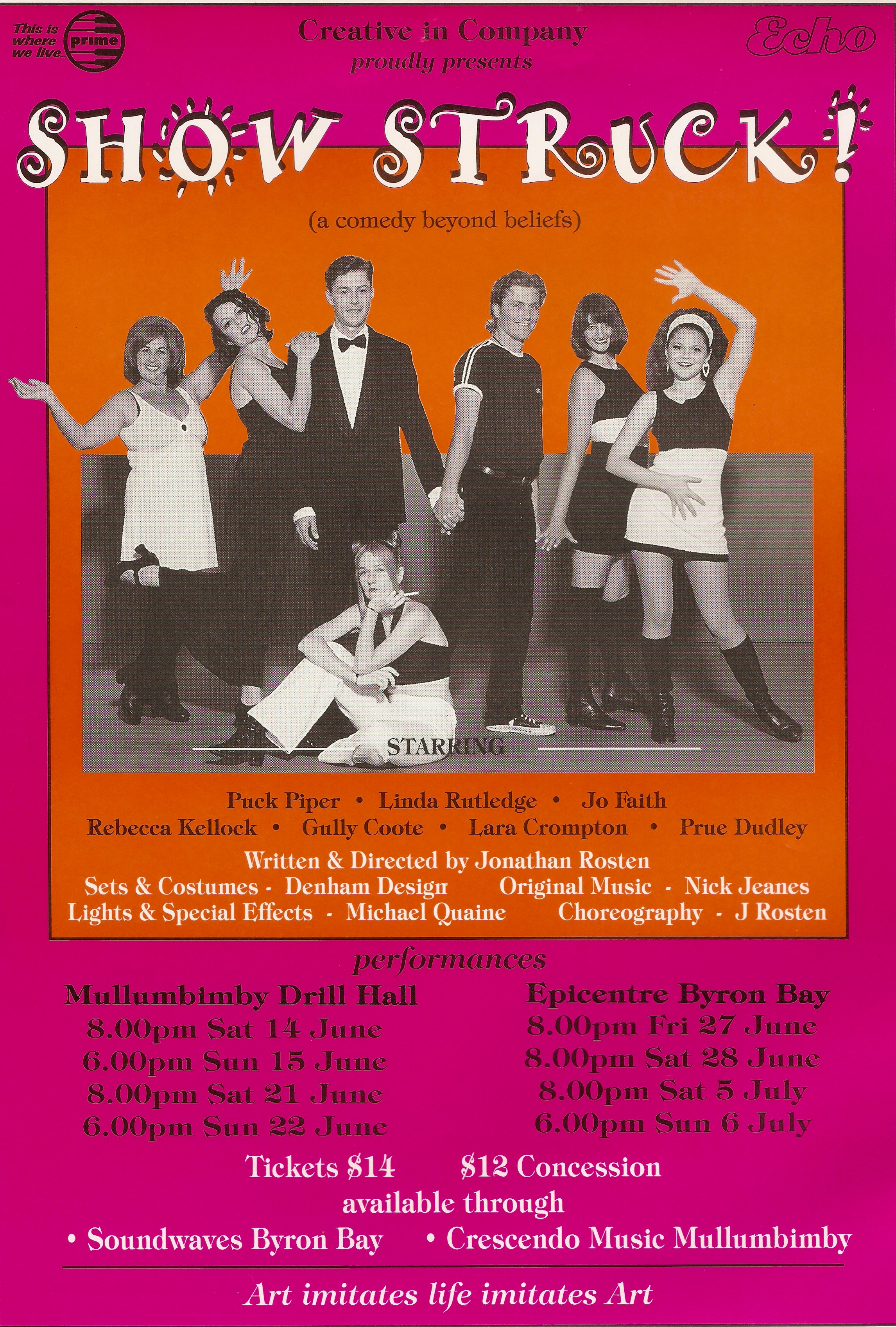
SHOWSTRUCK

He knew he had no time to waste. He knew he could be to Australia what Tanner was for Tinseltown, and shelved a host of stymied and incomplete works, including And Then God Created Showbiz! to embark on an entirely new piece called Show Struck!

Produced in the Northern Rivers area by Jono’s fledging theatre company Creative in Company, this new show was popular with audiences and was well-reviewed.

Jono created a show where the vaudevillian and alternative concepts were well within the context of a strong plot – one man’s journey through contemporary Australian show business, his desire to integrate spiritually in a spiritual vacuum, and to express his sexuality as a gay man. He wrote the show’s lyrics and produced, directed, choreographed and also acted in the show when one of the cast was injured.

Tired of endless touring to regional RSL’s, Daniel, the hero of Show Struck! is in creative limbo with his friend, mentor and bete-noire, Sherri, a showbiz survivor who has nurtured Daniel creatively and spiritually but will not let him flourish in the face of her own failures.

His journey takes him from also feeling like a failure in life, career and love to a state of limitless potential, having exorcised his demons – Sherri, his agent, and creative and sexual guilt within himself. Comically and beautifully, this journey is made in the form of an original show within a show.

One of Jono’s favourite real-life showbiz characters was Ed Wood of Plan 9 From Outer Space and Glen or Glenda fame. In the same spirit of this Hollywood maverick, Jono had big dreams to realise.

LOST SOULS The Lost Brother, Bondi Ballet, 2002.
LOST SOULS The Lost Brother, choreographed by Jonathan Rosten for Bondi Ballet, 2002.

He left Byron Bay for the Blue Mountains in 1999 and found himself in a new creative community where he quickly made his presence felt.

He began working with other maverick producers, like Out of the Blue, a community theatre group who through sheer hard work and self-belief staged the electrifying Australian Premiere of The Who’s Rock Opera Tommy at Parramatta Riverside Theatres in 2003, choreographed by Jono. Bondi Ballet gave Jono the chance to write and choreograph Lost Brother in 2002, a highly personal dance-multimedia work about the drowning death of his older brother Peter.

His dream now was to live close to the city and take original shows into Sydney after out-of-town tryouts in Katoomba. The Clarendon Dinner Theatre was the perfect venue for this plan, having birthed many successful productions over the years, and Jono approached the venue with a new show She Males from Outer Space!

Like all Jono’s shows She Males was purposely derivative. He dubbed it ‘Scooby Doo meets Plan Nine from Outer Space’. A gang of kids lost in the Australian bush encounter two strangely attired women who look like they’re from a science fiction movie, but claim to be collecting minerals at midnight. Before the kids know it they’re trapped in an intergalactic breeding program when one of them – Anne, a devout Brethren girl – is kidnapped. The gang must get her back and face their own shortcomings and lack-of-acceptance in the process.

SHE MALES

This show made it to Sydney in February 2004 as part of the Mardi Gras Cultural Festival, and had a 4-week season at The Edge Theatre in Newtown.

Jono injected this classic story of opposites with some of his best choreography. There were cheerleading sequences, mesmerising alien dance-moves and a continual comic through-line involving movement and lines inspired by old movies and television.

Deep in the plot was another of Jono’s appeals for acceptance when the hermaphrodite alien she-males explain to the younger gang that they are “Perfectly balanced in our male and female parts”, a beautiful piece of writing which challenges the gang (and us) to accept themselves, each other, and ultimately Anne’s alien she-male baby who was born during the curtain call.

Jono had succeeded in a long-held ambition to carry a weighty political message with a light comic touch, and reviewers and audiences responded. He had also discovered where his greatest talent lay – in storytelling using movement, dance and comic juxtaposition.

The Clarendon immediately asked for another show and Jono responded with his last unproduced show Double Identity (strangely there was no exclamation mark in this one). This show was again highly derivative, taking the film noir world and turning it on its head.

Inspired by audience reactions to the comic dance and movement styles in She Males, Jono created a series of dance/movement numbers and then built a plot around these. He also planned to return to the stage in a number of small crazy parts, including Frank the club owner who cross-dresses.

To date this show has had one performance only, two days before Jono died suddenly in rehearsal. Harking back to the garage-show in the 1980s, this performance was in the studio at the back of our home. I was the only member of the audience and the young leads – Nathan Roberts and Ines Vas De Sousa, were obviously going to be fantastic in the run. Jono was in there too – I had rarely seen him perform, and he sparkled with a glint in his eye, even when things went wrong and they had to do numbers from the top.

The man who started out as Buckingham in The Australian Ballet’s Three Musketeers, who danced for the Prince and Princess of Wales at Australia’s Bicentenary, who was The Milka Boy in the Swiss Alps with purple cows, was now integrating again in his newest incarnation as a singer-dancer-actor-writer-choreographer-director-producer.

Little did he or we know that the integration was so complete that only 48 hours later he would make the ultimate transition into death.

POSTER_email

Double Identity did not have its 3-month season at The Clarendon.

I can imagine Jono changing the name of this production to The Show Must Not Go On! (and scoring an exclamation!) because showbiz seems all too superficial without him.

Reality of his absence has kicked-in and Creative in Company has dissipated with the understandable shock.

The irony is that while his company was called ‘Creative in Company’ it really was just Jono instigating the work and driving it forwards, like Daniel in Show Struck!, helped and supported by a lot of talented people, but it was always Jono driving the bus.

“Don’t worry about being famous,” was one of the last things he ever said to me, in a way which told me he had once cared about fame, but had certainly let go of it and become much happier as a result.

I knew then why I loved him so much, and will never forget my years in the presence of this cheeky showbiz original who achieved his life’s ambition to understand himself, well out of the spotlight.

For this I am sure he would be happy to be remembered in the AussieTheatre.com Hall of Fame.

Published by AussieTheatre.com in 2004.

Beryl Guertner – décor queen

A Writer examines the home life of an Australian media pioneer.

SINCE the release of the Paper Giants franchise on Australian television screens, audiences have been exploring the stories of groundbreaking women in the print media.

But long before Ita Buttrose, Nene King and Dulcie Boling, a country woman who was good with words and had great visual flair was selected to spearhead a brightly coloured revolution in home decorating for a new magazine: Australian House and Garden.

Her name was Beryl Guertner. Behind her stellar career was the story of community-minded women who wanted to make a home for themselves in the leafy streets of Warrimoo.

As a tribute to a local magazine pioneer, this feature was first published in Blue Mountains Life in June 2010.

SITTING IN STYLE Beryl Guertner in the 1950s.
SITTING PRETTY Guertner at home.

Life with Beryl

The Warrimoo community remembers Beryl Guertner, Australian magazine pioneer and community woman.

Soon after WWII, residents of sleepy Florabella Street in Warrimoo noticed two women camping on a double block.

Ex-local Bruce Patman recalls: “The two ‘girls’ were befriended by our parents. On seeing them struggling with the elements, they were invited to sleep out on our verandah. There was a spare shed on our property which we cleaned-out. Beryl Guertner and Terri Margetts moved into that while they planned their house. Beryl was a journalist and she travelled to the city to work each day, while Terri (who I believe had garden nursery experience) grew gladioli flowers for market”.

BERYL GUERTNER
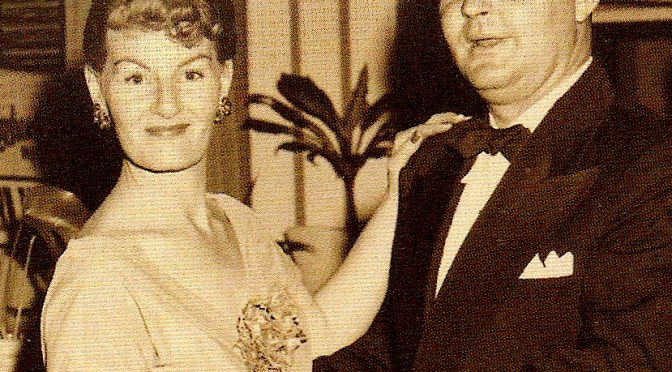
COMMUNITY WOMAN Beryl Guertner dancing with a neighbour at a local 21st birthday party, Warrimoo, 1958.

“No doubt as a result of the war, we had a number of women sharing homes in the village whom we regarded as ‘old maids’, Bruce adds. “Beryl and Terri were largely regarded as two girls pooling their resources for a dream of building a sandstone block house. I remember helping out at weekends with stonework in the gardens, and some of the heavy lifting.”

“Beryl got her first job when she settled here in the shed … with New Idea,” long-term local Elizabeth Leven recalls. “Then this opportunity came up to be editor of Australian House and Garden, and she applied for it.”

“I don’t think she was that confident she would get it,” Bruce’s brother Barry Patman reflects.

The new Australian House and Garden magazine opened its doors on Young Street, Sydney, in late 1947. The brainchild of publisher Ken Murray, the popular publication aimed to deliver low-cost décor to the average household, including monthly architects’ plans for small homes. Murray gave Beryl sixteen weeks to create the first edition from scratch.

“They were very excited when Beryl was accepted as the founding editor,” Bruce remembers. “Beryl was very enthusiastic with exciting ideas, and on occasion, she related them to us. She was very clever in her field.”

“I remember painting bottles with Christmas designs and making a lamp stand out of wine bottles as projects for the magazine,” Barry recalls.

AUSTRALIAN STYLE Early cover of Australian House & Garden magazine.

From such humble roots, Beryl Guertner became widely known in the Australian media for spearheading the home design revolution of the 1950s. The continued popularity of home makeover media owes much to the groundbreaking vision of Beryl and her contemporaries.

Born in Sydney in 1917 to Eugene and Maude, Beryl was raised and schooled at Wagga Wagga. By the outbreak of the war she’d returned to the city and embarked on a series of journalism and public relations jobs for companies like The Daily Telegraph and Paramount Pictures.

Beryl’s German father Eugene was interned at Liverpool for most of the war. Whether it was the whole family, or just Beryl, who adopted ‘Guertner’ from ‘Gürtner’ is not clear. It remained her professional name throughout her lengthy career.

Why Beryl chose Warrimoo remains a bit of a mystery. The semi-rural community was the vision of property developer Arthur Rickard, whose advertisements in the Sydney media for his satellite suburbs on the city’s fringe cannot have escaped Beryl’s attention in the 1930s and 40s.

The pressures of putting a new magazine together while commuting seems to have put an end to Beryl and Terri’s vision for a sandstone house. It may also have ended their relationship. “Terri worked very hard on the start of the sandstone house, but then there came a split between them and Terri moved away. We were very sorry for her after all her hard work,” Bruce recalls.

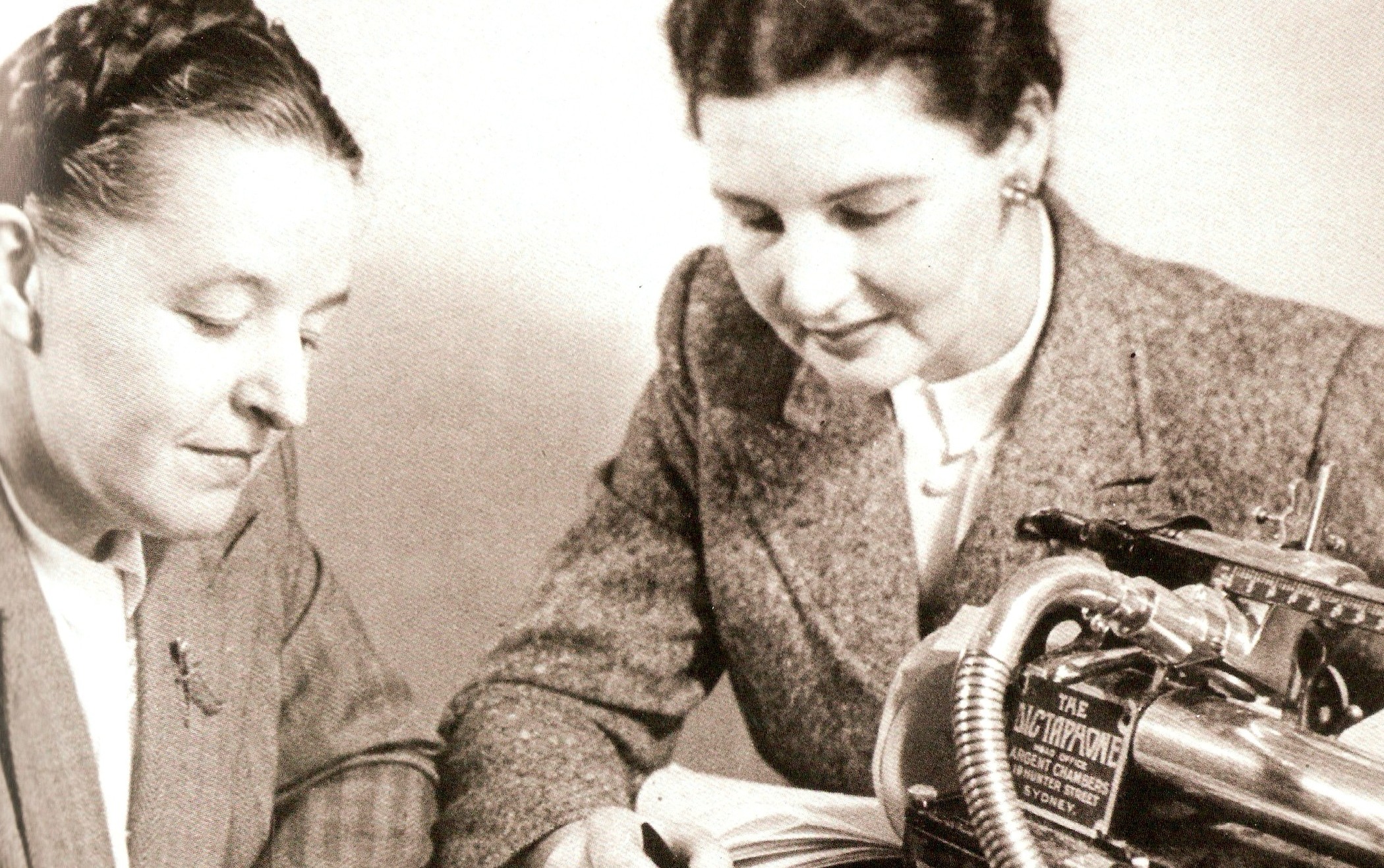
Other locals remember how Beryl met Catherine (‘Kate’) Warmoll, a fellow commuter who worked as an accountant for Cinzano, on the train. The two eventually moved in together and completed the first stage of their home around 1949-50. In the process, Beryl and Kate became integral members of the Warrimoo community.

Elizabeth Leven still lives in Florabella Street – “We used to laugh about Beryl,” she relates. “She had quite a few men under her as editor, and I remember her telling me one day that she used the filthiest language when she was talking to them … because that was the language the men understood. She and Kate used to walk to the station, but they would walk in old shoes and carry their good shoes.”

Bronwyn Kilner grew up at Warrimoo and remembers: “Beryl was very blond, and very pretty, she always wore gorgeous clothes, floral patterned skirts and looked lovely. Kate wore jeans and shirts, and dungarees, but the two of them made a great couple.”

Elizabeth Leven’s daughter Margaret states, with a fond smile, that Beryl was: “Always overdone for Warrimoo.”

Over time Kate and Beryl expanded their home from a one-room cottage to include a second bedroom, garage, stylish ‘crazy paving’ chimney, patios hewn from local stone, a verandah overlooking the valley, and a stone bridge in the front garden.

Their garden in particular left its mark in local memories. “Beryl always reckoned we were in the tropical belt,” Barry Hickey recalls. “She had a map showing the different climatic regions, and she reckoned Warrimoo was a place you could grow almost anything.”

Neighbours to Beryl and Kate since 1958, Barry and Joan Hickey remember how keen the couple were on the red-flowered ‘Coral Trees’, which many believe they introduced to the region.

Warimoo endured regular bushfires in the 1950s and 60s, and Beryl and Kate were members of the bushfire brigade. “It was Beryl who got me into the brigade,” Barry recalls. “She never rode the fire truck of course, but it was important that the community support the brigade.”

Artist and ex-local Donna Hawkins recalls: “Sometime in the late 1960s I had the good fortune to spend an evening in Beryl Guertner’s beautiful home. I went there with my Brownie pack to learn about cake decorating and how to make marzipan fruits. Compared to my simple home on the other side of the railway track, Beryl’s home was quite exotic – the lush entry graced with tree ferns and garden lights, the elegant lamps in the lounge room created a warm atmosphere. Our little group felt welcome and important”.

ICING QUEEN One of Beryl's many books on cake decorating.
ICING QUEEN One of Beryl’s many books on cake decorating.

“We crowded around the table and followed her lead, shaping marzipan into tiny bananas, oranges and apples, then painting them with food colouring. It was an evening of creativity I will never forget … to discover that food could be a work of art was inspiring.”

Bronwyn Kilner remembers her mother asking Beryl’s design advice for their newly completed home. “I recall that the main living area of the house, and the hallway, had very light oyster grey walls, with chartreuse ceilings!” Bronywn says. “There was green ivy-patterned wallpaper in the dining room and the entry foyer. The spare bedroom had grey walls, almost a gun-metal grey, and the ceiling was painted a tomato soup red!”

Beryl and Kate sold their home in the early 1970s to fellow commuter Jack Maddock. Nita Maddock’s first response, when Jack suggested they look at the house, was to say: “I’m not living in Warrimoo!”

However, once she saw Beryl and Kate’s home, she decided they should buy it immediately. “It was just the happiest house,” Nita remembers.

Beryl and Kate retired to the Central Coast, where Beryl continued to write and edit in her field until her cancer-related death in 1981.

I recently visited Beryl and Kate’s home on Florabella Street, the residence of John and Sue Cottee for the past thirteen years. I asked Sue when she became aware of the designer heritage of her home.

“It was a local who said to me one day: ‘You know you’re living in the party house?’” Sue recalls.

When the Hickey’s stroll in from next door, Joan and Barry both recall what sounds like the biggest party of them all – an event for the magazine – possibly the twentieth anniversary in 1968, with “magazine people up from the city,” Joan remembers. An electrician by trade, Barry tells us: “I floodlit the trees for the night.”

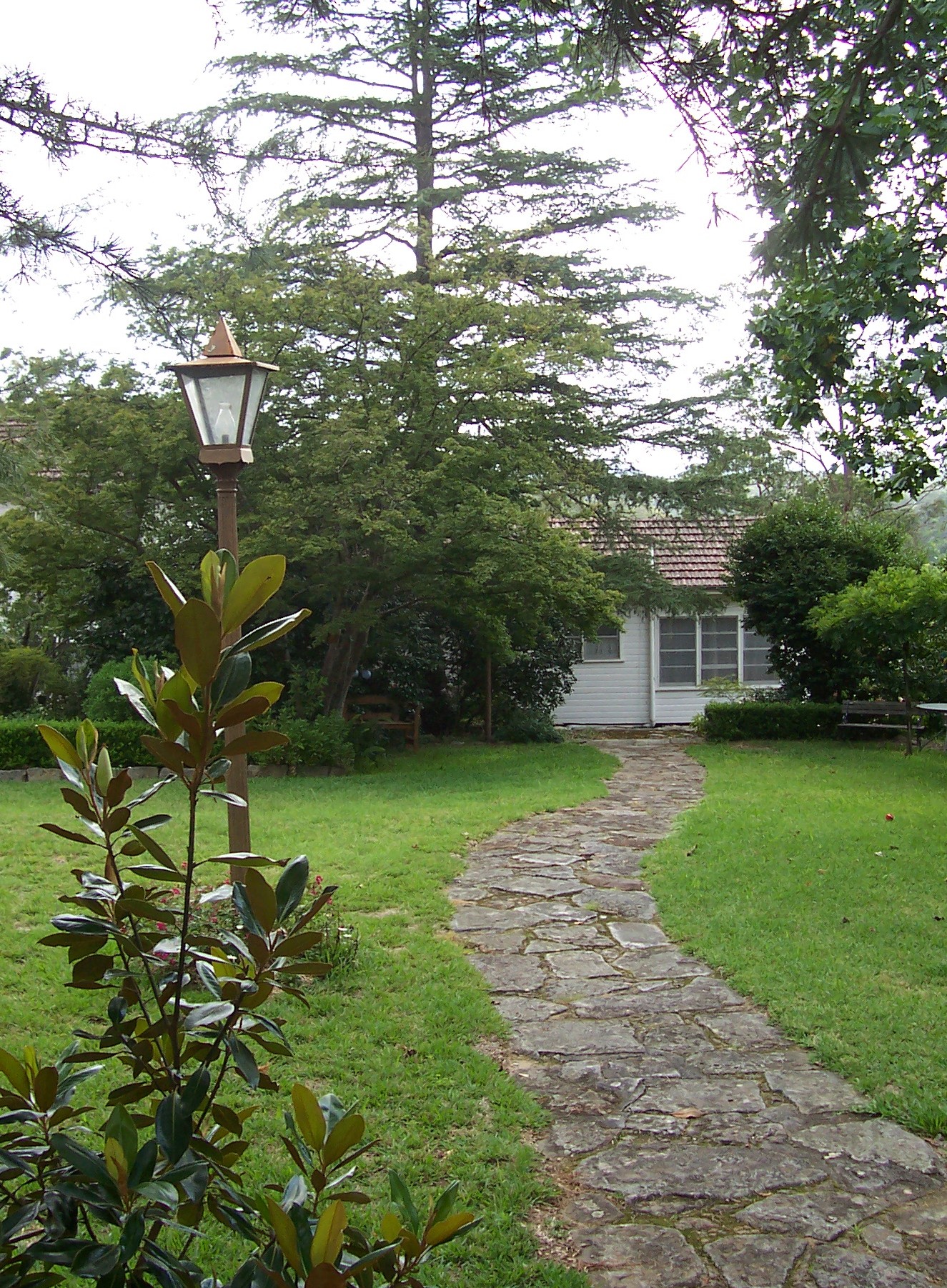
BERYL'S WAY Beryl Guertner's house in Florabella Street, Warrimoo.
BERYL’S WAY Beryl Guertner’s house in Florabella Street, Warrimoo.

The Levens join us in the front garden for coffee, amongst the surviving stonework patios, pathways, bridge and pond designed by Beryl, Kate and Terri.

“There was a time when I was welcome in every home on this street,” Elizabeth Leven recalls, and it’s clear from this gathering of long-term Warrimoo residents that Beryl and Kate were too. “Generous people”, “arty and flamboyant”, “involved in the community” are common terms the locals use when remembering the couple.

John Cottee shares the plan for expanding and renovating the house, which has been altered extensively since Beryl and Kate left.

“We want to preserve the surviving stone work in the garden,” John outlines.

I get the feeling that Beryl would very much approve of the 21st century renovation of a house and garden that has been evolving ever since she came to Warrimoo. After all, it was her life’s work to empower Australians to transform their own homes, and she herself had started life on the same block in nothing but a tent.

pluck-cover
BUY NOW

Thanks to Evelyn Richardson and Kate Matthew of the Warrimoo History Project, and all those who provided memories of Beryl Guertner for this article.

© Michael Burge, all rights reserved.

This article appears in Michael’s eBook Pluck: Exploits of the single-minded


The children of Coorah

BRAVE FACES The children and staff at Coorah c.1942. Yvonne is first on the right in the girls' row.
BRAVE FACES The children and staff at Coorah c.1942. Yvonne is first on the right in the girls’ row.

Two Writers collaborate on a hidden story.

THE years of research I’d undertaken on the historic home Coorah in Wentworth Falls took an interesting turn in 1995 when I was contacted by the current owner of the house, the Blue Mountains Grammar School, about a visitor who’d returned to Coorah after fifty years.

Yvonne Waters lived at Coorah during WWII, after it was gifted to the Bush Church Aid Society by the estate of the home’s original owner, Robert Pitt. In these years, Coorah served as a children’s home, a period of the building’s history only previously recorded in Bush Church Aid Society records, which related rather saccharine stories about the ‘happy days’ of the residents.

Because of its personal nature, it took many years of ruminating to bring Yvonne’s story to a wider audience. Inspired by the journey to justice started by the national apologies to the Stolen Generations and the Forgotten Australians, Yvonne’s account of her time at Coorah, as told to me during a searching interview, was published in Blue Mountains Life magazine in 2011, and related a very different story to the church records.

It is published here with Yvonne’s permission, inspired by the honesty of those who are beginning to tell their stories to the Royal Commission into Institutional Responses to Child Sexual Abuse.

Family, Interrupted

Yvonne Waters on her time at a Blue Mountains childrens’ home.

During World War Two many of Sydney’s children were evacuated to the Blue Mountains in the wake of the 1942 Japanese attack, but writer Yvonne Waters and her brothers found themselves in a Wentworth Falls children’s home in the winter of 1942 in the midst of a different kind of war.

“As we set out to walk to school – I was eleven, my brothers eight and five – suddenly our dad, whom we hadn’t seen since he’d left home five months previously, darted from behind a corner,” Yvonne recalls.

“Herded into the back of dad’s car, we were driven to our paternal nana’s house. Later that afternoon mum arrived. She had been to work, and on finding us not at home with our great aunt she had guessed what had happened. After numerous court cases, the court had cowardly decreed that if dad could manage to take us from our mother, he could keep us. I will never forget my last glimpse of our mother crying, after being told she would never see us again.”

Yvonne’s parents had separated at a time when public interest in divorce resulted in a family’s trauma being played out in the tabloid media, and since both had settled with new partners, neither was granted custody of the children.

After being moved between the Central Coast and western Sydney, Yvonne says, “Dad informed us he had found vacancies in a children’s home. With tremendous relief he pointed out how lucky we were, as all the other homes were full.”

Recalling their arrival soon after, she says, “The pines in rows like soldiers guarded the red gravel driveway which curved suddenly, revealing a Victorian two-storey building. Dad pulled over to the entrance, and motioned for us to get out”.

CHILDRENS' HOME Coorah, an historic home in Wentworth Falls, once a private home, a childrens' home, and now part of Blue Mountains Grammar School.
CHILDRENS’ HOME Coorah, an historic home in Wentworth Falls.

“He urged us up the nine stone steps to the verandah of the forbidding, silent building. Rattling the brass knocker on the huge oak door, he then turned to avoid seeing our stricken faces.

“Heavy footsteps on the other side signaled time was running out. A key turned in the lock. The door swung open to reveal a large, severe, grey-haired woman, dressed completely in black. She smiled, but the smile didn’t reach her eyes.

“‘Kiss your father goodbye!’ the woman we later knew as Matron ordered. The door was shut swiftly behind us and we were locked away from those we loved.”

The young trio had arrived at Coorah, an imposing home by the highway at Wentworth Falls. Once home to the Pitt family, the property was held by the Union Trustee Company after the death of Robert Pitt in 1935, with a stipulation that it be charitably gifted for the benefit of children.

The house was eventually given to the Bush Church Aid Society, an Anglican organisation which ran a number of children’s hostels, with a remit to provide accommodation for children living away from home for their education.

Just how three children in custody limbo (whose mother had no idea of their whereabouts) ended up at Coorah remains a mystery. Whatever the case, the shutting of the door changed Yvonne and her sibling’s lives forever.

Separated from her brothers on arrival, and forbidden to speak to them, even at meal times, Yvonne remembers, “We girls were allotted the job of kitchen chores and washing up after twenty-four children. The dining room floor would have to be scrubbed on hands and knees, and no girl would ever finish that mighty chore without reddened and bruised knees”.

“Twenty-four lunches had to be made before breakfast and Matron would stand behind me when it was my turn. Woe betide you if you tried giving anyone any extra.

“I think the teachers at the local school were aware of the conditions we lived in, as the headmaster asked me privately if we had enough food to eat.

“He’d witnessed one of our boys eating scraps from the school rubbish bin.”

Power struggles amongst resident children routinely resulted in abuse. “One frightening incident will never be erased from my mind,” Yvonne recalls. “An older boy in the home attempted to molest me. When I appealed to Matron for help, her answer shocked and hurt me.”

“‘You are a child of sin. You come from divorced parents. I would never believe your wicked lies!’ Today, I can still smell that boy’s dirty hands pressed against my mouth to stifle my screams. Only for the protection of a sympathetic older boy, I shudder to think what would have happened to me.

“I remember one boy was whipped with the buckle end of the strap, accused of laughing when saying grace. We were all still kneeling and I was opposite one of my brothers. Matron stood behind him and her temper seemed to be out of control. My look must have deterred her, so she moved on to the next victim.

“The feeling was high that evening. We all inspected the boy’s welted back. We were hurt and so angry.

“One girl and I retaliated to the cruelty by going on ‘strike’ and not doing the washing up. I’m amazed that we had the courage, for we were very afraid of the woman who controlled our lives. Arm-in-arm we ambled through the long grass to the edge of the paddock near the train line. We talked about the unfairness of everything and how we couldn’t wait to grow up and tell everyone about the treatment. Before we knew it, dusk was upon us! When we arrived at the back door, Matron had locked us out.

“Matron baffled and hurt us when she accused us of being with the boys. Her face was contorted with fury, and she was not at all interested in the truth.”

Yvonne believes the issue of boys and girls being housed together led to her eventual release from Coorah after eighteen months, when sent to an all-girl home in the Southern Highlands. Despite trying to write to them at Coorah, she lost touch with her brothers.

“I finally met them again before I was sixteen,” Yvonne recalls. “We smiled shyly at one another, but had nothing to say. It was a meeting between strangers.”

Fifty years after leaving Coorah, Yvonne was on a day trip to the Blue Mountains with her writing teacher, who encouraged her to pay a visit. The property had been owned by the Blue Mountains Grammar School since the 1950s.

“Not wanting to repeat the horrors recalled at that front door, I found a side door. A pleasant lady called Sandra answered my tentative knock. I suddenly couldn’t wait to look through my old dormitory window. The stairs were carpeted now and at the top we entered a room with computers and some workers.

“Everyone moved aside as I walked to where my bed had been. Standing in front of that window, I was eleven years old again, waiting for the sight of an occasional train and praying for my mother to find me. Those brightly lit carriages appeared to carry toy figures to their homes, and conjured up mine being a little closer to me.

“My thoughts raced back to a freezing day when a girl called up the stairs, ‘Yvonne, your Mother is here.’ I’d thought how cruel she was to joke.

FAMILY REUNION Yvonne, her mother, and one of her brothers the day their mother found them at Coorah.
FAMILY REUNION Yvonne, her mother, and one of her brothers after their mother found them at Coorah.

“The ground was heavily carpeted with snow. There, at the side of the building, was my Mother. She smiled and held out her arms to me. I tried to reach her, but my feet sank in the mush and I collapsed. My frozen body was lifted, and she held me close inside her warm coat.

“Nearly blinded by tears, I turned to face the people in my room of memories. They were gathered silently in a corner, some wiping their eyes. I felt as though I had been released from a lifelong jail sentence.”

At a distance of seventeen years since she first revisited Coorah, Yvonne is philosophical about what happened to her family. Writing about the journey has helped lay some ghosts to rest, and also the recent acknowledgement of similar separations wrought on the Stolen Generations and Forgotten Australians. “I can really feel their hurt,” she explains.

“My story is not to seek anyone’s sympathy,” she adds, “only to tell the truth of what actually happened under the cloak of religion. Today we live in a more enlightened age. Thanks to the Family Law Act, no blame is attached to either party in a divorce case”.

“I believe I had to go through so much to learn, and I have been able to help people when they’ve been unable to talk about bad things that have happened in their lives.

“Returning to the ‘scene of the crime’ helped to release my pain,” Yvonne adds.

Yvonne’s recollection of her time at Coorah has links to other elements of the property’s story, particularly the acres of daffodils around the house, planted by the original owner Robert Matcham Pitt (1849-1935).

© Michael Burge, all rights reserved.