Tag Archives: Creating Waves

Ban the Bard if Safe Schools scares you

WESTERNERS have lived through many periods in which extreme Christians distributed anti-gay propaganda and thereby got the ear of authorities, and this month’s spat from Australia’s hard, religious right shows not much has changed in four hundred years.

It’s an old war, that between conservatives wanting to put the brakes on equality, and progressives trying to touch the accelerator.

During the reign of James I (1603-1625) in England, the fires of Puritanism were well on their way to blazing a lasting wound through societies in many continents, burning until well after the Salem Witch Trials in New England at the end of the century.

The Puritans were antsy about anything showy. They railed against the Elizabethan and Jacobean playhouses as much as they did the Roman Catholic church, with its theatre-like ceremonies and costumes.

One of their main bugbears was gender. At its very core, Puritanism called for men to be men and women to be women. Any variation was seen as a threat to stable society.

So it’s fascinating, and a little alarming, to see modern-day politicians using similar fear-mongering language.

When Senator Cory Bernardi complains about the very idea that children role-play in an attempt to teach them empathy for same sex-attracted teenagers in the Safe Schools program, he could be accused of overreacting.

When columnists like News Corp’s Angela Shanahan labels Safe Schools a “radical form of sex education that promotes a fluid gender ideology,” she’s probably venting her spleen a bit much.

prynn-sm
PURITAN POLEMIC Cover of William Prynne’s Histrio-Mastix (1633).

But when these and others, like MP George Christensen and Lyle Shelton (MD of the Australian Christian Lobby) deliberately obfuscate the program, muddying its concepts with pornography and what they label “disturbing” behaviours like penis tucking and breast-binding, the pack invective calls to mind one of the great forefathers of postmodern gender panic, William Prynne (1600-1669).

Prynne encapsulated every Puritan complaint of the millennium in his polemic Histrio-mastix: The Player’s Scourge, published in 1633 as an argument to close the playhouses of Britain.

“…sundry common Actors do usually once a day, at leastwise twice or thrice a week, attire themselves in women’s array to act their female parts; yea, they make a daily practice of it to put on women’s attire, it being inseparably incident to their lewd profession,” is just one mild quote from this extremist manifesto.

And it worked. By the English Civil War, the Puritans got their way and Britain’s playhouses were closed in 1642.

But one popular publication survived this century of censorship. First printed in 1623, and hated by the Puritans, the complete works of William Shakespeare was firmly entrenched in the Australian school syllabus decades ago.

So if the Safe Schools program is questionable to neo-Puritans like Bernardi et al., let’s put Shakespeare to the test and see if he should stay on the curriculum.

Well, on gender fluidity, Shakespeare gets knocked out straight away. Cross-dressing takes place in one-fifth of his works. Enduring crowd pleasers such as Twelfth Night, As You Like It and The Merchant of Venice see the playwright’s heroines in male attire for the bulk of the play, masquerading as young men who find themselves in comic sticky situations with heroes who are fooled into homoerotic attractions to them.
Twelfth-Nigh-portfolio
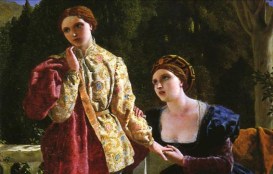
GIRL ON GIRL Lady Olivia wooing Viola in ‘Twelfth Night’.

Viola, the protagonist of Twelfth Night, even goes so far as to ask a sailor to secretly loan her clothes and present her to the local Duke as a eunuch.

Presumably this entails binding any breasts that might give her disguise away once Viola discards her “women’s weeds”.

When learning about the early production of Shakespeare’s plays, students will invariably come across a great reality: all the female roles were originally played by men.

But the end of that tradition in the 1660s didn’t end the fun. For centuries, whenever women played Viola, and these actresses dressed as a young man and encountered Lady Olivia who falls for ‘him’, endless girl-on-girl innuendo has entertained many a theatre and classroom.

Yet we do not hear the neo-Puritans within government crowing about these ‘gender-bending’ Shakespeare texts on the school curriculum, and no complaints about the 80,000 school students a year exposed to Shakespeare at the hands of the Bell Shakespeare Company, in receipt of $1.28 million in federal funding announced by George Brandis in the 2015 budget.

The neo-Puritans had their chance to rid Australian schools of Shakespeare, as part of a searching and robust review into the national curriculum by the Abbott government, reported under Turnbull in January, 2016.

But the Bard survived: “…drama, its different varieties, in tragedy, comedy, romance and historical plays, from Shakespeare (as a recurring presence) to the present will be represented,” the report confirmed.

I found one submission that called for more Shakespeare, but none that alerted the inquiry to the possibility that students might encounter all manner of sexual references in Shakespeare’s plays.
tumblr_noepfqqP7s1u44afdo1_540
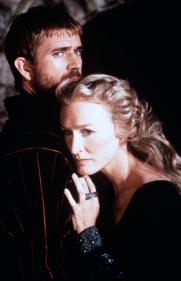
SEXY SCENE Mel Gibson and Glenn Close in ‘Hamlet’ (1991)

“To live in the rank sweat of an enseamèd bed, stewed in corruption, honeying and making love over the nasty sty,” says Hamlet to his mother, accusing her of adultery and not washing the sheets.

“Come, you spirits that tend on mortal thoughts, unsex me here, and fill me from the crown to the toe top-full of direst cruelty,” prays Lady Macbeth to deities that are not the Christian God, explicitly requesting gender reassignment and a nasty streak.

Like most of my generation, I studied Hamlet and Macbeth at school and was taken to many productions. We read and role-played scenes from Shakespeare, but we were left to interpret the diversity for ourselves, probably out of prudishness more than any Puritanism.

“All Australian students deserve access to a world-class curriculum that encourages diversity and which allows schools flexibility over how it is taught,” the curriculum inquiry website leads off with, like an over-arching mission statement.

With Safe Schools now under serious attack, it seems the very meaning of ‘diversity’ and ‘flexibility’ is also up for grabs.

But William Shakespeare, creator of more than 1700 words in the English language, and many a figure of speech, left us with a saying that can be used when answering over-zealous critics of sexual diversity.

Play | COMING SOON
BUY NOW
eBook | Paperback

It’s a line from Hamlet, perfect for when someone vehemently attempts to convince about something where the opposite is true.

About your trashing of LGBTI dignity, Cory, George, Lyle and your chums, I say: “The lady doth protest too much, methinks.”

Michael’s literary non-fiction debut Merely Players: Acting like Shakespeare really matters is available in paperback and as an eBook. 

© Michael Burge, all rights reserved. 

This article appears in Michael’s eBook Creating Waves: Critical takes on culture and politics.
Australia’s marriage equality in chains

After many years trying to interest the Australian media in my story, particularly the LGBTI media, it was only in the wake of another tragedy that a European mainstream media source published this op-ed on Australia Day. 

AUSTRALIA has long traded on its relaxed ‘fair go’ approach when spinning friendly, down-to-earth slogans to sell our easy-going holiday locations to the world.

But for one pair of British newlyweds who recently honeymooned in South Australia, a crucial danger lay completely hidden.

Why would the same-sex legislation of South Australia be of any concern to David and Marco Bulmer-Rizzi when they planned their romantic getaway?

“Between all the wine tasting and surfing, it’s easy to miss the inequality of this sun-soaked nation.”

We’re an enlightened, first-world society, aren’t we? Neighbours and Home and Away have their share of same-sex attracted characters; South Australia even has a proud record of LGBTI equality, being the first state in Australia to decriminalise homosexuality in 1975. It’s all good, right?

Wrong. Between all the wine tasting and surfing, it’s easy to miss the inequality of this sun-soaked nation.

Hearing about the South Australian legal system’s treatment of Marco Bulmer-Rizzi, who was subjected to the indignity of seeing his husband’s relationship status recorded as ‘never married’ in the wake of David’s accidental death in that state last week, I felt a familiar and frustrating pang of grief.

The international outrage was loud and justified. South Australia’s Premier Jay Weatherill quickly apologised, offering a guarantee that South Australian law would be changed to amend David’s death certificate. In an acute state of grief, Marco gave an interview, expressing his ardent hope that this kind of thing never happens again in Australia.

At that point I got very angry, because I have wanted exactly that ever since my partner Jono died in New South Wales more than a decade ago.

MIKEY:JONO
LIFE PARTNERS Michael Burge and Jonathan Rosten in 2002.

In 2004, despite NSW’s same-sex de-facto laws having been in place for five years, my deceased partner’s death certificate was issued to his blood relatives without my name on it or any reference to our relationship.

You read that right: Sydney’s Registry of Births, Deaths and Marriages broke the state law to disenfranchise me.

The complicity of the funeral company I’d contracted meant the illegally issued document took me two years to fix. Despite lobbying the NSW Attorney-General, no apology was issued by the state government, and no assurances were given that training would be put in place to prevent anything similar happening to others.

For 12 years, I’ve been communicating the dangers for LGBTI couples and death certification to anyone who would listen. In 2015, I wrote a book about my experience – Questionable Deeds: Making a stand for equal love. My motivation was to increase our awareness about how vulnerable LGBTIs are in Australia, with inconsistent state and federal laws that allow surviving same-sex spouses to fall between the cracks.

But death is a hard sell. Same-sex death is even harder. Too many Australians are unwilling to believe such unfairness and homophobia in our organisations and government departments.

Even more difficult to communicate is the homophobia that leads some families to deny the existence of same-sex spouses. At least Marco Bulmer-Rizzi was spared discrimination at the hands of homophobic in-laws, who were the driving force behind my disenfranchisement.

Whatever the reason behind the silence about my story, right now, there are generations of LGBTI in Australia who remain completely invisible on their deceased partner’s death certificates and were thereby blocked from their spouses’ estates.

Who is to blame for this legal lottery that has been erasing LGBTI stories in Australia for decades?

Politicians, sure, but it has long been painful and depressing to me how slow Australia’s media and publishing industries have been to recognize and disseminate the message about this disconnect. It’s impossible to argue they’re reflecting audience sentiment, when all polling on marriage equality places community support at over 70 per cent.

The solution is staring Australians in the face: a free vote of federal ministers on the floor of the nation’s parliament could enact marriage equality here in less than a week.

Yet national legislation that would sweep aside state anomalies is considered so controversial it put us in a holding pattern on marriage equality years ago.

“There has just never been enough outrage about marriage equality in this country.”

We have a sitting prime minister – Malcolm Turnbull – who supports marriage equality, but the political deal-making when he ousted Tony Abbott saw him sign away the parliamentary vote he once publicly backed. Instead, he has a plan for a divisive referendum at a time and in a manner he’s reluctant to reveal.

In the fallout of the Bulmer-Rizzi case, South Australia’s highest-profile conservative politician, Christopher Pyne, was quick to call for overseas same-sex marriages to be recognized in Australian states and territories.

But his approach illustrates the problem in a nutshell. Although he is a supporter of marriage equality, Pyne would rather advocate for a piecemeal solution that would protect visiting international LGBTI couples long before Australians.

When our leaders start to campaign for the human rights of guests instead of residents, they have lost touch with exactly who they represent in parliament.

Pyne’s words also imply he thinks marriage equality in Australia is so far away we’d best jet off to countries that support our relationships and benefit from a legal loophole.

MARCO BULMER-RIZZI
DISENFRANCHISED SPOUSE British citizen Marco Bulmer-Rizzi.

This behavior is far from isolated in Australia. Our tendency to overlook our creatives in favour of international artists – our ‘cultural cringe’ – is cast into the shade by this even stronger legislative blind spot for all domestic human rights. It’s only ‘bad’ if it makes world news. It only warrants a state premier’s apology when it happens to a foreign national. Fix it by sorting out the laws that the world is watching.

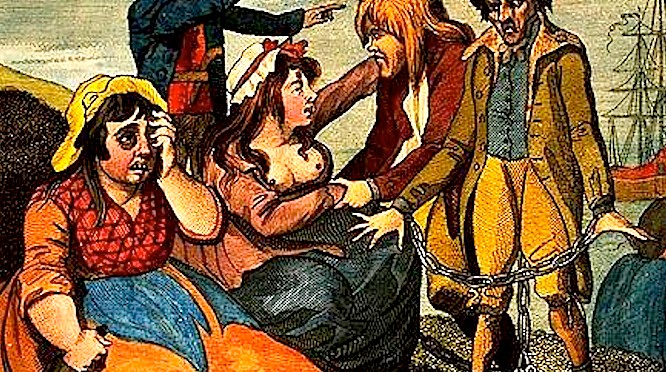
We were caught out treating Marco Bulmer-Rizzi with the heartlessness of our penal-colony roots, and, putting his confidence aside, Jay Weatherill will come up against plenty of homophobic politicians and public servants in his journey to amend David Bulmer-Rizzi’s death certificate. I’m anticipating the British media will track this Australian story closest.

creating-waves-cover
BUY NOW

Despite all our ‘fair go’ slogans – or perhaps because of them – there has just never been enough outrage about marriage equality in this country to drive the issue from a statistic into a legal reality. That we got a kick along only as the result of the untimely death of a young gay tourist is shameful.

This op-ed was first published by Gay Star News.  

It also appears in Michael’s eBook Creating Waves: Critical takes on culture and politics.
Carol out in the cold

WITH nothing more complex than a series of firmly closed doors, the film Carol takes a powerful dramatic turn that subtly gives two women the space to explore their attraction.

“The wait for enlightenment will be long, and the darkest, pre-dawn hour lies ahead.”

When Therese (Rooney Mara) slips into the passenger seat beside Carol (Cate Blanchett) and shuts out her fiancé, they leave him blinking on the kerbside. Soon after, Carol’s old flame Abby (Sarah Paulson) firmly shuts her front door on Carol’s estranged husband (Kyle Chandler), leaving him awkwardly framed through a small window.

But it is the shutting of the door between the two protagonists – closed by Carol against Therese at the height of an argument – which makes forbidden fruit all the more potent for both women.

Phyllis Nagy’s screenplay (based on Patricia Highsmith’s 1952 novel The Price of Salt) uses these pivotal separations to mark out the territory of a love story that breaks several taboos.

The shutting-out of men has been a powerful literary force ever since Anne Brontë’s The Tenant of Wildfell Hall (1848) in which Helen Graham dramatically slams her bedroom door in her husband’s face and created what many credit as the first feminist novel.

CAROL
CHRISTMAS CAROL Cate Blanchett as Carol and Rooney Mara as Therese.

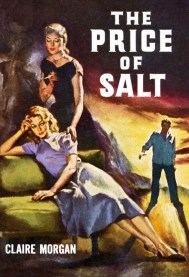
Published a century later, and phenomenally successful in its day, The Price of Salt disappeared from mainstream lists until Highsmith came out as its author in the 1980s and changed the book’s title. Plans were made in the 1990s to adapt it for the screen, and almost twenty years on – surely one of the film industry’s greatest examples of persistence – the story has been thrust into mainstream consciousness.

And its arrival pulls few punches. The unstable yearnings of unfolding passion will be familiar and understandable to anyone who has ever fallen in love, but emotional and sexual lust between two women is rarely seen on the big screen across suburban cinemas.

Carol contains several quite inadvertent similarities to other stories. When Carol and Therese take to the road, the story has strong echoes of Thelma and Louise. The escapist quality of that journey also speaks to the kind of concealed passion explored in Brokeback Mountain.

Highsmith’s novel traverses similar tragic precipices, yet its originality lies in the choices Carol and Therese make when their love is swiftly and coldly thwarted. Far from home, in a frozen place ironically called Waterloo, they have the door to their world cruelly wrenched open for the very worst of reasons – a blow that lands right in Carol’s weak spot.

It is from this point in the story, the final act of Carol, that Phyllis Nagy has done greatest service to Highsmith, but don’t be fooled by the alleged ‘happy ending’ tag this story has garnered. While it doesn’t have the shock ending of Thelma and Louise or the tragedy of Brokeback Mountain, the denoument of Carol comes with a level of compromise and risk that could never be defined as a positive outcome.

Cate-Blanchett-Fur-Coat-Carol-Movie
COLD COMFORT The original novel takes its characters on a road trip into America’s heartland.

Cate Blanchett portrays Carol as glamorous and anaesthetised, at times a sheer minx and at others world-weary, as though every stroke of make-up and hair product in the high-fashion front is only just managing to hold her upright. She inhabits Highsmith’s title role with a languid style that is never more poignant than when Carol is required to behave.

The slow burn of Therese’s story is given a sparse amount of dialogue, since her passion must remain internal until it is safe to express. Rooney Mara gives Therese the perfect hyper self-awareness in the role that is closest to Highsmith herself, who revealed in the book’s 1989 re-release that she’d encountered a woman like Carol while working in a department store as a youth. Despite finding out where she lived, Highsmith never made contact.

Knowing the fully fledged rage with which Highsmith went on to live and write by, it’s impossible to watch Rooney Mara’s performance without the sense that Therese would eventually give Carol a run for her money as a self-determined woman.

Haynes has been praised for the visual style of Carol, yet it has nothing like the luminous, throbbing-with-colour quality of his other 1950s-era film Far From Heaven (2002).

Carol and Therese inhabit a darkened, soft-focus, wintry world. Glimpses of sun show themselves at the edges, but remain out of reach, as though the wait for enlightenment will be long, and the darkest, pre-dawn hour lies ahead.

static1.squarespace
CLAIRE’S CAROL Highsmith’s book was originally published with a different title, under a pseudonym.

Nagy’s screenplay achieves far more with the story’s dramatic turns than Highsmith’s novel, which was her second and suffers a little from not knowing what to do with these characters before she sets them on the road.

Nagy knew Highsmith and drew on her friend’s experience of what it was like to be a lesbian in the 1940s and 1950s by adding detail on the legal and psychological challenges faced by same sex-attracted women in the United States.

But Highsmith’s novel sends Carol and Therese on a journey through America’s road culture, beyond the restrictions of their lives and dangerously oblivious to the ramifications of their journey, that is not fully realised on the screen.

“A mesmerising, disturbing film about unearthing passion and controlling rage.”

The scale of the route rivals that of Thelma and Louise, yet the cinematic potential of vast landscapes is not captured in the film. When the city-dwelling protagonists emerge in an expansive, elemental space they are unlocked from the world that confined them, and their enemies are required to do far more work to rein them in. In this, Carol is a precursor to Highsmith’s best-known works, the Tom Ripley series of thrillers, and leaves the novel worth reading for its own sake.

A mesmerising, disturbing film about unearthing passion and controlling rage for the sake of relationships, Carol explores the limits of what people will accept and the territory they will not negotiate.

creating-waves-cover
BUY NOW

The right to evade capture, to avoid being shut out emotionally, are portrayed as loudly as the sexual criminality of the era, and make a universal story out of what might otherwise have remained a period piece. 

© Michael Burge, all rights reserved.

This article appears in Michael’s eBook Creating Waves: Critical takes on culture and politics.