Tag Archives: Creating Waves

Hanging half a century on a solution

FORTY years since the premier of the Peter Weir film, it’s time for Australians to realise that Picnic at Hanging Rock has kept us completely fooled for five decades.

This evocative screen mystery burst into our consciousness the same spring that the constitutional crisis of the last months of the Whitlam government left Australians in an altered state.

“Australian cinema’s ‘new wave’ success story rose on the back of a terrible cultural lie.”

The original novel by Joan Lindsay was similarly about the impact of sudden change. When three schoolgirls and a governess do not return from a commonplace picnic at a local beauty spot in 1900, the mechanics of shock and denial challenge the very foundation of knowledge.

WHAT DO YOU KNOW? Helen Morse as Mlle de Poitiers and Vivean Gray as Miss McGraw in Peter Weir’s 1975 film Picnic at Hanging Rock.

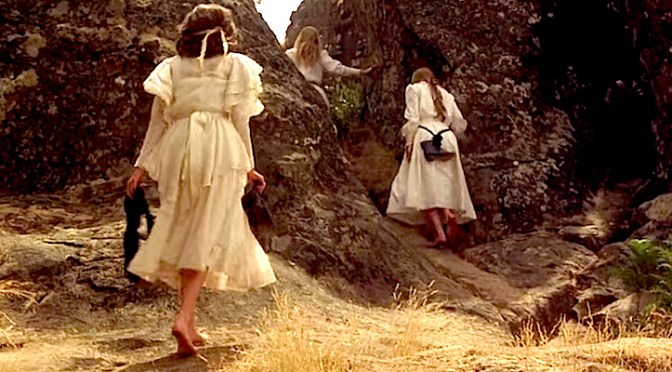
As French governess Mademoiselle de Poitiers farewells four of her charges wanting to explore the base of Hanging Rock, seeing Miranda turn away, she asserts: “Now I know”. The only one who hears is mathematics teacher Greta McGraw, who replies: “What do you know?”

Mlle de Poitiers is happy to believe she has seen an angel by an old master, although Miss McGraw appears to have her eye on something far more attractive.

Minutes earlier, this rational, scientific 45-year-old noticed her watch, like everyone else’s, had stopped, right on midday. The picnickers are suddenly, and literally, out of time.

This fictitious pre-Federation mystery perfectly captures modern Australia’s struggle to form an identity, because the answer to what drew Miss McGraw to follow the girls up the rock that timeless afternoon was always there, it’s just that others decided we were not prepared for it.

A real-life disappearance occurred at another famous rock and challenged Australian identity all over again, when, on the night of August 17, 1980, baby Azaria Chamberlain was taken from her tent by a dingo at a campground near the base of Uluru – at that time known by its European name Ayer’s Rock.

EVILANGELSIt did not take long for the majority of Australians to decide this event was nothing more than a fanciful story, sprung from the imagination of Lindy, Azaria’s mother, who was jailed for life for her daughter’s murder.

We were far more willing to cry murder than countenance the reality of predators in our landscape.

Fred Schepisi’s film of John Bryson’s book on the Chamberlain case – Evil Angels – outlined the dingo story and subsequently bombed at the Australian box office.

We could barely look at the Evil Angels, whereas the romantic never-to-return ‘angels’ of Picnic at Hanging Rock we took to our hearts; but Australian cinema’s ‘new wave’ success story rose on the back of a terrible cultural lie.

Joan Lindsay complained of endless fan mail asking whether her story was based on fact, although I call her annoyance a dodge, because she brought all the attention on herself as soon as she allowed her publishers to lop off the last chapter of Picnic at Hanging Rock before it was published in 1967.

But her original Chapter Eighteen survived the butchering of editors: she entrusted it to her literary agent John Taylor in 1972, with strict instructions to publish it after her death.

This he did in 1987, by which time a cult had grown around Lindsay’s ruse. The twelve pages of Chapter Eighteen published in the booklet The Secret of Hanging Rock were framed by tongue-in-cheek essays by Taylor (claiming that Lindsay’s solution was “unfilmable”) and Yvonne Rousseau, a writer who’d spent years sleuthing Lindsay’s oeuvre.

Despite the attention Lindsay’s ‘solution’ received, it was not enough to challenge the trajectory of the film’s success. A director’s cut was released theatrically and on DVD, including a documentary in which not a single mention was made of Lindsay’s Chapter Eighteen.

“They were happy to escape a life of corseting, cosseting and control.”

Her long-concealed dénouement quite matter-of-factly revealed the missing schoolgirls and their governess had undergone the kind of transformation common in Classical legends, although Lindsay had created a credible bridge between European myth and Aboriginal Dreaming.

Other writers had attempted this earlier. Arguably the most famous was the fake Aboriginal Legend of the Three Sisters, the story of three Aboriginal women transformed into the famous rock formation by their ‘witchdoctor’ father, written by Sydney schoolgirl Patricia Stone in the 1930s and subsequently sold by Katoomba’s tourist industry as genuine Aboriginal legend.
DREAMING WITHIN A DREAM Seeking the solution to what happened.

But Joan Lindsay avoided cultural appropriation. Instead, she allowed her large cast of European women to be themselves appropriated by a Dreaming entirely appropriate for an Australian story.

Picnic at Hanging Rock screenwriter Cliff Green identified one of the major themes in Lindsay’s story as child abuse, and once the women do not return, the checks and balances of a ‘proper’ education gradually do reveal the physical and emotional weaponry of British headmistress Mrs Appleyard.

The missing schoolgirls and their governess, then, were not victims of crime or whisked away unwillingly. They were happy to escape a life of corseting, cosseting and control.

“I can hardly wait,” star maths student Marion Quade says in Chapter Eighteen, anticipating her chance to shuffle off the twentieth century and follow her transformed maths teacher Miss McGraw “without a backward glance”.

Marion’s escape route comes straight out of 1960s notions of Aboriginal Dreaming, atmosphere that undoubtedly challenged the original publishers into such a severe deletion. Far more preferable for daughters of the Empire to disappear into thin air than be seen to delight in a spiritual transition well-known by the nation’s first people.

The edit allowed Joan Lindsay’s fact-fiction flim-flam to become the focus of the book and film’s success, and even though all along she knew she’d not written a mysterious disappearance, she played her part very well by suggesting the audience decide what was true and what wasn’t.

Fans and detractors rushed to pore over the archives and trample across Hanging Rock, well off the scent of a simple look into Lindsay’s education at a Melbourne ladies’ boarding school.

LADY LINDSAY Joan Lindsay (1896-1984).
LADY LINDSAY Joan, Lady Lindsay (1896-1984).

It was Terence O’Neill in a 2009 La Trobe Journal essay Joan Lindsay: A time for everything who proposed that Lindsay can hardly have been unaware of her alma mater’s move from Melbourne to Woodend, close to Hanging Rock, in 1919, after her graduation; and, far more interestingly, the account in the school magazine of a Miss McGraw, teacher at the school in Lindsay’s time, who led the twilight expedition to Hanging Rock that inspired forty years of annual picnics and the telling of ghost stories on the way home. 

It’s also enlightening to analyse the corporal punishments Lindsay portrayed in detail – those that inspire adolescent fantasies about escaping the control of disciplinary adult paradigms – when seeking the real seeds of Picnic at Hanging Rock.

Missing corsets and stockings, a maths governess seen climbing Hanging Rock availed of her skirt, and the discovery of one of the missing girls, are all clues in both book and film, but they remain the worst kind of red herrings without Chapter Eighteen.

Another red herring is the sound of Pan pipes played by Gheorghe Zamfi on the soundtrack, evoking the old Greco-Roman gods of different land altogether.

It’s probably un-Australian of me, but I call for a remake. 
PANIC
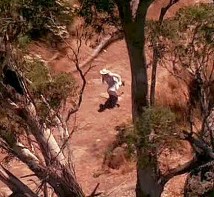
MUCH TO LEARN Edith runs from the top of Hanging Rock.

Pan pipes would easily be replaced by a well-known Aboriginal wind instrument; and doubtless there is much to learn from the Wurundjeri nation, traditional owners of Hanging Rock, the rock formation they were dispossessed of in the 1840s.

Joan Lindsay’s literary stock-in-trade was time. I can’t imagine her not approving of a reappearance of Miranda, Marion and Miss McGraw in an episode of Doctor Who, or at least a mash-up adaptation like Pride and Prejudice and Zombies.

The Northern Territory legal system took thirty years to come to terms with the facts about the dingoes that preyed on Azaria Chamberlain. Surely in that time we have grown enough to cope with Aboriginal Dreaming in one of our greatest novels?

creating-waves-cover
BUY NOW

As Gough Whitlam famously affirmed in 1972, ushering in the government that would transform the lifeless Australian film industry, led by Lindsay’s big-screen icon: “It’s time”.

© Michael Burge, all rights reserved.

This article appears in Michael’s eBook Creating Waves: Critical takes on culture and politics.
On the same page about marriage equality

26785881IN every writer’s life there comes a time when a piece written by someone else renders our own contribution unnecessary. After exploring the issue of marriage equality in my country for more than a decade, Rodney Croome’s new book has finally done this for me.

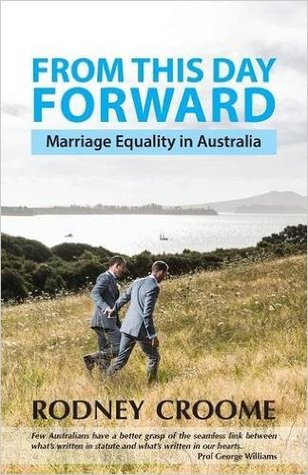
From This Day Forward: Marriage Equality in Australia is an aggregation of Croome’s major writing on the marriage equality debate to date, including updates on his 2010 contribution to Why Vs. Why: Bill Muehlenberg and Rodney Croome debate Gay Marriage (Pantera Press).

But Croome’s collection is much more that; it’s the best document Australia has to move the debate – finally – into legislation.

The only possible rebuttal to From This Day Forward is religious ranting or political belligerence, because, as Croome puts it: “The critics of marriage equality are trapped in an intellectual cul-de-sac.”

I had a particular interest in reading this book: I was keen to fact-check my own publication Questionable Deeds: Making a stand for equal love against a more comprehensive document covering the story of Australia’s legislative failure, but I was unaware of Croome’s book until it was launched in Brisbane last week.

“A well-articulated exploration of the total lack of arguments left for opposing marriage equality. It stands like a boundary, behind which the debate will retreat no longer.”

It’s a great year for books by same-sex attracted writers. With Magda Szubanski’s memoir Reckoning, and the rerelease of Timothy Conigrave’s Holding the Man off the back of the movie release, gay and lesbian writing is getting a great run.

Although like my title, From This Day Forward does not have a huge marketing machine behind it. This makes for a hard sell at a time when readers and audiences are at marriage equality saturation point, there’s an overbearing unwillingness to just get it done, and the mainstream media seems incapable of selling a story of what it sees as a dead horse, slaughtered by both sides of parliament.

Croome’s book is a well-articulated exploration of the total lack of arguments left for opposing marriage equality. It stands like a boundary, behind which the debate will retreat no longer. For someone who has heard and endured all the classic approaches (he was confronted by one at his launch – the old ‘why call it marriage?’ chestnut), in person and in his book, Croome – the national convenor of Australian Marriage Equality – maintains the neutrality of an activist prepared to go on calmly answering loaded questions forever.

Rodney_Croome
EQUALITY CAMPAIGNER Rodney Croome.

I admire such public strength. My own book reveals my inability to be as dispassionate. Driven by grief, fear and pain, I wrote the awful truth about the depth of my disenfranchisement in Questionable Deeds, revealing how prejudice and lax laws robbed me of self determination as a surviving spouse.

Although I was relieved my research stood up without the benefit of reading Croome’s book, what encouraged me more was his call to action from the LGBTI community to share our experiences.

“Whatever lies behind the power of personal stories, they are immensely effective in showing how marriage inequality affects ordinary people day-to-day. They tap into our desire to understand the ideas and feeling of others,” Croome writes.

Our stories are most effective for the cause when we manage to bend the ear of our federal MPs, Croome writes. Mine is Andrew Laming, federal member for the Queensland electorate of Bowman, a regular flip-flopper on marriage equality.

At his launch, Croome paid tribute to Queensland’s major contribution to the legislative push. It’s here that Warren Entsch (Liberal federal member for Leichhardt), and Teresa Gambaro (Liberal federal member for Brisbane, who launched Croome’s book last week), joined forces with Terri Butler (Labor federal member for Griffith) to co-sponsor a cross-party bill on marriage equality.

Since the entire house of representatives owned the bill, this was a unique moment in the journey, and a shining example of politicians getting their heads around the positive impact of equality on the mental health and wellbeing of their constituents. Andrew Laming would do well to watch and learn, and he could start by buying Croome’s book, and mine. He was invited to my book launch, but did not respond.

Croome also gets to the heart of the current plan for a marriage equality referendum or plebiscite.

“Human rights defenders are rightly concerned about putting inalienable rights to equality and personal autonomy to a show of hands,” he writes, underlining how there’s no constitutional requirement to ask the people on marriage when it was parliament that autonomously altered its definition in the first place.

I support Croome’s view that a national vote on marriage equality would pass the law. Even if the regular polls are significantly wrong, the majority of Australians would say yes.

“My concern is with the process, not the outcome,” Croome writes, referring to the high price that would be paid by the LGBTI community in terms of our mental health.

It’s in this zone that Croome’s book and mine intersect. Croome quotes statistics gathered in the wake of the banning of marriage equality in 2004 – the year my partner died – which showed a sudden increase in mental health challenges for LGBTI.

Of the 2004 ban, I wrote: “It would have passed through my consciousness in my deepest grief and registered only as another reason to feel dreadfully unsafe about being same-sex attracted in my own country.”

I recall the sadness that went into writing that sentence, and nearly deleting it from subsequent drafts because I’d kept such deep-seated emotions in check while remembering the daily struggle of grief and depression in that terrible year. Croome’s book has finally put my struggle to process my disenfranchisement in context.

A major new element of From This Day Forward is an essay ‘Flight from the gilded cage: addressing criticism of marriage equality from the left’.

It’s an area of great interest, not just for those of us who are shocked at how the marginalised seek to marginalise others, but also for anyone wanting to advance their knowledge on the last bastions of objection.

9780645270532
BUY NOW

At my own book launch, in conversation with No Fibs’ editor Margo Kingston, she expressed a wish that I’d written more on marriage equality opposition that didn’t stem from homophobia.

I touched on it in my afterword, but Croome’s essay is the most comprehensive and timely argument taken up to several high-profile commentators who have provided great fodder for the religious right over the years.

Croome confronts them all – from former Prime Minister Julia Gillard and her feminist arguments, to author Robert Dessaix and historian Dennis Altman, who have long argued that same-sex attracted people should not need such a heteronormative institution as marriage (although Altman began shifting his stance this year).

This essay validated all the times I’d thrown stuff at the television seeing these commentators failing the entire LGBTI community with their frivolous, often under-researched naysaying.

creating-waves-cover
BUY NOW

If you’ve endured the years of debate, From This Day Forward is worth reading for this boost alone.

From This Day Forward: Marriage Equality in Australia (Walleah Press) and Questionable Deeds: Making stand for equal love are out now.

© Michael Burge, all rights reserved.

This article appears in Michael’s eBook Creating Waves: Critical takes on culture and politics.
Dancing around casual homophobia

ONE of the big stories of the week came and went as quickly as a Channel Nine dancer running screaming past the camera.

Breaking late on Tuesday afternoon from the Fairfax stable, what became known as the French Ambassador Incident trended at least twice on Twitter in the following 24 hours, then disappeared.

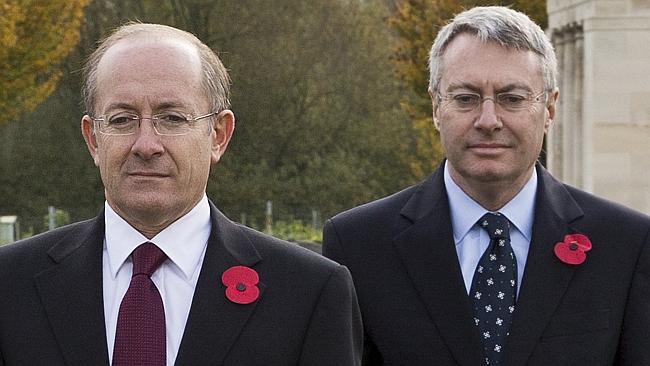
It’s hard to ascertain exactly what happened. Most media reported that Australia’s Ambassador to France, Stephen Brady, was witnessed shouting at someone on a Paris tarmac before, during or after the arrival of Prime Minister Tony Abbott fresh from Gallipoli late on Anzac Day.

“To many same-sex-attracted people, the stink of casual homophobia is unmistakable.”

The reason – according to eyewitnesses yet to be named – was the directive from the PM’s team for Brady’s partner of more than thirty years, Peter Stephens, to make himself scarce during the PM’s arrival, and wait in the car.

Quickly defined as a ‘hissy fit’ by some media, and a protocol error by others, the story of Brady’s reaction grew so fast that by Wednesday morning, Mr Abbott was forced to face questions about the incident during a doorstop about something else.

Visibly uncomfortable, he clarified that Mr Brady was a good “friend” and defined the conflict as “trivial”.

Neither me or my husband had ever heard of Brady and Stephens, or knew of their groundbreaking position in the international community as an out gay diplomatic couple.

But between us, we vocalised the rush of indignation that resonated on a gut level. To many same-sex attracted people, the stink of casual homophobia is unmistakable.

DIPLOMATIC DUO Australia's Ambassador to France Stephen Brady with his partner Peter Stephens. Photo: Ella Pellegrini
DIPLOMATIC DUO Australia’s Ambassador to France Stephen Brady with his partner Peter Stephens. Photo: Ella Pellegrini

LGBTQI people have different homophobia ‘breaking points’, but the trouble with casual homophobia is that it’s usually invisible. A protocol directive is a perfect place to deliver it, because, of course, it’s so diplomatic and neutral it’s all about how the message is taken, not how it’s given.

But as Wendy Harmer said in her tweet as the story grew: “‘Wait in the car’ – everyone understands what that means.”

Casual homophobia can be off-hand, even unintentional, but, by the sounds, it’s exactly what sent a man, who’s made a shining career out of being diplomatic, over the edge.

Speaking as someone who has received his share, the level of alarm and clamour witnessed on the Paris tarmac is the only way to register that casual homophobia has been directed at you. There is almost no use dealing with facts, all that hangs in the air is the intention to disenfranchise you or someone you love.

The PM’s office did not deny the incident took place. Junior staffers were blamed. Nobody offered an apology. The only thing that resulted was a resignation, in the moment, from Stephen Brady.

The last time international audiences were served this kind of open-ended story was the Jeremy Clarkson incident.

For weeks, more than a million Top Gear fans publicly defended Clarkson while an internal BBC investigation got to the truth of his violent physical attack on one of the program’s producers during location shooting. Clarkson spent the time making jokes in the media, but privately tweeting his apologies to his ‘alleged’ victim.

He was eventually sacked from the BBC’s flagship motor program. The voices in his defence have either come to terms with his crime, or silenced themselves.

Whether the French Ambassador Incident goes a similar way, or the facts never come to the surface, the limited, cautious reporting of it shows that, like most discrimination and bad behaviour, the media finds it almost impossible to report accurately on casual homophobia.

That’s possibly because the perpetrators sail so close, in fact beyond, what is legal and socially acceptable, that editors don’t know how to put the story in its correct context. In other words, they’re slow on the uptake when it comes to equality.

The social media is, of course, more of a free-for-all.

On April 24, Daily Telegraph columnist Miranda Devine dropped a casual clanger when she tweeted during the Brumbies vs Highlanders rugby match.

The Brumbies’ David Pocock had just scored his third try, and celebrated in front of the television cameras in a manner which Ms Devine took exception to:

So, Pocock’s vibrant gesticulation was actually the Auslan (Australian Sign Language) sign for applause. ‘Jazz Hands’ is a totally different thing.

Devine had scored a hat trick with her resort to “tosser” – not only was her tweet borderline unsporting, but she’d swiped the deaf, gay and showbiz communities in one try.

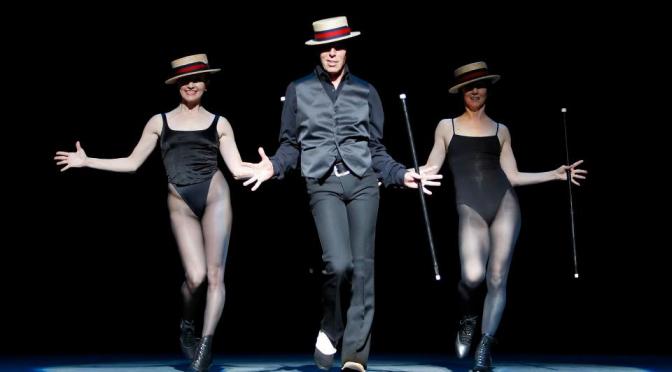
FOSSE'S WAY Classic Bob Fosse 'jazz hands' choreography.
FOSSE’S WAY Classic Bob Fosse ‘jazz hands’ choreography.

Many showbiz folk attribute the dynamic flat-handed open-fingered gesture, often accompanied by hat and cane, to the man who made it his signature move – American choreographer Bob Fosse – although it has deeper roots in centuries-old vaudeville.

Somehow, due to its association with enthusiasm and heightened expression, and probably because it involves articulation of the wrists, Jazz Hands has also come to denote camp behaviour – it’s shorthand for gay.

pluck-cover
BUY NOW

But Pocock wasn’t doing Jazz Hands: “Thanks, Miranda. That’s totally fine,” he replied, “also glad it wasn’t ‘jazz hands’.”

Which sounds like a casual diplomatic dance to me.

© Michael Burge, all rights reserved.

This article appears in Michael’s eBook Creating Waves: Critical takes on culture and politics.