

THIS week I was asked a set of insightful questions by journalist Daniel Seed in his interview about my non-fiction debut Questionable Deeds: Making a stand for equal love. Check out the video, which is also available at The Headline Act.
Tag Archives: Homophobia

Marriage equality on the never never
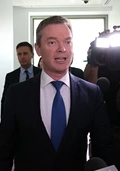
TONY Abbott has knocked Australian progressives and moderate Liberals into motionless disappointment on marriage equality.
The biggest political football of his government has been booted around by parliament again. There’ll be a few free kicks when the cross-party marriage equality bill comes before parliament, but Abbott’s moved the goalposts already, so none of the players will score.
The Australian with the highest hope for the Liberals on this issue – and at the greatest risk of being disappointed by her party – is Tony’s sister Christine Forster, a Liberal councillor for the City of Sydney.
She optimistically submits to interviews whenever she feels we are approaching a breakthrough. She’s also good-natured enough to engage in jokes about her brother, yet not hide her disappointment.
“It’s clear marriage equality will remain just a high hope.”
But it was Christopher Pyne who was this week’s highest-profile and most confident Liberal when it came to marriage equality, although his hopes for a free vote blinded him to a classic Abbott battle manoeuvre.
When the Prime Minister opened the discussion to the entire Coalition party room, including a wall of National Party MPs whose homophobia was guaranteed to bring out the same in everyone but moderate Liberals, Pyne’s reported response was shock. He then dashed through the media with the kind of sibilant schoolboy anger that often stereotypes him as gay.
As the dust settles, it’s clear marriage equality will remain just a high hope on the never never, that place where Australians know nothing will change in the short term.
I could analyse the chances of any of the dangling carrots – referendum, plebiscite, binding or free votes – but that would be to engage in the kind of hope Tony Abbott wants from me.
Progressives and moderates are good at hope, and at home in the southeast Queensland electorate of Bowman, there’s been plenty of it ever since Liberal MP Andrew Laming started filling letterboxes with his annual survey back in June.
Only one person per household could fill it out, and it didn’t mention marriage equality, just it’s poor cousin so beloved of right-wing religious Liberals – ‘gay marriage’ – which presupposes same-sex attracted people want something special, like ‘gay supermarkets’ or ‘gay sports ovals’.

I treated it as harmless until national media outlets started calling it a same-sex marriage survey. Long-term Bowman resident and LGBTQI activist Adele Fisher also had mixed opinions.
“I was aware, in previous years, people had reported not receiving the survey and had questioned both the statistical significance and accuracy of the results,” she said.
“A couple of friends and I decided to encourage as many people as possible in Bowman to complete Andrew’s survey and return it. We started a Facebook page. We contacted Andrew and continued to speak with him during the lead up to the survey being released and throughout it being distributed and returned.
“We organised a rally which was well attended and had some fantastic speakers, including community members, clergy and politicians. Unfortunately, Andrew’s schedule changed and he was unable to attend, however, he did provide a statement that was read out on the day.
“The rally was fortunately held the morning after marriage equality was achieved in all 50 states of the USA, and with a quick media release that morning we had a number of media outlets contact us on the day,” she said.
“With the assistance of Australian Marriage Equality we were able to run a full-page advertisement in the local newspaper and received other excellent support from them. We attended markets and spoke with hundreds of people in the Bowman electorate.”

I felt the same wave of hope across the region. My husband filled out Laming’s survey and duly posted it off, which meant our household was only half represented, but after the leaks about Warren Entsch and Terri Butler’s cross-party marriage equality bill, there was a sense that moves were afoot to deliver marriage equality by the year’s end, so my omission didn’t seem to matter.
Laming fuelled the hope by predicting he could be given a conscience vote on the bill as soon as parliament returned, but he did not bend over backwards to get his constituents to vote in the survey he promised would decide his vote.
“Unlike his fellow MPs such as Natasha Griggs (Liberal MP for Solomon, Northern Territory) and Ann Sudmalis (Liberal MP for Gilmore, NSW), Andrew did not offer an online option, an email option, a phone option or even a photocopy of the form for people to express their individual views,” Adele said.
“Questions have been raised regarding the validity of the survey process used. There are a large number of the electorate who are reporting that they did not receive the survey in the mail.”
According to Adele, Laming announced that people who had not received a survey could attend his office on one business day – August 6 – show their identification, and cast a vote.
Crunch time came so swiftly by August 11 that even the social media had trouble keeping up with events.
Not accustomed to being consulted on anything, even issues important to their rural electorates, like CSG, mining and native vegetation laws, National Party MPs may well have been stunned at being asked to have a say on marriage equality at a six-hour special Coalition meeting.
Late in the evening, when Tony Abbott made his captain’s call that there would be no free vote for Coalition MPs on marriage equality, Laming’s survey – and his support for a free vote – were rendered instantly redundant.
When he announced the results on August 12, they barely registered.
According to Laming, 58 per cent of respondents disagreed with gay marriage. To put that result in context, only 23pc of individuals in Bowman households responded.

“I have followed Andrew’s statements on marriage equality for in excess of five years,” Adele said, “since first attending a forum he held in Bowman, and have attempted to engage with him many times on the topic of marriage equality, in person, online and via email. Unfortunately, I cannot say that these have been productive.”
Adele and I have similar hopes on the future of marriage equality campaign.
“I think the events of this week were anticipated in part by many involved in the marriage equality campaign,” she said.
“Further plans and contingencies are in place for all of us who are campaigning for marriage equality. It has been a long journey so far and it doesn’t stop here. The campaign will continue and I’m confident will go from strength to strength.
“People are hurting though, and I have seen an outpouring of support for those people impacted by the decisions this week. Let’s never forget at the heart of the matter are real people, children, youth, adults and elderly.
“I think it is extremely important no-one loses sight of this.”
“Laming’s survey managed to get him squarely back in his leader’s good books.”
Even though the likes of Abbott and Laming say they understand there are strong feelings in the community on both sides, marriage equality supporters are too easily written off as attention seekers and bleeding hearts. This is the first week in years I have been labelled a deviant.
Some say the increase in vitriol means change is imminent, but I completely disagree. Without someone in the Liberal party rolling Abbott, or the electorate caring enough about the issue to vote him out, marriage equality is now years away.
And Laming’s survey managed to get him squarely back in his leader’s good books after February’s backbench revolt. Conservatives tend to do that sort of things while progressives hope.
© Michael Burge, all rights reserved.
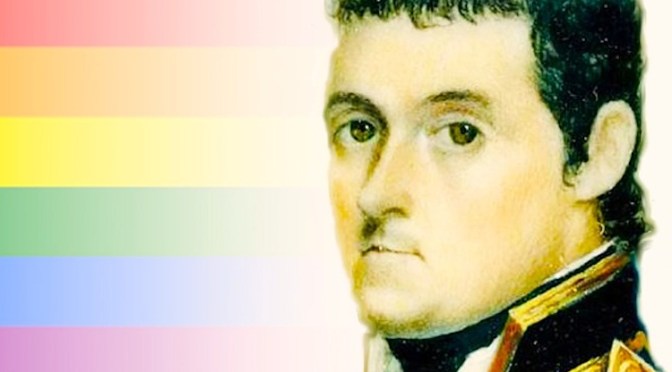
Navigating prejudice – Matthew Flinders

SPECULATION about the sexual orientation of iconic English seaman Matthew Flinders rose like a colourful maritime flag over a decade ago when previously unknown letters surfaced, including emotionally charged passages written by Flinders to fellow explorer George Bass.
In his 2007 Meanjin article “Exploring love: did they or didn’t they?” historian Garry Wotherspoon asserted: “If the excerpts from Flinders’ letter to Bass had been written to a person of the opposite sex, we would be in little doubt as to what sort of relationship it was or what kinds of hope and expectation it had once contained”.
“It’s time to shift perspective and explore the homophobia Matthew Flinders encountered.”
“We would probably even confidently presume a sexual component in it, a basis in physical feelings if not actions. The possibility of a physical side to or a sexual element in Bass and Flinders’ relationship should therefore be acknowledged and considered.”
In the years since, little acknowledgement or consideration has been given to the sexuality of either man.
Historians are invariably baffled by Flinders in particular. Many of his extraordinary reactions lead them to describe such moments as out-of-character; but for anyone genuinely wanting to understand him, it’s time to shift perspective and explore the homophobia Matthew Flinders encountered.
Both Lincolnshire-born, Bass and Flinders met on a voyage to Australia in 1795 onboard the HMS Reliance. Once in the new colony, the two made a series of expeditions together. First it was short trips along waterways close to Port Jackson. Eventually, onboard the Norfolk, they circumnavigated Tasmania.
It’s tempting to paint all kinds of Brokeback Mountain-style possibilities for two unmarried men isolated on vessels in far-flung locations.
“There was a time, when I was so completely wrapped up in you, that no conversation but yours could give me any degree of pleasure …” Flinders wrote to Bass towards the end of this period, “And yet it is not clear to me that I love you entirely …”
Both men returned to England on separate ships in 1800 – the year of Flinders’ ‘love’ letter – and were married within six months of one another.
Bass soon left on a trading mission to the southern hemisphere in January 1801, leaving Flinders’ letter at home, where Mrs Bass – Elizabeth – had plenty of time to consider its contents and form the response she penned onto the letter itself.
“This, George, is written by a man who bears a bad character … no one has seen this letter but I could tell you many things that makes me dislike him,” she wrote.
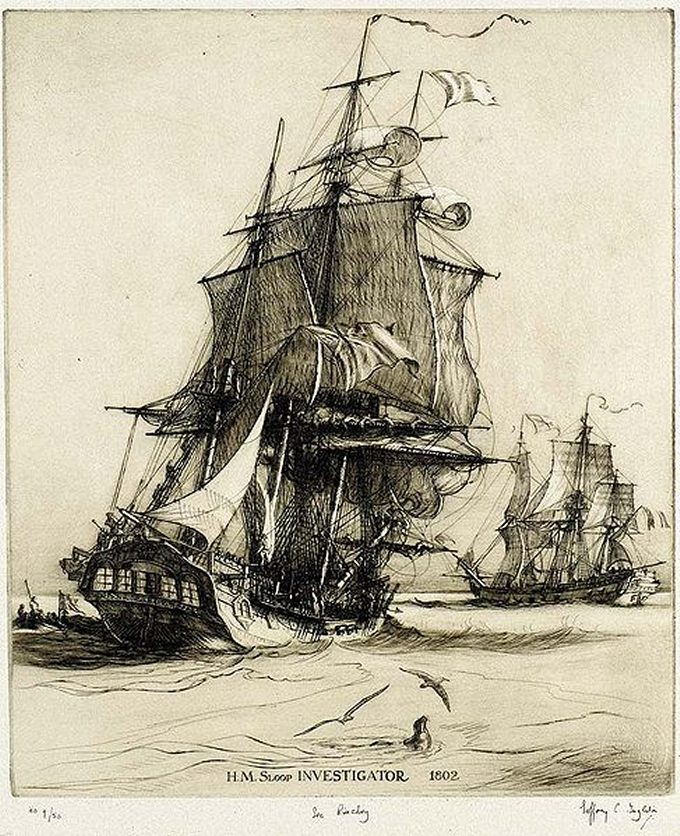
Her warning was given during a major turning point in Flinders’ life.
He shocked his friends and family by responding to a suggestion of marriage from a friend, Ann Chapelle, who he’d discouraged in previous letters.
Then he went so far as to invite her to return to Australia with him, keeping the reality of the Admiralty’s strict rules on wives from her until she was forced to get her things off the HMS Investigator and let him embark.
What the speed and the controversy of the marriage achieved was widespread gossip within the Admiralty and his circle that painted Flinders as a fervently married man.
Any Brokeback-style expeditions were off the cards in the following years for Bass and Flinders, whose paths did not cross again. Bass captained the Venus on trading jobs to New Zealand and Tahiti, while Flinders completed the first circumnavigation of Australia.
By the time the Investigator docked in Sydney in 1803, Bass had departed on the Venus bound for Tahiti and South America on a voyage for which there remains no known end – the ship and her crew all disappeared completely.
Flinders also had problems returning to his wife, when, in December 1803, he was arrested on the island of Mauritius, a French-held colony.
Much has been made of Flinders’ seven-year imprisonment at the order of Mauritian Governor Charles Decaen. The records revolve around spying accusations against Flinders and his incorrect passport, understandable concerns considering the English and the French were at war.
But what if homophobic whispers had pursued Flinders to the southern hemisphere?
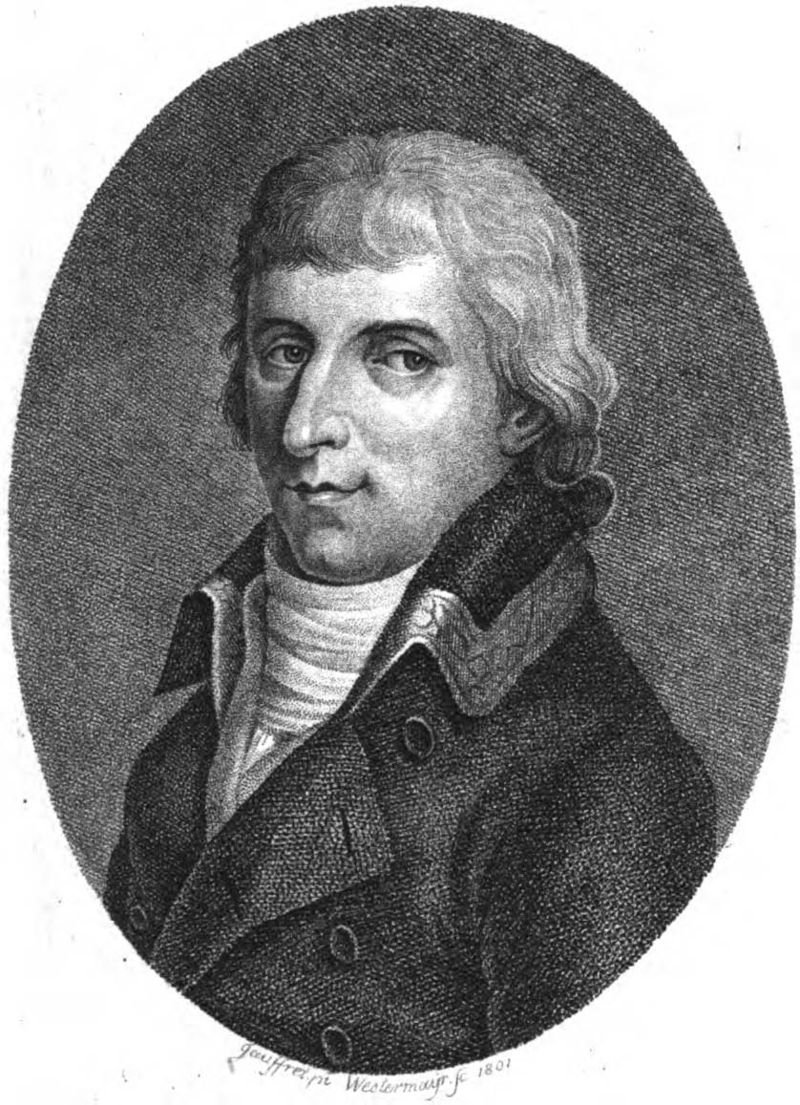
By the time Flinders limped into Mauritius in his damaged schooner the Cumberland, Decaen had heard of Monsieur “Flandaire”, probably from French captain Nicolas Baudin.
Baudin and Flinders had two previous encounters onboard Baudin’s ship, the Géographe, off the coast of southern Australia in early 1802.
After much flag-raising and shouting, when Flinders pulled the Investigator next to Baudin’s vessel and boarded, the men had the stilted, competitive discussion about charts and landmarks that has become folklore in the maritime history of both nations.
Researchers Jean Fornasiero and John West-Sooby had another look at the accounts of the Flinders-Baudin meetings in their 2005 essay A Cordial Encounter?
“Certain discrepancies between the accounts of the two captains are difficult to explain,” they wrote. “These have generally been attributed to communication difficulties between the French navigator and his English-speaking counterpart”.
“We do know Flinders ‘spat chips’ at Decaen for keeping him against his will.”
“This assumption, however, is far from self-evident. We have thus chosen to canvass the full range of possible explanations for the conflicting accounts of that meeting, including the hypothesis that Flinders, who is generally considered a reliable witness, may indeed have misrepresented his encounter with Baudin.”
But the one possibility they neglected was that Nicolas Baudin knew a homosexual when he saw one.
Eleven years prior to this encounter, the French Revolution recognised the existence of homosexuality when it left consensual, private sexual relations between two men out of the French Penal Code of 1791 (and again in 1810).
Before this, gay men could be burned at the stake if caught in sexual acts. As a consequence of the change, they were generally free to be themselves in public.
Compare that with Flinders’ place of birth, where, at the time of his meeting with Baudin, Henry VIII’s Buggery Act of 1533 still listed sodomy as a hanging crime. Consequently, writing love letters would only have been for the extremely courageous.
Baudin arrived in Mauritius, and died there of tuberculosis, just months before Flinders’ incarceration. Its doesn’t require a great leap to imagine him describing Flinders to Decaen as “pédéraste pétulant” instead of “un navigateur qualifiés”.
We do know Flinders ‘spat chips’ at Decaen for keeping him against his will, from letters the French Governor received from the explorer.
Decaen requested Flinders dine with he and his wife on the second day of Flinder’s detention. Flinders, who’d refused to remove his hat when he met the Governor, declined the olive branch and kept to his prison room dusting-off more missives.
His responses were so stinging that the Governor never repeated his invitation and kept this bird in a cage for a further seven years.
The cage wasn’t entirely austere for Flinders – trips to the theatre and stays with local aristocrats, and parole for extended periods, took place in a civilised French colonial society which tolerated any gay rumours and allowed him to pass the time writing.
But Decaen maintained his personal control over Flinders’ detention, even contravening Napoleon’s 1806 directive to free the Englishman. The Governor’s excuse was the kind of blanket term used to beleaguer Oscar Wilde: Flinders was dangerous.
After his release and return to England in 1810, where he continued writing on his many groundbreaking explorations, Flinders’ ill health brought about his untimely death at the age of forty.

Yet his remarkable achievements resulted in inexplicable omission from the ranks of the Royal Society, the Admiralty’s old boys’ club that may, like Baudin, Decaen and Mrs Bass before them, have suspected the truth.
© Michael Burge, all rights reserved.
This article appears in Michael’s eBook Pluck: Exploits of the single-minded.
 Michael Burge Media