Tag Archives: Homophobia

Lives at the crossroads

A COLLECTION of ten stories, all variations on the same theme: hiding from the truth. 

The matron who interprets her sexual desire as physical pain, obsessed with one of her nurses to the point of stalking (‘Dirty Nurse’); the father who has liaisons with men at public toilets, and the kid who works out he knows the bloke (‘Last Job of the Day’).

The painter who is out but not too proud, and the Auschwitz survivor she must care for in her day job (‘All the Worst Jobs’). The mother who tries to find ‘the right girl’ for her son, only to come face-to-face with his male partner (‘Hilda’s Dance’).

The daughter who finds her gay uncle on Facebook and confronts her christian father about his homophobia in one insightful email (‘A Quick Fix’) …

Captured at the crossroads of their lives, these people face choices between extraordinary heroism and cowardice.


An extract of ‘Dirty Nurse’ from Closet His, Closet Hers.

The office was a reward for attaining the position of Night Supervisor by the age of thirty, the youngest promotion of its kind in the hospital’s history.BY the time Marilyn had her own office, it was much like her bedroom – isolated at the end of a verandah and damp, since Maintenance never finished the guttering.

There was no new uniform to expand into, only a chrome-plated badge which Marilyn ordered from the town jeweller and collected on her day off.

She was unprepared for the grizzly smile of the young man she’d been a year ahead of in school, who looked at her through the smoky glass of a recent refurbishment.

It was an unusual look which Marilyn did not recognise, and and read as a slight retardation.

He fetched her badge, which had been sent away for engraving, and proudly held it up for Marilyn in his gloved hand. She checked the spelling, retrieved her purse, and curtly said: “Yes please” to the plush velvet drawstring bag he proffered with his other hand.

‘You’ve done well,’ he said, ‘out of everyone we went to school with, you’ve done the best,’ he added, sniffing at the last minute, signalling that he didn’t much like taking on the family business that had been in town for sixty years.

Marilyn thought of something to say, but stifled it, then another thought popped into her head, and she left that alone too, game show-type retorts which she’d never used anywhere other than the hospital. All she could get out was: ‘Thank you, Brian Ward,’ as though naming him would thwart his unwelcome familiarity.

As she walked away he wondered how much arse any woman had a right to. Still, he thought, she’s more of a looker than Leanne. Leanne was his now ex-wife and the mother of their two children, who’d left for the city last weekend.

Mum had told Marilyn all about it, and she’d had it from Merle at the Bowling Club. Merle was Brian Ward’s godmother.

Driving home, Marilyn remembered what Brian’s look reminded her of. She put it right out of her mind, until at five past eight that evening it came back to her: the face of Pam Cooper, maybe ten years before, in the storeroom where they kept the cylinders of laughing gas.

While running her bath, Marilyn revived the tinny smell of the tanks as Pam handed them to her, only Pam was always slightly careless and had dropped one. It had fallen against a shelf, which twisted the tap and shot a spray of laughing gas over both of them.

“Marilyn had nearly slapped Mum for taking away that chance to hug Pam. Her hands had been so close to both women, but nobody wanted them.”

Pam broke into giggles first, in disbelief more than anything. She’d fallen to her knees, knew to turn the tap off, but hadn’t quite managed. Marilyn had tutted, put her tanks down, and went to help. By the time she turned to Pam the other woman was collapsed over a pile of sterile linen, gripped with silent mirth.

Marilyn hadn’t meant to giggle too, but the gas dragged it out of her. She shook her head, trying to be free of it, but Pam slapped both hands onto Marilyn’s leg in an innocent, jaunty motion which Marilyn recalled like a bolt of lightning running through a feather.

The two women fell about for only a minute, but in that minute Marilyn was touched more than she’d ever been in her entire childhood.

As Pam gathered her wits and stood, Marilyn saw her breasts in the shadow of her collar, right through the join of her bra to the top of her stomach.

The sight haunted her now, as she slid into the bath.

Pam had three kids to a real estate agent. They’d visited because Mum had it from Coral at cards that Pam was ‘going to leave That Man’, and Marilyn had told Mum to tell Coral to tell Pam she was ‘welcome anytime with the kiddies’.

Marilyn had to stop the kids dipping their bikkies in their tea. She’d told them it was ‘bad for their toothie-pegs’, but they still did it. She’d held the little girl and Dad and Mum had a boy each on their knees, but the little lady didn’t like Marilyn’s broad, hard lap.

Pam hadn’t worked since leaving the ward. She’d swapped starched uniforms for an array of stylish polyester outfits purchased during the abundant early years of her marriage.

Marilyn couldn’t get to the wedding because she’d made sure she was rostered on for a double shift to avoid seeing Pam walking down the aisle with That Man.

Around their dinner table, Marilyn waited for news of when Pam was leaving him, but the slightest mention of ‘things’ brought a tear to Pam’s eye, and before Marilyn could go for a hug Mum jumped up with one of her ‘don’t you worry now love’ consolations and Dad had taken the boys out the back to the shed. Marilyn was left to watch the little girl, who insisted on pulling at Marilyn’s shoelaces, the way Maggie had when she was a puppy.

Only Maggie was long dead. Mum hadn’t even given a cuddle or a kiss when they put the little dog in the ground inside an old floral pillowslip.

Marilyn had nearly slapped Mum for taking away that chance to hug Pam. Her hands had been so close to both women, but nobody wanted them. Not even the little girl had wanted them.

That was years ago now. Pam hadn’t left That Man. Marilyn sometimes saw the station wagon parked at the supermarket, and caught glimpses of Pam between the aisles, but her jealousy over that stolen hug always prevented her from saying hello.

So Marilyn slid her head into the searing heat of the bathwater, peeling off the memories she was sure would dissipate in the chilled air long before she surfaced.

© Michael Burge, all rights reserved.

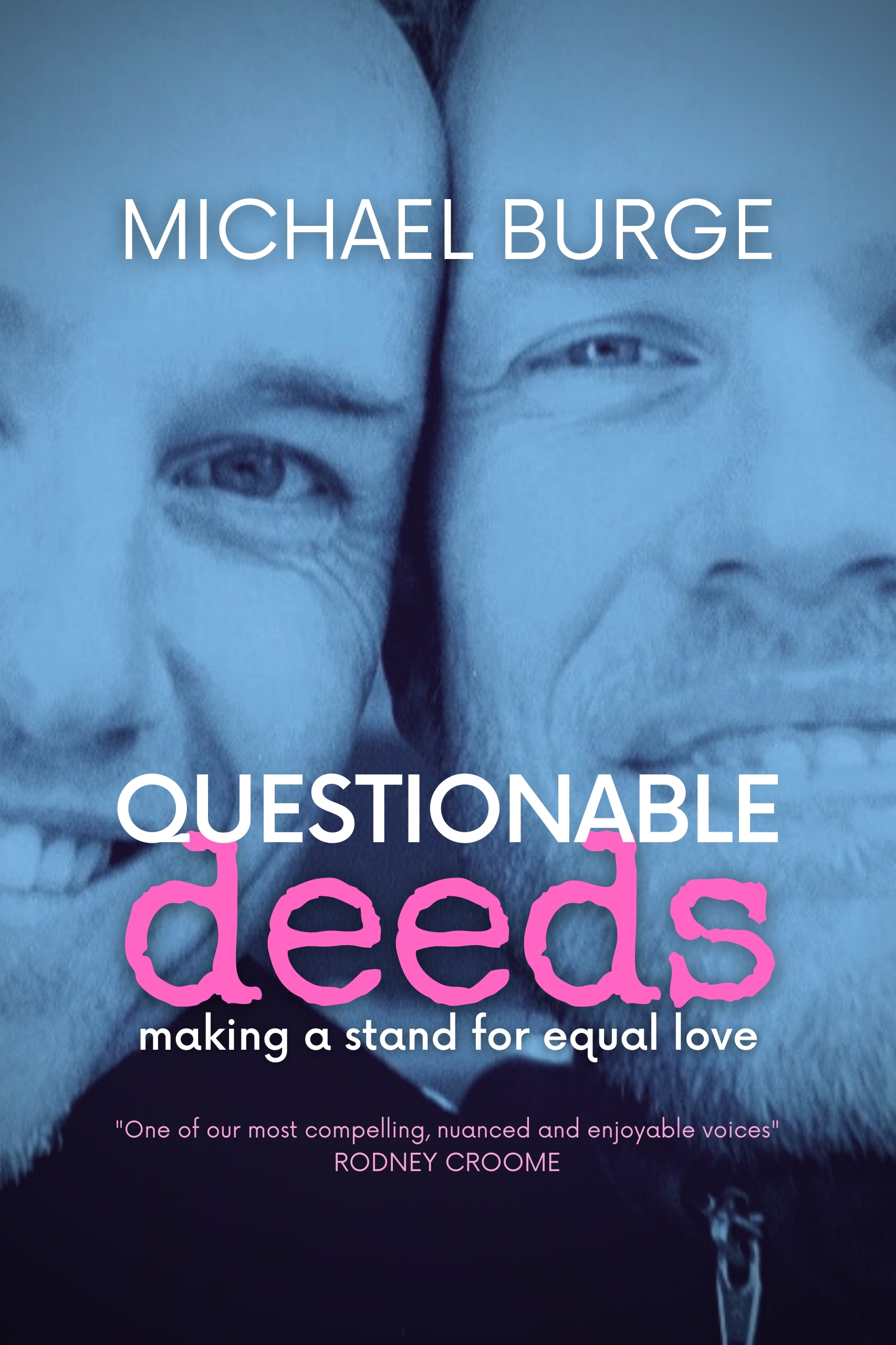
The making of a marriage equality advocate

IRELAND’S yes vote for marriage equality kicked a rainbow-coloured goal for LGBTI people around the globe, and while the major Australian political parties fight for ownership of the ball, this extract from an upcoming podcast and book Questionable Deeds is a reminder of how far we’ve come. 

IN the lead up to the 2004 federal election the issue of same-sex marriage hit the media.

The year prior, various provinces followed Ontario’s lead in Canada and allowed same-sex marriages to take place. Many Australians availed themselves of this legislation since it did not require the couples to be residents, but as soon as the newlyweds stepped back onto Australian soil, the marriages had no legal standing whatsoever.

Two couples decided to test Australia’s Marriage Act (1961), and their application landed on the desk of federal Attorney-General Phillip Ruddock, sending him into a spin.

“Marriage, like a seed, was planted within me.”

It turned out there was no specific mention of gender in the Act. As far as the law was concerned, any two people, same-sex or otherwise, could apply to be married in this country. Back in the early 1960s when the legislation was created, nobody even dreamed of same-sex marriage.

The conservative Liberal government, led by John Howard, went into overdrive to see this loophole changed, and they got plenty of support from both sides of parliament, election year or not.

By August of the year my partner Jono died, same-sex marriage had been made a legal impossibility in this country. I barely recall the announcement. It would have passed through my consciousness in my deepest grief and registered only as another reason to feel dreadfully unsafe about being same-sex attracted in my own country.

The looming election, of course, required me to turn up at the ballot box, since all Australians must have our names ticked off the voting register on the day, whether we use our vote or not.

The voting queue at the local primary school, the same one I had attended over twenty years’ prior, was long. It gave me plenty of time to think over the issues, and, more importantly, to observe people and the colour of the how-to-vote cards in their hands.

Prime Minister John Howard was showing great leadership for the majority of Australians – sixty per cent – who objected to same-sex marriage, and, by the amount of blue of the cards I saw all around me, things were not about to change.

They didn’t. The diminutive target John Howard saw off the Labor party’s brutish Mark Latham, no problem.

But marriage, like a seed, was planted within me as a concept. Alone, processing the loss of my partner, I pondered what difference marriage would have made to my situation.

First and most obvious was the certification. The warranting of a relationship’s existence is so easy with that ‘one piece of paper’ which straight couples had access to for years prior, eschewed by many as either too binding or not needed.

I realised how much simpler it would have been for me, one certificate, and how much harder – impossible, really – it would have been for Jono’s mother and brother to erase the visible signs of his relationship with me.

I thought of the traditional marriage vows, and the words ‘forsaking all others’.

I processed its meaning, looked deeper than any sublimation of women and property rights, to find how the line was actually a warning to all those present at a marriage ceremony that they are the forsaken ones. Their son or daughter is placing them on solemn notice with that line, warranting that they are no longer the next of kin to their loved one.

Their spouse replaces family, from that moment, and a new family unit is created.

My parents’ marriage had ended in acrimonious divorce, to the point where my mother was wary of any signs of my father in me and my brother, and our father allowed his new wife to demonise our mother as she saw fit.

I was glad they did not stay together, and Prime Minister Gough Whitlam’s leadership on fault-free divorce through the creation of the Family Law Act (1975) had built the firm foundation that allowed many families to undo what needed to be undone, with access to legal aid and counselling.

Almost instantly I shed my wariness of marriage. I saw exactly how it could work for same-sex couples needing that line in the sand around our relationships, whether the marriage lasted forever or not.

Marriage did not have to follow the archetypal plan. Its history is littered with anomalies, of couples stretching its boundaries, simply because they were quite safe to do so by law. In recent times, any victim of marriage also had recourse to become un-married.

I recalled the night Jono and I took one another to our favourite pizzeria on Katoomba Street, on the brink of relocating to Sydney and starting a new phase of our lives. Jono was pensive until he revealed what was on his mind: he was worried that he did not have enough to offer me as a partner, being ten years my senior. He wondered if I wanted to explore other relationships.

I looked him in the eye, and held his hands between mine, and said: “No, Jono, that is not what I want. I want to be with you.”

He bent his head in his humble, accepting way, flicked the corners of his mouth up, and we kissed.

From that moment, we were married. The only things missing, apart from the support of any law, were two witnesses and a state-sanctioned celebrant.

9780645270532
 

Widowed and alone in that voting queue, barely two years later, I became a marriage equality advocate.

An extract from Questionable Deeds: Making a stand for equal love.

© Michael Burge, all rights reserved.

Questions coming at you

ONE random night in 2004, Michael Burge’s long-term partner, choreographer Jonathan Rosten, died suddenly while rehearsing a show.

In the midst of the ensuing grief, Jono’s relatives started the secret and devastating process of disenfranchising Michael from his position as Jono’s next of kin.

Unable to wrap-up his de-facto partner’s affairs, in a legal, ethical and financial ‘David and Goliath’ battle, Michael was exiled from his own life, facing grief, depression and suicidal thoughts.

The story of how he found the strength to right the wrongs is told in a new book.


An extract from Questionable Deeds

“A tough but ultimately triumphant and deeply satisfying read. It touches on themes of grief, denial and injustice. The ending is uplifting.”Mary Moody.

“You know that your partner’s heart has stopped?” he asked me in a careful tone.

I said: “Yes”, waiting for the next part about them rushing Jono into surgery.

“Well,” the nurse said, “we’ve been unable to start it again.”

My hand went to my face, but it hit me on an angle. I didn’t care, I thought I was slipping off my chair. People seemed to be rearranged in their seats by unseen forces as I left the nurse and Jono’s old friend Amanda behind.

I was led into a corridor, where I watched how another nurse pushed a red button to open opaque glass double doors. Behind that, in a curtained space, Jono was lying still on a gurney under a sheet.

It is true what they say about the newly dead appearing to sleep. Jono’s face was relaxed, his skin pliable, as I brushed my hand across his forehead, the sobs starting to run through me like tremors. I felt the silkiness of his eyelashes as I kissed him.

Not yet believing, I opened one of his hazel eyes, and the gaping darkness of his dilated pupil met my gaze; a sudden wall against the life here, the emergency department of a Sydney hospital, and wherever he now was.

“The room was about to fill with strangers it would take me hours to free myself of.”

My glance must have been like a scan, both forensic and feeling. He was just so beautiful, a perfect version of himself, with his body’s tendency to slump slightly sideways, chin dropping to his left shoulder, the way he’d always done in life in moments of vulnerability and cheekiness.

But the worst thing of all had happened to him, the very worst. The eyes told me that.

The green sheets around his naked body concealed all trauma, apart from the point at the top right of his chest where an intravenous main line had been inserted in an attempt to save him, and two small grazes on his nose and cheek where he’d knocked himself as he’d fallen to the floor, alone, in the rehearsal room.

But all that knowledge was to come. In that precious, solo moment I took in the reality of Jono’s death.

“I will cry for you for a very, very long time,” I said, my loneliness coming back at speed.

Acceptance did not take long. Resistance to it is useless. I read years later how, faced with this moment, Yoko Ono had repeatedly smashed her head against the tiles of the hospital wall.

For me, the moment was filled with the memory of the grief of losing my mother at a young age, although I had the cold sense of how very much worse this was going to be.

I instinctively ran my hands over Jono’s arms, his belly, and cupped his penis in one hand through the sheet, bidding those intimacies farewell. After not very long I tried to return to the hallway, through the automated doors.

But I found myself trapped in the corridor. The exit to the waiting room was one way into the life to come. Jono, and our life together, was in the other direction. When I chose to go back to him, a passing nurse came across me in my indecisive confusion, and pushed the button for me.

I went back to him for a moment. I don’t know why. To see if it was true? It was. I don’t remember anything about the next moment of separation, the walking back outside.

I sat down in a new room, and a young man, a counsellor, introduced himself to me. I needed to make some calls. I tried my sister Jen. There was no answer. Amanda stood and hugged me, told me how sorry she was. For a moment, sitting in my chair, I was suspended in the naphthalene scent of her fur coat.

Somehow I was made aware that Amanda was going in to see Jono, but I made no objection. I was in shock. The reality of Jono’s death was being transmitted across the city. The room was about to fill with strangers it would take me hours to free myself of.

It never occurred to me that nobody in that place, apart from a medical practitioner, or me – Jono’s partner and senior next of kin – had the right to view his body. His naked body.

Because I was unaware that my relationship with Jono was not ours alone. I had no idea in those precious, vulnerable moments that he and I were well and truly owned.

© Michael Burge, all rights reserved.