Tag Archives: Homophobia

Making way for the marriage of true minds

AUSSIE AUSSIE AUSSIE Unequal, unequal, unequal.

A Writer is helped to understand his subject.

I WASN’T going to write anything more on the lack of marriage equality in Australia. Frustrated and saddened by the wait, I decided to stop trying.  But this week I had one of my most profound experiences around the debate, one which needs sharing.

A week ago I received an unprompted apology from someone I went to school with. He sought me out on Facebook and made amends for his homophobic bullying more than twenty-seven years ago.

I was initially cynical – after all, this particular cruelty was usually an invitation into a fake conversation followed by a bullying sting.

So I publicly asked him to take some action – to write to his federal member in support of marriage equality – just to see if his apology was something more than words.

“The self-determined gay couple, if ever aware enough to lobby for the full backing of the law, would force societies to evolve.”

Then I waited. My husband witnessed me waver as the days passed – “I’ll never hear from this guy” I muttered, realising that I’d asked him to come out as a supporter of same-sex marriage.

I already knew from bitter experience how hard coming out can be. Declaring anything unexpected within your community can be a deal-breaker for all our relationships.

While I hoped for a reply and yearned for it to be a positive one, I revisited my own journey to marriage equality.

It began 10 years ago while I was standing in the voting queue at the 2004 federal election.

My life had taken its harshest turn for the worse earlier that year. My long-term partner Jono died suddenly, and in the midst of my grief his family denied the existence of our relationship and caused a legal battle over Jono’s debt-ridden estate.

Homophobia mixed with grief mixed with denial mixed with money … a devastating cocktail I tried my best to assuage, and failed.

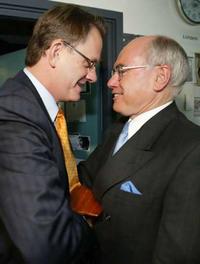
I sorely missed a powerful record of our relationship to use against that force, but that year federal Attorney-General Phillip Ruddock and Prime Minister John Howard trounced any chance  same-sex-attracted people had of accessing the federal Marriage Act to create legally recognised relationships.

NEVER GONNA HAPPEN Mark Latham roughing-up John Howard in 2004.

By the looks of the colour of the how-to-vote cards in that long voting queue, Labor’s Mark Latham was not going to see-off Liberal Prime Minister John Howard, and, with community support for same-sex marriage languishing at just over 35 per cent, marriage equality seemed forever away.

Jono and I were oblivious to the precarious legal situation our relationship was in. We’d been happy to live very much to the tune of Joni Mitchell’s ‘My Old Man’: “We don’t need a piece of paper from the City Hall, keepin’ us tied and true”.

Not an uncommon stance in our generation but one which can leave either party in legal limbo after the death or incapacitation of the other.

As I waited to vote, I realised there was a tool to keep an indelible legal line in the sand when one in a couple dies – a marriage certificate – that elusive piece of paper.

I suddenly felt duped by the society in which I paid taxes. It had never given me and Jono the chance to feel secure, and all the while we’d fooled ourselves that we had forever, and that nothing could touch our evolving togetherness.

That was the scary part for many people – the self-determined gay couple, if ever aware enough to lobby for the full backing of the law, would force societies to evolve. No wonder our collective relationships were such a political football.

A decade on, the only thing that’s changed is the percentage. Now, 72pc of Australians support marriage equality – surely a free kick for whichever Prime Minister has the guts to kick that ball over the line.

Like many LGBTIQ commentators, I find the lack of parliamentary leadership on this issue deeply unsettling, and in what I thought was my marriage-equality-writing-swan song, I extrapolated all the issues as I saw them.

But in trying to express my pain and angst in words, it turns out I was wrong about all of it.

Here’s why.

Earlier this week I woke for a very early start at work. Bleary-eyed at the computer I noticed I’d been sent a friend request on Facebook – from the man who, as a teenager, bullied me at school.

The sending of that request, the most common, throwaway click of a virtual button, and my equally everyday acceptance of it, revealed a far more powerful acceptance.

“He is not a bully, he is a hero.”

On his Facebook wall I saw he’d graciously acquiesced to my challenge.

Here is his letter in full:-


Dear (name deleted)

I am writing to urge you to support a free vote on marriage equality.

I went through school with a gay student and recently reconnected with him. He was gracious enough to share with me the way that society’s treatment of gay people has impacted his life. As a young student he was bullied at school, and as a gay man he has been subjected to ridicule, discrimination and disenfranchisement for no other reason than because of who he loves. The reason I am giving you this context is because I am ashamed to say that at school, I was one of his bullies.

This person sharing his experience of how my actions at school impacted him, provided me with an opportunity to put myself in his shoes, to empathise with how it must have felt to be a victim of discrimination. Looking back I am appalled at my thoughtless disregard for the rights of another person. Today, all these years later, I am equally appalled that this person is still having  his rights disregarded, only this time it is via Government-sanctioned  draconian legislation, rather than by a high school bully.

As a parent, all I can think of is how I would feel if one of my children was forced to face the same struggles for acceptance, and forced to fight for what you and I, as heterosexual males, take for granted — the right to marry the person you love.

Could I ask you to place yourself in the shoes of someone facing this discrimination? Imagine if it was your own son who was in this position, if your beloved child was unable to marry the person he loved.  Or perhaps think how it would feel if one of your daughters was not legally allowed to marry the person she had fallen in love with. If one of your own children was denied the same rights as the rest of society based purely on their genetic sexual orientation, wouldn’t you do everything in your power to fix this injustice?  Wouldn’t you fight against the ignorance of others to ensure the freedom and chance of happiness for one of your own?

Research has shown that the majority of Australians believe it’s time marriage equality became a reality. I would hope that as a father, a husband, and a citizen of Australia in 2014, you agree that now is the time for this change. Now is the time for you to join 72% of the Australian population who are saying that all Australians are entitled to marriage equality.

I strongly urge you, as my representative with the power your position bestows upon you on my behalf, to take the necessary steps to ensure marriage equality becomes a reality. Please support a free vote on marriage equality. Do this on behalf of every parent, for the sake of every child who deserves the same rights as you and me.


This man and I must always have had more in common than we realised. He is not a bully, he is a hero, and on reading this for the first time, I was released from cynicism into fierce protection.

Same-sex marriages and civil unions have been granted and overturned at state level; the community support in all known polling regardless of age, region, religion and ethnicity is in the seventieth percentile, and plenty of same-sex-attracted couples want one.

Clearly, the culture war has long been won.

All that’s standing in the way are the real bullies – the politicians and community leaders who never really grew up and continue to cajole, avoid, ignore and deny the rights of same-sex attracted people, and our friends.

It took a reformed bully, and a reformed victim, to see it.

© Michael Burge, all rights reserved.

Apology from a school bully

HOMOPHOBIC
HOMOPHOBIC BULLYING has long-lasting impacts on perpetrator and victim.

A Writer’s reply to a childhood persecutor.

THERE must be something in the planets, because this week I was contacted out of the blue on social media by two bullies from my past.

One of them – a family friend in her sixties – is an educated, well-spoken, active-in-the-community, serial bully. She contacted me to get at her daughter, who she’s created devastating conflict with, but all she got was a reminder of her unfinished business with me.

The other is a man I went to school with.

Unlike my family friend, he made an unreserved apology for bullying me at school, some 30 years ago.

“I am a white, middle class, heterosexual male, who, for no other reason than the lottery of my birth, has never had to deal with discrimination,” he wrote.

“I want to be part of the change, part of the solution, rather than part of the problem.”

“All l can do is try to imagine what it would be like to deal with fools like me and their behaviour.

“Growing up, dealing with parents and high school, and puberty, and relationships, while also trying to find out where you fit in amongst it all of it was tough.

“Tough enough without also having to deal with the added layers of ridicule, judgment and misunderstanding.

“I apologise for bullying you, I apologise for ridiculing you, I am sorry for all of the ways I disregarded your feelings and failed to consider your emotional wellbeing.”

Revealing stuff. He asked me for feedback, so here’s what I wrote in reply …

Dear (name deleted),

I am a little cynical about your letter. So often I engaged in conversations with boys in our class, only to find your invitation was really a cruel trap with a bullying sting at the end. Your approach to me now could well be a case of the ‘little boy who cried poof’.

Your particular behaviour was more a sneering from the sidelines of the main bullying action, although I remember one occasion when you openly shamed me about my sexual orientation in front of an entire classroom of people, and I retreated in shock.

That sort of thing definitely contributed to me staying closeted until I was 28, by which time one of my parents had died before I had the courage to come out to her. That’s an irreversible regret I carry.

There is no doubt you remember my mother – she was one of the most active parents at our school, and you benefitted from her contributions.

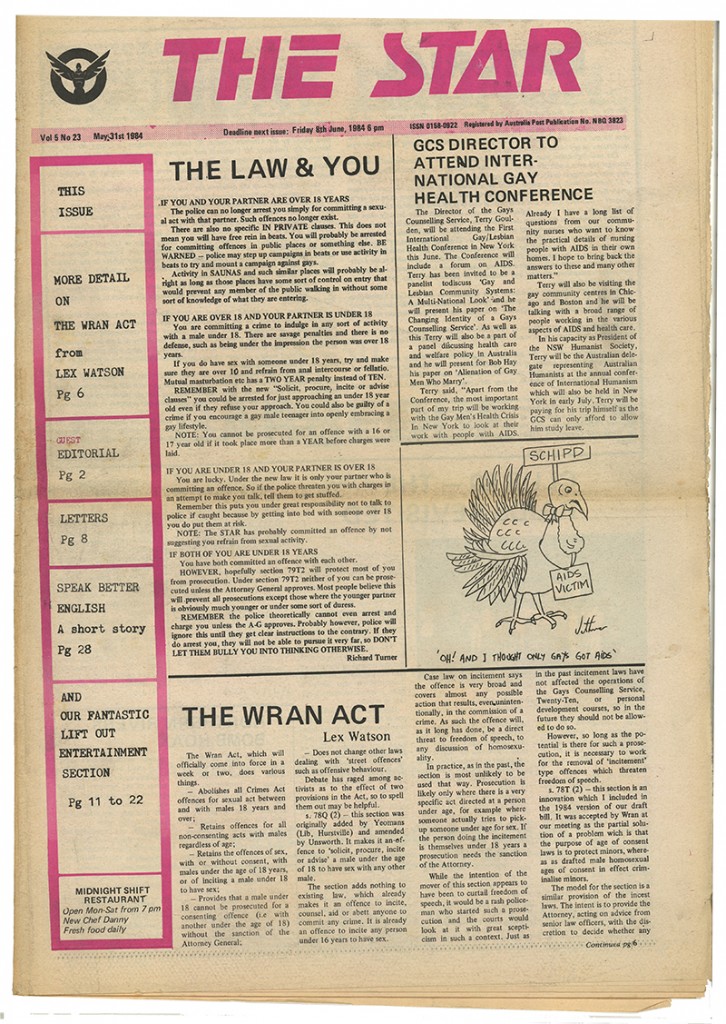
OKAY TO BE GAY Front cover of the Sydney Star Observer when men could no longer be arrested for sex with men.
OKAY TO BE GAY Front cover of the Sydney Star Observer after men could no longer be arrested for sex with men, in 1984.

My family had survived death and divorce by that time, and the community I lived in, primarily made up of school families, led me to believe that my sexuality was only going to deliver more bad news.

What a fool I was to buy into all your fears.

During our high school years, homosexuality in NSW was decriminalised.

Even though your behaviour was wrong, it was sanctioned by the state and the establishment at a private Anglican school. You and your mates were only responding to society’s pressure to shame and ridicule same-sex attracted people, but it’s great to see you’re not still letting yourself off the hook.

Truth is, our school had as many homosexuals as there were homophobes – staff and students in all years, male and female. The gay staff members were particularly vulnerable to sacking without cause, and still are, so when you were throwing around your accusations, alarm bells would have been ringing deep down for many.

Hopefully you agree that to toy with that bell is a power no child should ever have.

“Bullying children should never have power over gay people.”

If I’d been a smaller person you might now be regretting physically abusing me, but because I grew to the size I am now at the age of 15, none of you ever had the guts to approach me with the kind of abuse many other gay boys endure from their classmates. Even an awkward blow from me would have landed unpredictably and heavily.

You didn’t always succeed in shaming me.  I clearly remember with great delight the day on which I turned the tables on you.

We were playing indoor cricket and I was selected to bowl with you at the crease. Your assumptions about a gay bowler saw you step forward expecting to knock the ball to the ceiling. Instead, it snuck straight under your triumphant pose and knocked the stumps over with a clatter.

The PE teacher gave me a validating look, while you had no choice but to walk to the sidelines, where your attitude belonged.

Team sport… it has its uses.

My other strong memory of you was the day you brought a cassette into English class – Cold Chisel’s “Khe Sanh” – and you asked the teacher if you could play it for us all. She agreed, sensing it was important to you, and you unabashedly sat at the front moving your head and drumming your hand on your desk.

What drew my attention was your affinity with the song and its message, and the shame-free way you claimed your right to self-expression.

I accept your apology because unconditionally offered amends are the very rarest, and you seem to ‘get’ that if I had played a song that moved me in front of our class, the outcome would have been very different.

SMALLTOWN BOYS British Synth Pop band Bronksi Beat.

My choice would have been Bronski Beat’s “Smalltown Boy”.

Have a listen to the lyrics one day and you’ll find some insights. The song laid out the options for growing men as starkly as Jimmy Barnes did for you.

In the 27 years since we left school I have tackled more discrimination than you can possibly imagine. Not the predictable gay bashing crimes, or the puerile name calling, but the far more subtle disenfranchisement that underpins the last frontier in same-sex equality.

I would like you to do one thing, if, as you wrote, you really seek to be part of the solution to homophobia.

Find out where your federal member sits on the issue of marriage equality through the Australian Marriage Equality website, and, regardless of what you find, write to them.

Congratulate them if they publicly support same-sex marriage – they’ll need courage from their constituents to enact change in the small window of opportunity we have to achieve this human right during the current parliament.

And if they don’t, please tell them why you now support the equality that will deliver the greatest message to school children about gay people.

That our love is equal to yours in every way.

And that bullying children should never have power over gay people.

If you do this, I’d love to see a copy of it on your Facebook wall. I’ll know when to have a look when you send me a friend request.

© Michael Burge, all rights reserved.

I have a man here who won’t take off his hat

HATS OFF or else, in some parts of the world.

A Writer’s encounter with the Catholic faith.

FROM the shade of Bodhi yum-cha restaurant we could see the steeples of St Mary’s Cathedral rising above the bustling lunchtime streets of Sydney.

It was Richard’s birthday, so it was up to him where we spent our city day trip. He’d expressed an interest in going to the Australian Museum, just along the road, but the thought of the cool air inside the cathedral beckoned us both.

I’d also wanted to show Richard the reproduction marble of Michelangelo’s heartfelt Pietà sculpture of Mary and the dead Jesus in her lap, which I’d last seen on a school excursion.

That idea sealed the deal, so we paid for our meal and ascended the steps in the heat of a late summer Sydney day.

“I slid onto the cool marble floor and put my hands together.”

I spotted the ‘no photography’ sign at the last-minute, and the memory of numerous cathedral visits in Europe made me think of removing my hat. But there was no sign, and a flock of tourists in hats beyond the threshold, so I shrugged and left my cap on.

The darkness and temperature drop was immediate, as was the sense of calm away from the traffic and crowds. Richard disappeared towards a set of stunning brass gates, as we started our respectful, slow search for the sculpture.

We were soon separated by another crowd of tourists, and I waited in the half-dark by the gates until they passed.

By a door on the eastern side of the nave, I saw a sad sight: an old man, slumped pitifully against a pew, wisps of hair lifted by the breeze. A homeless man, perhaps, or someone so down on his luck that only time in this place of worship could restore him?

His demeanour was so compelling that I turned away, because looking seemed an imposition.

But as I went to move, a sudden jabbing drove into my shoulder from behind.

I turned in shock as a security guard said to me, breaking the calm: “Remove your hat!”

CATHOLIC GROUND Interior of St Mary's Cathedral, Sydney.
CATHOLIC GROUND Interior of St Mary’s Cathedral, Sydney.

In a bit of shock, I paused, looked at the tourists near me, some of whom had heard the guard, and said: “I will, in a moment,” and turned to find my husband.

“You will remove it now,” the guard said, loudly, “hats are not allowed in the cathedral!”

I turned, looked at the be-hatted tourists, and said: “I will remove my hat, when you ask them to remove theirs.”

I moved off quickly and heard him muttering at my heels. Adrenalin rushed through me, the result of the sudden physical attack on my shoulder, and something about the guard’s attitude towards me in particular.

When I caught up with Richard, his hat in his hand, I ascertained that the original request had been made to him. The guard caught up with us and repeated his demand.

I refused, and repeated my request for hat-removal equality in the cathedral, adding that I would be more than happy to remove my head covering when the same demand had been made of all the visitors.

“Women are allowed,” he snapped, thinking he’d snookered me.

I looked at the group again. Women and men, many of both, wearing hats, a point which I assertively made to the guard, before I turned away and determined to find the Michelangelo reproduction.

His unmistakable footsteps came after me, so I did the first thing that came into my head. Inspired by George Emerson in E. M. Forster’s A Room with a View, who, when harassed in Santa Croce, slumped to his knees in a position of prayer, I slid onto the cool marble floor and put my hands together.

Richard chortled.

The guard stopped, tutted, and waited. I could see him out of the corner of my eye. We were in a waiting game I’d need to play to its end if I was going to stay prone, so I took my time, finished my ‘prayer’ and stood, before calmly resuming my search.

“I’d impersonated a devout catholic, so fair cop that he did his best impersonation of what he thought I was.”

My tactic got him off my back, although he kept his distance and tried a new one of his own. He reached for his mobile phone and punched numbers into it as clumsily and implausibly as a comedian would, and said: “Hello? Is that the police? Yes, I have a man here who won’t take off his hat!”

Suppressing laughter, I told him I’d give him a Logie for that performance, and we did a dance of barely controlled energy all the way back to where Richard and I had arrived, my hat firmly in place all the way.

As I left, I turned and saw the guard attempt a dreadful impersonation of a poof. Limp wrist, hand on hip, and a lisped farewell: “Bye-bye, see you laytaaa!”

I laughed. I’d impersonated a devout catholic, so fair cop that he did his best impersonation of what he thought I was, but when I told my husband outside, Richard stormed back in and demanded the guy’s name.

Holding his hand over his badge, he began a tirade that did not end until we were both ejected through the door onto the steps, the place where thousands, perhaps millions of those in need had sought help from the church: at their door.

Adding to the surrealism of the moment, the poor soul I’d taken pity on by the eastern door came over and joined in the very loud rant about respect, hats, and who gets to wear one and who doesn’t on hallowed catholic ground, saying we could do what we liked in the world, but in the cathedral, it’s their rules. All of it avoided the reality that surrounded us: many men with covered heads, going into the church unmolested.

We were spat out, rejected and thoroughly repelled, but none of it was really about my hat.

As we descended the steps, the Museum in our sights, I asked Richard if he still wanted to go there.

“No, I’ve had enough of antiquities for one day.”

Touché.

We went shopping instead, and within minutes I’d worked out why the incident had happened.

Sydney’s Gay and Lesbian Mardi Gras, which has taken place annually on the doorstep of St Mary’s Cathedral in Sydney’s gay heartland – Darlinghurst – was in its final days.

I’d read years before that LGBTIQ catholics from around the world make a point of visiting the cathedral and visibly asking for confession and communion as a form of protest.

Thus the security guards, who, I hasten to add, have very delicate gaydar sensor settings indeed. Richard and I had not held hands or been in remotely close proximity while in the cathedral, but, like most gay men, we have a kind of ‘uniform’ when it comes to clothing.

creating-waves-cover
BUY NOW

We wear hats because we’re both rather bald, but the classic baseball cap (as opposed to the truckers’) is probably a bit of a giveaway for security in a Darlinghurst cathedral.

I’ve never been so quickly labelled as gay without opening my mouth.

And I’ve never so mistakenly labelled a soul in ‘need’.

This article appears in Michael’s eBook Creating Waves: Critical takes on culture and politics