Tag Archives: Homophobia

Human rights of reply

FIGHTING DISCRIMINATION Andreas Ohm and Jim Woulfe, Michelle McCormack and Lynne Martin with son Tom, Michael Burge, Maria Vidal and Susan Everingham with daughter Antonia, and Jiro Takamisawa. (Photo: Sahlan Hayes).
FIGHTING DISCRIMINATION Andreas Ohm and Jim Woulfe, Michelle McCormack and Lynne Martin with son Tom, Michael Burge, Maria Vidal and Susan Everingham with daughter Antonia, and Jiro Takamisawa.
(Photo: Sahlan Hayes)

A Writer discovers his voice.

SOMEONE once said: “Don’t get mad, get even”, which must have been on my counsellor’s mind when he suggested something towards the end of my two years of grief counselling after the death of my partner, Jono.

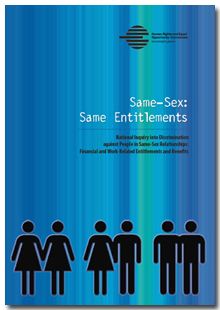
The Australian Human Rights and Equal Opportunity Commission (HREOC), now the Human Rights Commission, were looking for people to make submissions to illustrate various aspects of their Same Sex: Same Entitlements investigation into financial discrimination against same-sex couples in Australia.

“Why not think about writing your experiences?” he put to me.

I said I’d think about it, although my first thought was that my experiences were somehow not relevant. Then I thought deeper.

The death of my partner, with whom I cohabited, ran a business, and had joint financial affairs, had cost me dearly emotionally, but it had also cost me economically.

Unlike straight people in my situation, Centrelink did not recognise the validity of my relationship in any way. I was unable to claim any kind of support linked to my grief or my monetary losses when I had to move house three times in one year, and take time off work.

Centrelink staff had been quite defensive about their organisation’s shortcomings, and told me to apply for Newstart (Newspeak for ‘the dole’) which came with the requirement to be seen to be seeking work and attending mind-numbing ‘how to write a resume’ courses.

I’d taken things into my own hands and gotten a part-time job in aged care, which I happily did for a few months until my car blew a gasket, and needed thousands of dollars for a new engine. I sold it as scrap, had to quit my job (for which I needed a car), and proceeded to hunker down in my cheap accommodation, a granny flat, until I had to move because the property was sold.

I headed back to Sydney and city rent, and tried to speed up my application for Jono’s superannuation, which was slowed by the machinations of his family. They threatened to apply for it in its entirety, then didn’t apply for it at all. None of them were in any way financially dependent on Jono when he died, so none of them were eligible.

I was, but, thanks to all the unwelcome nonsense, it was months before Jono’s super fund could simply do what the law required of them and send me a cheque.

I endured financial discrimination because my country had nothing for me by way of support. What was slightly galling was that certain demographics – straight divorcees over the age of 50, for example – were allowed to access the ‘widow’s pension’ automatically. No job-seeking or resume classes for them.

Me, a genuine widow, could get nothing.

ACTU-Worksite-Australian-Human-Rights-Commission

I didn’t feel like entering into a sob story, but when I contacted HREOC, they encouraged me to submit a written document on these experiences, because they had not received any accounts of people in my particular position, and many of the unequal laws applied to the circumstances of being widowed.

Like my affidavit to the Supreme Court of NSW, my submission to HREOC was easy to put together. They have strict guidelines, I couldn’t just cry: “It wasn’t fair!” and let them sort it out, I had to show where I fell between the cracks because I had lived in a same-sex de-facto relationship.

Part of the deal was the delivery of a live submission to the Commission, and a willingness to submit to media interviews afterwards. I agreed without thinking, because, when the day came, I had a plan to follow the contents of my written submission, but completely overlooked the possibility that emotions would take over.

I watched as other gay and lesbian people expressed their experiences, and, when my turn came, I forced my story out from beneath an aching heart.

Expressing the inexpressible about death is one thing. Defining negative behaviour by other people around that death is another. I struggled my way through my submission, masking hurt with the kind of plosives that hit the microphone with the cut-glass anger that is entirely suitable for such occasions.

As I exited the hearing I forgot about the media, and had more microphones shoved in my face to elaborate further. The interviews went live at midday, and many of my family and friends, and my counsellor, heard me explain the disenfranchisement to a State that finally seemed to be listening.

report_cover

Adele Horin, formerly of Fairfax Media, interviewed me at length on the phone after my HREOC submission, for an article which appeared in the Sydney Morning Herald.

It took her a few attempts to fully understand my position, and with hindsight I understood her difficulty was the same obstacle that many people encountered when coming to terms with my experience, because they simply could not understand why Jono’s mother and brother would do what they did, it was such an aberration.

In the end, I suggested she ask them directly for their reasons, to secure the ultimate right of reply, although I suggested she’d need to be tactful – their son and brother had died, after all, and the illegal actions they’d taken made them vulnerable to heavy fines and/or jail terms, had anyone really wanted to “get even”.

Somewhere in her research, Horin came to realise that my experience went way beyond financial discrimination and spoke to one of the final frontiers of same-sex equality in this country: marriage.

The last twelve months of the Howard government needed to pass before anyone in power was willing to read the Same Sex: Same Entitlements report.

So it was with great delight that many in the LGBTI community watched 11 years of conservative government swept away by KevinO7 and the ALP, who’d made the implementation of the Same Sex: Same Entitlements recommendations an election promise, and finally altered almost 100 pieces of discriminatory federal legislation in 2009.

The fight for full equality continues.

Michael’s story is published as Questionable Deeds.

© Michael Burge, all rights reserved.


I fought the law

BOB'S WAY Attorney General of NSW until 2007, the Hon. Bob Debus.
BOB’S WAY Attorney-General of NSW until 2007, the Hon. Bob Debus.

A Writer takes on an Attorney-General.

NINETEEN months after the death of my long-term partner Jonathan Rosten, I received an email out of the blue via the Sydney Star Observer, one of Australia’s gay and lesbian news sources.

Weeks before I’d shared my story in an interview with a journalist from that paper, detailing the precarious legal and financial deadlock I had been subjected to by Jono’s family, their denial of our relationship, and their illegal actions which prevented me from accessing his death certificate.

I’d spoken about my experience to warn other gay couples in Australia, particularly in the city I lived in (‘gay friendly’ Sydney), that it was still a political act for two people of the same gender to live together, because they were not afforded the full protection of the law.

The email was from a man whose name I will not write here – we’ll call him Wayne – because what he told me could have gotten him sacked.

He worked within the Registry of Births, Deaths and Marriages, presided over by State Attorney-General, The Hon. Bob Debus.

Wayne’s email was friendly, letting me know he’d read about my experience in the SSO, and wasn’t it great that the laws had recently been relaxed, meaning I could now get a copy of Jono’s death certificate with my name on it?

This was news to me.

I contacted the SSO and got Wayne’s number. He confirmed for me that, yes, working within the Registry, he’d witnessed directives that same-sex spouses were now to be granted access to their deceased partner’s death certificates. He wanted to remain anonymous because there were homophobes in very high positions within the department he worked in.

I rang the Registry, fobbing off the typical bureaucratic nonsense the telephonists engaged in. I already knew nobody but a top shit-kicker could help me, got put through, stated my case, and booked an appointment the next day.

The first thing that shocked me about the NSW Registry of Births, Deaths and Marriages was the level of security. Bouncers, thick glass screens, metal detecting barriers, and an air of protection pervaded the place.

That’s when I realised why I’d had such a tough time with these bastards: they control access to some of the most important life decisions we enter into as citizens, so they expect problems, and they’re in a permanent state of lock-down.

Upstairs, the chief shit-kicker invited me to show him the documentation in my possession: statutory declarations, bank accounts, rental contracts, personal items, Jono’s journal; in all some sixty documents which proved various parts of our relationship.

His eyes widened, and he went to stand, saying he just needed to photocopy the first three. But I didn’t, couldn’t, let him go.

I got extremely angry and emotional at having to wait for this moment much longer than a straight spouse in my position would have had to. In the nineteen months prior I’d been brought to my knees emotionally, financially, and spiritually. I’d survived suicidal thoughts, processed deep shame, lost friends, and had to move far too often because I’d been forced to become a ball of unmanageable humanity by the shortcomings of one family and the internal regulations of this man’s department.

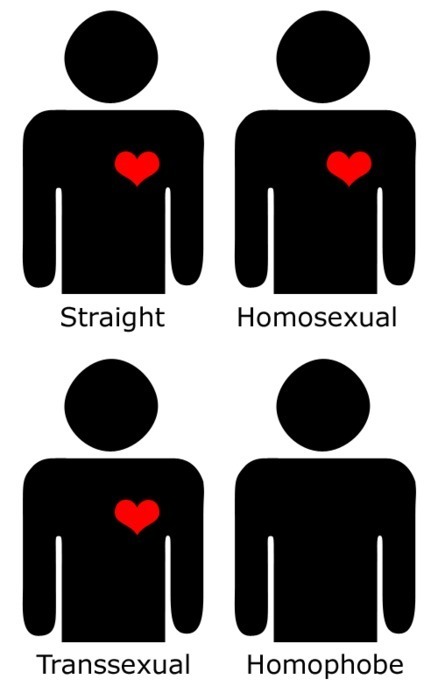
FINDING A PULSE in a homophobe can take some work.

He was not getting away with just copying a few documents, this guy. I already sensed he was trapped between his feelings of homophobia and the new regulations which now required him to treat me equally, a full seven years after the NSW laws had changed.

He managed to squeeze out that he reckoned I had a very good case, and that if a new certificate were to be issued, all the old copies would be recalled for destruction.

Did he need the details of exactly where those fraudulent copies were now?

Yes, he mumbled, shame-faced.

I handed over the names and addresses for him to request the return of the death certificate which had been created for me, long withheld by the funeral director I’d contracted and held in their safe behind a wall of defensiveness and avoidance; and the other at Jono’s family’s disposal, already widely distributed to claim that I, Jono’s surviving spouse, did not exist.

At that, the shit-kicker looked as though he’d shit his pants.

Ironically, it was just a week later, after attending Sydney’s first screening of Brokeback Mountain (the story of two men who could barely come out to one another, let alone live as a couple, the way Jono and I had), that I arrived home to a letter inviting me to collect Jono’s death certificate from the Registry, whenever I was ready.

I could have gotten it from the front desk, but I booked an appointment with the shit-kicker and I made him give it to me, right into my hand.

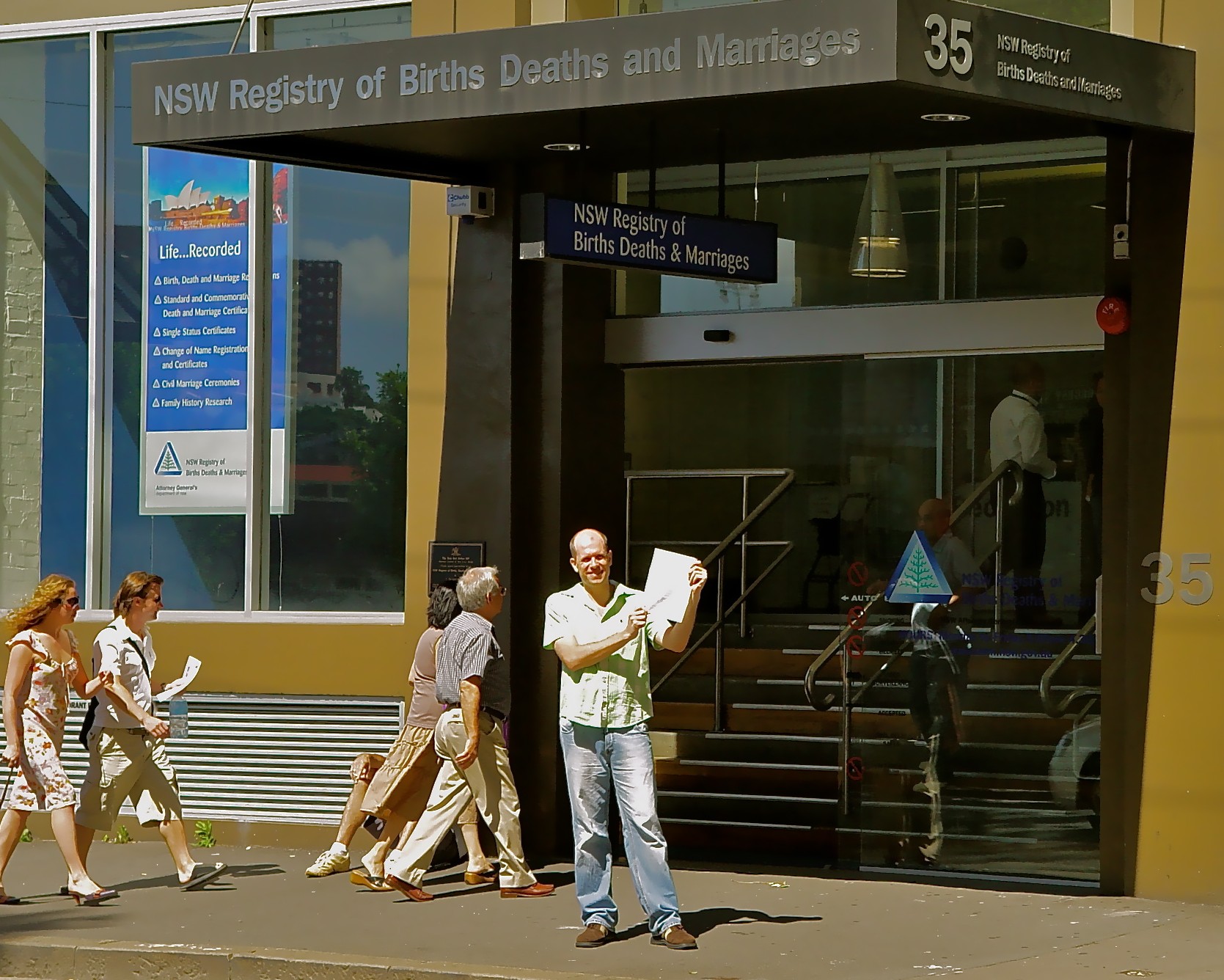
IN HIS OWN HANDS My friend Prue took this shot of me, Jono's death certificate hot off the press.
IN HIS OWN HANDS My friend Prue took this shot of me, with Jono’s death certificate hot off the press.

There, on the same page, was Jono’s name, and mine, a record of the exact number of years we had been together, and the address we shared on the day he died: the truth which had frightened the homophobes in our lives, finally laid bare in paper form more indelible than any gravestone.

I cried a little, and then I went downstairs to apply for another original of the certificate by filling a form and passing it across the desk with the thick glass screen.

The young woman took the form and immediately shook her head, tapped her finger on my name and Jono’s, and said: “You can’t get this, not when you’re the same gender.”

I was not surprised. I said to her, calmly so as not to set off any security screens or draw the attention of the bouncers, that she was incorrect and needed to ask her manager for some training on this issue. The jaw, that had been munching so enthusiastically on chewing gum, went motionless.

I went upstairs and saw the shit-kicker’s distorted face through the glass as I made the same demand of the managers. Not one of them would come out of their office to meet me.

So I went to the top. I wrote to the NSW Attorney-General, and made a formal request for him to ensure all staff in his department were now made aware, ideally through some kind of training, that same-sex couples were able to apply for their deceased spouses’ death certificates without recourse to anyone.

Perhaps, I suggested, some media releases to the same effect would be an idea?

When his reply was tardy, I went to NSW’s best shit-kicker, Independent MP Clover Moore, who hurried the Honorable Mr. Debus along a little.

We never received more than a staffer’s reply. I guess Attorney-Generals hate to be reminded they need to catch up with the law.

© Michael Burge, all rights reserved.

Michael’s story is published as Questionable Deeds.

E. M. Forster – literature’s god of love

BARED IT ALL Edward Morgan Forster, 1911 portrait by Roger Fry.

A Writer’s first hero.

FROM the moment I saw the trailer for David Lean’s 1984 adaptation of his A Passage to India during an English class, I became a sucker for the literature of Edward Morgan Forster (1879-1970).

I’d been ambivalent about the drab Penguin Modern Classics edition, but the sight of Judy Davis as Adela Quested, scrambling down the dry slopes of the Marabar Caves, bloodied by thorns, pith helmet rolling in her wake, dislodging rocks (and an ensuing British panic) gripped me into attention.

We had our toes dipped into the ideas of Bloomsbury and the racial overtones and class structure of Empire.

Merchant Ivory did the rest, with their iconic production of A Room with a View in 1985. Through their lens Forster’s English hypocrites and heroes came to life.

“Forster had a greater vision of love between two men than his contemporaries. One or two of them may well have been jealous.”

The icing on the cake was the word which I spied in the blurb of the edition of Maurice that my enthusiasm for Forster had garnered me at Christmas. The word, of course, was inescapable when describing that work.

I wonder now if it was the first time I ever saw the word in print? Only whispered around the schoolyard, it had, by that time, been uttered louder at the peak of the AIDS crisis in the mid 1980s.

But here, on the reverse of Forster’s posthumously published story of Maurice Hall and his gay sexual awakening, it brought a wave of validation.

I recall waiting for my family to register the word. Had my mother seen it when she purchased the book? Had my brother sneered about it when she gave it to him to wrap up for me?

When nobody mentioned “homosexual”, I took that as tacit approval.

I subsequently devoured all Forster’s novels. My favourite moment was starting Where Angels Fear to Tread when boarding my train to university, only to be flawed by a classic Forsterian surprise death before reaching the next station, just six minutes down the track. What great ignition for a story!

On summer holiday, during my first year in the United Kingdom, I came across a collection of Forster’s short stories at a hostel in Cornwall.

The inclement weather saw me feast on them, immediately hit by one in particular – Other Kingdom. The Irish Home Rule theme of this story went right over my head, but the gusto of the young Irish protagonist (Evelyn Beaumont), brought my consciousness to a standstill, while I tried to capture her, as did all the other characters in this shining example of Forster’s storytelling skill.

I agreed with Iris Murdoch, in that, “I loved Miss Beaumont, because she bamboozled a pack of boors.”

Being a film school student, I had big plans. The biggest became my obsession to bring Other Kingdom to the screen.

I adapted it into an approved screenplay at the behest of the owners of Forster’s work (King’s College Cambridge) and tried for some years to tout it around the funding bodies, to no avail.

The central mystery of what happens to Evelyn Beaumont when she escapes from an ill-fated marriage into a dour English family could not be explained even by Forster himself, let alone by a potential screenwriter in a pitching session.

It wasn’t for another decade that I really understood my attraction to the story, when I realised a deep-seated wish for a solution just like Evelyn’s. I admired her escape in the light of my own need to find a way out of the life I was leading.

In the wake of my coming out, Forster continued to deliver. My second reading of Maurice brought the searing grief and triumph of his gay protagonists back to haunt my recovery from the death of my partner five years later, because Maurice Hall and Alec Scudder loved, no less ordinarily than any other couple.

Forster’s long-unpublished epilogue to Maurice was the heartbreaker. Anyone seeking to understand this novel should read Forster’s exploration of what happened to his characters, for it is no elemental conundrum like that of Miss Beaumont in Other Kingdom.

Forster’s trusted friends who read the drafts prior to 1933 suggested the epilogue be cut from the final manuscript, but I get the distinct impression they were baffled by Forster’s unsullied vision of Maurice and Alec happily ensconced as woodsmen, living rough, fused by the heart, and happy, despite their accidental discovery by Maurice’s unsettled sister Kitty.

Forster had a greater vision of love between two men than his contemporaries. One or two of them may well have been jealous.

Forster left as much written material about his childhood, his career, and his relationships as any biographer would ever need. Trouble is, few have used this resource – the ‘sexuality issue’ undoubtedly the main obstacle.

The finest work on Forster is Wendy Moffat’s A Great Unrecorded History. This study has done more to debunk the myth of Forster as simply a class-conscious comic novelist who stopped writing in 1924, than anything which came before.

PERFECT PANIC Adela Quested (Judy Davis) flees in David Lean’s screen adaptation of Forster’s ‘A Passage to India’.

Forster earns hero status from this writer for protecting his great love, policeman Bob Buckingham, from the criminal courts while he, Bob and Bob’s wife May lived-out a three-way relationship from 1930 until Forster’s death in 1970.

He earns it for politely, and with humour, pointing out the hypocrisy of those in positions of power and privilege in his literature.

He earns it for writing himself onto Hitler’s ‘hit list’ of authors with his WWII broadcasts exploring the axe of Nazism as it threatened to fall onto the neck of civilisation.

He earns it for not killing himself, despite as much cause for depression, isolation and marginalisation as Virginia Woolf cited.

He earns it for creating the archetype of the lusty English Gamekeeper. Long before D.H. Lawrence’s Oliver Mellors’ trysts with Lady Chatterley, Forster’s Alec Scudder hunted his way into Maurice Hall’s bed, and his heart.

And he earns it for diarising himself as he was, warts and all, and sometimes that meant writing about actual bodily warts.

For gay men, Forster’s humanist document on the entire life of a homosexual man will endure as a record of emerging and practical homosexuality which may well come to eclipse his novels.

E.M. Forster might not have physically embodied a Love God, but with his pen, in the shadow of the Oscar Wilde trials, he carved a place in history as a Titan who turned from the affairs of men and women, to those between men and men. His publishers must have hated him for it.