Tag Archives: LGBT equality

Carol out in the cold

WITH nothing more complex than a series of firmly closed doors, the film Carol takes a powerful dramatic turn that subtly gives two women the space to explore their attraction.

“The wait for enlightenment will be long, and the darkest, pre-dawn hour lies ahead.”

When Therese (Rooney Mara) slips into the passenger seat beside Carol (Cate Blanchett) and shuts out her fiancé, they leave him blinking on the kerbside. Soon after, Carol’s old flame Abby (Sarah Paulson) firmly shuts her front door on Carol’s estranged husband (Kyle Chandler), leaving him awkwardly framed through a small window.

But it is the shutting of the door between the two protagonists – closed by Carol against Therese at the height of an argument – which makes forbidden fruit all the more potent for both women.

Phyllis Nagy’s screenplay (based on Patricia Highsmith’s 1952 novel The Price of Salt) uses these pivotal separations to mark out the territory of a love story that breaks several taboos.

The shutting-out of men has been a powerful literary force ever since Anne Brontë’s The Tenant of Wildfell Hall (1848) in which Helen Graham dramatically slams her bedroom door in her husband’s face and created what many credit as the first feminist novel.

CAROL
CHRISTMAS CAROL Cate Blanchett as Carol and Rooney Mara as Therese.

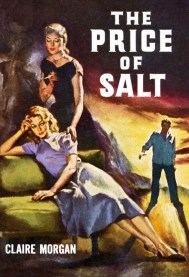
Published a century later, and phenomenally successful in its day, The Price of Salt disappeared from mainstream lists until Highsmith came out as its author in the 1980s and changed the book’s title. Plans were made in the 1990s to adapt it for the screen, and almost twenty years on – surely one of the film industry’s greatest examples of persistence – the story has been thrust into mainstream consciousness.

And its arrival pulls few punches. The unstable yearnings of unfolding passion will be familiar and understandable to anyone who has ever fallen in love, but emotional and sexual lust between two women is rarely seen on the big screen across suburban cinemas.

Carol contains several quite inadvertent similarities to other stories. When Carol and Therese take to the road, the story has strong echoes of Thelma and Louise. The escapist quality of that journey also speaks to the kind of concealed passion explored in Brokeback Mountain.

Highsmith’s novel traverses similar tragic precipices, yet its originality lies in the choices Carol and Therese make when their love is swiftly and coldly thwarted. Far from home, in a frozen place ironically called Waterloo, they have the door to their world cruelly wrenched open for the very worst of reasons – a blow that lands right in Carol’s weak spot.

It is from this point in the story, the final act of Carol, that Phyllis Nagy has done greatest service to Highsmith, but don’t be fooled by the alleged ‘happy ending’ tag this story has garnered. While it doesn’t have the shock ending of Thelma and Louise or the tragedy of Brokeback Mountain, the denoument of Carol comes with a level of compromise and risk that could never be defined as a positive outcome.

Cate-Blanchett-Fur-Coat-Carol-Movie
COLD COMFORT The original novel takes its characters on a road trip into America’s heartland.

Cate Blanchett portrays Carol as glamorous and anaesthetised, at times a sheer minx and at others world-weary, as though every stroke of make-up and hair product in the high-fashion front is only just managing to hold her upright. She inhabits Highsmith’s title role with a languid style that is never more poignant than when Carol is required to behave.

The slow burn of Therese’s story is given a sparse amount of dialogue, since her passion must remain internal until it is safe to express. Rooney Mara gives Therese the perfect hyper self-awareness in the role that is closest to Highsmith herself, who revealed in the book’s 1989 re-release that she’d encountered a woman like Carol while working in a department store as a youth. Despite finding out where she lived, Highsmith never made contact.

Knowing the fully fledged rage with which Highsmith went on to live and write by, it’s impossible to watch Rooney Mara’s performance without the sense that Therese would eventually give Carol a run for her money as a self-determined woman.

Haynes has been praised for the visual style of Carol, yet it has nothing like the luminous, throbbing-with-colour quality of his other 1950s-era film Far From Heaven (2002).

Carol and Therese inhabit a darkened, soft-focus, wintry world. Glimpses of sun show themselves at the edges, but remain out of reach, as though the wait for enlightenment will be long, and the darkest, pre-dawn hour lies ahead.
static1.squarespace
CLAIRE’S CAROL Highsmith’s book was originally published with a different title, under a pseudonym.

Nagy’s screenplay achieves far more with the story’s dramatic turns than Highsmith’s novel, which was her second and suffers a little from not knowing what to do with these characters before she sets them on the road.

Nagy knew Highsmith and drew on her friend’s experience of what it was like to be a lesbian in the 1940s and 1950s by adding detail on the legal and psychological challenges faced by same sex-attracted women in the United States.

But Highsmith’s novel sends Carol and Therese on a journey through America’s road culture, beyond the restrictions of their lives and dangerously oblivious to the ramifications of their journey, that is not fully realised on the screen.

“A mesmerising, disturbing film about unearthing passion and controlling rage.”

The scale of the route rivals that of Thelma and Louise, yet the cinematic potential of vast landscapes is not captured in the film. When the city-dwelling protagonists emerge in an expansive, elemental space they are unlocked from the world that confined them, and their enemies are required to do far more work to rein them in. In this, Carol is a precursor to Highsmith’s best-known works, the Tom Ripley series of thrillers, and leaves the novel worth reading for its own sake.

A mesmerising, disturbing film about unearthing passion and controlling rage for the sake of relationships, Carol explores the limits of what people will accept and the territory they will not negotiate.

creating-waves-cover
BUY NOW

The right to evade capture, to avoid being shut out emotionally, are portrayed as loudly as the sexual criminality of the era, and make a universal story out of what might otherwise have remained a period piece. 

© Michael Burge, all rights reserved.

This article appears in Michael’s eBook Creating Waves: Critical takes on culture and politics.

Marriage equality on the never never

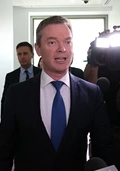
PYNE SURPRISE Christopher Pyne running the media gauntlet after being blindsided by Abbott.

TONY Abbott has knocked Australian progressives and moderate Liberals into motionless disappointment on marriage equality.

The biggest political football of his government has been booted around by parliament again. There’ll be a few free kicks when the cross-party marriage equality bill comes before parliament, but Abbott’s moved the goalposts already, so none of the players will score.

The Australian with the highest hope for the Liberals on this issue – and at the greatest risk of being disappointed by her party – is Tony’s sister Christine Forster, a Liberal councillor for the City of Sydney.

She optimistically submits to interviews whenever she feels we are approaching a breakthrough. She’s also good-natured enough to engage in jokes about her brother, yet not hide her disappointment.

“It’s clear marriage equality will remain just a high hope.”

But it was Christopher Pyne who was this week’s highest-profile and most confident Liberal when it came to marriage equality, although his hopes for a free vote blinded him to a classic Abbott battle manoeuvre.

When the Prime Minister opened the discussion to the entire Coalition party room, including a wall of National Party MPs whose homophobia was guaranteed to bring out the same in everyone but moderate Liberals, Pyne’s reported response was shock. He then dashed through the media with the kind of sibilant schoolboy anger that often stereotypes him as gay.

As the dust settles, it’s clear marriage equality will remain just a high hope on the never never, that place where Australians know nothing will change in the short term.

I could analyse the chances of any of the dangling carrots – referendum, plebiscite, binding or free votes – but that would be to engage in the kind of hope Tony Abbott wants from me.

Progressives and moderates are good at hope, and at home in the southeast Queensland electorate of Bowman, there’s been plenty of it ever since Liberal MP Andrew Laming started filling letterboxes with his annual survey back in June.

Only one person per household could fill it out, and it didn’t mention marriage equality, just it’s poor cousin so beloved of right-wing religious Liberals – ‘gay marriage’ – which presupposes same-sex attracted people want something special, like ‘gay supermarkets’ or ‘gay sports ovals’.

FISHER FAMILY (L-R) Baeleigh, Monique, Adele and Caden.

I treated it as harmless until national media outlets started calling it a same-sex marriage survey. Long-term Bowman resident and LGBTQI activist Adele Fisher also had mixed opinions.

“I was aware, in previous years, people had reported not receiving the survey and had questioned both the statistical significance and accuracy of the results,” she said.

“A couple of friends and I decided to encourage as many people as possible in Bowman to complete Andrew’s survey and return it. We started a Facebook page.  We contacted Andrew and continued to speak with him during the lead up to the survey being released and throughout it being distributed and returned.

“We organised a rally which was well attended and had some fantastic speakers, including community members, clergy and politicians. Unfortunately, Andrew’s schedule changed and he was unable to attend, however, he did provide a statement that was read out on the day.

“The rally was fortunately held the morning after marriage equality was achieved in all 50 states of the USA, and with a quick media release that morning we had a number of media outlets contact us on the day,” she said.

“With the assistance of Australian Marriage Equality we were able to run a full-page advertisement in the local newspaper and received other excellent support from them. We attended markets and spoke with hundreds of people in the Bowman electorate.”

SKEWED SURVEY Andrew Laming's 2015 electorate survey, showing progress reports mid-survey (Photo: Facebook)
SKEWED SURVEY Andrew Laming’s 2015 electorate survey, showing progress reports mid-survey (Photo: Facebook)

I felt the same wave of hope across the region. My husband filled out Laming’s survey and duly posted it off, which meant our household was only half represented, but after the leaks about Warren Entsch and Terri Butler’s cross-party marriage equality bill, there was a sense that moves were afoot to deliver marriage equality by the year’s end, so my omission didn’t seem to matter.

Laming fuelled the hope by predicting he could be given a conscience vote on the bill as soon as parliament returned, but he did not bend over backwards to get his constituents to vote in the survey he promised would decide his vote.

“Unlike his fellow MPs such as Natasha Griggs (Liberal MP for Solomon, Northern Territory) and Ann Sudmalis (Liberal MP for Gilmore, NSW), Andrew did not offer an online option, an email option, a phone option or even a photocopy of the form for people to express their individual views,” Adele said.

“Questions have been raised regarding the validity of the survey process used. There are a large number of the electorate who are reporting that they did not receive the survey in the mail.”

According to Adele, Laming announced that people who had not received a survey could attend his office on one business day – August 6 – show their identification, and cast a vote.

Crunch time came so swiftly by August 11 that even the social media had trouble keeping up with events.

Not accustomed to being consulted on anything, even issues important to their rural electorates, like CSG, mining and native vegetation laws, National Party MPs may well have been stunned at being asked to have a say on marriage equality at a six-hour special Coalition meeting.

Late in the evening, when Tony Abbott made his captain’s call that there would be no free vote for Coalition MPs on marriage equality, Laming’s survey – and his support for a free vote – were rendered instantly redundant.

When he announced the results on August 12, they barely registered.

According to Laming, 58 per cent of respondents disagreed with gay marriage. To put that result in context, only 23pc of individuals in Bowman households responded.

RIGHTS RALLY Marriage equality rally in the Queensland electorate of Bowman, July 2015 (Photo: Carole Margand)

“I have followed Andrew’s statements on marriage equality for in excess of five years,” Adele said, “since first attending a forum he held in Bowman, and have attempted to engage with him many times on the topic of marriage equality, in person, online and via email. Unfortunately, I cannot say that these have been productive.”

Adele and I have similar hopes on the future of marriage equality campaign.

“I think the events of this week were anticipated in part by many involved in the marriage equality campaign,” she said.

“Further plans and contingencies are in place for all of us who are campaigning for marriage equality. It has been a long journey so far and it doesn’t stop here. The campaign will continue and I’m confident will go from strength to strength.

“People are hurting though, and I have seen an outpouring of support for those people impacted by the decisions this week. Let’s never forget at the heart of the matter are real people, children, youth, adults and elderly.

“I think it is extremely important no-one loses sight of this.”

“Laming’s survey managed to get him squarely back in his leader’s good books.”

Even though the likes of Abbott and Laming say they understand there are strong feelings in the community on both sides, marriage equality supporters are too easily written off as attention seekers and bleeding hearts. This is the first week in years I have been labelled a deviant.

Some say the increase in vitriol means change is imminent, but I completely disagree. Without someone in the Liberal party rolling Abbott, or the electorate caring enough about the issue to vote him out, marriage equality is now years away.

And Laming’s survey managed to get him squarely back in his leader’s good books after February’s backbench revolt. Conservatives tend to do that sort of things while progressives hope.

© Michael Burge, all rights reserved.

‘It doesn’t have to be Shakespeare’

MERELY PLAYERS COVER PR (2)
Paperback | eBook | BUY NOW

WHEN a middle-aged boy player returns to London’s Globe playhouse during a terrible revival of Romeo and Juliet, she sets off a chain of events as great as any of Shakespeare’s entertainments, revealing a love story that lay hidden for decades, just beneath the lines of the script.

Centuries later, an out-of-work Sydney actor connects the dots of this drama and is inspired to write a play, bringing him face to face with big life lessons in the art and politics of storytelling.

The lives of these two unconventional players collide in a journey from Australia to England, from drama school to the professional stage, from male to female, from failure to success and back again, exploring the untold story of those who created the complete works of William Shakespeare.


An extract from Merely Players: Acting like Shakespeare really matters.

Masters, I have seen a man out of his clothes before, and not tried to make him mine.”

I go back to the place I have made for myself by the rack. Master Burbage sulks while the others begin to peel doublets over expanded bellies, revealing sweaty waists and backs. I notice Heminges undoing his hose on the other side of the rack, trying to conceal himself.

‘Masters, I have seen a man out of his clothes before, and not tried to make him mine, but if you’d be more comfortable hiding your glorious forms, I can wait upstairs,’ I say.

‘Nay, your place is down here with us. We’re not going to make a fuss about Master Tooley, now are we?’ Heminges asks.

Condell shakes his head.

‘Perchance you just sit by the steps and tell me if you can spot any printer’s boys in the crowd,’ Heminges adds.

‘You’re letting printers into the playhouse now?’ I ask, crossing to the stairs.

‘Much has changed since you were in the playhouse, Master Tooley. They’ll have real women playing soon enough,’ Condell says.

‘Don’t believe him, it will never happen,’ Master Burbage mutters into his lap.

‘And there’s never a rehearsal for the bit players, because there’s no lines apart from whatever you can drag up from within your receptacle,’ Condell adds, tapping the side of his head.

I search the ceiling by the stairs, where that larger crack allowed the light to fall onto my mirror when I arrived. Three steps up, the view of the stage reveals itself.

The sun has dipped below the highest gallery of the playhouse, where people sit talking and eating, some asleep against pillars or calling down to others in the pit.

I glance back into the darkness below, to see Condell rushing to get his wide arse back into a fresh pair of hose before I can see him.

‘It won’t be much of a play, without all the lines,’ I say, eyes back on the crowd.

‘We all know how the stories go, just follow the patterns,’ Condell says, ‘you enter, you wait and you listen, then you throw in a line or two which you think sounds right according to your part. Make it a rhyme, if you have the time. Keep it short, or have some sport … it doesn’t have to be Shakespeare.’

‘We don’t do too many old plays by Master Shakespeare,’ Heminges adds, emerging fully clothed from behind the rack, ‘not these days, because whenever we do, the printers send a pair of their pock-faced boys to sit up the back and scribble down our words as best they can. By the time they go to print with it, Will’s best poetry sounds like a madhouse ditty!’

Judging it safe to take my eyes from the stage, I say: ‘I might have been away from this playhouse for many years, Master Heminges, but I do recall you once had a grand plan to print all the plays of Master Shakespeare’s in the one book.’

“While you’re on the stage, duckie, perchance you work out what it is you did come back for.”

‘I did, but then one player of this playhouse took it upon himself to sell the contents of his receptacle to a printer, and when the little books of Master Shakespeare’s became so popular no printer was interested in paying for our plays anymore, they were only interested in stealing more of them. If I ever discover which player it was I’ll hang him by his balls from the top of this playhouse, but I could never catch him at it. I always thought it had to be a player who disappeared from our playhouse, and never dared show his face back here again,’ Heminges says.

I glance down at them, three pairs of eyes, looking into me.

Before I can say anything, a sudden round of trumpets announces the play. The crowd explodes into applause.

‘We’re off!’ Condell says.

‘No-one is listening to you prattle, Heminges, ready yourself,’ Burbage says.

‘I have, but where is my Lady Montague?’ Heminges asks, offering the hat and veil to me. I don them without thinking, and reach for the sliver of mirror in my basket, by the steps, the light from the stage falling across my aged face.

‘Oh dear … I am not ready for this,’ I say, pulling the veil tight and slipping it under my chin.

Heminges takes my arm in a strong grip. ‘You’ll soon be, duckie. A player who does not play has no place in a playhouse!’ he says, as we ascend into the light.


Performance rights for Merely Players are available via the ePlay rights page.

© Michael Burge, all rights reserved