A PUBLIC vote on marriage equality is delivering what some Australians have craved for years: an excuse to publicly trash LGBTIQ dignity.
The usual pundits are hailing the Coalition’s survey as a victorious tipping point for the fortunes of the Turnbull Government, but at best it’s a hand-holding exercise for the prime minister.
“A sad, embarrassing uncle – let’s call him Malcolm – is trying to get us to pull his cracker; but we know what’s coming.”
Because when the 122-million-dollar show comes to an end – and regardless of the result – if he wants to harness the voice of the people Mr Turnbull will still need to stand on his own two feet, walk into parliament and vote on a bill with his colleagues.
Not one outside voice, recorded at great cost to the Australian taxpayer, will echo in that chamber.
It happened that way five years ago this month when the parliament last voted on legalising marriage between any two Australians regardless of their gender. The Prime Minister was Julia Gillard, who crossed the floor and sat with then opposition leader Tony Abbott to vote the reform down 98 votes to 42.
In 2017, the numbers are a lot tighter thanks to a monumental campaign on multiple fronts, but it’s a very brave pundit who would predict the outcome.
If parliament votes on marriage equality – and there is nothing about the Coalition’s survey that binds it to vote on the result – the leadership vacuum may well see the status quo maintained.
Turnbull assures the country he and Lucy will vote yes… but remember, Mal, Lucy doesn’t get a vote where it really matters.
Uncle Mal
LGBTIQ Australians are in for a turbulent patch, and whenever our detractors pause from labelling us as dangerous to society they’ll be busy playing the victim, set to lose their freedom of speech and religious rights.
The display is already astonishingly vile, and when same-sex-attracted Australians and our supporters crack the shits and bite back, I support them, because it’s just not possible to debate human rights respectfully.
This survey is akin to a family Christmas where the LGBTIQ community has been seated on folding chairs at the wobbly card table, inches lower than the ‘adults’. It’s just assumed we’ll listen to the ignorant windbags sitting at the other end and consume whatever gets served up.
A sad, embarrassing uncle – let’s call him Malcolm – is trying to get us to pull his cracker; but we know what’s coming… a dumb joke and a cheap trinket.
It’s just another opinion poll, this survey. I’ll vote yes just like I’d wear Uncle Mal’s silly hat… for the sake of appearances, not because I’m having a great time.
His techniques include publishing running tallies on Facebook, thousands of ‘lost’ forms, unscrutinised counting and only one vote per household. Unsurprisingly, Mr Laming has never announced a result that wasn’t a fervent no to marriage equality.
It was also petitioned in 2016 and the result was overwhelmingly in favour of equality for same-sex couples.
For all of his ‘ask the people’ cleverness and claims of giving voice to democracy, none of Laming’s surveys ever united this electorate or resolved the issue once and for all, and it will be the same nationally.
Whatever the outcome of this misguided moment in the long game, creating legislation with the result will take a prime minister who leads the nation from the front.
MARRIAGE Equality will be legislated in Australia no sooner than 2019. I know many will fly into a rage about that assertion, but let’s get real for a few moments: the current Coalition will never independently instigate a change to the Marriage Act allowing equal access to same-sex couples. Even this week, Malcolm Turnbull told us it’s a plebiscite or nothing, and despite the fact that he has no money for a public vote, he means it.
Before you lose your shit at me, you need to acknowledge that the majority of the Australian LGBTIQ community are okay with that. When the largest ever group of this demographic was recently polled on whether we’d be happy to wait for another government to hold a parliamentary vote instead of a plebiscite almost 60 per cent of us said yes.
From South Australia’s decriminalisation of homosexuality in 1975; the first legislation recognising same-sex de-facto relationships in the Australian Capital Territory in 1994; the first same-sex adoptions in Western Australia in 2002; the federal amendment of 100 pieces of discriminatory federal legislation in 2009; the enabling of any adult to choose to identify as male or female in 2013, and the first same-sex marriages in the ACT in 2014 (overturned by the High Court less than a week later), the ALP can be relied on to get LGBTIQ equality started, eventually.
The notion of “eventually” is the key. We read it often in the media, and I’ve heard a hundred friends and pundits offer it as a panacea to tough times: “Eventually, it’ll happen,” they advise, probably wishing I’d just shut up and stop reminding everyone that we still don’t have federal civil unions for same-sex couples in this country, let alone marriage.
But honestly, I accepted this unwelcome advice years ago. Why would any informed observer not, when we compare our lack of reform with the equality wins of our closest cultural and political allies?
AT LAST Marriage Equality passes in the New Zealand parliament in 2013.
Australia’s decriminalisation of homosexuality lagged thirty years behind the United Kingdom’s and Canada’s, and a decade behind New Zealand’s.
All three of those nations passed civil unions over a decade ago, and same-sex marriage duly passed in all three – Canada in 2005, New Zealand in 2013 and the United Kingdom in 2014.
After you’ve done all the lobbying, it seems what you have to do in Australia to achieve LGBTIQ equality, is wait.
Some commentators bravely attempt to name the date. I’ve often quoted Guardian Australia journalist Gay Alcorn’s courageous prediction that reform would arrive by 2014-2015, but only because her remonstrations about being tired of the debate were delivered ten years after the start of the main game. Sorry you’ve got marriage equality fatigue, Gay, but hopefully you joined the end of the queue and got someone to share a pillow with you.
Waiting stinks, and progressives don’t like it, but when you force a nation to wait, strange things happen.
Waiting hijinks
This week has seen many classic absurdist hijinks that are the result of an immature Coalition putting the brakes on reform.
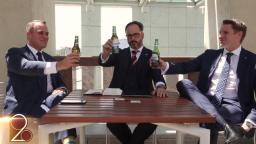
Aussies are known to imbibe a few rounds at the pub whenever there’s time to kill, and this week the fermented amber beverage was put to good use in ‘that’ corporate video produced by the Bible Society of Australia.
In the absence of anything practical to do about marriage equality during the current political impasse, Coopers beers were raised by two Liberal Party MPs in the name of civil debate, and merry hell was raised across the social media in the fallout.
CIVIL DEBATE MPs Tim Wilson and Andrew Hastie pretending we need more of it.
Many couldn’t see the issue with (yet another) debate on reform that is already supported by the vast majority of Australians in any poll you’d like to pick; but just as many raged at the flippancy of “keeping it light” where delayed civil rights are concerned, and the attempts to fit the whole boring exercise into a hashtag for marketing purposes.
But I can understand why Tim Wilson MP needed some confected progress on marriage equality, because even he, with his enthusiasm and the ear of the PM, cannot get Malcolm Turnbull to pick up any existing bill and vote on it in parliament.
Lobby groups are also coming to terms with the delays.
You only have to look at and/or participate in Mardi Gras to see what fun can be had while we wait for equality, and letting off steam collectively helps many, but the event is no more or less sponsor-soaked than the Bible Society’s video, which is why key LGBTIQ lobby groups aren’t pointing the finger at the Society or the Liberal Party for forging a strategic alliance with Coopers Brewery: the bills have to be paid while the timeline for reform stretches out.
Wrong. It’s yet another distraction in the waiting game. If Turnbull was going to deliver marriage equality as a conservative Prime Minister in the same manner as New Zealand’s John Key and the UK’s David Cameron, he would already have done it.
His hands are not tied, he’s just content to wait. It’s what conservatives do best.
Victim blaming
In the glut of social media after Coopers apologised and supported marriage equality, and the Bible Society pulled its video, plenty of impatient pundits engaged in victim-blaming of equality advocates. It was as eye-opening as always, seeing those who should know a lot better accusing people of shutting down debate if we boycott a commercial brand, or congratulate those who do, but it’s just the confused commentator’s way of dealing with the delays in reform.
They’re sick of twiddling their thumbs and we feel their pain. As worldy-wise, global thinkers, they’re embarrassed Australia is being shown up by a growing list of countries that have no problem legislating for marriage equality, but an astute LGBTIQ community – and our supporters – shouldn’t be blamed because Australian commentators are bored, ashamed, or just don’t get the Coalition’s problem with marriage equality.
Back in 2004, when John Howard and Mark Latham enthusiastically united Australia’s parliament to alter the Marriage Act and exclude same-sex couples, 2019 seemed an impossibly long way off. These days, this pivotal election year looms larger for Malcolm Turnbull and the Coalition than anyone else in the country. Ironically, I can’t wait.
“It would lower the temperature of the political debate and would provide some back-up support to any politician who takes this thing on in future,” Oakshott said.
Despite voting against marriage for same-sex couples in parliament, Windsor started wavering in favour of relationship equality after attending a same-sex civil union. “If it came down to my vote [in Parliament] I’d have to have a really hard think about it. But that ceremony had an impact on me. I’d probably vote for it,” he said.
Yet he plumped for a public vote instead of just wielding his parliamentary power, a move which has set the tone for the conservative approach to marriage equality in this country ever since: why deal with the pesky issue of allowing gays to marry when it can be handed over to the people?
Even the Greens were up for a referendum in 2013, with Christine Milne wanting to take the debate away from former Prime Minister Julia Gillard and then opposition leader Abbott, labelling them both “on the wrong side of history”.
But what happened to the marriage equality plebiscite in the Senate late on November 7, 2016, is a ‘David and Goliath’ tale of how Australian LGBTI found our voice.
Ask the people
Abbott and the hard right must have rubbed their hands together on the night of August 11, 2015. With this strange-sounding, hard-to-spell latin word – plebiscite – they’d well and truly snookered marriage equality advocates and lobbyists with a matching slogan that would appeal to the lowest common denominator: “Ask the people,” usually thrown with a nifty kicker: “What are you afraid of?”.
Australia hadn’t experienced a plebiscite in more than a generation. The last came in 1974 under Gough Whitlam, and it asked Australian voters about our preferred national anthem. We selected ‘Advance Australia Fair’ over ‘God Save The Queen’, but Malcolm Fraser ignored what the people said and reinstated the old song. It wasn’t until Bob Hawke altered the song sheet for good in 1984 that our voice was respected by parliament.
The cheers within many LGBTI households were loud the night Abbott was dumped, but just as many warned about the chance of betrayal. We’d been duped before by Julia Gillard, who’d presented as progressive but soon adopted an anti-equality mantra, and Turnbull disappointingly followed suit. His mantra was intoned differently, dictated by the National Party from the moment the new PM signed the nation’s most secret power pact – the Liberal Party-Coalition agreement. Clearly, a plebiscite was to be the only way forward under this regime.
What are you afraid of?
The question was so powerful it spread its tendrils throughout the Australian LGBTI community. A public vote sounded good. It sounded fair. Objections were hard to come up with once it had been embedded in the Liberal Party’s suite of election promises.
Only marriage equality lobbyists, it seemed, witnessed the way the rhetoric changed throughout the lengthy election campaign. In the final week, marriage equality barely left the news cycle, the plebiscite positioned as some progressive torch lit by true believers. But many of us asked how on earth a policy championed by Tony Abbott, dreamed up in rural heartlands by conservative thinkers, could be in any way beneficial to LGBTI?
Rodney Croome.
The problem was there was very little detail about how a plebiscite would be managed, and the Coalition was painfully shy about giving it, which generated credible reports that the Coalition might well make the outcome non-binding and require a majority of electorates to pass. The pressure was enough for Turnbull to come clean before the ballot: Coalition MPs could snub their noses at any plebiscite outcomes.
After the election, the diverse Senate and the return of Pauline Hansoncaptured most of the media’s attention. During the fallout, one of the highest-profile marriage equality activists in the county resigned from the organisation he’d created in 2004.
Over its first decade, AME had become the peak marriage equality advocacy group in the country, so there was some explaining to do. Doug Pollard at The Stirrer managed to get AME’s Alex Greenwich (Independent NSW MP), on the record answering serious questions about why the group had not campaigned harder against Turnbull’s plebiscite during the election; but the marriage equality waters were muddied, and there weren’t too many clear answers to be found anywhere.
Plebiscite or nothing
The mantra from within the Coalition quickly evolved. It was now ‘accept the plebiscite or wait indefinitely’. On a sunny Sunday afternoon working the Brisbane Markets with my husband, Richard and I talked through what was at stake and agreed: if it came to a choice, we were prepared to wait for our New Zealand civil union to be recognised in our home country.
We also knew what it was to knock on doors asking for our human rights, having petitioned our region to gauge the mood. Our results showed the electorate of Bowman in South East Queensland was overwhelmingly behind marriage equality, but the process was painful. The question brought out the first homophobia either of us had been exposed to in more than a decade.
As we shared our story, friends in the lobby networks started to come out on the same page: the plebiscite was a great risk to mental health, and there was a sense that had AME campaigned harder against it during the election, Turnbull may not have won. We all reminded ourselves that Doug Pollard had called on AME to change its ways within a week of the election, even as Turnbull’s victory hung in the balance and everyone was speculating about the formation of the new Senate, which would stand as the last line of defence against the plebiscite.
Several Coalition MPs relied on the positive outcome of the Irish marriage equality referendum, using mantras like ‘dancing in the streets’ and ‘bringing the nation together’. This was quickly countered by a study showing a different picture of the negative Irish experience.
The message was clear: the majority of people who would be impacted by marriage equality in Australia – that is, the LGBTI community – were prepared to wait for a parliamentary free vote on our human rights. We demanded the Parliament ditch the plebiscite.
Under any circumstances
AME and its new arm Australians For Equality (A4E) adopted strong anti-plebiscite language in response, and called for the nation’s LGBTI activist and advocacy groups to unite, but the devil was in the detail.
Once again it was Doug Pollard who covered the story: even though the majority of Australian LGBTI activist and advocacy groups were opposed to the plebiscite with AME and A4E, a smaller collective – just.equal, Shelley Argent, Rodney Croome and Rainbow Families (Victoria) – wanted to add three simple words to the anti-plebiscite declaration.
“Our position, and the position the LGBTI community wants us to advocate, is very simple: no plebiscite under any circumstances, just a free vote,” a statement issued by just.equal revealed.
Shove it
Miranda Devine can always be relied on to capture the moment. She went out early and hard and told the LGBTI community to take the “olive branch” offered by conservatives and “shove it where the sun don’t shine”. Classy dame, Miranda, but her vitriol, and where it was specifically aimed, showed savvy pundits knew the plebiscite was in its death throes, attacked not by Bill Shorten and Labor (the preferred chief suspects of the Coalition), but by us, the majority of the nation’s LGBTI community.
Rodney Croome recaptured the moment from Ms Devine: “For the first time at a federal level the voice of the LGBTI community has been the leading voice on an issue that affects us more than anyone else. For the first time our mental health in the face of prejudice and hate has been a primary consideration for many law makers. For the first time we are seen not as an issue but as people.”
The Liberals tried reviving the plebiscite with a compromise deal offered by Warren Entsch – an electronic online poll with a lower price tag. But while he remains a great supporter of marriage equality and has done much to raise awareness about the issue in the Liberal Party, Entsch still struggles with the reality that any vote that is not binding on Parliament is a dodo.
Turnbull and his team bravely flew the rainbow flag all the way from the House of Representatives to the Senate vote, repeating every old myth and mantra on the way; but after a short life, this unnecessary, expensive, divisive shit of a policy has been slain.
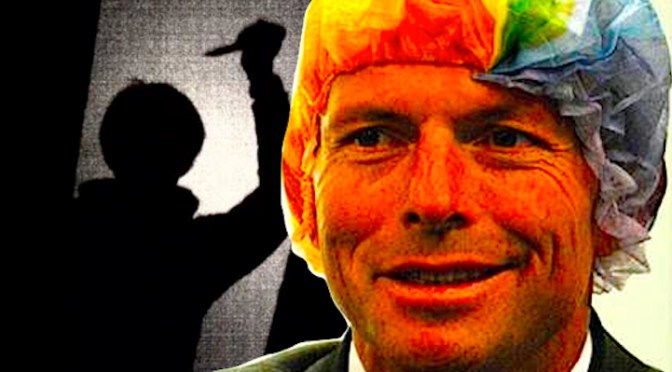
The Prime Minister can hardly be disappointed, since he was opposed to a public vote on human rights before he shoved Tony Abbott out of the top job, and today’s Senate vote rids the Upper House of even more residual Abbott stink.






 Michael Burge Media