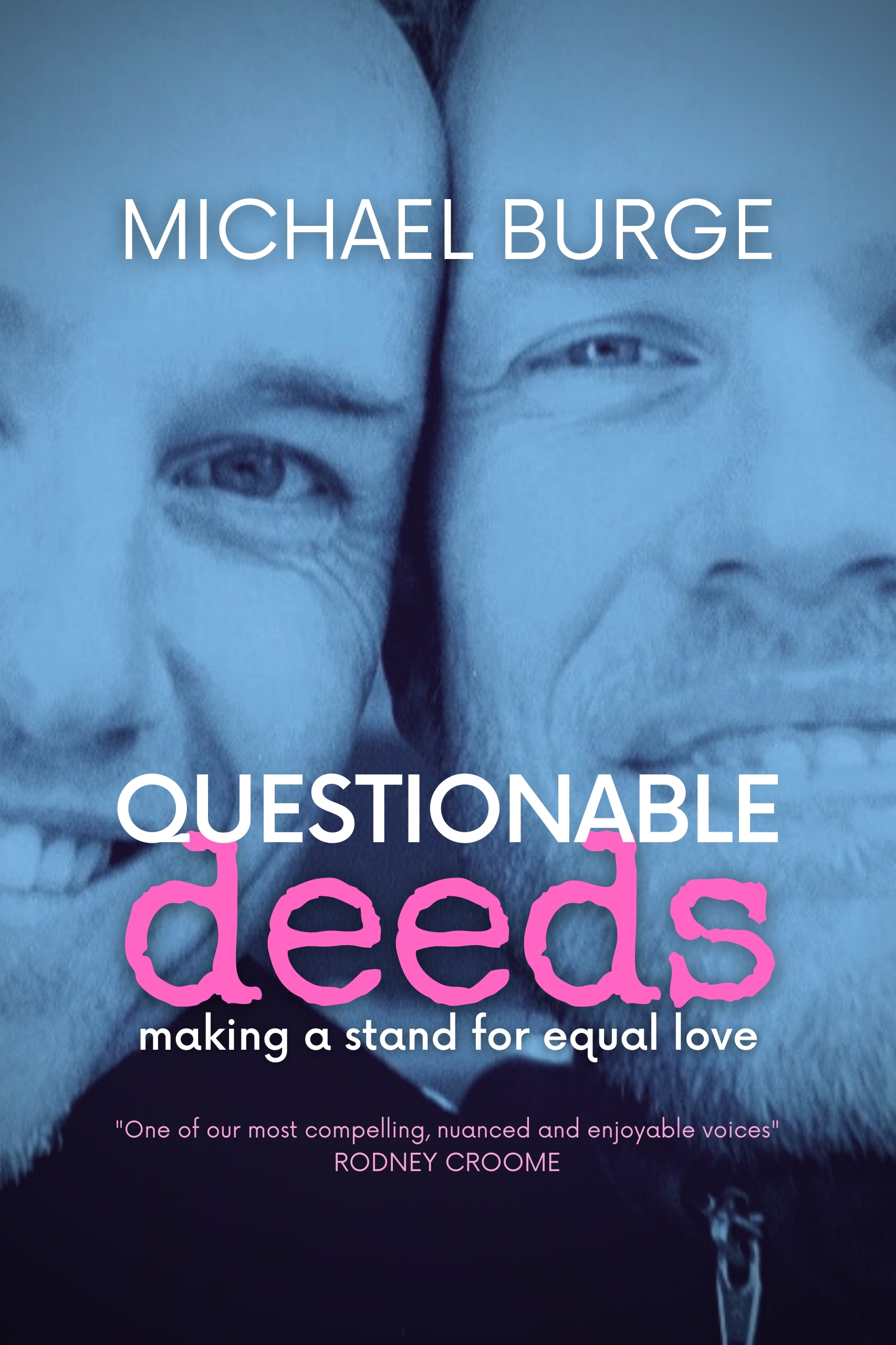
ONE random night in 2004, Michael Burge’s long-term partner, choreographer Jonathan Rosten, died suddenly while rehearsing a show.
In the midst of the ensuing grief, Jono’s relatives started the secret and devastating process of disenfranchising Michael from his position as Jono’s next of kin.
Unable to wrap-up his de-facto partner’s affairs, in a legal, ethical and financial ‘David and Goliath’ battle, Michael was exiled from his own life, facing grief, depression and suicidal thoughts.
The story of how he found the strength to right the wrongs is told in a new book.
“A tough but ultimately triumphant and deeply satisfying read. It touches on themes of grief, denial and injustice. The ending is uplifting.” – Mary Moody.
“You know that your partner’s heart has stopped?” he asked me in a careful tone.
I said: “Yes”, waiting for the next part about them rushing Jono into surgery.
“Well,” the nurse said, “we’ve been unable to start it again.”
My hand went to my face, but it hit me on an angle. I didn’t care, I thought I was slipping off my chair. People seemed to be rearranged in their seats by unseen forces as I left the nurse and Jono’s old friend Amanda behind.
I was led into a corridor, where I watched how another nurse pushed a red button to open opaque glass double doors. Behind that, in a curtained space, Jono was lying still on a gurney under a sheet.
It is true what they say about the newly dead appearing to sleep. Jono’s face was relaxed, his skin pliable, as I brushed my hand across his forehead, the sobs starting to run through me like tremors. I felt the silkiness of his eyelashes as I kissed him.
Not yet believing, I opened one of his hazel eyes, and the gaping darkness of his dilated pupil met my gaze; a sudden wall against the life here, the emergency department of a Sydney hospital, and wherever he now was.
“The room was about to fill with strangers it would take me hours to free myself of.”
My glance must have been like a scan, both forensic and feeling. He was just so beautiful, a perfect version of himself, with his body’s tendency to slump slightly sideways, chin dropping to his left shoulder, the way he’d always done in life in moments of vulnerability and cheekiness.
But the worst thing of all had happened to him, the very worst. The eyes told me that.
The green sheets around his naked body concealed all trauma, apart from the point at the top right of his chest where an intravenous main line had been inserted in an attempt to save him, and two small grazes on his nose and cheek where he’d knocked himself as he’d fallen to the floor, alone, in the rehearsal room.
But all that knowledge was to come. In that precious, solo moment I took in the reality of Jono’s death.
“I will cry for you for a very, very long time,” I said, my loneliness coming back at speed.
Acceptance did not take long. Resistance to it is useless. I read years later how, faced with this moment, Yoko Ono had repeatedly smashed her head against the tiles of the hospital wall.
For me, the moment was filled with the memory of the grief of losing my mother at a young age, although I had the cold sense of how very much worse this was going to be.
I instinctively ran my hands over Jono’s arms, his belly, and cupped his penis in one hand through the sheet, bidding those intimacies farewell. After not very long I tried to return to the hallway, through the automated doors.
But I found myself trapped in the corridor. The exit to the waiting room was one way into the life to come. Jono, and our life together, was in the other direction. When I chose to go back to him, a passing nurse came across me in my indecisive confusion, and pushed the button for me.
I went back to him for a moment. I don’t know why. To see if it was true? It was. I don’t remember anything about the next moment of separation, the walking back outside.
I sat down in a new room, and a young man, a counsellor, introduced himself to me. I needed to make some calls. I tried my sister Jen. There was no answer. Amanda stood and hugged me, told me how sorry she was. For a moment, sitting in my chair, I was suspended in the naphthalene scent of her fur coat.
Somehow I was made aware that Amanda was going in to see Jono, but I made no objection. I was in shock. The reality of Jono’s death was being transmitted across the city. The room was about to fill with strangers it would take me hours to free myself of.
It never occurred to me that nobody in that place, apart from a medical practitioner, or me – Jono’s partner and senior next of kin – had the right to view his body. His naked body.
Because I was unaware that my relationship with Jono was not ours alone. I had no idea in those precious, vulnerable moments that he and I were well and truly owned.
I WASN’T going to write anything more on the lack of marriage equality in Australia. Frustrated and saddened by the wait, I decided to stop trying. But this week I had one of my most profound experiences around the debate, one which needs sharing.
I was initially cynical – after all, this particular cruelty was usually an invitation into a fake conversation followed by a bullying sting.
So I publicly asked him to take some action – to write to his federal member in support of marriage equality – just to see if his apology was something more than words.
“The self-determined gay couple, if ever aware enough to lobby for the full backing of the law, would force societies to evolve.”
Then I waited. My husband witnessed me waver as the days passed – “I’ll never hear from this guy” I muttered, realising that I’d asked him to come out as a supporter of same-sex marriage.
I already knew from bitter experience how hard coming out can be. Declaring anything unexpected within your community can be a deal-breaker for all our relationships.
While I hoped for a reply and yearned for it to be a positive one, I revisited my own journey to marriage equality.
It began 10 years ago while I was standing in the voting queue at the 2004 federal election.
My life had taken its harshest turn for the worse earlier that year. My long-term partner Jono died suddenly, and in the midst of my grief his family denied the existence of our relationship and caused a legal battle over Jono’s debt-ridden estate.
Homophobia mixed with grief mixed with denial mixed with money … a devastating cocktail I tried my best to assuage, and failed.
I sorely missed a powerful record of our relationship to use against that force, but that year federal Attorney-General Phillip Ruddock and Prime Minister John Howard trounced any chance same-sex-attracted people had of accessing the federal Marriage Act to create legally recognised relationships.
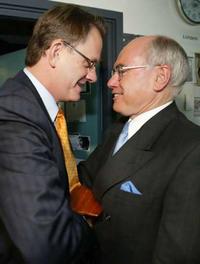
NEVER GONNA HAPPEN Mark Latham roughing-up John Howard in 2004.
By the looks of the colour of the how-to-vote cards in that long voting queue, Labor’s Mark Latham was not going to see-off Liberal Prime Minister John Howard, and, with community support for same-sex marriage languishing at just over 35 per cent, marriage equality seemed forever away.
Jono and I were oblivious to the precarious legal situation our relationship was in. We’d been happy to live very much to the tune of Joni Mitchell’s ‘My Old Man’: “We don’t need a piece of paper from the City Hall, keepin’ us tied and true”.
Not an uncommon stance in our generation but one which can leave either party in legal limbo after the death or incapacitation of the other.
As I waited to vote, I realised there was a tool to keep an indelible legal line in the sand when one in a couple dies – a marriage certificate – that elusive piece of paper.
I suddenly felt duped by the society in which I paid taxes. It had never given me and Jono the chance to feel secure, and all the while we’d fooled ourselves that we had forever, and that nothing could touch our evolving togetherness.
That was the scary part for many people – the self-determined gay couple, if ever aware enough to lobby for the full backing of the law, would force societies to evolve. No wonder our collective relationships were such a political football.
A decade on, the only thing that’s changed is the percentage. Now, 72pc of Australians support marriage equality – surely a free kick for whichever Prime Minister has the guts to kick that ball over the line.
Like many LGBTIQ commentators, I find the lack of parliamentary leadership on this issue deeply unsettling, and in what I thought was my marriage-equality-writing-swan song, I extrapolated all the issues as I saw them.
But in trying to express my pain and angst in words, it turns out I was wrong about all of it.
Here’s why.
Earlier this week I woke for a very early start at work. Bleary-eyed at the computer I noticed I’d been sent a friend request on Facebook – from the man who, as a teenager, bullied me at school.
The sending of that request, the most common, throwaway click of a virtual button, and my equally everyday acceptance of it, revealed a far more powerful acceptance.
“He is not a bully, he is a hero.”
On his Facebook wall I saw he’d graciously acquiesced to my challenge.
Here is his letter in full:-
Dear (name deleted)
I am writing to urge you to support a free vote on marriage equality.
I went through school with a gay student and recently reconnected with him. He was gracious enough to share with me the way that society’s treatment of gay people has impacted his life. As a young student he was bullied at school, and as a gay man he has been subjected to ridicule, discrimination and disenfranchisement for no other reason than because of who he loves. The reason I am giving you this context is because I am ashamed to say that at school, I was one of his bullies.
This person sharing his experience of how my actions at school impacted him, provided me with an opportunity to put myself in his shoes, to empathise with how it must have felt to be a victim of discrimination. Looking back I am appalled at my thoughtless disregard for the rights of another person. Today, all these years later, I am equally appalled that this person is still having his rights disregarded, only this time it is via Government-sanctioned draconian legislation, rather than by a high school bully.
As a parent, all I can think of is how I would feel if one of my children was forced to face the same struggles for acceptance, and forced to fight for what you and I, as heterosexual males, take for granted — the right to marry the person you love.
Could I ask you to place yourself in the shoes of someone facing this discrimination? Imagine if it was your own son who was in this position, if your beloved child was unable to marry the person he loved. Or perhaps think how it would feel if one of your daughters was not legally allowed to marry the person she had fallen in love with. If one of your own children was denied the same rights as the rest of society based purely on their genetic sexual orientation, wouldn’t you do everything in your power to fix this injustice? Wouldn’t you fight against the ignorance of others to ensure the freedom and chance of happiness for one of your own?
Research has shown that the majority of Australians believe it’s time marriage equality became a reality. I would hope that as a father, a husband, and a citizen of Australia in 2014, you agree that now is the time for this change. Now is the time for you to join 72% of the Australian population who are saying that all Australians are entitled to marriage equality.
I strongly urge you, as my representative with the power your position bestows upon you on my behalf, to take the necessary steps to ensure marriage equality becomes a reality. Please support a free vote on marriage equality. Do this on behalf of every parent, for the sake of every child who deserves the same rights as you and me.
This man and I must always have had more in common than we realised. He is not a bully, he is a hero, and on reading this for the first time, I was released from cynicism into fierce protection.
Same-sex marriages and civil unions have been granted and overturned at state level; the community support in all known polling regardless of age, region, religion and ethnicity is in the seventieth percentile, and plenty of same-sex-attracted couples want one.
Clearly, the culture war has long been won.
All that’s standing in the way are the real bullies – the politicians and community leaders who never really grew up and continue to cajole, avoid, ignore and deny the rights of same-sex attracted people, and our friends.
It took a reformed bully, and a reformed victim, to see it.
She declared the debate “interminably dull” and credited lobby group Australian Marriage Equality’s (AME) latest pitch for support – via the small business benefits of allowing same-sex marriage – with triggering her boredom threshold.
This is a world record – even in countries which have already passed marriage equality legislation, community support for same-sex marriage is nowhere near that high.
So, with apologies to Gay and anyone else who’s asleep on marriage equality, here’s why it’s already too late for anyone in the current political spectrum to bring full civil rights to lesbian and gay Australians.
Tony Abbott will never take the free kick
After promising his cabinet would be free to raise the issue of marriage equality “after the election”, nobody in the Coalition party room seems keen to take up the challenge.
“In order to lead Australia to marriage equality, our primary leader, our Prime Minister Tony Abbott, needs someone in his party to lead him to the debate.”
I have an undeniable gut feeling that twelve months “after the election”, if he was ever going to back marriage equality, Tony Abbott already would have done.
His sister Christine Forster and her partner Virginia Edwards announced their engagement after the election. I imagine they’re getting quite impatient to tie the knot on home soil, and it’s Christine we have to thank for the latest news about her brother’s leadership on the issue, when she spoke at a Parents and Friends of Lesbians and Gays (PFLAG) event in Brisbane last month.
“I have been married, I am a gay woman, a lesbian, but I was married for 20 years,” Forster said, “so I know the significance of marriage and how that speaks to your community, friends and family and what it says about the special relationship you have with your partner”.
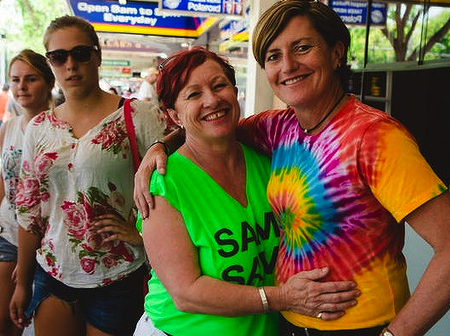
THEY’RE WAITING Christine Forster (right) with her partner Virginia Edwards. (Photo: James Boddington)
“My brother is a very good Liberal and a very good leader of the party and if that’s what the party tells him that’s what he will accept,” Forster said.
You read it right: in order to lead Australia to marriage equality, our primary leader, our Prime Minister Tony Abbott needs someone in his party to lead him to the debate.
Even if this somehow qualifies as leadership, even if by some miracle a Coalition minister has the guts a week, a month, a year from now, Tony Abbott will never escape the taint that he left it too long.
Too late, Tone. Far, far too late.
Laboring on equality despite Plibersek’s evolution
Australian LGBTIQ must look elsewhere for our civil rights champion.
But both of Plibersek’s public gauntlet throws to the Coalition occurred while she was in opposition, and seemed designed to highlight the shortcomings of an incumbent government, because that’s the only impact they had.
Labor supports marriage equality without a binding ‘yes’ vote for their MPs, a situation which will not change unless the ALP national conference in 2015 agrees to it, and will not change anything for LGBTQI.
The last time any government had the numbers to do anything unilaterally was under Kevin Rudd’s first suck of the sauce bottle between 2007 and 2010, but the ALP didn’t do anything about marriage equality.
Not as late as some, but still too late, Tanya.
The sky did not fall down
Marriage equality arrived in Australia for a brief time when the ACT passed the Marriage Equality (Same Sex) Act 2013.
After decades of inconsistency between state, territory and federal legislation on everything from homosexual criminality, de-facto recognition, superannuation, adoption and a host of other issues, the High Court suddenly demanded consistency.
STONE’S FRUIT Sharman Stone MP, federal member for Murray. (Photo: ABC)
I knew of this Victorian MP, federal member for Murray, because of the many voluntary sub-editing hours I gave in support of SPC Ardmona, the fruit canning company in Stone’e electorate, during the wave of No Fibs articles filed during the 2014 #SPCsunday campaign.
“But believe me the loss of the last Australian fruit processor would be a human as well as a regional economic and national tragedy.”
But Stone had little such empathy for her correspondent Tilly Rose Goldsmith’s situation, replying that her conscience did not extend to upholding marriage as an option for Australian LGBTIQ.
“The family implications of a marriage are totally different to the outcomes possible in a same-sex marriage i.e. not inferior but DIFFERENT” (Dr Stone’s capitalisation).
Stone’s response fell into the argument-breaking trap which invalidates childless heterosexual marriages, and it ignored how prone young LGBTIQ are to suicide as a result of bullying, a subject Goldsmith had raised in her letter to the minister.
I took a small stand on Twitter after reading Stone’s letter. As far as I am concerned, overseas canned fruit is no longer inferior, it’s just DIFFERENT. Food for thought for SPC Ardmona workers when it comes to election time.
Too late to question my support for Stone’s cause. More fool me for not checking her marriage equality record.
Defining Australian LGBT as “second-class citizens” until we have full marriage equality, Leyonhjelm’s announcement that he would bring on a marriage equality bill nevertheless contained some big qualifiers – he would not bring a bill forward until there was a conscience vote across the parliament, encouraging Coalition senators to tow the line and warning that, with six years as a Senator, he would see his “libertarian” bill through.
“There seems no urgency in Leyonhjelm’s stance on marriage equality.”
Six years could be far too late, Dave. Bring it on.
Pink dollar last link to marriage equality?
Although Gay Alcorn seemed to be chortling to herself at AME’s idea that marriage inequality was hitting the back pocket of Australia’s wedding industry, there is some merit in looking at boycotts as a way to lever the Australian parliament into legislating for same-sex marriage.
Fact is, there are widespread ‘faith boycotts’ encouraged by anti-gay advocates across the world, and Australia is no exception.
Before you write off the idea of the LGBTQI community boycotting anyone, name a single civil rights movement which succeeded without using the only language that moves postmodern communities into action: money.
For the LGBTQI community, their families and friends, those who constitute the 72pc of Australians who support marriage equality, the question is this: is it too late for you to boycott companies that do not support marriage equality?






 Michael Burge Media