Tag Archives: Write regardless!

Literary Death Match knocked out my self-publishing shame

I WAS STILL packing for my long weekend away at the Bellingen Readers & Writers Festival, where I was to present my debut novel Tank Water (MidnightSun Publishing), when I got a slightly desperate call from one of the organisers, asking whether I had any short stories to my name.

I did, so the next question was whether I’d be up for a round of Literary Death Match. I’d never encountered this movement before, which has been entertaining readers and writing fans globally since 2006. A big-name author had to drop out for urgent dental work, meaning one place in the Bellingen LDM was available. So I said yes before I really understood what the whole thing was.

For an un-agented author who started out independently published and operates as my own publicist, even having a traditional book deal under my belt doesn’t stop me agreeing to everything a literary event asks of me. Such offers are so rare you’ve got to take what you get, and make the most of it.

I needed a short piece of fiction that I’d be prepared to read aloud in front of a crowd on Sunday evening. The right one popped into my mind immediately, so I grabbed my copy of my short story collection Closet His, Closet Hers and shoved it into my luggage.

Bellingen’s annual literary event is a gem of a way to spend the June long weekend. Situated in the coastal hinterland of the Mid North Coast, the community turns out in force for a huge number of visiting authors and wordsmiths.

Over the first two days of the festival, a few authors told me with great relief that they’d turned down the spare spot in the LDM on the final evening. I didn’t reveal I was the mug who’d said yes when everyone else was either too nervous or not prepared to stick around. Anyone who’d ever competed in a LDM, or who’d seen one take place, was effusive about it being “just a bit of fun”.

I sensed that was true, but my inner boy scout said: Be prepared!

So I honed the delivery of my short story ‘A Quick Fix’, which I wrote in the form of an email from a schoolgirl to her father, traversing some bitter family dynamics about an estranged gay uncle. Partly based on experience, I imbued this work with all the teenage brevity I recall from my own school years.

Bellingen’s glorious riverside parkland was the perfect place to sit in the winter sun and practice. Acting and broadcasting training goes a long way in such situations, and I needed to make a few cuts to deliver in the seven-minute time allocation, plus annotations to emphasise certain characteristics of this clarity-filled teen who delivers a dose of equality into a terrible situation.

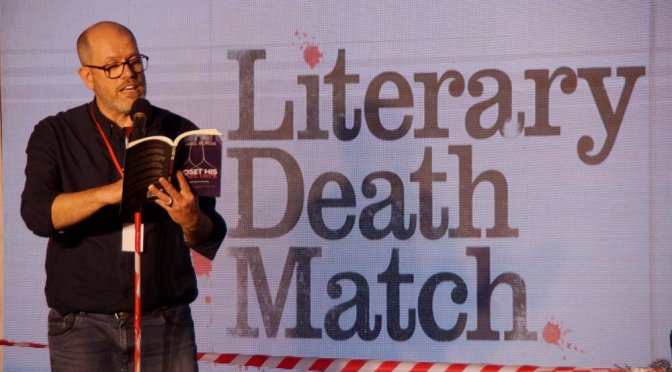
LITERARY CHAMPS: (L-R) Sofie Laguna, Sophie Overett, Michael Burge, Thomas Keneally, Adrian Todd Zuniga, Alison Gibbs, Robbie Arnott and and Costa Goergiadis at Bellingen Reader & Writers Festival Literary Death Match, June 2022.

When I met the competition – my fellow LDM authors Sophie Overett, Robbie Arnott and Alison Gibbs – in the green room, we were a herd of nervous deer about to meet a very large headlight.

I’d already been on a panel in the huge marquee we were suddenly being led to, lit up in the darkness with a capacity crowd expecting to have a blast, so I knew this was big.

Judges Sofie Laguna, Thomas Keneally and Costa Goergiadis walked up to the stage at the invitation of LDM host and creator Adrian Todd Zuniga, leaving we writers crouched down the back in the shadows. By the looks on our faces, we’d have preferred to stay there.

DEATH WATCH: The crowd at LDM

Yet we managed to go two rounds, reading to the crowd and getting bombed by literary questions. I barely remember any of it, just the glare of the spotlight and the silence as I started to read, my voice pitched slightly higher and rather quietly, to ensure I got their attention.

Paragraph by paragraph, every middle-aged one of my six feet very publicly embodied that teenage girl on the brink of discovering what equality means in this world.

And with my final line, I brought the house down, a tsunami of laughter and applause washing every bit of shame away about self publishing a collection of short fiction that no editor, agent or publisher in the country had ever thought enough of to get behind.

The judges awarded me a win in my round, but I was finally KO’d by the lovely Sophie Overett in a spelling bee finale.

In the aftermath, my copy of Closet His, Closet Hers was torn from my hand so that a reader could look up where to buy it. A big name author asked me in the green room who published it. I pointed to myself, which is what I did once at another event, when a bestselling author asked me who my publicist was.

Eyebrows go up in such moments, mine more than anyone’s, because for a short time it’s not about the luck, the opportunity, the contacts, the networking, the five-year plan or the affirmations… it’s simply about the writing.

That’s the beauty of Literary Death Match, writing really is the winner.

Here’s my top tips for anyone recruited into LDM:
– It is fun, and the rules are there to be massaged, purely for entertainment value. When Adrian called time on me, three times, I waved him off and kept reading
– Be bold and read with all the characterisation you can muster
– The crowd is pumped and on your side, they know writers are very often shy and retiring and LDM is a raucous big deal
– It’s fast, and will flash by in a heartbeat!
– You can read self-published, emerging work, so give the crowd an early literary experiment!
Writer, you’re an author!

“This is a time to take great care of yourself.”

THERE is nothing quite like hitting the publish button on your own work. It’s an even sweeter experience when you’ve been patient and really done the work on your book, confident that you’ve made it the best it can be with the resources at your disposal. Congratulations, writer… you have transformed yourself into an author! Here are a few considerations your new title brings with it.

The book blues

Many authors draw comparisons between publishing a book and having a baby, no doubt due to the long gestation period and the potential for a difficult birth. There’s also a good chance you’ll encounter something of an anti-climax after publishing a book, particularly after your launch has come and gone, and the initial flurry of sales has died down. This is a time to take great care of yourself. You’ve achieved something major after sending one of your precious brainchildren out into the world. You’re bound to feel vulnerable as your work finds its feet.

Reviews (the good and the bad)

It won’t take too long before you start garnering feedback on your publications, on online book-selling sites across the world, or social media sites like Goodreads. Be prepared for people to love and hate your work in equal measure. Bad reviews hurt, leaving authors feeling misunderstood and disheartened. My best advice on this is to let reviews be. Always encourage readers to write them, but read them very rarely, and never engage in an argument with a reviewer who didn’t like what you wrote. This is an incredibly difficult standard to maintain, and one of the best ways to get through it is to get busy on positive actions around your publications.

Keeping your book (and yourself) buoyant

The great thing about print on demand (POD) publishing services is that you don’t have to sit with thousands of copies of your new book in your office. They can be printed in short runs, allowing independent publishers to plan marketing campaigns that are financially low-risk. Having said that, it’s easy to end up with a few spare new paperbacks on your shelf. Get them out there!

“Share the good news about how you contributed to making the world a better place for writers.”

Direct selling

Readers love meeting authors, especially when there’s a copy of their book for sale. Reserve a weekend, gather up all spare copies of your book, print signs with great review quotes, and hold a stall at your local markets. Ensure you have a special ‘market price’ for your book (such as a discount for buying more than one), and you’ll shift a few copies; but there’s an old marketing saying about never letting a customer go without being able to get in touch with them again!

Connect with readers

Direct selling gives authors an opportunity to begin an ongoing relationship with our readers. There are many ways to do this, such as handing out a business card, or becoming friends on social media. Starting an emailed newsletter allows you to regularly stay in touch with readers and let them know your news about upcoming titles and events you’re participating in. Because avid readers still tend to enjoy the communication offered via email, they’ll often readily agree to giving you their email address. Social media platforms like MailChimp can be used to create free or low-cost email newsletters for independent publishers, but always let respondents know you’re not planning to sell or share their details with any third party.

IMG_1670Shameless self-distribution

Just about any bookshop or bibliographic service in the world will be able to stock or supply your book if it has an ISBN, but independent bookshops and libraries are likely to ask you to arrange for the printing and delivery of your titles directly. Work with them in their way and you’re likely to shift a good number of copies. You’ll also maximise your profits by cutting out the middle man.

Checking out the competition

An increasing number of book trade festivals and competitions are opening the door to independent publishers, who’ve grown from an anachronism into a relevant player in the international publishing industry. Some still have their gates firmly closed to indies and operate on an invitation-only basis, just check their application details and be prepared to travel. Many conferences, conventions and exhibitions are seeking authors to present their work, so think laterally and stay open to invitations.

Marketing madness

Selling stuff takes energy and an iron will. In this era, selling words in any format is in one of the most challenging periods in the history of publishing, as the social media inevitably supplants the mainstream media as the dominant platform for all things newsworthy and literary. Stay agile, take the knock-backs with a light approach and ensure you celebrate your wins. In my first year of independent publishing, I made about one-third of the average income of a mainstream, traditionally published author, with absolutely no assistance from the media or the publishing industries. That left me feeling wiser but also, in my own way, successful. Remember that you define what it successful, not others. Keep to your goals and ignore all the white noise.

Adjust your course

Redesigning a cover, re-launching a title that has not been effective in the marketplace, and re-pricing or rebranding existing work are old publishing industry tricks. Independent publishers can benefit from employing all of them if we find our work doesn’t hit the mark first time around. We can always think again, laterally and creatively!

Conceive another brainchild

As I have written on many occasions in Write, Regardless! no publisher ever releases just one book. One of the best ways to stave off post-publishing blues is to be already well on the way to completing another manuscript by the time they hit. Now that you know the process of independent publishing, achieving your second-born will be all the easier for you.

Recap

write-regardless-cover
BUY NOW

Publishing your first book, and ensuring it is a high-quality product that delivers for readers, is an incredible achievement. One of the best things you can do when you achieve it is to share the good news about how you contributed to making the world a better place for writers. Write, Regardless! is my way of inspiring wordsmiths to keep putting work out there despite the odds that traditional publishing poses. If I have inspired you, please find me and return the favour!

An extract from Write, Regardless!

© Michael Burge, all rights reserved.

Writer, show your proof!

“Be hard on yourself and make your book the best it can be.”

BY now your book and your plan to market it should be well advanced. You’re nearly at the finish line with the formatted, beta-read manuscript that you’ve read multiple times from start to finish; your effective title and cover; all your publishing matter (such as an ISBN and barcode), and your established working relationships with the mainstream and social media into which to spread the good news about your book’s publication. It’s now time for one of the very hardest parts of the marathon: to proofread your book and ensure is passes the eagle eye of hungry readers.

Good housekeeping

What no independent publisher should try to do without is a cast-iron back up of their work somewhere external to their computer, such as a USB memory stick or a separate hard drive. Within that, ensure you always know which is the most up-to-date version of your work as you proofread it. If you’re proofreading eBook and paperback versions of the same content, you’ll need to ensure every change is made across each version. Work out what kind of system works for you, and stick to it religiously.

Copy editing

In independent publishing, beta-reading has come to replace what was once the first stage of copy-editing. After having your work read by one or more beta-readers, take the opportunity to use the feedback to rework it. Once you’ve formatted your work, and before you do your final proofreading, there is another chance to tweak your book’s plotting and content. Be hard on yourself and make your book the best it can be.

Watch the formatting

Ensure that any copy-editing does not throw out your book’s formatting. If you make cuts or a lot of additions, your paperback will end up thinner or thicker than it was and you may need to adjust the spine width of your cover design. Very often, a traditionally published book has a few blank pages at the very end. These are to allow for expansion and contraction of the content prior to publication without impacting the cover design, but check with your print on demand (POD) platform as it may have restrictions about leaving too many pages blank.

House style

Whether you complete your own copy editing or you engage someone, you’ll need to decide on a house style or style guide. There are differences in publishing style between major international publishing territories that reflect not only the spelling of those regions, but also publishing conventions. Choose one and stick to it.

Consistency

There is no rule on earth that demands independent publishers follow an existing house style, but what readers will always notice is a lack of consistency in a book. Consistency suggests to readers that your choices are intentional, not mistakes. If your house style is all over the place, they’ll be unforgiving. Staying consistent between books is also important. Think about visual links between book covers and interior styles across all the books you publish in a one-year period. Let readers grow familiar with your publishing style.

proofreading-google-imageProofreading

It’s crunch time. If you want an excellent publication that doesn’t let you (and your readers) down, this is your chance to prove yourself a quality book publisher with a future in the industry. There really is no way to avoid this stage of the process… put friends on notice, make the kids walk the dog, lock the office door, take the phone off the hook and put every sentence through its paces.

Contracting-out the job

You may wish to engage a copy-editor and/or a proofreader to complete this stage of the work for you. Agree on the terms of the job and the cost before they embark on the task, and which house style you require them to follow. Don’t expect the work to be done swiftly if you want accuracy. As with every part of the publishing process, if you want speed, anticipate errors and an invoice that reflects your impatience.

Start at the end

After several reads of a manuscript, you’re bound to have been alert to copy errors in the first half, and blind to them in the second. On one of your error-hunting missions, work backwards through your book, starting at the last section and working your way to the first, giving fresh eyes to text that’s probably not had much focussed attention.

Mistakes on mistakes

One of the easiest stages to make proofreading mistakes is when you’re correcting errors. Get into the habit of altering the text, then reading the whole sentence again to ensure you have corrected it properly.

Avoiding litigation

As an independent publisher, it’s crucial to ensure that what you are publishing does not defame anyone. If you’re quoting a person or a source, check that you’ve been accurate. Be accurate with the portrayal of people’s identity (job titles, spelling of their names, backgrounds). If you are writing about real events, think about changing names and locations to protect the privacy of individuals, places and businesses, and include a disclaimer in your book’s front matter. Be scrupulous about this process and don’t rush it. Check every source, quote, attribution and reference. If in doubt about anything, leave it out.

Copyright clearances

If your work quotes from or includes the work of others, you’ll need to get clearance from whoever owns or manages the copyright of the material. Usually, your first port of call is the publisher of the work, who may seek clearance for your use of the material from the author. Sometimes, work is out of copyright and in the public domain, and there may not be a need to get clearance, although out-of-copyright material is often held in a collection that requires clearance for its use (for example, an art gallery that owns a copyright-free painting). Always check if clearance is required, or if there are limitations imposed on use of word and images; and always attribute a source where it is known.

Readers are your friends

“Let go of perfection and aim for consistency – imperfections will be picked up by your early readers.”

Independent publishers need to come to terms with a reality: publishing without the support of others will mean making at least a few errors in your first print run. Even whole teams of highly skilled users of the English language have been known to miss obvious inaccuracies before titles hit the printing press. Prepare for this inevitability by engaging ‘first readers’ of your work when it’s just been published – perhaps your beta readers – and ask them to give you feedback about spelling mistakes, grammatical errors, inconsistencies, etc. Your online publishing platform will allow you to make as many changes as required to the publicly available versions of your books. There’ll be a few rogue copies out there with errors… but that happens to every book publisher in the world.

Recap

write-regardless-cover
BUY NOW

For many writers, there is a willingness to hit the publish button in a rush at the last minute, but quality publishers will slow down at this penultimate moment and proofread the work properly first. Let go of perfection and aim for consistency – imperfections will be picked up by your early readers, so invite them into the process. You can see the finish line from here, just don’t trip!

An extract from Write, Regardless!

© Michael Burge, all rights reserved.