Tag Archives: Writing

I’m a day job superhero

keep-calm-and-don-t-quit-your-dayjobA Writer’s other resume.

I’VE been writing full-time for six years, but I don’t think I’ve ever actually told anyone I am a writer.

The jobs of wordsmith – writing, rewriting, editing, selling, waiting – have occupied so much of my time that I have gone through two (diminishing) eyesight diagnoses. If I was a Hipster using a real typewriter, by now I’d have RSI…

But what I do carry is a certain amount of shame about my vocation.

“All-you-can-eat free popcorn is not a great deal after all.”

I know exactly why this is. Firstly, I have not had any of my major works published or performed (yet). Secondly, I still suffer from the illusion that it’s one’s day job – that which you get paid for – that is the only acceptable answer to that most difficult of questions for anyone who has not chosen a safe career: “So, what do you do?”

I worked on a print floor in my last year of school, and waited tables to put myself through university, but I don’t count these as real ‘day jobs’.

Day jobs are those employment periods you undertake to survive while keeping dreams alive. The Queen of day-jobbers was New York writer Helene Hanff, who floated her writing on the greatest number of day jobs I’ve ever encountered in a creative.

I’m proud of my day jobs. They’ve saved me from hunger and homelessness, and given me great inspiration for writing.

So, here it is – my ‘other curriculum vitae’ – another way to look at what I’ve done with my life.

Male applicants considered

When I moved to London a friend lined me up with her employment agent, who leaped at the chance to have a man on her books. I only managed to type 36 words a minute (40 was the minimum), so was sent to walk the halls of HarperCollins publishing in west London as a mail trolley boy. Most annoying moment: being so close to real publishers on a daily basis, but having nothing to submit. Career defining moment: deciding I was meant to start writing seriously.

Catering experience essential

If you can’t get a traineeship with the BBC, and you weren’t in the Cambridge Footlights, you can still have a career in London entertainment if you start as a post-production runner. Like ‘sandwich artist’ is designed to net desperate creatives, so ‘post-production runner’ entraps desperate media wannabes… it’s basically catering for the fabulous people. Most annoying moment: not having enough ciabatta to serve lunch to a hungry media maven. Career defining moment: resigning in order to find a job making programs instead of catering for them.
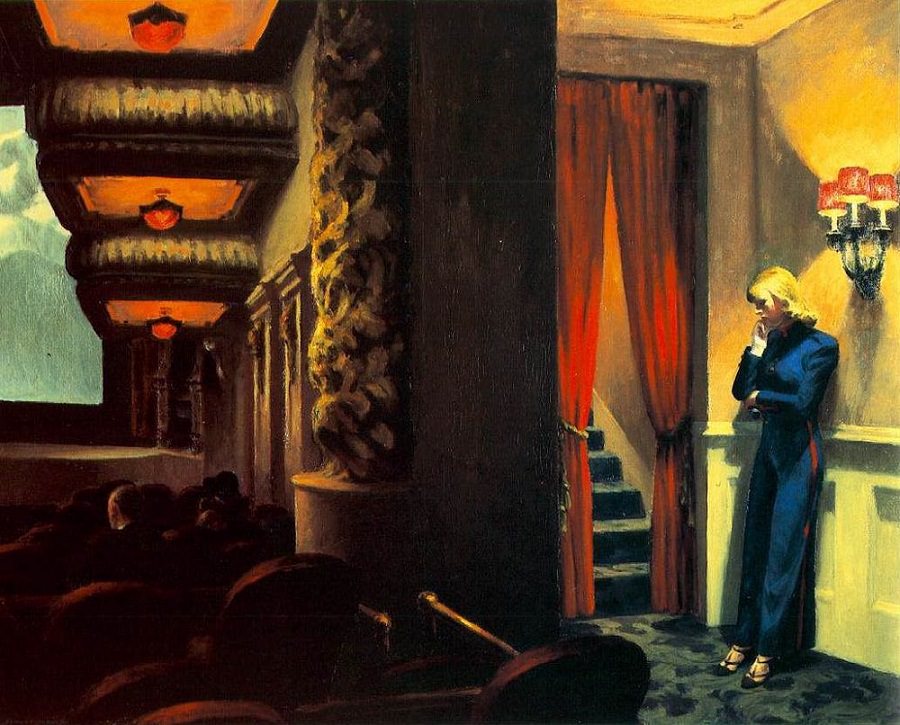
The misunderstood usher in Edward Hopper's 'New York Movie'.
CINEMA LEGEND The misunderstood usher in Edward Hopper’s ‘New York Movie’.

Good screen presence preferred

Ushering is the staple income of performers – it’s so close to the stage and the screen you can smell it, yet it’s far enough away to keep you driven to find your break wherever you can take it. South of the Thames in the genteel village of Greenwich I took to ticket collecting and didn’t look back. Most annoying moment: realising all-you-can-eat free popcorn is not a great deal after all. Career defining moment: seeing movies so many times I came to understand they’re full of the kind of mistakes media students routinely get shamed for.

Vegetarians need not apply

I came home from England, came out, and landed in career no-man’s-land. When the applications went nowhere, I went to the local Coles supermarket to work in the delicatessen. Refreshing the grey surface of trays of liver has never been as exciting. Warning for shoppers: deli staff give you nick-names based on your lip-licking, hungry-eyed facial expressions. Most annoying moment: having to hide in the cool room to avoid my high school classmates and teachers. Career defining moment: my Food Handling and Hygiene Certificate.

Willing to travel

It got me out of liver and shaved ham, but the travel industry was undiscovered country of its own. Daily struggles with brochure sorting, accounting systems, and fakey-fake customer service saw me come undone about the time I was let go because they only needed someone to cover the pre-Christmas rush. Most annoying moment: having to remind the boss that giving discount deals only to straight people was actually illegal. Career defining moment: seeing the new girl with the Ivana Trump hairdo go to lunch and never come back.

Mature outlook a positive

Suddenly widowed at 34, career dreams down the toilet, I joined the ranks of return-to-work mums and the recently redundant, caring for older people living in their own homes. Most annoying moment: when I realised the system was so stacked against many older people there’s almost nothing you can do to really help them. Career defining moment: it’ll come to me one day.

Good night vision a plus

Taking punters’ tickets at the door, playing with sound and light in enormous accoustically-perfect caverns, telling stories with drama and comedy, and often getting a round of applause… well, cave guiding was a distracting day job and fitness program in one. Most annoying moment: the petty jealousies and power trips of the public service… can’t pick one. Career defining moment: fooling entire Ghost Tour groups into believing we were completely lost.

© Michael Burge, all rights reserved.

Pitching practice for writers

SERVED UP Making a meal of your hard writing work.

WHEN I was a teenager with a head full of writing dreams and acres of my very own fantasy novels in my wake,  one of my favourite pastimes was designing the covers of my latest books, long before I’d even written a word.

Despite the fun of emulating the great cover designs of the day, this process was a handy short-term distraction from the long-term graft of capturing ideas and writing them into shape.

When I returned to fiction writing five years ago, I was determined to avoid this salacious trap and eschewed all musings on titles, covers, blurbs and similar ego-massaging pastimes.

I just wrote, and wrote, and wrote. Then I read, and read, and read.

When I eventually began making submissions to publishers, who asked me to describe, define and sell my work to them, I reached the point of forming what’s known as a pitch.

Time for a little dreaming, then. Here’s what I learned …

Titles always change

Manuscripts need to have a file name on your computer, so you (and anyone you submit them to) doesn’t lose them, but that’s all they need. Nailing that one great title for our work is a great way to inspire us to create a whole pitch-ready work, but don’t get precious about what it’s called if a publisher or agent has other ideas. Jane Austen’s working title for Pride and Prejudice was, simply, First.

Blurbs are best

The sales tool used by publishers on the back cover of printed books, traditionally known as a blurb, is the benchmark for pitching language. Strike a balance between the raw courage of “it’s Jurassic Park meets Star Wars” and the blandness of “this is the best novel written about dinosaurs in space”. Go back to the storytelling strategy of your plot and work that into your blurb, with all its tensions, turning points and battles.

Give away the ending

Publishers and agents know good storytelling, but don’t expect them to suspend their disbelief about yours. The main difference between your pitch and the eventual blurb of your work is that you must let the publisher/agent into its secret. This takes courage, because when we reveal our work’s one big secret, the thing we feel will make people love it, it feels like giving away all our power. Be brave and let it go, because your plot’s turning point may be the key to keeping your work out of the slush pile.

Keep images to yourself

One heartening and inspiring tool I make use of is imagery. I like to find one strong image which I imagine would work on a book cover. It evolves through the writing process, of course, but sometimes I find images so arresting they end up informing the story and characters. I never submit these images as part of my pitch, but I work with them,  keeping them in mind whenever I am asked what my story is about.

Have an answer ready

Family and friends love to know what we’ve been spending our writing time doing, and they’re  a great test audience for verbal pitches. Most writers squirm when asked about their work, but a little preparation and practice helps to have an answer ready when someone asks: “So, what’s your book about?” As with the blurb, go back to your plot. If you can’t answer this question to a friendly audience, you are probably not ready to pitch it to a publisher.

There are only seven great stories

The great Arthur Quiller-Couch was one of the first modern writers to maintain there are a limited number of story archetypes embedded in human existence. Other thinkers have fleshed-out his approach, but the basic premise has not altered. What you are writing will be found in one of those story brackets. It’s your job to stretch the medium into new territory. That’s possibly what being original means.

What’s it like?

Publishers and agents often ask for a few examples of existing titles our work is similar to. Don’t snap straight to “it’s entirely original”, have a look at the marketplace, both the new titles and the classics. There will be echoes of your work in there. Use them to define what you’re writing. See what major genres the publishing industry has divided the book trade into, and work out where you fit. If you don’t know, publishers probably won’t waste their time working it out for you.

Break the rules, a little

WRITE REGARDLESSCreating and sending multiple pitches can get very boring. Have some fun and break the rules a little. I recently sent a pitch to a publisher who said “no unsolicited material”, and they looked at it! Doing this each and every time is probably not a great way to get a book published, but now and again, mix it up. There is really nothing to lose when you think about the crazy odds of the publishing trade.

An extract from Write, Regardless!

© Michael Burge, all rights reserved.

A thousand ways to say no

gladiator-thumbsdown

ANYONE who has ever done anything out of the ordinary, against the very will of societies and economies (like writing a book, crazy you!), invariably meets with the head-shaking, heartbreaking moment of dashed dreams which occurs in the wake of the average rejection.

In a sense, if you’ve put yourself in rejection’s path, you’ve already done more than most people. Trouble is, rejection rarely feels that way.

I have little time for those writers who try to mollify emerging creatives with cries of: ‘get used to it’ and ‘we’ve all been there’. To leave it at that is to ignore the genuine pain that rejection inflicts, and the possibility of finding ways through the hurt to a place of understanding.

So, for the rejected, here is my best advice, from one who stands with you.

J.K. Rowling had it good

The latest in a long line of success stories that gets trawled-out to give hope to the rejected is that of the author of the Harry Potter series, but don’t be fooled. Yes, Joanne Rowling’s first Harry Potter book was resoundingly rejected by multiple publishers, but she was signed with a literary agent at the time, and the rejection process came to an end after around twelve months. That is not an abject state of rejection. During her short rejection ‘purgatory’, Rowling had a sounding board, a guide, and a mentor in her agent, something most writers never encounter, so don’t feel too sorry for her.

Rejectors like to keep it interesting

These days, publishers and agents rarely engage in reasons why they reject your work. It’s likely you’ll never even receive a reply. If (and it’s a big if) you get feedback, don’t believe it immediately. “An irresponsible holiday story that will never sell,” went the rejection of Kenneth Grahame’s The Wind In The Willows, a book which went on to sell 25 million copies. “Too different from other juveniles on the market to warrant its selling”; “You have no business being a writer and should give up”; “We feel that we don’t know the central character well enough”, and “I recommend that it be buried under a stone for a thousand years” all featured in rejections of some of the bestsellers in publishing history. Check out some more at this great site.

Publishers have rejection shame of their own

I once worked for one of the many publishing houses who rejected Dick King-Smith’s bestselling childrens’ book The Sheep-Pig, the story which was so successfully adapted for the screen as Babe. I can assure you the company still carried a certain amount of shame about its decision a decade later. Think of the hand-wringing and guilt-tripping amongst those publishers who rejected J.K. Rowling!

Be ready for rejection

There are only two ways to endure rejection. The first and perhaps the hardest is to be a megalomanic who has absolutely no shred of self-doubt. The other is to know the true value of your work; to have spent time and energy making your manuscript the best it can be within your skill level at this time of your life. When it gets rejected, you’ll be able to send it to another publisher straight away if you know it’s the best work you can do right now. If you don’t know this for sure, you’re possibly sending your work out too early.

Keep faith with your stories

The greatest damage rejection can wreak is if the writer gives up, leaving the characters they have worked on unread, unloved, and, in a way, unborn. Not every manuscript in history gets published, but every character needs to be loved by at least their creator. Even when all seems useless, revisit your own creation, laugh and cry at your characters’ highs and lows, keep them alive through your own faith. Think about self publishing if you’ve tried every avenue, like Virginia Woolf and Beatrix Potter did. Accept your own work. If you don’t, it’s possible no-one else ever will.

True criticism will fill you with power

If you ever get truly constructive feedback from an agent or a publisher, it will resonate with you on a very deep level and you’ll know immediately how to fix your manuscript. Nothing on earth will be able to hold you back from making the changes. If the feedback doesn’t move you on this level, question everything about it.

Keep some rejections to yourself

Loved ones, who always think what we write is Booker Prize material, believing mirrors that they are, need a break from our rejections sometimes. Don’t register every ‘no’ with blood-letting. Find other writers to share the pain with.

WRITE REGARDLESSSend it out again

I try my best to have a few balls in the air at one time. It provides a sense of potential, so that when a rejection lands, there is still hope on its way from some other source. For many writers, even just a tiny bit of hope is all it takes to keep going.

© Michael Burge, all rights reserved.

An extract from Write, Regardless!