All posts by Michael Burge

Journalist, author, artist

Keeping Marriage Equality off the record

WHEN the South Australian government was caught out by the world’s media for its lax approach to recognising overseas same-sex marriages on death certificates, the justifiable outrage about Marco Bulmer-Rizzi being documented as “never married” to husband David resonated with many readers.

One small voice of disagreement came from Marriage Alliance, a grassroots anti-marriage equality movement with a presence in Australia, in the form of a tweet defining the Bulmer-Rizzi disenfranchisement as “unusual” and criticising Australian Marriage Equality for politicising the issue.

This was news to me. From where I sit, the negative treatment of same-sex spouses at the crucial and highly-sensitive time of death certification is so commonplace it’s time Australia admitted this kind of homophobia is the norm.

I should know, because it happened to me.

When my name was removed from my partner Jono’s death certificate in NSW in 2004, it was the result of illegal and underhand action by his blood relatives.

Long after his funeral, I was left to work out for myself what had taken place when Jono’s death certificate was not issued to me but to his mother. My name and any reference to our relationship was missing, and the offensive phrase “never married” inserted.

It hurt deeply to be coldly cut off from my own life. Legally it made wrapping up Jono’s affairs impossible. Meanwhile, his mother was busy collecting assets in her son’s name that were legally mine.

“It felt like a cold label for what was a beautiful love affair.”

Since my name was not on the document, I couldn’t apply for one independently. I sought help from a lawyer and she too was unable to extract the certificate from the NSW Registry of Births, Deaths and Marriages.  The funeral company sided with Jono’s mother’s version of our relationship and challenged me to “do my worst” in fixing the miscarriage of justice.

But I was in shock and grief, the kind it takes years to recover from, the kind I still feel when I see the same thing happen to others.

I heard anecdotal evidence about incorrectly-created death certificates in NSW, from the pre-1999 era, before the state’s de-facto laws were amended to recognise same-sex spousal rights. The majority of these stories were about community warriors of the HIV-AIDS crisis, when deceased long-term spouses were routinely listed as “never married” on death certificates.

MIKEY:JONO
DISENFRANCHISED IN DEATH Michael Burge and Jonathan Rosten.

Almost two years after his death, I managed to get Jono’s death certificate re-issued and our relationship acknowledged. In order to ensure the NSW Registry of Births, Deaths and Marriages ceased to operate in contravention of the state de-facto laws, I wrote to the NSW Attorney-General, the ALP’s Bob Debus, but I never received more than a staffer’s reply that the matter was being looked into.

That wall of political denial is what ultimately assisted me in making a submission to the Human Rights Commission in 2006 when it was investigating its Same Sex, Same Entitlements report.

Years later, when what happened to me eventually happened to someone else, I felt a terrible mix of validation and guilt. Having a potential ally was great, but for the worst of reasons.

Australian academic and LGBTI activist Dennis Altman’s partner Anthony died in 2012. The couple lived in Victoria at the time of death, and Altman wrote:“There was no provision on the death certificate to list Anthony as my de-facto partner.”

In his heartfelt account of life after his partner’s death, Altman outlined several of the challenges all surviving spouses face, although I didn’t realise at the time what an opponent of marriage equality Dennis Altman was, whereas since my disenfranchisement, access to our strongest, most legally-binding, irrefutable symbol of relationship became one of my driving forces.

By 2013, although five successive governments had enacted a range of laws since Jono’s death, recognising same-sex attracted relationships after the death of a spouse in everything from equal superannuation access to social security benefits, only Kevin Rudd had publicly acknowledged the need for marriage equality. His reason: to end “such unnecessary angst in the gay and lesbian community, it just shouldn’t be the case”.

I recognised that word, ‘angst’. It spoke loudly to the dreadful mix of apprehension and fear that I’d endured. Rudd never publicly named the LGBTI staffer who’d communicated so effectively to him the need for marriage equality, but if anyone else was feeling the angst of disenfranchisement, it wasn’t apparent.

DENNIS ALTMAN
FEELING THE ANGST Dennis Altman on the ABC’s QandA.

That was until Dennis Altman appeared on a special episode of the ABC’s Q&ABetween a frock and a hard place.

When the Reverend Fred Nile made the point that marriage equality was not necessary, he said: “All the laws were changed a couple of years ago to give de-facto, homosexual couples exactly the same rights as married couples in Australia.”

“But you are wrong,” Altman said. “You are wrong and I will tell you why you are wrong and it happens in a very important area. When my partner died, the death certificate could not record that he’d been in a relationship.”

“And I’m happy to change a death certificate arrangement if that’s what happened to you,” Nile casually replied.

Altman said: “Good. Go talk to the Government of Victoria.”

At that point I threw a tea towel at the television. Obviously, Altman knew the angst but had kept it under wraps. A month later, he begrudgingly declared a shift in his thinking and came out in support of marriage equality.

The issue of de-facto laws vs marriage equality came into sharp focus in the wake of another tragedy, the sudden death of Tasmanian Ben Jago’s partner Nathan in January, 2015.

Journalist Tracey Spicer reported on the case for Fairfax Media in November. “There’s a misconception that same-sex couples and married heterosexuals have equal legal rights,” she wrote. “It’s an urban myth.”

Removed from his position as Nathan’s next of kin almost instantly, and replaced by his partner’s mother, Ben’s story had strong resonance with mine, although he was made to endure the added indignity of having to sit at the back of the gathering at his partner’s funeral, with no public mention of the relationship during the service.

BEN JAGO
DEATH DISCRIMINATION Tasmania’s Ben Jago

Jago had trouble with the Tasmanian Registry of Births, Deaths and Marriages, who gave him conflicting information about what he could do about his situation. His case will come before Tasmania’s Anti-Discrimination Tribunal this year.

I read that news with a sense of camaraderie for Ben. Good on him for having the courage to seek some kind of recourse.

Another Fairfax journalist, Monique Farmer, reported in December on the difficulty in creating a correct death certificate for her Aunt Julia, who’d lived for thirty years with her partner Annie, already dead by the time of Julia’s death.

“They were married, or at least they seemed that way to me. Their lives were as inter-mingled as my parents’ were, perhaps even more so,” Farmer wrote.

“Had they been de-factos for those 30 years? Well, legally yes – they lived together in a sexual relationship, their finances were combined, they owned property together. But it felt like a cold label for what was a beautiful love affair.”

Faced with what Farmer later described in a tweet to me as “a daze of grief”, she ultimately selected the descriptor ‘never married’.

And she felt the angst, also: “With a heavy heart I ticked that box. This meant that the next section of the death registration, asking for her partner’s name and other details, was left sadly blank. As if she’d never loved or been loved.”

I tweeted Farmer to let her know I’d been able to amend Jono’s death certificate some time after he died. She replied: “Since writing the story I’ve been thinking the same.”

The legal trap that David and Marco Bulmer-Rizzi entered when they chose to honeymoon in Adelaide in January was set long before they arrived. Why would any Australian citizen assume their relationship – particularly a marriage – was not enshrined by every law of the land?

MARCO BULMER-RIZZI
SURVIVING SPOUSE British citizen Marco Bulmer-Rizzi.

In his grief-stricken interview, I got the sense that Marco Bulmer-Rizzi felt duped by a terrible system that compounded his shock with its inability to be real about what love between any two people means. That system has been supported by plenty of mixed messages and slow realisations within the LGBTI community, but it will take well-formulated, national marriage equality legislation to sweep away the mess our unequal state laws are currently creating.

Marco Bulmer-Rizzi left Australia hoping what happened to him would never happen again. What denial and obfuscation has this country indulged in that my case – twelve years prior – was not enough to change any laws or draw an apology from Bob Carr, NSW state premier at the time Jono and I were labelled “never married”?

Marriage Alliance is way off the mark. Australia has been caught out with homophobic anomalies in our relationship legislation at least five times. The Bulmer-Rizzi story is bringing more disenfranchised same-sex spouses out of the woodwork.

9780645270532

The question Australian politicians need to ask themselves is how many more painful miscarriages of justice they require before allowing a marriage equality free vote on the floor of parliament?

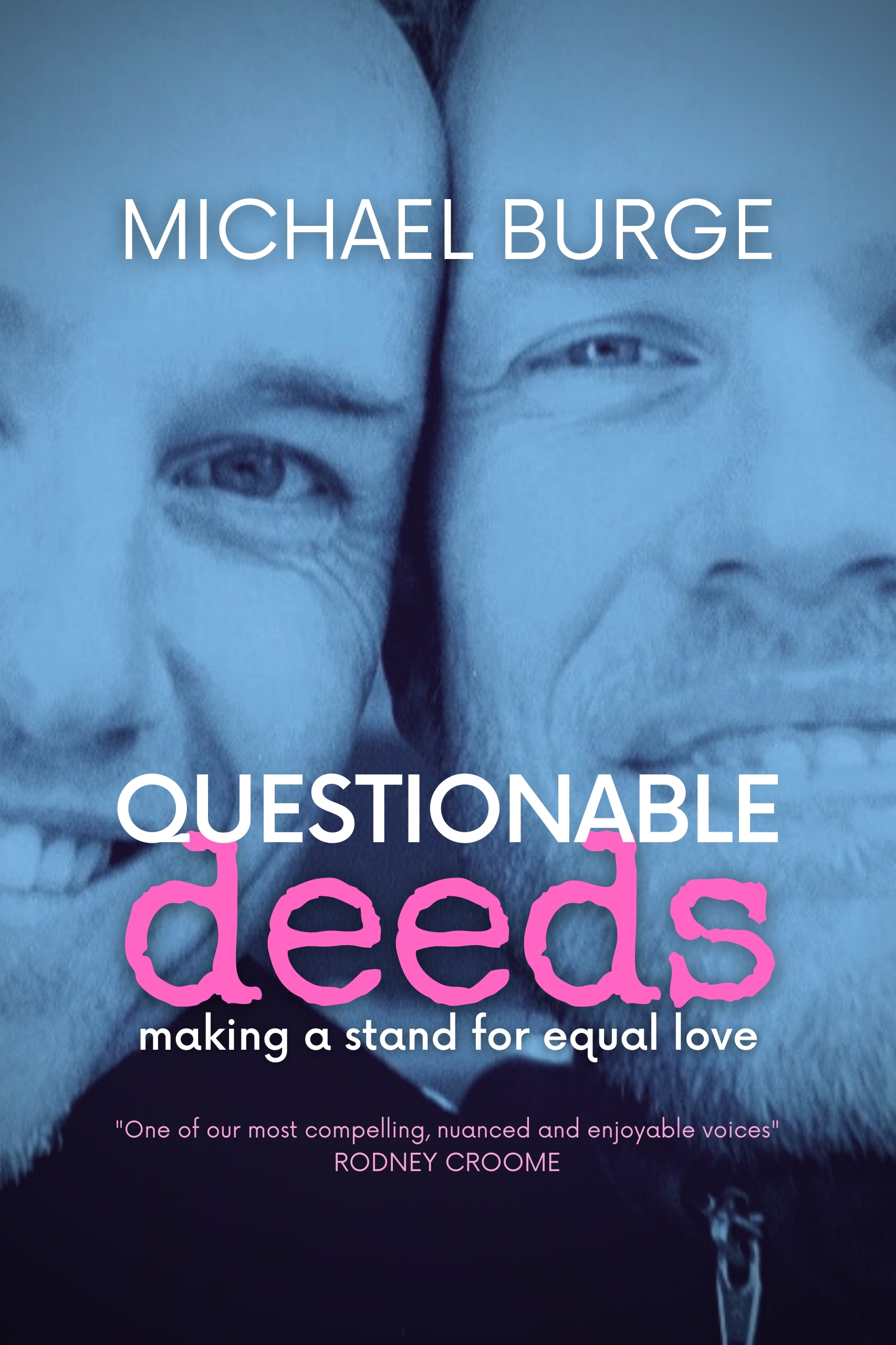
Michael Burge’s book ‘Questionable Deeds: Making a stand for equal love’ is out now.

This article was first published on No Fibs.

Keeping #MarriageEquality off the record: @burgewords comments on #NeverMarried

Michael Burge

Michael Burge

Journalist at No Fibs
Michael is a writer, editor and journalist who lives on the beautiful island of Coochiemudlo. He is passionate about LGBTI equality and emergent forms of online publishing, marketing and access for writers and artists.
Michael Burge
Michael Burge
Michael Burge

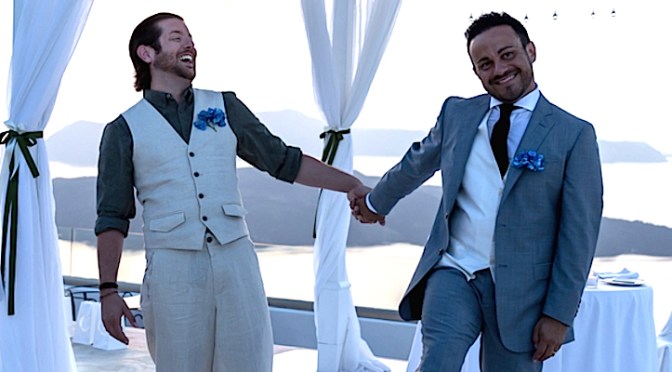
David and Marco Bulmer-Rizzi on their wedding day.

David and Marco Bulmer-Rizzi on their wedding day.

It felt like a cold label for what was a beautiful love affair.

WHEN the South Australian government was caught out by the world’s media for its lax approach to recognising overseas same-sex marriages on death certificates, the justifiable outrage about Marco Bulmer-Rizzi being documented as “never married” to husband David resonated with many readers.

One small voice of disagreement came from Marriage Alliance, a grassroots anti-marriage equality movement with a presence in Australia, in the form of a tweet defining the Bulmer-Rizzi disenfranchisement as “unusual” and criticising Australian Marriage Equality for politicising the issue.

This was news to me. From where I sit, the negative treatment of same-sex spouses at the crucial and highly-sensitive time of death certification is so commonplace it’s time Australia admitted this kind of homophobia is the norm.

I should know, because it happened to me.

When my name was removed from my partner Jono’s death certificate in NSW in 2004, it was the result of illegal and underhand action by his blood relatives.

MIKEY:JONO

Michael Burge and Jonathan Rosten.

Carol out in the cold

WITH nothing more complex than a series of firmly closed doors, the film Carol takes a powerful dramatic turn that subtly gives two women the space to explore their attraction.

“The wait for enlightenment will be long, and the darkest, pre-dawn hour lies ahead.”

When Therese (Rooney Mara) slips into the passenger seat beside Carol (Cate Blanchett) and shuts out her fiancé, they leave him blinking on the kerbside. Soon after, Carol’s old flame Abby (Sarah Paulson) firmly shuts her front door on Carol’s estranged husband (Kyle Chandler), leaving him awkwardly framed through a small window.

But it is the shutting of the door between the two protagonists – closed by Carol against Therese at the height of an argument – which makes forbidden fruit all the more potent for both women.

Phyllis Nagy’s screenplay (based on Patricia Highsmith’s 1952 novel The Price of Salt) uses these pivotal separations to mark out the territory of a love story that breaks several taboos.

The shutting-out of men has been a powerful literary force ever since Anne Brontë’s The Tenant of Wildfell Hall (1848) in which Helen Graham dramatically slams her bedroom door in her husband’s face and created what many credit as the first feminist novel.

CAROL
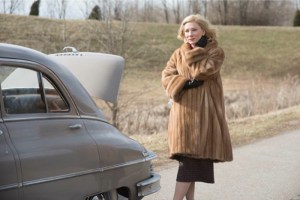
CHRISTMAS CAROL Cate Blanchett as Carol and Rooney Mara as Therese.

Published a century later, and phenomenally successful in its day, The Price of Salt disappeared from mainstream lists until Highsmith came out as its author in the 1980s and changed the book’s title. Plans were made in the 1990s to adapt it for the screen, and almost twenty years on – surely one of the film industry’s greatest examples of persistence – the story has been thrust into mainstream consciousness.

And its arrival pulls few punches. The unstable yearnings of unfolding passion will be familiar and understandable to anyone who has ever fallen in love, but emotional and sexual lust between two women is rarely seen on the big screen across suburban cinemas.

Carol contains several quite inadvertent similarities to other stories. When Carol and Therese take to the road, the story has strong echoes of Thelma and Louise. The escapist quality of that journey also speaks to the kind of concealed passion explored in Brokeback Mountain.

Highsmith’s novel traverses similar tragic precipices, yet its originality lies in the choices Carol and Therese make when their love is swiftly and coldly thwarted. Far from home, in a frozen place ironically called Waterloo, they have the door to their world cruelly wrenched open for the very worst of reasons – a blow that lands right in Carol’s weak spot.

It is from this point in the story, the final act of Carol, that Phyllis Nagy has done greatest service to Highsmith, but don’t be fooled by the alleged ‘happy ending’ tag this story has garnered. While it doesn’t have the shock ending of Thelma and Louise or the tragedy of Brokeback Mountain, the denoument of Carol comes with a level of compromise and risk that could never be defined as a positive outcome.

Cate-Blanchett-Fur-Coat-Carol-Movie
COLD COMFORT The original novel takes its characters on a road trip into America’s heartland.

Cate Blanchett portrays Carol as glamorous and anaesthetised, at times a sheer minx and at others world-weary, as though every stroke of make-up and hair product in the high-fashion front is only just managing to hold her upright. She inhabits Highsmith’s title role with a languid style that is never more poignant than when Carol is required to behave.

The slow burn of Therese’s story is given a sparse amount of dialogue, since her passion must remain internal until it is safe to express. Rooney Mara gives Therese the perfect hyper self-awareness in the role that is closest to Highsmith herself, who revealed in the book’s 1989 re-release that she’d encountered a woman like Carol while working in a department store as a youth. Despite finding out where she lived, Highsmith never made contact.

Knowing the fully fledged rage with which Highsmith went on to live and write by, it’s impossible to watch Rooney Mara’s performance without the sense that Therese would eventually give Carol a run for her money as a self-determined woman.

Haynes has been praised for the visual style of Carol, yet it has nothing like the luminous, throbbing-with-colour quality of his other 1950s-era film Far From Heaven (2002).

Carol and Therese inhabit a darkened, soft-focus, wintry world. Glimpses of sun show themselves at the edges, but remain out of reach, as though the wait for enlightenment will be long, and the darkest, pre-dawn hour lies ahead.

static1.squarespace
CLAIRE’S CAROL Highsmith’s book was originally published with a different title, under a pseudonym.

Nagy’s screenplay achieves far more with the story’s dramatic turns than Highsmith’s novel, which was her second and suffers a little from not knowing what to do with these characters before she sets them on the road.

Nagy knew Highsmith and drew on her friend’s experience of what it was like to be a lesbian in the 1940s and 1950s by adding detail on the legal and psychological challenges faced by same sex-attracted women in the United States.

But Highsmith’s novel sends Carol and Therese on a journey through America’s road culture, beyond the restrictions of their lives and dangerously oblivious to the ramifications of their journey, that is not fully realised on the screen.

“A mesmerising, disturbing film about unearthing passion and controlling rage.”

The scale of the route rivals that of Thelma and Louise, yet the cinematic potential of vast landscapes is not captured in the film. When the city-dwelling protagonists emerge in an expansive, elemental space they are unlocked from the world that confined them, and their enemies are required to do far more work to rein them in. In this, Carol is a precursor to Highsmith’s best-known works, the Tom Ripley series of thrillers, and leaves the novel worth reading for its own sake.

A mesmerising, disturbing film about unearthing passion and controlling rage for the sake of relationships, Carol explores the limits of what people will accept and the territory they will not negotiate.

creating-waves-cover
BUY NOW

The right to evade capture, to avoid being shut out emotionally, are portrayed as loudly as the sexual criminality of the era, and make a universal story out of what might otherwise have remained a period piece. 

© Michael Burge, all rights reserved.

This article appears in Michael’s eBook Creating Waves: Critical takes on culture and politics.

Writer, don’t rest!

“You’re a writer, right? Keep it up.”

SO, you’ve completed multiple drafts of your manuscript, you’ve reworked its plot and tweaked its narrative, and it’s been sent to beta readers to see about its readability. You’ve done the work. Excellent. Here’s a list of things to be getting on with while your book is off your desk.

Write another book

Writers are always getting ideas, and the chances of finding inspiration for more books while writing one is very high. Act on that motivation by sifting through ideas for what’s got legs. Now that you have one book being read, maintain your regular writing schedule by getting another manuscript down. You’re a writer, right? Keep it up.

Second book syndrome

Invariably a malady of high-maintenance, traditionally-published authors who find their creative well has run dry with all the attention, ‘second book syndrome’ strikes when writers have too much thinking time and allow their writing schedule to go by the wayside. Instead of indulging in a round of writer’s angst, a good fix is to just start writing again and never allow space for this first-world problem to get a grip. If you’re keeping up with Write, Regardless! you’ll know that a regular writing schedule is a must. What better way to avoid second book syndrome than to have one written by the time you’ve published your first?

How’s your list looking?

No book publisher in the world prepares just one title and focuses all their attention on marketing it. All publishers, large and small, release annual lists of titles. If you are heading for the independent publishing pathway, you’ll need to publish a list. If you plan to persist until a publisher accepts your manuscript, you’ll need more books in the pipeline, in fact their very existence may sway a publisher’s view of your viability. Readers love to be loyal to their favourite authors. When they find you, ensure you have a list of titles on offer.

Get reading

Even better, beta read for another writer, there really is no better way to see how plot and narrative work. When they say that good teachers learn as much as their pupils, this is what they mean: reading another’s manuscript will shine a strong light on your own. Spend some time reading published books. With your new writing knowledge, you’ll probably learn something fresh from an old favourite, or you may notice how the ‘latest, hottest thing’ in the book trade is not all that hot or new: maybe the writer is simply adept at good plotting and narrative, and found original ways of utilising established storytelling techniques. Reading will show you how far your writing has come.

cardsCards close to your chest, writer!

The great temptation, in this isolating, internet-driven world, is to tell everyone you’ve finished writing a book and bask in the encouragement your peeps are bound to bestow on you. There is nothing more dangerous for the emergent writer than this kind of public display. It builds an expectation of you and attracts the inevitable question: “So, what’s your book about?”, which you might be prepared for, but will take a chunk of self assurance out of most writers each time it’s asked.

A brainchild is born

There are times and places to share the news of a book’s birth. Join a writer’s group and let everyone know of your completed manuscript (a great way to find beta readers); or tell select friends who respect your creative boundaries (but be very sure they do). If you are planning to independently publish your book, you’ll eventually need to make an announcement to your social media network, but now is just not the time, when you don’t even know for sure what the book will be called. Don’t confuse manuscript completion with the start of a book’s marketing campaign. For now, just keep marketing yourself as a writer in your fields of expertise. Readers will assume you have books in the pipeline.

Extend your networks

By now, you should have a growing social media presence, fed by your regular online articles. During this process, you’ll have naturally seen and read work by other writers, published in other networks. Set aside some time to research and send your work to these websites and social media feeds, particularly if they are linked to your subject matter.

Offer articles for free

“Focus your energies on creating more work and increasing its reach.”

The people behind websites and social media groups (who sometimes identify themselves as editors) will appreciate an approach from a writer offering free content, which is as simple as them sharing your posts. Some feeds will allow you to self post while following a set of group guidelines; others will offer you access as a site author or ‘admin’. Ensure your work is quality journalism and always has a link back to your website or social media assets, which will allow readers to find you, follow you and therefore access your published works down the track. The value of your posts being published is not in charging per word, but in increasing your social media following: your future audience.

Review a book

Preferably an independently published book. Whatever path your writing career takes, the most generous thing you can do as a participant in the publishing industry is to regularly review books. Critical responses are a great way to fill your online publishing schedule with content that reflects on you as a good writer and increases your reach to potential readers. Here are my tips for good reviewing.

Recap

write-regardless-cover
BUY NOW

In terms of announcing your book is in a complete form, less is more at this stage, which is the antithesis of the ‘share everything’ world we have made for ourselves; but your work and sense of wellbeing as a writer depend on a bit of containment at this stage. Focus your energies on creating more work and increasing its reach.

An extract from Write, Regardless!

© Michael Burge, all rights reserved.