I RECENTLY published my non-fiction debut, a biting memoir about the ‘David and Goliath’ battle I fought to have my relationship recognised after the death of my partner, Jono. Get the flavour of the book from this abridged audio version of Questionable Deeds, read by me. To buy the book, go to my online bookshop.
All posts by Michael Burge
Writer, start online publishing!
TIME to create your regular online writing program, the hub through which a world of readers can discover your writing and, eventually, your books. We’ll also look at how to send each online article you publish to your social media assets with one click, and monetising.
Publishing with WordPress
By now, you should have all your social media assets (if not, skip back to Writer, show off your assets! You’ll need them for the next step). You should also have your very own WordPress account, which you can use as a classic blog (‘web-log’) or as a website with regularly added content. Here is a great, short video about the nuts and bolts of publishing on WordPress. Make sure you watch the section on how to Tag and Categorise your posts. These form the metadata that will help your readers find you when browsing through search engines. Never publish a post without at least one category and a cluster of tags (no more than ten Tags and Categories collectively with the basic, free WordPress account). As a rule, Categories are like the contents of a book – the objective main subjects (e.g. ‘performers’). Tags are like the index of a book – the subjective individuals (e.g. ‘Judy Davis’).
A word on WordPress
“A little output, executed consistently, adds up very quickly.”
Just dive into WordPress. There is plenty to learn, but the basics are easy to get your head around if you’re familiar with Facebook. You select a theme (the look of your site – there are plenty of great free choices). A WordPress account will allow you to blog (which at its most basic is a diary of sorts) but you can create a website instead. My WordPress account has a home page via which readers can navigate to different sections.
My WordPress journey
When I started my site, I posted once a week, and I did so for years. I started writing posts about my journey as a writer, and these quickly included pieces about my writing heroes and performers, writers and visual artists who inspired me. After about six months I realised there was a theme emerging: I tended to write about people who threw down the gauntlet at pivotal moments. One of the earliest and most popular of these was Don’t f%#k with Judy Davis which continues to attract great numbers of readers across the world. Now, this article heads-up my book Pluck: Exploits of the single-minded, which made it to No. 12 on Amazon.
I labelled my site ‘Michael Burge Media’, and over the years I’ve added articles that I published in my journalism day-jobs, so it is truly a source of all my writing output. Along the way, I altered my site’s look, the content of the two menus (one at the top and one at the side) and I monetised it with an online bookshop and gallery.
My online writing program
Is like my writing schedule: I have all my settings on ‘achievable’ and ‘realistic’. Many people ask me how I remain so prolific as a writer. The truth is, I write a minimum of one page of new material per week, and one social media post. That means I am constantly creating and constantly selling work. If I miss a week of new writing, I need to do two pages the following week. This sounds like very little, but I have maintained this schedule through full-time and part-time work, for more than a decade, and I have never run out of ideas (which I jot down as soon as they come to me – there’s always a list to get though). I have also created ten full-length titles in that period, written for other online platforms and news mastheads, and created a readership. A little output, executed consistently, adds up very quickly.
A monetising moment
All online publishers will encounter the attractive-sounding concept of monetising at some point. Some bloggers shamelessly beg for money, while others are paid to write about certain products under a commercial agreement. I encourage you to give away plenty of free articles for a long time, because that will allow readers to grow accustomed to you, your subject matter, your publishing schedule and your evolving plan. WordPress will host paid advertising on their free sites (or you can pay a little per year to have no ads) – you’ll need to wait until you have tens of thousands of visitors to your site every month to apply for a share of that advertising revenue, or you’ll need to learn how to self-host your WordPress site (as in run the whole thing yourself, from the programming up) to manage your own ad revenue. I realised very quickly how self-hosting would drive me nuts and impinge on my writing schedule, so I settled on another plan: to monetise my website via the products I sell on it, namely my books. Since sales of these products are hosted on other sites (such as Amazon, iTunes, and Booktopia) I don’t need permission from WordPress to promote and link to them.
Recap

Decide what kind of online writer you are and map-out a schedule. Accept this will evolve over time and don’t beat yourself up if you need to alter it. One great post per month is better than a crap once-a-day blog post. Create your WordPress site – pick a theme and start posting. Send me a link to your first post – I’ll swing by and read it. The most important thing to get right is to just keep writing and publishing. Five minutes after I published my first WordPress post, someone in America read and liked it. Get your writing out there!
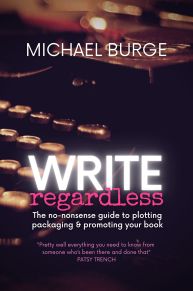
An extract from Write, Regardless!
© Michael Burge, all rights reserved.
Writer, show off your assets!
“These word-of-mouth moments are still the greatest form of promotion available, they are free, and many believe they are the only form of advertising that really works.”
IT’S not time for writers to stress about our writing (there’ll be hours of that later) just keep up a regular writing schedule and start creating social media assets. These are tools such as WordPress, Twitter, Facebook, LinkedIn, Goodreads and others which allow us to interact with other social media users and – importantly for writers – for readers to find and follow us to access our books.
Why do I need social media assets?
The social media has become the greatest shop window for writing the world has ever seen. Having multiple social media assets also increases a writer’s search engine optimisation (SEO) – your ranking on search results via search engines like Google (which you’ve already created your account within, I hope? If not, head back to Writer, identify yourself!).
Web of Fabulousness
By creating a cluster of social media assets using your real name, you are telling the internet you exist. As search engines aggregate information about you, they’ll notice you more when your name pops up on Facebook and Twitter and other social media sites. I call this a writer’s ‘Web of Fabulousness’ as it nets followers naturally (without you having to buy them).
Putting the ‘social’ in social media
Use your social media assets regularly. Read, share and comment online as you normally would. Participate! Remember, it’s called the ‘social’ media. Like the level of socialisation that employees participate in at the coffee station, you share something, you learn something, and you’re sociable, which means keeping yourself a bit nice. Don’t do the hard sell, however. If someone’s at the water cooler flogging their cleaning products every day, you’ll avoid them, right? The key to social media participation is to do it genuinely without constant pressure to buy things.
Why is this essential for marketing and promotion?
Because these word-of-mouth moments are still the greatest form of promotion available, they are free, and many believe they are the only form of advertising that really works. If you want your work to find readers, participate in the social media.
Domain names don’t matter
In the early years of the internet, everyone was focussed on domain names, and there’s still a common fear that we need to buy a domain name before someone gets the one we want. While this used to be the case, it’s no longer essential to have a domain name to market something. I am a writer called Michael Burge who lives at Deepwater, NSW, and all my social media assets have my name, my vocation and my location embedded in them. If you google the terms: ‘Writer’, ‘Michael’ and ‘Deepwater’, you’ll find my website. If you google those terms and add ‘Facebook’ or ‘Twitter’, you’ll find my website, Facebook and Twitter accounts in one search. You don’t need to ensure people write down your domain name these days, just say: “Google ‘Writer Michael Burge’ and you’ll find me!” Even if they forget half the details, they’ll find you, thanks to what’s known as metadata.
Metadata is what matters
Metadata describes something (e.g. a writer, or a book) and allows it to be found again by browsing or searching. In the blogging world, metadata has been filtered-down into a process of creating tags and categories for each page of information you publish on your website or blog. I participate in the social media with a special interest in LGBTIQA+ equality, so if you google my name and ‘marriage equality’ or ‘LGBTIQA’, you’ll also find me, because I regularly use these terms as tags and categories. More on this process when we get to blogging. For now, let go of domain-name thinking, the world has moved on to metadata.
Usernames and User IDs
In order to generate good SEO and social media followings, using your real name is ideal for social media assets, however, in most cases your real name will already have been used by someone else. To counter this issue, social media platforms allow you to have a User ID, sometimes known as a ‘handle’, which is a form of nickname (for example, my Twitter handle and my WordPress URL both use ‘burgewords’); leaving you to label your asset profile with your real name. Think of a simple, short word that describes what you do and that nobody else in the world is using, and consider this for your URL and social media username or User ID.
WordPress is the way
Every writer needs a website, an online place to showcase our work to the world, allowing readers to find our books, and public relations (PR) people and journalists, booksellers and book trade people to contact us. Creating a website was once an expensive business that many writers needed to pay someone to do for us, but since the advent of the world’s largest blogging platforms, Blogger and WordPress, it’s been possible to create a free blog that works as a website.
A blog (a ‘web-log’) is not for everyone. I have a WordPress blog platform which I use as a website, and for more than three years I had a basic, free, WordPress account, recently upgraded in order for me to host video marketing material for around USD$160 annually. Set up your free site with your service provider of choice – it will be a major tool in your writing journey, and it will evolve.
Since you already have a Gravatar account, setting up WordPress will be easy as the platforms are linked (here’s how). Remember, if someone else is using your real name as their WordPress URL, think of an alternative name (like mine – ‘burgewords’) and use your real name as the profile User ID. The next part of the Write, regardless! series will be all about using a WordPress site.
Twitter is tops
Twitter is misunderstood. Before I was on it I believed it was the domain of navel gazers and people intent on telling me what it was like on the bus as they commuted… boring! It is all that, but used wisely, Twitter is also a fantastic distribution network for journalism, books and other publications.
Set up your free Twitter account, but remember, if someone else is using your real name as their Twitter handle, think of an alternative handle name (like mine,@burgewords) and use your real name as the profile User ID. Twitter will assist you to set up and start tweeting. Find my Twitter handle and follow me. I’ll follow you back if you send me a tweet (learn how to ‘tweet to’ someone). More about using Twitter for marketing in a later chapter.
Facebook is fab
If you have a Facebook timeline (the basic Facebook account to keep tabs on your friends) you can also create a free Facebook Page. Facebook will ask you to identify the type of business you are. Like me, the word ‘business’ might give you a jolt, but publishing your books will be a business, I assure you, so move past this with confidence. There is an option to select ‘Writer’. My Facebook Page allows me to promote myself in all forms of writing – non-fiction, fiction, journalism and playwriting.
The benefit of having a Facebook Page (your business) in addition to your Facebook timeline (your personal life) is that it gives you a place specifically for communicating about your books to an interested following. More about using Facebook for marketing later in Write, regardless!
A LinkedIn your chain (see what I did there?)
LinkedIn is a bit strange to me as it’s very corporate, but I embraced it as a social media asset simply because it adds to my Web of Fabulousness, and the basic version is free. Of all the social media assets I use, LinkedIn is the one that puts most pressure on me to upgrade to premium, paid services, but creating a free profile on LinkedIn allows us to add a list of our publications – which is great for promoting books. Find me on LinkedIn and create your profile. I don’t go behind the scenes on LinkedIn very often – I set it and forget it, and update things when I need to. You may want to participate there more often, especially if you are writing something in the corporate/employment sphere.

Goodreads is great
One of the world’s largest reader-reviewed sources of book information, Amazon-owned Goodreads is often described as ‘Facebook for readers’. Until you have published titles, you’ll only be able to create a reader’s profile, where you can share your reading experiences and follow authors and other readers. I was a Goodreads reader and reviewer for years before upgrading to my author page.
Instagram is interesting
I came late to Instagram – the place where people post images and not much more – but at the time of writing it seems to be where much of the action is on social media. Writers have started using intriguing ways of including words on this platform, despite being unable to share articles or links. It’s another thread in your Web of Fabulousness, and I found it a great way to connect with booksellers.
My social media asset is better than yours
Many in the day-job world love and swear by LinkedIn, as much as creatives swear by Pinterest and writers cannot sing Twitter’s praises loud enough. All platforms get eager, loyal followers who will sell their granny on the promise that if only you were on that same one, all your marketing problems would be solved. Try to move through this enthusiasm with a firm smile plastered on your face, accepting that not everything is everything to everyone. Choose your social media assets based on your interests, just ensure you don’t miss Twitter, Facebook, Instagram and Goodreads if you want to promote writing and books. Don’t ask me about TikTok, I just don’t get it.
High rolling on the social network
People may try to convince you that social media assets cost money, that they need ‘premium’ accounts in order to be secure and give you a large audience. They don’t. All online entities have levels. Just create the most basic, free social media assets and ensure that when they try to sell you bells and whistles, you either decline, or understand why you’re saying yes.
Recap

Get your social media assets sorted, adding your usernames and passwords to your safe place for future reference. This process will take a few sessions, but don’t get despondent! When you hit an obstacle, make a cup of tea and go back to it with fresh eyes. When you’re done, add your social media assets to your Gravatar profile (have a look at my Gravatar profile to see how that will look), that way, when you make that brilliant observation on The Guardian culture page, people will be able to find your full range of social media assets!
An extract from Write, regardless!
© Michael Burge, all rights reserved.