All posts by Michael Burge

Journalist, author, artist

Thanks (in advance) for the day jobs

A Writer lets go.

I’VE had my share of day jobs, those pesky positions that keep the bills paid and the artist fed while keeping dreams alive.

This week, my latest contract came to an end – a one-year editing position perfect for a writer, covering a colleague’s parental leave on a national news website.

After twenty-two years in a wild variety of day jobs, I’ve noticed some fundamental shifts.

You rub me the wrong way

Today’s workplaces are so understaffed they’ve become like skeletons with no cartilage – everyone’s grating right up against one another, and there’s plenty of friction. Back when my day-job career commenced, workplaces had enough staff to soften the blow between competing personalities. Now, there’s so few people on deck that the old workplace standards – like consultation, notice, give-and-take – seem to be lost forever. Feeling friction at work? That’s the new normal.

‘Flexibility’ means you’ll be stretched

These days we’re expected to do our work and that of other people, every day of the week. This is because there are not enough staff and/or several are on leave (invariably a result of overworking). Maintaining the right to prioritise your own work will signal your lack of flexibility, whereas once it was an indication that the human resources department needed to place several job ads for extra staff. Jobs are becoming less specific every year – you are expected to do anything for anyone, anywhere, anytime and for any amount of money. Limber up, peeps.

‘Manners’ mask incredible insults

I can’t watch the Australian series Utopia for the same reason as I could not watch Ricky Gervais’ groundbreaking series The Office, simply because it’s all too close to the bone. You’re more likely to be told: “Thanks in advance for doing it this way” than “let me know how you’re going with this” from bosses, desperate in their ‘right first time’ mentality, an outcome best achieved by a robot not a pesky human being. I found myself writing “thanks in advance for…” in one of my last work emails, but after trying to be polite, this way and that, it turned out to be the only phrase to telegraph to the recipient that the conversation was over, and a low point in my communication abilities.

Training is ‘all intuitive’

Back in the day, a quick instruction session from colleagues about how to navigate the pathways of the internal computer systems was all it took to start the job. Now, workers are hard pressed to find anyone willing to give even a hint of training, and the catchphrase: “It’s all intuitive” has come to signal: “I don’t know”, “I’m not telling you” and/or “work it out for yourself”. If you get instructions at all, it’s likely you’re being told the way a colleague would prefer you do your job.

Silence is the new no

Haven’t received a reply to that email you sent your boss asking for the passwords for Google analytics? Didn’t hear back about your leave application? If silence is the only response, you can take that as a clear “no”, and move on accordingly. The reason for this unwillingness to reply in the negative can be put down to a need for colleagues to avoid a firm paper trail on anything. No paper trail means: “You can’t pin me down”.

PIPs stick in my throat

While the concept of IQ is on the mat in its death throes and emotional intelligence is on the rise, workers are increasingly prone to being hauled in for Performance Reviews (yes, they are important, so they deserve Capital Letters) or worse, threats of Performance Improvement Plans (PIP). The former is now considered highly questionable as a way to improve any workplace, and the latter signals: “I want to sack you, and this is how I am going to achieve that, thanks in advance for signing this”. A PIP is unlikely to appear in any workplace contract, so never sign or agree to one, although your annual Performance Review is a time-wasting dance you’ll have to endure with your boss until your workplace realises just letting people do their job is probably a better use of everyone’s time. Phone conferences fall into the same category.

Equipped for solo work

There is one plus in the modern workplace for journalists, and that is the tiny equipment it takes to do the job. It once required three strong people to carry the average camera and sound kit. Recording a print interview once resulted in hours of transcribing quotes. Now, the same work can be done with hardware smaller than one of the batteries we once had to keep warm with our body heat on remote hillsides. There is a payoff, however: all that digital technology has stripped workplaces of staff, so you’re likely to be left to shoot, record, present, write, edit and promote the work all by yourself.

If you survive that, subject yourself to a Performance Review, give yourself top marks, and take the rest of the day off. 

© Michael Burge, all rights reserved.

Mrs Christie would kill for a holiday

THE CHRISTIES Agatha and Archie.

WHEN Agatha Christie abandoned her car by a quarry in Surrey late on December 3, 1926, she couldn’t have imagined igniting a mystery so intriguing it is still being dissected a century later.

Married society girls did not walk alone at night, no matter how capable. They certainly were not expected to disappear, which is exactly what Mrs Christie did that evening.

Was the whole event a publicity stunt, or a nervous breakdown brought on by Archie’s request for a divorce on the day of her disappearance? The 36-year-old English author appeared on the cover of The New York Times only days after her green Morris Cowley was discovered. Police mobilised multiple counties into a hunt for the crime writer – or her body – while an international press pack pursued Agatha’s husband Archie.

agatha-christie-1926-disappearanceBooks, films and articles have explored everything between these two extremes, but the seeds of Agatha Christie’s escape may well have been planted years before.

The first way to understand the incident is to apply a bit of context.

Agatha Christie the ‘Queen of Crime’ did not exist in 1926. After serving their country in World War One – Agatha as a voluntary nurse, Archie in the Flying Corps – the couple produced a daughter and settled into civilian life.

“I had written three books, was happily married, and my heart’s desire was to live in the country …” Agatha wrote in her autobiography, “and then something completely unforeseen came up.”

This was an offer for the couple to join delegates on a ‘grand tour’ of the world while drumming up participation for the British Empire Exhibition.

In June, 1922, on a weekend escape from meeting dignitaries, Archie and Agatha made a dash to Australia’s largest cave system – Jenolan Caves in the Blue Mountains of NSW.

Agatha wrote home about the one-night trip to the remote holiday resort. “So we started in style, much to Archie’s annoyance. He hates motoring in the cold, and much prefers going by train any day,” she guilelessly joked, indicating it wasn’t all plain sailing.

“Our car went well until we started climbing miles from anywhere when it proceeded to turn nasty. We induced it to go on for a bit but it broke down about six times and eventually we arrived at the Jenolan Caves at 6pm instead of 2.30, freezing cold and dead tired.

“After a meal we were taken as a ‘special party’ around the Orient Cave which is supposed to be the best. It really is wonderful, you go for two miles through the bowels of the earth, up and down steps (1500 in all – and you know it the next morning!) twisting in and out through labyrinths and coming to the different chambers.

REMOTE RESORT Caves House, Jenolan Caves, NSW, Australia.

“We were up early the next morning and did some of the open air caves. The Hotel (or Cave House as it is called) is right in the heart of the mountains.

“They rise up all round it, and to get to it the road zig zags down and seems to end, but really it is a great natural arch through the mountain itself.

“We had to start back at 2 o’clock unfortunately. I could have spent a week there quite happily.”

This and countless other letters languished in family hands for ninety years until they were published in 2012 by the Christies’ grandson Matthew Prichard, revealing glimpses of the marriage that crumbled so swiftly less than four years after the tour.

Settling back into their home life a second time saw a typical divide quickly develop. Her burgeoning writing career kept Agatha in the city and his struggle to get a foothold in the corporate world drew Archie away from it to the Christie’s Berkshire home and its adjacent golf course.

Into this fertile ground came a rival for Archie’s affections – a younger woman called Nancy Neele – who worked as a clerk in London but frequented the same country house parties as the couple.

A trial separation and reconciliation ensued, until Archie’s December, 1926, divorce demand. 

HAPPY HOLIDAY Timothy Dalton as Archie Christie and Vanessa Redgrave as Agatha Christie in Agatha, a film adaptation of the mystery released in 1979.
HAPPY HOLIDAY Timothy Dalton as Archie and Vanessa Redgrave as Agatha in ‘Agatha’, a film adaptation of the mystery released in 1979.

When Agatha ran from her marital home on the back of such life-changing news, dumped the car and walked to a nearby railway station, she slipped back into holiday mode and headed for a place just like Jenolan Caves – a classic resort in the Belle Époque tradition.

The name she used to check into Harrogate’s Swan Hotel – Teresa Neele – not only bore the surname of Archie’s mistress, but her fictitious character was from South Africa.

In a sense, she killed-off her old life with that fake signature, as surely as she would have if she’d put her foot down and stayed longer at Jenolan Caves.

“The fiction that began when Agatha signed the hotel register was only just beginning.”

Agatha’s Harrogate holiday lasted slightly longer than the week she yearned for at Jenolan. When a band member took a punt and identified her, the eleven-day ruse was over. Archie hurried to Yorkshire to collect his wife, who, it was announced to the press, was suffering a bout of amnesia.

Reality closed in fast. A year later the Christies divorced and Archie married Nancy.

But the fiction that began when Agatha signed the hotel register was only just beginning. She entered a cycle of imagination that would transform her career, and as she began to polish her oeuvre, she was far from settling on her primary detectives.

By the time of Agatha’s disappearance, many of her famous sleuths had been created – Hercule Poirot, Tommy and Tuppence Beresford, and regulars Colonel Race, Superintendent Battle, Inspector Japp and Arthur Hastings.

Marriage over, Christie’s experimentation continued, with spinster Miss Marple’s appearance in a 1927 short story collection. Two single young female detectives were trialled in the early 1930s. Ariadne Oliver, Christie’s mystery author alter-ego, married but with no husband to account for, also appeared. Harley Quin got a run, as did another detective by the name of Parker Pyne.

Parker Pyne Investigates is a rumination on troubled marriages, kicking off with The Case of the Middle Aged Wife, in which a husband runs around with a mistress called Nancy – a clear reference to the new Mrs Christie – leaving his wife to seek help from Mr Pyne to win him back.

Christie turns the focus onto Archie in The Case of the Discontented Husband, where a different couple is challenged by his love of golf and hers of the arts. 

Parker Pyne’s common sense marriage advice is so benign it suggests Agatha had undergone some kind of counselling after her disappearance, or at least listened to loved ones about what she may have contributed to the demise of her marriage.

Agatha’s confidante may well have been her new love Max Mallowan. The couple married in 1930 after meeting while she was on another holiday, this time at Mesopotamian dig in modern-day Iraq.

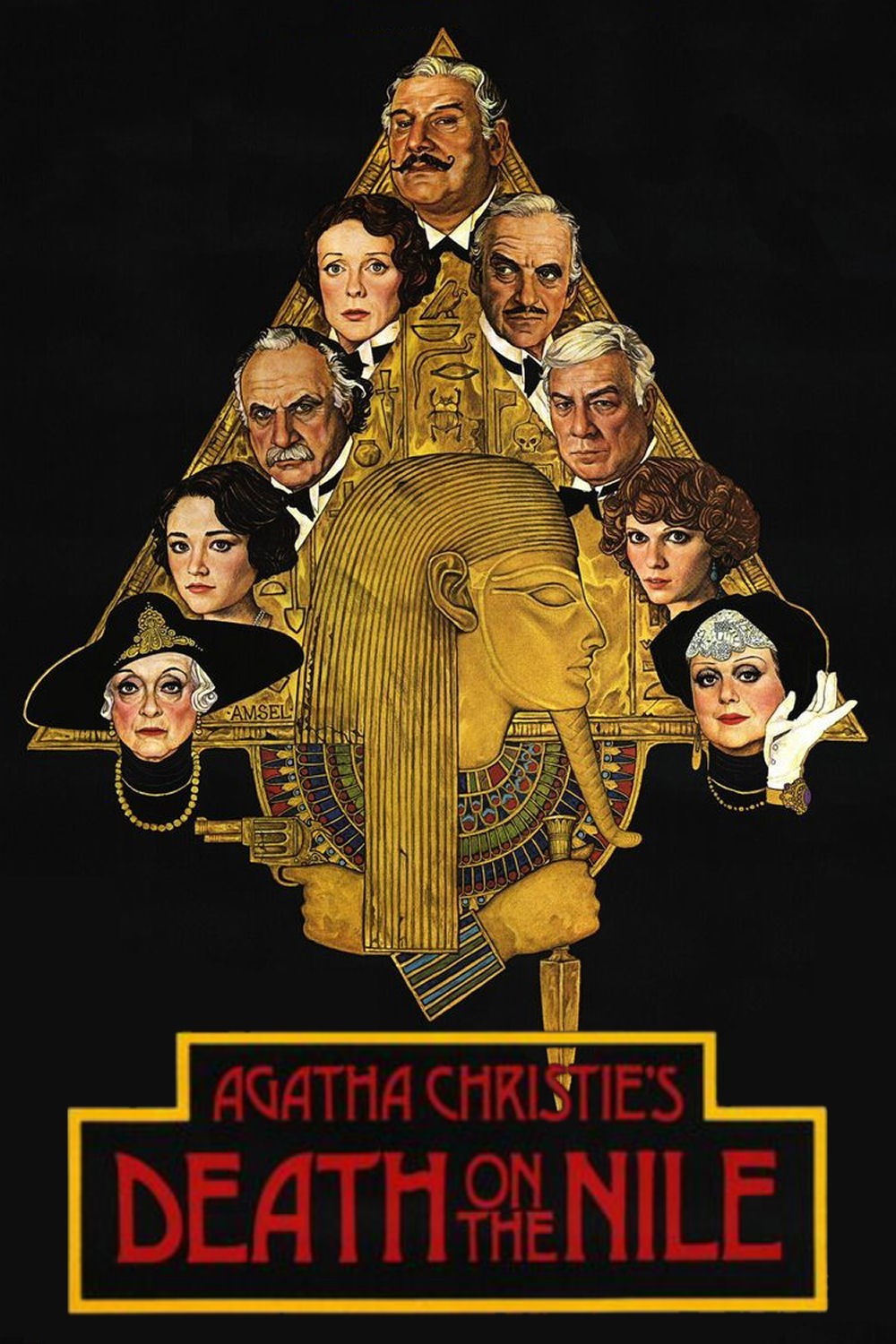
death-on-the-nile.10902After joining Mallowan’s digs throughout the Middle East, trains, boats, islands, archaeological digs and isolated resorts emerged with indelible force in Christie’s work, replacing the stately homes, villages, and coastal towns she’d limited herself to.

Readers can see the transformation taking place across the Parker Pyne collection, in which Agatha Christie combined exotic locations with marriage fallouts, but it made for pleasant distraction more than gripping crime drama, and was possibly not enough to placate her damaged heart.

It wasn’t until she located an array of scheming lovers – with no patience for divorce – right within her great ‘destination crime’ cycle that she found the winning combination.

These shameless paramours do away with hapless wives far from home, but they never quite get away with it. Christie delivers justice in the form of a funny little Belgian with a penchant for travel, and forever challenges her readers to guess who life’s real villains are.

pluck-cover
BUY NOW

The author who never had an exotic honeymoon when she married Archie Christie on the eve of war had finally flown the coop for good, and in doing so she became the Queen of Crime.

© Michael Burge, all rights reserved.

This article appears in Michael’s eBook Pluck: Exploits of the single-minded


Where angels fear

pluck-cover
BUY NOW

LEAVING a mark on history is usually the result of courage, but it always starts by simply making a stand.

Since 2009, Michael Burge has written about single-minded individuals who faced fear, grief and oppression, yet went through with defiant acts of social and cultural rebellion.

Pluck is Michael’s re-examination of several divas, dilettantes, groundbreakers, chameleons, rebels and heroes faced with crossroads, comebacks and reinventions.Many of them got a very bad name in the process, or had their motives shrouded in mystery.

This fascinating collection reveals new perspectives on fame and sheds a timely light on lives which may never be acclaimed, yet went where angels fear to tread.


Extracts from Pluck.

“Remembering Orry-Kelly comes with a pretty big Hollywood revelation, one which has undoubtedly contributed to his relative anonymity in the country of his birth, because Kiama’s forgotten son knew another Hollywood icon, loved and lived with him, long before they both made it big on the silver screen …” from Orry-Kelly – the costume king from Kiama.

“Altering the plot of Pride and Prejudice by one degree would expose prospects for Georgian women which Jane Austen might never have contemplated. Kill-off Mr Bennet in the feared duel over his daughter Lydia’s elopement, and his women might land in the same boat as Mary Pitt and her five children, on a factual voyage from Dorset to New South Wales in 1801 …” from Grit and Gentility.

“A human side to this seemingly untouchable superstar.”

“It was reported that Whitney Houston had apologised to fans during a live show for not being able to reach the signature high note towards the end of her most famous song, which was odd not because an apology seemed so honest, but because this was Whitney Houston, ‘The Voice’. It showed a human side to this seemingly untouchable superstar, but in hindsight it was an indication that an extended silence was on its way …” from The soul searching of Whitney Houston.

© Michael Burge, all rights reserved.