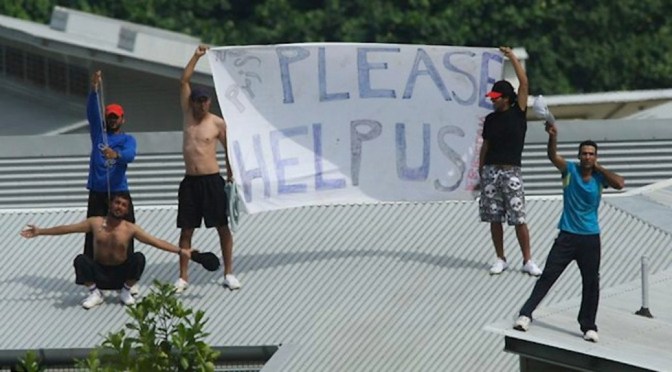

A Writer interviews George Georgiadis, refugee advocate.
THE Australian twittersphere freaked out when refugee advocate @VanessaPowell25 was threatened with legal action by the Department of Immigration and Border Protection (DIBP) in April, 2014.
Unless she removed a post on her Facebook, which documented one moment at a protest outside the Villawood Detention Centre in Sydney’s Western Suburbs, the DIBP would “consider our options further”.
“What else are detention centres, if not concentration camps?”
Public servants tweeted about looming changes in policy on the use of social media for political critique, and warned the Abbott government’s $4.3 million in contracts for research companies to trawl the social media, ostensibly to seek “perceptions”, was actually the force behind ‘dob in a mate’.
Talk of tweet deleting did the rounds. Powell removed the post, and her Twitter following tripled to over 800 across the weekend.
Like a few other journalists, I picked over the traces to find the facts, because a comment on Powell’s post by another refugee advocate, George Georgiadis, was the underlying focus of the DIBP.
So I took a gamble and friended him on Facebook. A few weeks later, George replied.
Turns out the man who posted the “offensive” comment was continuing to do what he has done for the past five years, visiting detainees at Villawood twice every week in between his shifts as a mental health nurse.
Yes, George Georgiadis is a public servant, and in the midst of the social media storm, he dobbed himself in on Facebook. This week, I became his 18th Twitter follower.
He didn’t want to talk about ‘that comment’ because, George said, it’s “bleeding obvious” he’s under surveillance, and this issue is not about him, it’s about the men, women and children incarcerated in Australia’s detention centres.
Listen-up slacktivists, we have a lot to learn.

I started by asking George if five years of visits to Villawood had allowed him to witness any change in governmental approaches to mandatory detention.
“What do you mean by ‘a different government’?” George asked. “Both major parties are now almost indistinguishable, we simply have different politicians doing the same thing the previous politicians did”.
“Nor can it be claimed that one party is worse than the other in their cruelty toward asylum seekers. It was the Labor Party’s then Minister for Immigration, Gerry Hand, who introduced mandatory detention in 1992.
“It was the Labor government which reopened the Nauru and Manus Island detention centres. It was the Howard government which worsened conditions for people in detention, however, they also removed children from detention, but it was the subsequent Labor government under Julia Gillard which placed children back into detention,” he said.
“Things have been getting worse, but it’s not because one party’s policies are worse than the other, but rather because we as a nation have become worse.”
In 2011, George Georgiadis appeared in Detention Centre, an SBS interactive documentary in which his barely concealed emotion for asylum seekers’ plight illustrates the passion behind his words.
“I stated that we as a nation had lost our compassion. Now it’s worse, we have lost our empathy by dehumanising asylum seekers in the media, breaking their spirits, returning them to where they have fled from,” George said this week.
“I mean, for God’s sake, we are now trying to send Syrians back to the horrors of Syria! Children born in detention are being kept in detention! People Australia recognises as refugees have been held in detention for five years and will continue to be held indefinitely.
“There are over a thousand children being held in detention centres, pregnant women and newborns are being sent to detention on remote islands lacking facilities. How is any of this acceptable to people who supposedly pride themselves on living in the land of ‘a fair go’?
“You can’t just continually blame the government in a democracy. The Australian peoples’ hands are not clean in this either,” he said.
Touché.
“A concentration camp is ‘a guarded compound for the detention or imprisonment of aliens, members of ethnic minorities, political opponents’, etcetera,” George said. “That is precisely what detention centres are”.
“They are not ‘processing centres’, because there are asylum seekers being held in indefinite detention because they are ‘Stateless Persons’. What ‘process’ can they go through other than being granted a nationality?
“They are not ‘processing centres’ because there is no ‘process’,” he said. “Since Manus Island was re-opened, not one asylum claim has been processed, not one”.
“This is not ‘administrative’ detention as is claimed in order to justify its indefinite nature, it is quite obviously punitive detention, and worse, it is the punishment of innocent people seeking refuge in Australia with the aim of deterring other innocent people from seeking refuge here,” George said.
“They are being punished for not only their own innocence, but the innocence of others.
“This nation has gone mad, and is completely insightless about its madness. People who have broken no law are indefinitely locked up in detention, they are dehumanised, cut off from society, denied freedom, denied access to legal assistance or trial, they are killing themselves, cutting themselves, hanging themselves and now they are being murdered.
“What else are detention centres, if not concentration camps?”
Why does George believe successive Liberal and Labor governments have sanctioned this treatment of people?
 “It’s simple,” he said. “It’s scapegoating. There is a brilliant story by Ursula K. Le Guin entitled The Ones Who Walked Away From Omelas which describes a ‘utopia’, a city in which everything is idyllic and whose inhabitants are intelligent and cultured. But the happiness of Omelas depends on one thing: a single, unfortunate child must be kept imprisoned in filth and darkness and must not be shown any kindness”.
“If any kindness were to be shown to the child, the peace and prosperity and happiness of Omelas would end. Each citizen of Omelas learns of the existence of this child at their coming of age. Most are shocked and horrified at first, but soon learn to accept the child’s fate.
“A few, however, choose not to accept, and they walk away from the ‘bliss’ of Omelas which they realise is, in reality, a dystopia because of the abused child.
“This is much like what is happening now in Australia,” George said.
“If you want people to vote you into power, the easiest way is to create an imaginary enemy for people to fear and then promise to protect them from the bogey man.
“‘Border Protection’ sounds impressive until you realise we live in a nation which has no borders with any other country, yet now has a government department responsible for protecting those imaginary borders. It’s advertising hype to buy votes, nothing more.
Five years of visiting asylum seekers has given Georgiadis a deep awareness of detention experiences. How has this impacted on him?
“I was actually scared about what I was getting myself in to, and that fear, in some ways, has proved to be justified,” George said. “When I saw for myself what was happening to fellow human beings, I couldn’t go back to not seeing it. My life has changed dramatically as a result, and I’m glad it has”.
“The despair of the situation, the hopelessness, the apparent indifference of the majority of Australians to their plight, not knowing the reason why you are imprisoned and having no redress, the years of young lives wasted away, being separated from contact with family and friends,” he said of what he has seen as a visitor to Villawood.
“I have to be very careful here because there is a genuine fear that cases which are discussed in the media are unofficially punished with adverse assessments. This climate of fear has, in my opinion, been deliberately created to prevent cases coming to light which show the cruelty and inhumanity of the system.
“It is not safe to do so now, perhaps in years to come when the concentration camps are closed, individual cases will be able to be openly discussed.”
What can ‘average’ Australians do to help asylum seekers?
“They need to stop being average. Average people are the most destructive to the world in my experience,” George said. “The average Australian couldn’t care less about our inhuman treatment of asylum seekers”.
“If we think of it as a bell curve, about 20 per cent of the population care about what is happening and want the inhumanity to end. On the other end of the curve, another 20 per cent hide their racism and bigotry under the guise of ‘Border Protection’ and ‘saving lives at sea’.
“The middle 60 per cent – the ‘average Australians’ – try to reassure themselves that their silence on the issue is neither condoning nor condemning,” he said.
“Asylum seekers have become political footballs and have been demonised in this nation, and this dehumanisation has allowed us to lock them in prison indefinitely – even children and newborns – without charge or trial.
“To remain silent in the face of this is like remaining silent when you see a child being molested. There is now no ‘morally neutral ground’ on the issue of the treatment of asylum seekers in Australia,” George said.
“Ultimately, each person has to decide for themselves whether or not to ‘walk away from Omelas’, but I recommend making the decision that you will wish you had made when looking back on your life on your deathbed, and once you make that decision, act on it.”
For those who act, is there a way to gauge the impact of their actions?
“What makes a difference to the issue of our treatment of asylum seekers are the peaceful protests around Australia, the candlelight vigil for Reza Barati (the asylum seeker killed during a riot on Manus Island) which drew 15,000 and the Palm Sunday rallies around Australia which drew more thousands,” George said.
“Trying to stop the buses from taking handcuffed asylum seekers to remote detention centres is an act of love by a friend for a friend, but angry violent protests will never achieve anything in my opinion.”
It was George Georgiadis’ comment on Vanessa Powell’s public image of a bus intended for detainee transport from Villawood to Curtin, Western Australia, which drew the attention of the DIBP. I asked George if he recalled his comment before it was deleted.
“Actually, no, I can’t, but if you read the three DIBP’s tweets, they differentiate between the comment and the post, and insist that the whole post, not just the comment, be removed.
“The post was a photo of the back of a private coach being used to transport handcuffed detainees and the name of the bus company and their contact details were on the back.”
How did it feel to be singled out in this way?
“Laughable. If the aim was to have the post removed, why on earth would you make a public tweet about it to draw attention to it instead of sending a private message? If this is a result of the $4.3 million taxpayer dollars spent on social media research, I’d be asking for my money back,” he said.
“It’s ironic that for a department which insists on keeping the public in the dark about operational matters, it has managed to publicly disclose the names and identifying information about detainees in its care and also publicly draw attention to a post they supposedly wanted removed.”
George cites a Sydney Morning Herald report on the Abbott government’s contracts for social media analysis about border protection as the reason his comment came to the DIBP’s attention.
When asked about whether being a public servant should prevent him from commenting on government policy, George Georgiadis simply said:
“Yes I am a public servant. I was always under the impression that, in a democracy, a public servant serves the public and that the government is supposed to do the same.”
This article first appeared in No Fibs.
© Michael Burge, all rights reserved.
This article appears in Michael’s eBook Creating Waves: Critical takes on culture and politics.