
All posts by Michael Burge

Journalist, author, artist

Surviving the heat while the world’s watching

A Writer on how the story often gets told regardless.

THE world will be watching Brisbane, Queensland, for the upcoming G20 economic summit in the city. For a few weeks, if they’re savvy, international media (and social media) will be capturing stories straight from the heart of the Australian state named for Queen Victoria.

The last time this heightened media attention occurred was the focus on Russia’s gay and lesbian rights track record in the lead-up to February’s Sochi 2014 winter Olympics opening ceremony.

“Once the disenfranchised have a name, they can never remain a blind spot, even for an entire nation.”

At that time, equality advocates in Australia really had nothing to crow about.

When the same inquiring analysis cast its eye over Australia’s human rights standards at the Sydney summer Olympics in 2000, we were found wanting, and I don’t believe we’ve ever really recovered.

International press attention found the majority of Australians ignorant when it came to knowledge of Aboriginal culture and politics, and with Aboriginal athletes and performers taking centre stage at the world’s largest sports carnival, there really was no excuse for us to have so little idea about even the basics.

Fourteen years ago, I doubt most Australians could name the traditional Aboriginal nation in which they resided. I thought I did, until I realised I was living right at the junction of at least six of them.

ABORIGINAL NATIONS of Australia.

I learned this not from my formal education, but from maps exhibited at Australia’s interpretive show for the world about the history of this land, once considered a ‘new’ world by European explorers, but in reality an island continent inhabited by the oldest established culture on earth.

These days, the names of Aboriginal nations are commonplace. The issue doesn’t stop there, of course, but once the disenfranchised have a name, they can never remain a blind spot, even for an entire nation.

In time, I believe an observable change in Aboriginal equality will stem from the year of the Sydney Olympics, because after the world witnessed the human face of our country, Australians had no more excuses for ignorance.

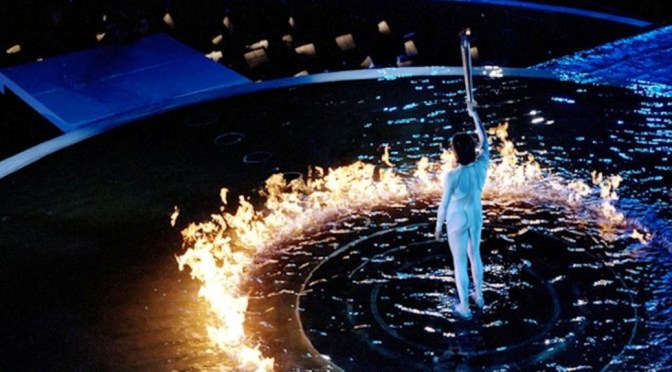
During the penultimate moments of the Olympic flame lighting, a technical glitch caused the rising movement of the cauldron structure to malfunction. It was supposed to rise around Kuku Yalanji and Birri Gubba woman of Far North Queensland, and international athlete, Cathy Freeman.

The four-minute pause allowed the world to take a longer-than-planned look at a living, breathing, self-defining Aboriginal Australian woman. Australians were in the box seat for the viewing – we probably needed to witness it more than anyone – and with the technical fault’s tinge of embarrassment, the reality of Cathy Freeman can never be extricated from the moment.

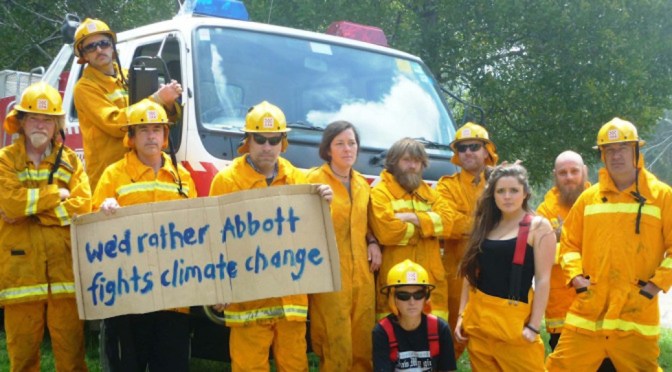
BANNED BANNER One of many which will not be seen by international delegates at the G20 in Brisbane.

Australians should consider ourselves lucky we got off very lightly compared to other Olympic human rights controversies, and we should not point the finger so quickly at others. If we do, we’re forgetting the sting of the Olympic human rights flame as it shone the light on us.

It will be interesting to see if the cream of international political conservatism is allowed to learn anything while they’re staying in Turrbal country in the place known as Meanjin since long before it was renamed Brisbane by European settlers.

Early signs from the G20 are not promising, after billboards promoting action on climate change were banned by the Brisbane Airport Corporation, and Aboriginal offices have been forcibly closed by Brisbane City Council without adequate explanation.

We can only hope for a technical glitch to get the real story to the world.

© Michael Burge, all rights reserved.
 

Burning issues for Tony Abbott

A Writer puts Direct Action on climate to the test.

CLIMATE change efforts in Australia have become a matter of simple mathematics.

With the Coalition’s Direct Action Bill in place just this week, after a deal struck with the Palmer United Party and Senate crossbenchers, Australia is now attempting to reduce its carbon emissions by 5 per cent by 2020.

It’s official: we’re trying, and we won’t have to wait very long to gauge if this policy of financial incentives for major atmosphere polluters to reduce emissions is working.

Mind you, the repeal of the perfectly good carbon tax was supposed to reduce my electricity bill. So far, it’s gone dramatically skyward, no matter how many times Environment Minister Greg Hunt assures me it has not.

Meanwhile, our television screens are replete with footage of Tony Abbott planting trees, as though fixing climate change was that simple.

But the first visible signs of Mr Abbott taking Direct Action against climate change as Prime Minister came a year ago, with his televised efforts fighting fires with his local Rural Fire Service (RFS).

While it’s commendable that he so visibly helped NSW volunteer fire fighters during the bushfire crisis in New South Wales in October 2013, by rolling up his sleeves and getting his hands dirty, questions were raised at the time about whether his government was doing its international climate change fighting as collaboratively.

“The guy doesn’t like talking about climate change, it’s clear.”

It seemed terrible timing for the newly-minted Prime Minister to close the Climate Commission, a science-based climate authority created under Julia Gillard’s leadership, just before some of the most damaging and unseasonal bushfires were linked, by scientists, to human impact on global warming.

Although I can see why many analysed Mr Abbott’s fire fighting motives, I’d rather he just encourage his MPs to volunteer for their local RFS, and look to ways he might represent us at international climate change events. Representing us is, after all, his job.

While bushfires ravaged parts of NSW in October and November 2013, destroying homes and impacting lives, the Intergovernmental Panel on Climate Change (IPCC) was meeting in Georgia.

The IPCC is described as: “The leading international body for assessing the most recent scientific research on climate change”. It’s outcomes are regularly reported in the Australian media, and not just the left-leaning titles.

In November 2013, climate change talks in Warsaw came and went without an Australian delegate.

Further bushfires occurred last summer, the most damaging were those in Western Australia in the Perth Hills region in early January.

Peak-of-summer bushfires are a commonplace occurrence in Australia, so the climate change link was not so intense in the media at the time.

In September, Mr Abbott neglected to publicly explain why he missed a UN climate change summit in the United States by just one day, while attending talks on Australia’s military  involvement in Iraq.

The guy doesn’t like talking about climate change, it’s clear.

As the traditional bushfire season takes it grip nationally, it will be interesting to observe attempts to hose the climate issue down, or whether unseasonal bushfires are assimilated into the new Direct Action plan.

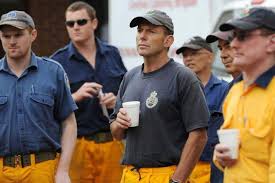
GETTING HANDS DIRTY Australia’s Prime Minister, and local fire fighter, Tony Abbott.

Direct Action is the perfect solution for a local bushfire. Hazard reduction, containment lines and controlled burns are all utilised in the battle. Local RFS brigades are assisted by interstate teams when more assistance is required. On many occasions, international crews and/or equipment (such as aerial fire fighting machinery) are deployed from overseas. Bushfire fighting is an international movement which assistance to afflicted communities when there is a need.

If it’s okay to have an international fire fighting movement (the cure), what is wrong with an international community fighting the potential causes of extreme fire conditions (the prevention)?

What I hope is that the government has its eye on the issue  and someone (perhaps an elected leader?) sparks a rational debate based on the data, because surely Australia’s bushfire statistics would be of relevance to international climate change talks?

Only one person in this week’s Prime Minister’s Science Award’s audience gave Tony Abbott a loud show of applause after his speech, which seemed designed to inspire forgiveness for the Coalition’s terrible track record on supporting the concept of science.

His deft joke around the deafening silence was one thing. Whether Direct Action does what he is so confident it will, will be another.

As the Coalition is so fond of telling us: let’s wait and see.

But I suspect we’re witnessing a little of what Direct Action on climate change will consist of: getting hands dirty locally, fighting fires and planting trees, and plenty of support for coal mining in a continent perfectly designed for solar and wind energy capture, with no eyes in government on the bigger picture.

© Michael Burge, all rights reserved.
Poets’ Land

POET'S LAND Pen y Ghent seen from Lower Winskill.

WHEN I am gone,
Bury me not in dusty claims with my forebears,
In dry-rot graveyard, by tin-roof church and dunny.

Give me not to the sea, for wrasse-filled rockpool’s swallow.
Don’t leave my ashes high, escarpment winds to hollow.

Just fold me up,
Where weathered rock, by dry stone wall
Has made a deeper place,
Where hawthorn hedgerow
Has hidden me a ditch.
A place in green-grass valley,
That would be my wish.

My soul has a footprint
In Poets’ Land,
In rain-sluiced loam,
On flatbed stone,
Where shepherd, waller, and my tear-stained boy
Can call me home.

© Michael Burge, all rights reserved.