All posts by Michael Burge

Journalist, author, artist

The desecration of story

WE'RE WATCHING but we're sick of waiting. Smaug's eye from The Desolation of Smaug.
WE’RE WATCHING but we’re sick of waiting. Smaug’s eye from The Desolation of Smaug.

MASTER storytellers don’t come along very often. You’d think by now we’d have learnt to respect their work.

Mess with the canon of any of these literary icons, and you’ll spark a reaction of such magnitude that it could, in at least one case, cause a war. You see them at the top of the ‘Most Popular Books of All Time’ lists – Charles Dickens, Jane Austen, William Shakespeare, the various authors of The Bible, Homer, Agatha Christie, and, usually scoring two spots for his seminal fantasy titles – John Ronald Reuel Tolkien (1892-1973).

Yet all of these writers’ works have been the subject of translations, adaptations, mash-ups, and spurious references in Doctor Who. It seems there is no end to re-imagining plots that have already proven themselves popular with readers.

The latest on our screens is Peter Jackson’s production of Tolkien’s The Hobbit, the 1937 children’s fantasy which spawned one of the most beloved literary cycles of the 20th century – The Lord of the Rings (1954-55).

Like countless others, I devoured these works in my childhood, so it was strange when I found myself dragging my feet to see The Desolation of Smaug at the cinema.

But that wonderful shot of Smaug, unfurling his great wings, the hapless Lake Town in his sights far below, was every inch the Tolkien moment I was seeking.

Yet before we could ride the crest of the roller coaster, the credits rolled, and, with news that we’d have to wait until Boxing Day a year hence for the third instalment, I heaved a sigh of annoyance.

This was not storytelling. This was commercially delayed gratification.

Peter Jackson’s Hobbit movies will never escape the criticism of taking a simple childrens’ tale and padding it into a three-part prequel to The Lord of the Rings.

We cannot blame Tolkien, of course, but it is worth noting that he created many of his early stories for his children. Imagine what the kids would have thought had Dad told the tale in three episodes, a year between each: they would have lost interest, thought their father a very mean and boring man for withholding, and revolted!

SCRIPT SPOILERS Gandalf and Radgast in search of Sauron.
SCRIPT SPOILERS Gandalf and Radagast in search of Sauron.

About half way through The Desolation of Smaug, with Gandalf off tomb raiding, my sister, not a Tolkien reader, turned to me and asked whether the disembodied shadow of Sauron was actually ‘in’ Smaug the dragon?

It was a good question, considering Gandalf and Radagast were looking for something that Bilbo already seemed to have found.

Tolkien knew how to construct a plot, and he took his time doing it. Not for him the publishing schedule of Harry Potter.

There was a very good reason why Sauron does not appear in The Hobbit: because when Tolkien wrote that childrens’ book, he was unaware how far his mythology would evolve in its sequel.

Tolkien’s collected letters reveal that at the behest of his publishers, the rise of Sauron (known as ‘The Necromancer’ in The Hobbit) was only published in an interesting appendix in The Return of the King.

Writing to a reader of The Lord of the Rings in 1964, Tolkien revealed how he connected the two books with the One Ring.

“The magic ring was the one obvious thing in The Hobbit that could be connected with my mythology. To be the burden of a large story it had to be of supreme importance. I then linked it with the (originally) quite casual reference to the Necromancer [in The Hobbit], end of Chapter. vii and Ch. xix, whose function was hardly more than to provide a reason for Gandalf going away and leaving Bilbo and the Dwarves to fend for themselves, which was necessary for the tale.”

Mythology, which runs through the works of all the writers mentioned, is the archetypal source for all tale-telling. Twist mythological rules, and everything from The Odyssey to Pride and Prejudice is at risk of being deemed, well, boring.

When Jackson and his writing team were coerced by the distributors into three Hobbit films, they needed to pad-out Tolkien’s mythology with endless sequences of Legolas slaying orcs; extensions of famous scenes, such as the dwarves’ escape from the Elven King in barrels down a river; and Gandalf the Grey sniffing his way around graves and towers with Elrond and Galadriel in search of Sauron.

DRAGON VISION Tolkien's own depiction of Bilbo's comversation with Smaug.
DRAGON VISION Tolkien’s own depiction of Bilbo’s comversation with Smaug.

I can accept Legolas, a character who never appeared in The Hobbit, and I can even buy his love interest Tauriel, a totally new creation re-addressing Tolkien’s inherent plot-misogyny, because Jackson and his writers are doing what Shakespeare did with great stories: shaking them around to find stronger, fresher ideas to engage new audiences.

But two master villains – Sauron and Smaug – in the same story is akin to having Moses and Jesus in the same telling of Exodus, or Romeo and Juliet and Mercutio. It’s too crowded to pack a real punch.

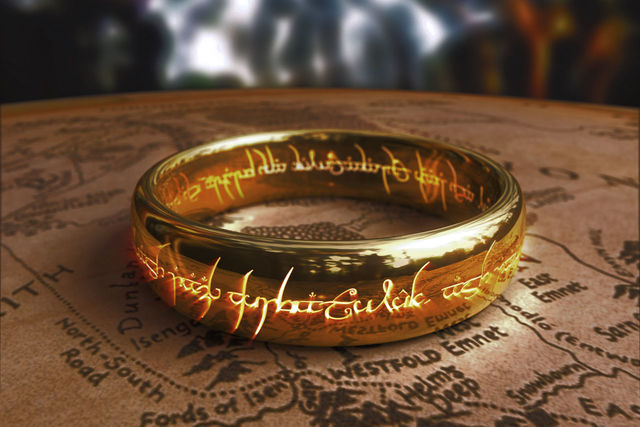
ONE RING TWO STORIES Tolkien's One Ring as it appeared in Peter Jackson's films.
ONE RING, TWO STORIES Tolkien’s One Ring as it appeared in Peter Jackson’s films.

Audiences who watch the six-movie Lord of the Rings cycle consecutively will be denied the great tension which Tolkien builds up in The Fellowship of the Ring.

They’ll miss a storyteller’s masterstroke, the linkage of Bilbo’s journey with Frodo’s through the secretion of Middle Earth’s most powerful implement, that plot device of “supreme importance” – in a place no one, not even Gandalf, ever thought to look.

To know the power and significance of the ring above being a handy trick for a hobbit engaged as a burglar, and to know the extent of Bilbo’s real enemy long before he does, is a terrible case of spoilers.

Money people don’t trust writers. They never have, and they probably never will, which is one reason why none of the Lord of the Rings movies ranks anywhere near the top of the Favourite Movies of All Time list, whereas Tolkien’s books rank second only to the stories we rely on to explain our own world’s creation.

creating-waves-cover
BUY NOW

Messing with Middle Earth might not spark a war, but it’s testament to the power of Tolkien’s writing that audiences will pay to see the butchering of his work at the hands of New Line Cinema and Metro Goldwyn Mayer.

© Michael Burge, all rights reserved.

This article appears in Michael’s eBook Creating Waves: Critical takes on culture and politics.

Meeting Mittigar

COUNTRY CUSTODIAN A man of the Darug Nation (Photo: David Walsh).
COUNTRY CUSTODIAN A man of the Darug Nation (Photo: Kevin Welsh).

A writer’s encounter with the Darug Nation.

Writing for Blue Mountains Life magazine brought plenty of insights into the region’s finest homes, yet whenever an early property’s history was explored, a constant theme arose – the indigenous heritage of the Hawkesbury and Penrith Valleys.

Ever since the area was earmarked for land grants and agriculture in the colony, European settlers and their descendants encountered the traditional owners of the lands adjacent to Deerubbin, the Darug name for the Hawkesbury River.

There’s also the matter of warfare between the settlers and the Darug, a subject rarely spoken or written of, yet an unavoidable part of the Hawkesbury’s history. This article was published in the Aug-Sep 2011 edition.

Custodians of country

Learning pathways at Muru Mittigar.

Researchers, community members and tourists are able to share a brilliant resource in Muru Mittigar. Meaning ‘pathway to friends’ in the Darug language, this cultural centre, adjacent to the Penrith Lakes, has reached out with a message of reconciliation and learning since its establishment in 1998.

The day I visit, Wayne Krause shows me through the newly renovated shop and the cultural centre itself, where a timeline, a map of Australia’s Aboriginal territories, and interpretive signage illustrate the journey of Australia’s Aboriginal people, with a focus on the place of the Darug Nation.

It becomes clear very quickly that this is not a museum in the European tradition – it comes to life only with the guides, who interpret Muru Mittigar’s displays for visitors.

“‘Art’ is European terminology,” Ngemba man Peter Williams explains, as he interprets a painting on Darug law. “This picture is telling the story in the old way, what you can and can’t do, where you can and can’t go, in relation to Darug Country”.

“The hands done in red are those of men who have done law. The hands in yellow are those of women who have done law. The black and white hands are those men and women who have not yet done law.”

Symbols of islands in the Hawkesbury-Nepean river, of land bridges, of nets for catching animals, of bush turkeys, quolls, possums and other food sources in the region are easier for me to interpret than the concentric circles – “They represent the law itself,” Peter says, also showing me the spirits figures in the work.

Peter and Wayne explain in turns how Darug culture fits into the whole of Australia’s Aboriginal landscape, often ribbing one another on points of learning and territory, yet it’s clear these men, despite being of different nations (Wayne is of the Kalara people of the Wiradjuri language group), are brothers.

“We’re all one,” Wayne says, “but there is a diversity of culture in New South Wales”.

I arrived with a basic understanding about who was a famous Darug warrior, and who was of a neighbouring nation, but both Peter and Wayne are quick to explain how warriors like Pemulwuy (featured in a near life-sized image at Muru Mittigar) are considered brothers of the many Aboriginal nations of Australia’s east coast.

“It’s not about skin colour,” Wayne says, “it’s about spirit. All the mobs have relations with others. Our dreaming coincides. Clan groups and skin groups travel, and you encounter the same stories, and the stories never stop.

“In this country, there are more sites – art sites and camp sites – than anywhere else in NSW. It’s been estimated that there are 27 sites per square kilometre.”

When I ask Wayne if it’s Muru Mittigar’s role to preserve these, he says: “It’s our job to ensure Aboriginal culture is practiced, not preserved. Aboriginal culture is alive. The challenge is now to make sure our Mother, our country, survives.”

“Muru was a necessity,” Peter adds, “to set up a permanent base for teaching. I needed to be taught Darug language, and now we have fluent speakers.”

“One of our dreams is to develop courses for people to learn about culture,” Wayne says, and Peter quickly adds: “It’s a slow process, bringing mobs together, teaching people to be one again. The law has been lost, and respect. The settlement turned everything topsy-turvy. The money system became greater than the law.”

“It’s time to come back, to take away the power struggle that money brings. It’s not ‘mine, mine, mine’, we are all custodians,” Wayne explains.

Looking over a map of Australia’s Aboriginal nations, Wayne and Peter demonstrate something about how Aboriginal interconnection works.

“If you know your clan, family, blood, animals (totems, or ‘meat’), your scarring and your teeth,” Wayne says, “you could travel across this country and the people will know where you fit into the system”.

“It’s not about which clan had which land,” Peter adds. “You can walk and sing your way through country”.

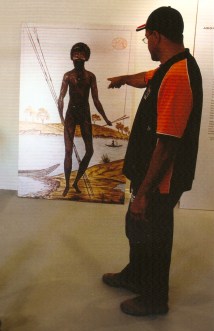
PROUD WARRIOR Peter Williams interprets a portrait of Pemulwuy.

“Which you can’t do by flying across it in a plane,” Wayne is quick to point out.

When it comes time to ask about the wars between settlers and the Darug in the Hawkesbury, both men are clear that conflict was secondary to settlement.

“Many of the settlers were starving, and the indigenous people showed them how to survive, what to eat,” Wayne explains. “The wars happened when the indigenous peoples’ source of food was taken away. When Bennelong went to London, he saw what was coming and he knew there was no way it could be stopped, but by the time he came back, there was full-scale war.”

Looking again at Pemulwuy’s image, Peter explains how the warrior’s family scars are similar to his own: “But if you were at the same camp fire as him, you’d sit still and be respectful otherwise he’d be able to-” and he slaps a fist into himself.

Peter also notes how none of Pemulwuy’s teeth are missing, another symbol Aboriginal people look for to interpret another brother or sister’s place in the community.

I ask Peter and Wayne where they learnt about their country and their law, and they name the three uncles who, twenty years ago, ensured the next generation learned what they needed to.

“Learning breaks down barriers that don’t need to be there,” Wayne says. “It’s not about blame, it’s about teaching others to look after Mother Earth.”

“Muru encourages our people into higher education. Not just the training but employment too, in tourism, hospitality, woodwork and other industries. As an Aboriginal not-for-profit corporation, Muru Mittigar has a high amount of employees.”

“The Darug were pretty-much decimated,” Peter says. “There were diseases we had no resistance to, and we were blended into the community as a whole. We’re never going to know the full story until the law comes back, but people learn culture on many levels. and we teach what we know.”

The effects of the Hawkesbury’s settlement by Europeans is just one part of Muru Mittigar’s story – I leave with my preconceived ideas replaced by a growing understanding of the land that we share, and the feeling that the Darug nation is in very good hands.

© Michael Burge, all rights reserved.

Very Good With Words

WRITTEN OFF words become action.
OUT OF THE PAGE words can become actions.

A Writer takes ownership of an insult.

ONE of the most cutting slights ever levelled at me turned out to be the greatest compliment I ever received, and one which really put fuel in my tank as a writer.

I’ve read plenty of self-help books in my time. The one I responded to the most was The Artist’s Way by Julia Cameron. In its pages, and through its practical sessions, I managed to find direction enough to keep going through tough times as an artist.

I also developed a swag of practical tools for dealing with the obstacles in every Artist’s way, not only those within myself, but those that come from other people.

So it was probably not so coincidental, when embarking on my first round of The Artist’s Way, a program based squarely in the 12-step recovery principles of Alcoholics Anonymous, that I manifested a very close friendship with a recovering addict.

By the time I knew she was an alcoholic, Claudia was about to move into my house. I thought about her announcement, remembered my upbringing about not turning away people in need, and helped her move into my spare room, where she lived for almost two years.

I was thankful that I didn’t have to cohabit with someone who would forever be dragging me to the pub at the top of our street. My coming out was made easier by having a house mate with her own baggage, and we had a history because our parents had been good friends when we were at school. It was a case of win-win for two families.

Warning bells rang when I came home a year later with the strong sense that everything in the house had been moved, just a little, like someone had been picking through the antiques I’d inherited from my grandmother.

Claudia had disappeared, her new boyfriend (who was avoiding drug court) at the wheel. On their way to score drugs, they’d stolen her mother’s safe, before the seedy side of the Western Suburbs opened its arms to them.

She had ‘swapped the witch for the bitch’, as they say in Narcotics Anonymous, and added heroin to her other addictions.

I fielded desperate phone calls from her family, managed to find Claudia on the phone, and challenged her to come home from the dire moral and legal reality she’d manifested.

When she did, I opened my door to her, even though she had a key and was ashamed to use it. After she stepped over my threshold, she stayed clean for the rest of the time she was under my roof … as far as I know.

Having grown up in a divorced family, I don’t know why I was blind to the possibility of ‘friend divorce’ around every corner of my friendship with Claudia.

So it came as a shock that she was incapable of helping me as I had helped her.

Claudia was the first person I could reach on the phone when my partner died suddenly. She came to my side, but my needs became larger than hers at that time, and she had no way to cope with that reality. Weeks after Jono died, Claudia was out of my life too.

Nothing if not naive, I went back when she found ways to offer me support, but she called me one day when I was standing on a train platform, on my way to a party.

She muttered something about having sent me an email she wanted to me to read. It sounded serious, so I offered what any true friend would do: I said I’d delete it without reading it, if she wanted me to.

“No, I want you to read it,” she said.

The next morning, I did. In it, she wrote that our friendship was over.

I knew the feeling of having to express something in writing as opposed to just saying it. I’d been that way ever since I announced that I couldn’t wake my baby brother in his cot. The ramifications of those spoken words were dire for my family.

So I didn’t go into, ‘you could have just told me’ territory, which is just a case of shooting the messenger.

I did what comes naturally to me, I wrote a reply. In it, I rose above Claudia’s definition of the status quo. At that time, I was having plenty of new world orders foisted on me in my grief.

Claudia rang. Her voice was distant, what I’d come to call ‘drug-frozen’. She managed to force out some clipped platitudes, which I eloquently rebuffed. She was, after all, only fifty per cent of this friendship, and her truth applied to only her half.

“You’re very good with words,” she said, low and cold.

“As are you,” I said in reply.

We both spoke the truth.

In that moment I came to terms with being a friend to an addict, and how we become like islands onto which they wash up, where they receive our succour, and our help to climb the mountain, all the way down to the far shore, where they dive in and swim away.

But they leave us wiser, emboldened by their definition of us, even as they try to demolish us. We’re able to spot others of their kind on their way to our shore, able to help them onto their legs, point them to the mountain and say, simply: “Start climbing”.

Since then we’ve both become very, very good with words, Claudia and I.

But while I took an overdose of the truth and became addicted to speaking and writing it, Step Nine tells me she’s still got work to do.

© Michael Burge, all rights reserved.