Category Archives: LGBTIQ Equality

Nuptials and the Deep North

WEDDING PARTY Elves around the fire at our reception.

A Writer encounters Queensland’s LGBTQI equality record.

ON the same day as the Northern Territory found that a dingo did indeed take Azaria Chamberlain, the Queensland Government decided to release some news of its own. Perhaps, since there was plenty of other distractions for the media, they thought we wouldn’t notice?

A very important factor in our decision to move to Queensland was its record on same-sex equality.

Despite the state being a bit late on decriminalising homosexuality in 1990, in 2011 the Bligh Government passed a bill allowing same-sex civil unions.

But on Tuesday, June 12, 2012, Newman’s new conservative government bowed to pressure from christian groups and repealed part of the legislation. Civil unions are still legal in Queensland, but no state-sanctioned ceremonies are allowed for same-sex couples creating such unions.

Apparently some christians don’t want to see same-sex attracted people ‘emulating’ marriages in our ceremonies.

Obviously such objectors haven’t been to too many same-sex marriages lately … you see, we don’t really ‘do’ marriage like these christians do. We ‘do’ marriage a whole lot differently.

“The tide has long-since turned for same-sex equality across Australia.”

Richard and I were married at Twizel on the South Island of New Zealand, during a Lord of the Rings tour guided by Discovery Tours, who take people into the foothills of the Southern Alps where location shoots were conducted for the movie trilogy.

We’re not dyed-in-the-wool LOTR fans, we just wanted to get married in a wilderness region without all the hassles of permissions and insurance. The setting was magnificent and soul-lifting, a perfect place to create a lasting union.

Back at home in the Blue Mountains, however, we went further by hosting a Lord of the Rings-themed party in our garden, for our family and friends. Richard thought of the costume idea, because he didn’t want to be the only one dressed-up.

We had quite a small house, but that was offset by a huge garden, so, in late May 2008, we invited everyone for what we hoped would be a lovely autumnal afternoon and evening, outside.

About half an hour before the ceremonial start to the party, the weather took a turn for the worse. Our guests, bedecked in everything from Hobbit feet to Ent branches, and smatterings of Elvish ears, sheltered in a billowing marquee.

Now, The Reverend Fred Nile might have prayed for rain on our parade, but as Richard and I dressed in our medieval-style outfits, a patch of blue sky shone out of the west.

By the time we were marching up the aisle of our driveway, to stand beside the anvil where our guests were forging our wedding bands, the rain was gone.

We were enveloped in so much love – friends playing and singing our favourite songs (our wedding march was ‘Moon River’); family taking care of us (my sister Jen was dressed as an Elf we named Gilgandra, which is pretty close to Galadriel); other friends speaking or performing for us; and everyone braving the conditions around a series of fires, well into the night.

It was an elemental celebration like no other.

Leaving the garden where this event took place was a little sad – little bits of sparkly confetti were always surfacing here and there in our cool climate paradise, a reminder of our wedding party – but this time in our lives was one step on a long journey.

You see, despite some christian’s doubts about the validity of our marriage, we really are in it for the long haul.

We could be angry that Queensland seems to be a case of two steps forward, and one back, for same-sex couples … but we’re already married, and we’ve headed north.

The tide has long-since turned for same-sex equality across Australia, and we were happy to ride that wave into Queensland, with our progressive votes at the ready.

© Michael Burge, all rights reserved.

Boldly going nowhere: the inequality of Sci-Fi

SPACE PHENOMENON Patsy Trench (left) as Cadet Tina Culbrick in Phoenix Five.

A Writer explores the limits of the universe’s acceptance.

“WHEN I was nine years old Star Trek came on,” actress Whoopi Goldberg told Gene Roddenberry, creator of Star Trek, at a casting session for the show’s reboot in the early 1990s.

“I looked at it and I went screaming through the house: ‘Come here, mum, everybody, come quick, come quick, there’s a black lady on television and she ain’t no maid!’ I knew right then and there I could be anything I wanted to be, and I want to be on Star Trek.”

That ‘black lady’ was African-American actor Nichelle Nichols, in the role of Lieutenant Uhura, a character who inspired even Dr. Martin Luther King to follow the voyages of the Starship Enterprise.

Goldberg’s moment of validation and inspiration is now half a century behind us. In fifty years from now, will stories emerge about children today who saw themselves in the current crop of mainstream science fiction titles, or has Sci-Fi lost its edge within today’s asteroid belt of conservatism?

A bit of time travel might unearth some answers.

When George Lucas relaunched the Star Wars franchise in the late 1990s, he created a character whose name still draws ire across the geek chat rooms: Jar Jar Binks.

Designed to appeal to younger audiences in a similar manner to the Ewoks of Return of the Jedi, Jar Jar, a Gungan from the planet Naboo, with his exaggerated mannerisms and flamboyant voice, seemed to have the opposite effect, and he was subsequently toned down and written into the sidelines of two further prequels.

The fear of flamboyant space travellers and aliens was not always so keen. Doctor Zachary Smith in Lost in Space (played by Jonathan Harris) camped and shrieked his way through the series, defying any notion of being sidelined.

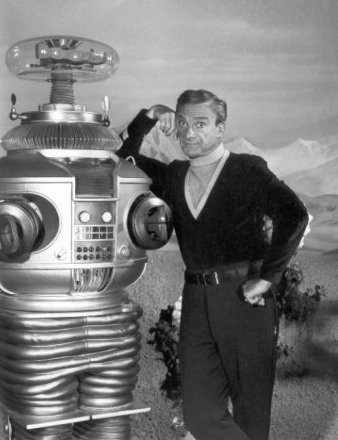
BUMBLING BOOBY! Jonathan Harris as Dr Smith in Lost in Space.

That he was a comically selfish villain, opportunistic in his attempts to get back to Earth, leaving the Robinson family behind, didn’t seem to matter. Flamboyant was fine, as long as you were the bad guy.

More recently the Doctor Who franchise (and its spin-off, Torchwood) experimented with alternate sexuality in the form of the bisexual Captain Jack Harkness (played by John Barrowman), but his intergalactic promiscuity, and the untimely death of his longest love, ensured audiences never had to countenance this high-profile non-heterosexual character in a relationship as progressive as a commonplace same-sex marriage.

Sci-Fi lesbianism is even more marginal, offering only a handful of onscreen same-sex kisses and a whole universe of subtext in everything from Alien: Resurrection to Xena Warrior Princess.

Here in Australia, TV producers were quick to jump on the bandwagon of popular TV series set in the future, with a crop of titles on our small screens by the end of the 1960s.

One of these was Phoenix Five produced by the Australian Broadcasting Corporation from 1968-69.

Amongst the show’s stars was Patsy Trench (now a London theatre guide) in the role of Cadet Tina Culbrick, the only female in a crew of three on the galactic space patrol ship of the show’s title, tasked with protecting the known universe from an evil humanoid and a rebel scientist in the year 2500.

“It was certainly not a progressive series, not in any sense,” Patsy said. “It made no social statements, it was just a series of adventures featuring three humans versus a number of weird aliens”.

“As for gender equality, the characters were all pretty well asexual. We wore identical clothing – a yellow tunic-type top (very cliché Sci-Fi) and very unflattering black ski pant-type trousers. There was absolutely no sense of sexual tension between the three of us and no sense of gender – equality or otherwise. Tina may have objected from time to time to being patronised by her male crew members, but that’s about as far as it went.

HIS AND HERS The key cast of Phoenix Five.
HIS AND HERS The key cast of Phoenix Five in their gender-neutral tunics (Clippings courtesy of Patsy Trench).

“Every single episode I had to say ‘space phenomenon ahead’, whatever that was supposed to mean.

“It became a running joke. I remember pressing a series of buttons without having a clue what they were or what I was supposed to be doing.

“Nowadays a director and actor might pay a bit of attention to that kind of detail, but not then.”

I asked Trench whether she believes Australia was capable in the 1960s of imagining a future that had racial/sexual equality?

“Probably not,” she said. “When I was living there in the late Sixties I did not get the impression the Aboriginal people featured much in people’s consciences, certainly not as they do now. I’m not sure when they were given full voting rights, but I think it was around that time, and I had no idea it had taken so long – the issue was never discussed.”

Does Trench think Sci-Fi has a role to play in imagining a more equal future?

“Of course, because the limits are as huge as our imaginations,” she said.

Territory upon which only the boldest equality explorers tread is one which has long been a source of some of Science Fiction’s most renowned characters: disability.

Few children of the Seventies will have missed the blind, wheelchair-bound Davros who first appeared in the 1975 Doctor Who ‘Genesis of the Daleks’ episodes, probably the most prominent example of a physically disabled humanoid character ever to feature on television screens in our living rooms at prime time.

In her enlightening feature ‘Disability in an alternative universe’ for the ABC’s Ramp Up disability discussion forum, Leah Hobson gets right to the point: “As a fan of science fiction and fantasy – genres which most often ask ‘what if?’ in more playful and profound ways – I notice the dearth of ‘good’ stories about disability”.

“If a character is portrayed with any sort of disability,” Hobson wrote, “a realistic depiction means you’re typically male, and you’re typically either bound to a bitter and/or evil existence with a good dose of sexual openness thrown in just to really show you’re evil.”

Exploring whether there is any positive purpose to depictions of Transhumanism (the human condition enhanced by technology) in Sci-Fi, Hobson found more questions than answers.

I started to enjoy Doctor Who when River Song (played by Alex Kingston) became a regular character, and, in geeky conversations at work about the future of the show, I threw in my view that the show’s producers might be grooming River Song to be the series’ first female Doctor.

And why not? She was riveting, charismatic, intelligent and kept taunting viewers on her backstory with her cheeky warning: “Spoilers, sweetie”.

During 11th Doctor Matt Smith’s unsuccessful regeneration in ‘The Impossible Astronaut’ episode, I hoped to see River’s signature curls emerge from the amniotic glow to be reborn as his replacement. Sure, she was standing right there watching, but this is Sci-Fi, anything could happen, right?

But The Doctor was killed (to tell you more would be a spoiler), along with all my hopes for River Song, who joined Amy, Rose, Martha, Tegan and Sarah Jane, playing second fiddle through time and space.

Dr King made a resounding point when he learnt that Nichelle Nichols wanted to leave the cast of Star Trek. As she recalled, he said: “Gene Roddenberry has opened a door for the world to see us. If you leave, that door can be closed, because, you see, your role is not a black role, and it’s not a female role, he can fill it with anything, including an alien.”

Until mainstream science fiction producers start opening a few more doors, and opening them wider than Roddenberry ever did, equality in Sci-Fi will remain far, far away.

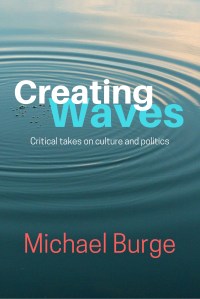
This article appears in Michael’s eBook Creating Waves: Critical takes on culture and politics.

© Michael Burge, all rights reserved.
I have a man here who won’t take off his hat

HATS OFF or else, in some parts of the world.

A Writer’s encounter with the Catholic faith.

FROM the shade of Bodhi yum-cha restaurant we could see the steeples of St Mary’s Cathedral rising above the bustling lunchtime streets of Sydney.

It was Richard’s birthday, so it was up to him where we spent our city day trip. He’d expressed an interest in going to the Australian Museum, just along the road, but the thought of the cool air inside the cathedral beckoned us both.

I’d also wanted to show Richard the reproduction marble of Michelangelo’s heartfelt Pietà sculpture of Mary and the dead Jesus in her lap, which I’d last seen on a school excursion.

That idea sealed the deal, so we paid for our meal and ascended the steps in the heat of a late summer Sydney day.

“I slid onto the cool marble floor and put my hands together.”

I spotted the ‘no photography’ sign at the last-minute, and the memory of numerous cathedral visits in Europe made me think of removing my hat. But there was no sign, and a flock of tourists in hats beyond the threshold, so I shrugged and left my cap on.

The darkness and temperature drop was immediate, as was the sense of calm away from the traffic and crowds. Richard disappeared towards a set of stunning brass gates, as we started our respectful, slow search for the sculpture.

We were soon separated by another crowd of tourists, and I waited in the half-dark by the gates until they passed.

By a door on the eastern side of the nave, I saw a sad sight: an old man, slumped pitifully against a pew, wisps of hair lifted by the breeze. A homeless man, perhaps, or someone so down on his luck that only time in this place of worship could restore him?

His demeanour was so compelling that I turned away, because looking seemed an imposition.

But as I went to move, a sudden jabbing drove into my shoulder from behind.

I turned in shock as a security guard said to me, breaking the calm: “Remove your hat!”

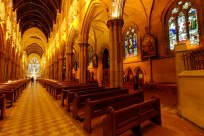
CATHOLIC GROUND Interior of St Mary's Cathedral, Sydney.
CATHOLIC GROUND Interior of St Mary’s Cathedral, Sydney.

In a bit of shock, I paused, looked at the tourists near me, some of whom had heard the guard, and said: “I will, in a moment,” and turned to find my husband.

“You will remove it now,” the guard said, loudly, “hats are not allowed in the cathedral!”

I turned, looked at the be-hatted tourists, and said: “I will remove my hat, when you ask them to remove theirs.”

I moved off quickly and heard him muttering at my heels. Adrenalin rushed through me, the result of the sudden physical attack on my shoulder, and something about the guard’s attitude towards me in particular.

When I caught up with Richard, his hat in his hand, I ascertained that the original request had been made to him. The guard caught up with us and repeated his demand.

I refused, and repeated my request for hat-removal equality in the cathedral, adding that I would be more than happy to remove my head covering when the same demand had been made of all the visitors.

“Women are allowed,” he snapped, thinking he’d snookered me.

I looked at the group again. Women and men, many of both, wearing hats, a point which I assertively made to the guard, before I turned away and determined to find the Michelangelo reproduction.

His unmistakable footsteps came after me, so I did the first thing that came into my head. Inspired by George Emerson in E. M. Forster’s A Room with a View, who, when harassed in Santa Croce, slumped to his knees in a position of prayer, I slid onto the cool marble floor and put my hands together.

Richard chortled.

The guard stopped, tutted, and waited. I could see him out of the corner of my eye. We were in a waiting game I’d need to play to its end if I was going to stay prone, so I took my time, finished my ‘prayer’ and stood, before calmly resuming my search.

“I’d impersonated a devout catholic, so fair cop that he did his best impersonation of what he thought I was.”

My tactic got him off my back, although he kept his distance and tried a new one of his own. He reached for his mobile phone and punched numbers into it as clumsily and implausibly as a comedian would, and said: “Hello? Is that the police? Yes, I have a man here who won’t take off his hat!”

Suppressing laughter, I told him I’d give him a Logie for that performance, and we did a dance of barely controlled energy all the way back to where Richard and I had arrived, my hat firmly in place all the way.

As I left, I turned and saw the guard attempt a dreadful impersonation of a poof. Limp wrist, hand on hip, and a lisped farewell: “Bye-bye, see you laytaaa!”

I laughed. I’d impersonated a devout catholic, so fair cop that he did his best impersonation of what he thought I was, but when I told my husband outside, Richard stormed back in and demanded the guy’s name.

Holding his hand over his badge, he began a tirade that did not end until we were both ejected through the door onto the steps, the place where thousands, perhaps millions of those in need had sought help from the church: at their door.

Adding to the surrealism of the moment, the poor soul I’d taken pity on by the eastern door came over and joined in the very loud rant about respect, hats, and who gets to wear one and who doesn’t on hallowed catholic ground, saying we could do what we liked in the world, but in the cathedral, it’s their rules. All of it avoided the reality that surrounded us: many men with covered heads, going into the church unmolested.

We were spat out, rejected and thoroughly repelled, but none of it was really about my hat.

As we descended the steps, the Museum in our sights, I asked Richard if he still wanted to go there.

“No, I’ve had enough of antiquities for one day.”

Touché.

We went shopping instead, and within minutes I’d worked out why the incident had happened.

Sydney’s Gay and Lesbian Mardi Gras, which has taken place annually on the doorstep of St Mary’s Cathedral in Sydney’s gay heartland – Darlinghurst – was in its final days.

I’d read years before that LGBTIQ catholics from around the world make a point of visiting the cathedral and visibly asking for confession and communion as a form of protest.

Thus the security guards, who, I hasten to add, have very delicate gaydar sensor settings indeed. Richard and I had not held hands or been in remotely close proximity while in the cathedral, but, like most gay men, we have a kind of ‘uniform’ when it comes to clothing.

creating-waves-cover
BUY NOW

We wear hats because we’re both rather bald, but the classic baseball cap (as opposed to the truckers’) is probably a bit of a giveaway for security in a Darlinghurst cathedral.

I’ve never been so quickly labelled as gay without opening my mouth.

And I’ve never so mistakenly labelled a soul in ‘need’.

This article appears in Michael’s eBook Creating Waves: Critical takes on culture and politics