

THIS week I was asked a set of insightful questions by journalist Daniel Seed in his interview about my non-fiction debut Questionable Deeds: Making a stand for equal love. Check out the video, which is also available at The Headline Act.
Category Archives: My Story

Thanks (in advance) for the day jobs
A Writer lets go.
I’VE had my share of day jobs, those pesky positions that keep the bills paid and the artist fed while keeping dreams alive.
This week, my latest contract came to an end – a one-year editing position perfect for a writer, covering a colleague’s parental leave on a national news website.
After twenty-two years in a wild variety of day jobs, I’ve noticed some fundamental shifts.
You rub me the wrong way
Today’s workplaces are so understaffed they’ve become like skeletons with no cartilage – everyone’s grating right up against one another, and there’s plenty of friction. Back when my day-job career commenced, workplaces had enough staff to soften the blow between competing personalities. Now, there’s so few people on deck that the old workplace standards – like consultation, notice, give-and-take – seem to be lost forever. Feeling friction at work? That’s the new normal.
‘Flexibility’ means you’ll be stretched
These days we’re expected to do our work and that of other people, every day of the week. This is because there are not enough staff and/or several are on leave (invariably a result of overworking). Maintaining the right to prioritise your own work will signal your lack of flexibility, whereas once it was an indication that the human resources department needed to place several job ads for extra staff. Jobs are becoming less specific every year – you are expected to do anything for anyone, anywhere, anytime and for any amount of money. Limber up, peeps.
‘Manners’ mask incredible insults
I can’t watch the Australian series Utopia for the same reason as I could not watch Ricky Gervais’ groundbreaking series The Office, simply because it’s all too close to the bone. You’re more likely to be told: “Thanks in advance for doing it this way” than “let me know how you’re going with this” from bosses, desperate in their ‘right first time’ mentality, an outcome best achieved by a robot not a pesky human being. I found myself writing “thanks in advance for…” in one of my last work emails, but after trying to be polite, this way and that, it turned out to be the only phrase to telegraph to the recipient that the conversation was over, and a low point in my communication abilities.
Training is ‘all intuitive’
Back in the day, a quick instruction session from colleagues about how to navigate the pathways of the internal computer systems was all it took to start the job. Now, workers are hard pressed to find anyone willing to give even a hint of training, and the catchphrase: “It’s all intuitive” has come to signal: “I don’t know”, “I’m not telling you” and/or “work it out for yourself”. If you get instructions at all, it’s likely you’re being told the way a colleague would prefer you do your job.
Silence is the new no
Haven’t received a reply to that email you sent your boss asking for the passwords for Google analytics? Didn’t hear back about your leave application? If silence is the only response, you can take that as a clear “no”, and move on accordingly. The reason for this unwillingness to reply in the negative can be put down to a need for colleagues to avoid a firm paper trail on anything. No paper trail means: “You can’t pin me down”.
PIPs stick in my throat
While the concept of IQ is on the mat in its death throes and emotional intelligence is on the rise, workers are increasingly prone to being hauled in for Performance Reviews (yes, they are important, so they deserve Capital Letters) or worse, threats of Performance Improvement Plans (PIP). The former is now considered highly questionable as a way to improve any workplace, and the latter signals: “I want to sack you, and this is how I am going to achieve that, thanks in advance for signing this”. A PIP is unlikely to appear in any workplace contract, so never sign or agree to one, although your annual Performance Review is a time-wasting dance you’ll have to endure with your boss until your workplace realises just letting people do their job is probably a better use of everyone’s time. Phone conferences fall into the same category.
Equipped for solo work
There is one plus in the modern workplace for journalists, and that is the tiny equipment it takes to do the job. It once required three strong people to carry the average camera and sound kit. Recording a print interview once resulted in hours of transcribing quotes. Now, the same work can be done with hardware smaller than one of the batteries we once had to keep warm with our body heat on remote hillsides. There is a payoff, however: all that digital technology has stripped workplaces of staff, so you’re likely to be left to shoot, record, present, write, edit and promote the work all by yourself.
If you survive that, subject yourself to a Performance Review, give yourself top marks, and take the rest of the day off.
© Michael Burge, all rights reserved.

A Myall in my shoes
A Writer on Australia’s Frontier Wars.
IT has taken me a lifetime to get back to Myall Creek, a typical watercourse that traverses a remote country road like thousands of others in NSW’s New England district.
Here, between the towns of Delungra and Bingara, a corrugated iron hall by a long-disused pair of tennis courts has been a place of dances, Christmas parties, cricket meets and a century of community gatherings.
As kids, me, my siblings and school friends played on iron swings that were already old by the time we clambered over them, while our parents enjoyed social tennis.
On the sidelines between one of those matches, my mother parked herself next to me on the swing in her tennis whites and told me a story.

She gestured along the creek that snaked its way close to the shed, across a field dotted with pepper and willow trees, and whispered how, long ago, white settlers had driven Aboriginal people over the edge of the gully to their deaths.
The injustice in her tone got my attention, but also her reticence to tell me publicly. In all the years since, I have wondered if she’d been told about this crime, casually, over a lemon barley water on the other side of the court, when some long-term local updated this city girl on the region’s history.
Mum got essential details wrong at that first telling, but what she told me remains one of the most indelible events in Australia’s Frontier Wars – the Myall Creek Massacre.
Life took my family away from the New England region less than two years later. Over the decades, we drove across Myall Creek many times travelling to family events, never stopping.
“Now, the dead are ready to have us remember them.”
But the story of the massacre stayed with me, cropping up in school projects and writing efforts. Eventually, I did some research at Sydney’s Mitchell Library, and read for myself the newspaper accounts of the Myall Creek Massacre trials, replete with the often quoted, eye-popping racist responses from readers incensed at the white perpetrators being bought to justice.
The day I return with some of my family for the annual June Long Weekend Myall Creek Memorial, the paddocks around the hall are full of cars.
I find my way back to the tennis courts, now covered by grass. The swings are still there. I spy the bridge over the creek, and the same gully my mother gestured to almost forty years ago.
By the time the crowd has moved up to the memorial site itself, it’s as though we cannot help but stand in racial groups. There is a hesitation about mingling. We don’t know anyone else. They don’t know us. We’ve all returned to Kamilaroi country because we remember.
Two Aboriginal men, helped by their kids, light a fire for a smoking ceremony. The sound of boomerangs being clapped together calls Aboriginal dancers into action. Smoke rises, wrapping around us, bringing us together.

The air is heavy with a scent that wakes us into joining the respectful queue that forms at the head of the track leading into the memorial, and hands reach up to draw the white paint across our foreheads.
Now, the dead are ready to have us remember them.
The Myall Creek memorial is a short walk through scrubland typical of the region, with its basalt soils – chocolate-brown and ochre red – and the knee-deep sea of sandy coloured grass, lapping between stands of trees.
It’s also granite country. Small boulders lie everywhere, like markers, and as we walk, school students, some of them Aboriginal, read the plaques set into the stones while we progress.
Each tells part of the story of the killing of 28 unarmed Aboriginal women, children and old men in June, 1838. Most were felled by swords after being chained together, one chapter of the long conflict between European settlers and Aboriginal people.
The track leads us to the massacre site, a massive boulder set on the edge of a high place overlooking the remnant of the old Myall Creek Station.
In the distance, cattle feed and call. This was the land granted to squatter Henry Dangar, whose patch was eventually subdivided to create the nearby farm my parents worked in the late 1960s and 70s.
The familiarity of the farm noises comforts me, but when guest speaker Professor John Maynard speaks of the Aboriginal contribution to the wars Australia fought on foreign soil, his voice carries protest at the way Aboriginal history has been whitewashed. It’s a much-needed jolt of reality.
At the ceremony’s end, the next generation is encouraged never to forget the crime. Watching white and Aboriginal kids led by their elders, I am struck by what it must be like to not know about the Myall Creek Massacre.
Plenty of other massacres happened across Australia during the Frontier Wars – in other places, many more Aboriginal people were killed than at Myall Creek, in a variety of ways, from poisoning to shooting. Myall Creek stands out only because it was the first crime after which the bulk of the European killers were brought to justice.
Did the oral histories run deep amongst the white farmers because our ancestors were hanged for their crimes?
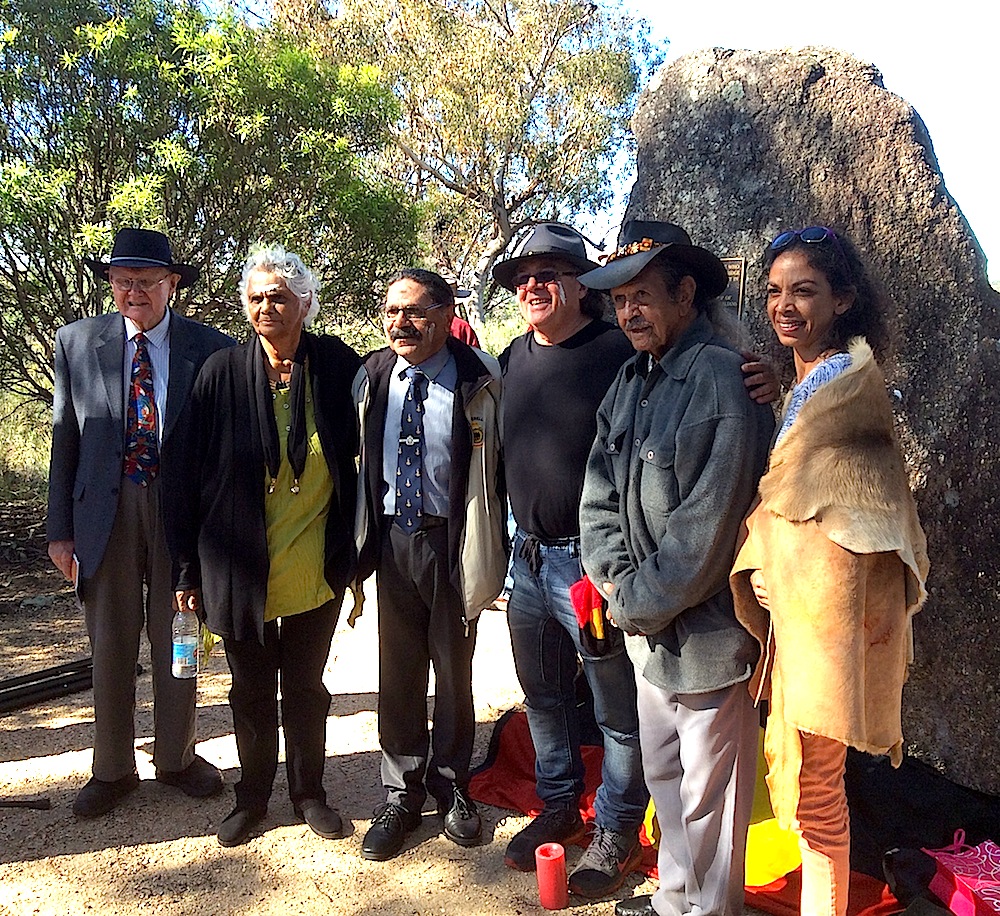
When American writer Bill Bryson came in search of the massacre site in the late 1990s, he found nothing.
By 2000, the place had been identified and marked. Occasional vandalism since has not dulled the growing spirit of reconciliation which will never be stymied by faceless racism. Now, a fundraising effort is behind a planned onsite education centre.
During the thoughtful walk back to the car, cautious divisions start falling away. We walk as one group. One people.
On the way to visit our old farm, we pause at a high point along the road where another farmhouse became derelict long ago. Very soon, other cars arrive, bearing various descendants of the other families who farmed down the same lane. They were all at the massacre memorial too.
Although we are all different ages, live across two states and our lives have followed varied pathways, one thing unites this group of relative strangers meeting on a tract of the Kamilaroi nation on this particular day – every one of us has always known about the Myall Creek Massacre.
This strong oral history has been handed down through generations and does not come with judgement, shame, or pity for white killers.
It comes with an unforgettable knowledge of what injustice really means in this country, and the desire to pass that message on.
© Michael Burge, all rights reserved.

