

Category Archives: My Story

Apology from a school bully

HOMOPHOBIC
HOMOPHOBIC BULLYING has long-lasting impacts on perpetrator and victim.

A Writer’s reply to a childhood persecutor.

THERE must be something in the planets, because this week I was contacted out of the blue on social media by two bullies from my past.

One of them – a family friend in her sixties – is an educated, well-spoken, active-in-the-community, serial bully. She contacted me to get at her daughter, who she’s created devastating conflict with, but all she got was a reminder of her unfinished business with me.

The other is a man I went to school with.

Unlike my family friend, he made an unreserved apology for bullying me at school, some 30 years ago.

“I am a white, middle class, heterosexual male, who, for no other reason than the lottery of my birth, has never had to deal with discrimination,” he wrote.

“I want to be part of the change, part of the solution, rather than part of the problem.”

“All l can do is try to imagine what it would be like to deal with fools like me and their behaviour.

“Growing up, dealing with parents and high school, and puberty, and relationships, while also trying to find out where you fit in amongst it all of it was tough.

“Tough enough without also having to deal with the added layers of ridicule, judgment and misunderstanding.

“I apologise for bullying you, I apologise for ridiculing you, I am sorry for all of the ways I disregarded your feelings and failed to consider your emotional wellbeing.”

Revealing stuff. He asked me for feedback, so here’s what I wrote in reply …

Dear (name deleted),

I am a little cynical about your letter. So often I engaged in conversations with boys in our class, only to find your invitation was really a cruel trap with a bullying sting at the end. Your approach to me now could well be a case of the ‘little boy who cried poof’.

Your particular behaviour was more a sneering from the sidelines of the main bullying action, although I remember one occasion when you openly shamed me about my sexual orientation in front of an entire classroom of people, and I retreated in shock.

That sort of thing definitely contributed to me staying closeted until I was 28, by which time one of my parents had died before I had the courage to come out to her. That’s an irreversible regret I carry.

There is no doubt you remember my mother – she was one of the most active parents at our school, and you benefitted from her contributions.
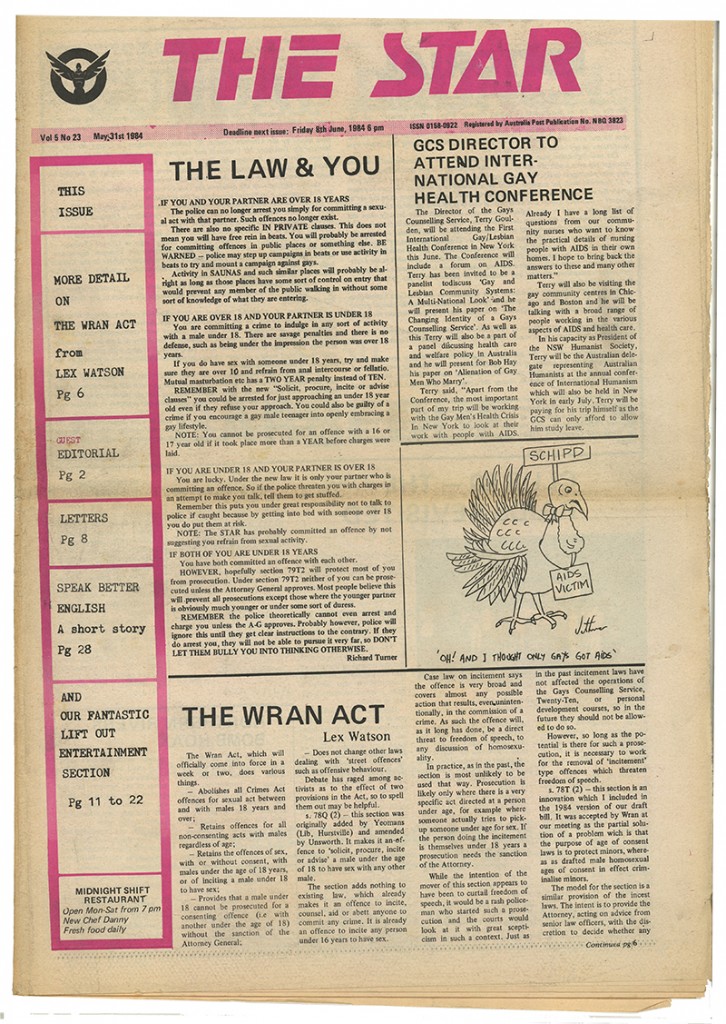
OKAY TO BE GAY Front cover of the Sydney Star Observer when men could no longer be arrested for sex with men.
OKAY TO BE GAY Front cover of the Sydney Star Observer after men could no longer be arrested for sex with men, in 1984.

My family had survived death and divorce by that time, and the community I lived in, primarily made up of school families, led me to believe that my sexuality was only going to deliver more bad news.

What a fool I was to buy into all your fears.

During our high school years, homosexuality in NSW was decriminalised.

Even though your behaviour was wrong, it was sanctioned by the state and the establishment at a private Anglican school. You and your mates were only responding to society’s pressure to shame and ridicule same-sex attracted people, but it’s great to see you’re not still letting yourself off the hook.

Truth is, our school had as many homosexuals as there were homophobes – staff and students in all years, male and female. The gay staff members were particularly vulnerable to sacking without cause, and still are, so when you were throwing around your accusations, alarm bells would have been ringing deep down for many.

Hopefully you agree that to toy with that bell is a power no child should ever have.

“Bullying children should never have power over gay people.”

If I’d been a smaller person you might now be regretting physically abusing me, but because I grew to the size I am now at the age of 15, none of you ever had the guts to approach me with the kind of abuse many other gay boys endure from their classmates. Even an awkward blow from me would have landed unpredictably and heavily.

You didn’t always succeed in shaming me.  I clearly remember with great delight the day on which I turned the tables on you.

We were playing indoor cricket and I was selected to bowl with you at the crease. Your assumptions about a gay bowler saw you step forward expecting to knock the ball to the ceiling. Instead, it snuck straight under your triumphant pose and knocked the stumps over with a clatter.

The PE teacher gave me a validating look, while you had no choice but to walk to the sidelines, where your attitude belonged.

Team sport… it has its uses.

My other strong memory of you was the day you brought a cassette into English class – Cold Chisel’s “Khe Sanh” – and you asked the teacher if you could play it for us all. She agreed, sensing it was important to you, and you unabashedly sat at the front moving your head and drumming your hand on your desk.

What drew my attention was your affinity with the song and its message, and the shame-free way you claimed your right to self-expression.

I accept your apology because unconditionally offered amends are the very rarest, and you seem to ‘get’ that if I had played a song that moved me in front of our class, the outcome would have been very different.

SMALLTOWN BOYS British Synth Pop band Bronksi Beat.

My choice would have been Bronski Beat’s “Smalltown Boy”.

Have a listen to the lyrics one day and you’ll find some insights. The song laid out the options for growing men as starkly as Jimmy Barnes did for you.

In the 27 years since we left school I have tackled more discrimination than you can possibly imagine. Not the predictable gay bashing crimes, or the puerile name calling, but the far more subtle disenfranchisement that underpins the last frontier in same-sex equality.

I would like you to do one thing, if, as you wrote, you really seek to be part of the solution to homophobia.

Find out where your federal member sits on the issue of marriage equality through the Australian Marriage Equality website, and, regardless of what you find, write to them.

Congratulate them if they publicly support same-sex marriage – they’ll need courage from their constituents to enact change in the small window of opportunity we have to achieve this human right during the current parliament.

And if they don’t, please tell them why you now support the equality that will deliver the greatest message to school children about gay people.

That our love is equal to yours in every way.

And that bullying children should never have power over gay people.

If you do this, I’d love to see a copy of it on your Facebook wall. I’ll know when to have a look when you send me a friend request.

© Michael Burge, all rights reserved.

Poets’ Land

POET'S LAND Pen y Ghent seen from Lower Winskill.

WHEN I am gone,
Bury me not in dusty claims with my forebears,
In dry-rot graveyard, by tin-roof church and dunny.

Give me not to the sea, for wrasse-filled rockpool’s swallow.
Don’t leave my ashes high, escarpment winds to hollow.

Just fold me up,
Where weathered rock, by dry stone wall
Has made a deeper place,
Where hawthorn hedgerow
Has hidden me a ditch.
A place in green-grass valley,
That would be my wish.

My soul has a footprint
In Poets’ Land,
In rain-sluiced loam,
On flatbed stone,
Where shepherd, waller, and my tear-stained boy
Can call me home.

© Michael Burge, all rights reserved.

Gough Whitlam – Australia’s true Liberal

A Writer remembers a great Australian.

IT took me almost half my lifetime to work out what I owe Gough Whitlam.

The second son of a NSW grazier and a nurse from Sydney’s north shore who gave up her career to have kids, I was a five-year-old when Whitlam was dismissed. At twelve I was given a fearful lesson on what would happen if the Australian Labor Party ever got back into power, which consisted of a darkly uttered statement: They’ll spend all the money the country has, just like they did under Gough.

By then my family was a victim of the D-word (‘divorce’), a fate no other family seemed prone to, one that was uttered behind cupped hands. Mum still wore her wedding ring and kept her married name. It makes things easier, she said.

“Gough Whitlam got conservatives in Australia on the move in the late 1960s and they have never stopped running.”

At 18, I saw Gough and Margaret Whitlam enter a lecture hall at Sydney University. Not making for the stage, that practical pair equipped with a rug for both laps and a thermos, but for whichever spare seats they could find. A ripple of recognition ran through the capacity crowd, which turned into an electric standing ovation. Both acknowledged the accolade, and proceeded to dampen our enthusiasm with a few waves of their long arms, because they didn’t want to distract proceedings.

They seemed harmless, the instantly recognisable yet strangely anonymous Whitlams, portrayed as villains on both sides of my city-country family, so I started asking questions.

My parents didn’t vote for Gough, it just wasn’t done on the land, but mum did reveal when asked about life during the Whitlam era that when it came to the survey on changing Australia’s national anthem from God Save the Queen to Advance Australia Fair, two votes – hers and my father’s – were registered in the affirmative in our region. I turned this seed of progressive thinking in my family into a world of possibilities.

Soon after, I left Australia for six years. A political and economic dunce up to that point, the experience of living in another economy taught me everything that being a high achiever at private school never could.

In post-Thatcher Britain all the elements of an economic rationalist society were at work. Working alongside people who had families to feed for the same meagre weekly return as I managed, I started to realise how stacked the deck was. The cost of living was extortionate, the financial burden on the average family of a day trip to the coast so prohibitive that many I knew just stayed at home. What if that happened in Australia? I thought. A trip to the beach only for the very wealthy? Imagine how Australians would complain!

Returning home for breaks, I suddenly saw my country for the vibrant place it was, full of life, light and colour, whereas England was an economic web, waiting to trip you up if you didn’t feed the machine like you had to feed the electricity meter with pound coins. I decided to come home and embrace the land I was born in before it changed beyond recognition, and I only just got back before the damage really started. Ever since coming home I have despaired at the way Australia has bought the economic line of leaders intent on emulating Thatcher and her P-word (‘privatisation’) here.

Today, I feel like I have lost a family member. All day the media has covered reaction and response, from Prime Ministers past to an indulgent set of speeches in the House of Representatives, and I have tried to work out why.

FIRST COUPLE Gough and Margaret Whitlam at the apology to the Stolen Generations, 2008.

Walking the dogs after work it struck me how distracted we are by the loss of Gough, because he has become so ingrained in our nation’s consciousness. For progressives, he’s held in our hearts, but his actions are possibly most ingrained in the hearts and minds of Australian conservatives, those who live under the great Australian misnomer of ‘Liberal’, because Gough came to embody their greatest fear – that people are infinitely more important than economies.

We live in a world where a tsunami created by an earthquake can occur in front of our very eyes, live on television, and yet the commentary, response and analysis is not about the people dying on a screen in our living room, it is about whether the economy will survive, forget about the people. I feel this same lack of compassion in the Ebola and Iraq coverage and the lack of action it inspires in Australians.

Gough didn’t think that way, and he didn’t act that way – he simply gave us what we needed.

When my family found peace away from the expectations of ‘happy marriage’ for the childrens’ sake, and didn’t have to find someone at fault and someone to play the victim, that was Whitlam’s legacy.

When my mother needed to work and still had nursing up her sleeve, started at a local hospital as a casual and ended up being night supervisor for a decade, her self-determined life as a single mother was Whitlam’s legacy.

My presence in that lecture hall, a student at an Australian university, free of charge, that was Whitlam’s legacy. My right to vote that same year, my eighteenth, was probably far more significant, although I didn’t understand it at the time.

I hope he felt the greatest compassion for himself after the dismissal. When I consider how he never seemed bitter, I feel a strong life lesson about failure, because even in the midst of his ‘well may we say …’ speech, a wry smile that always reminded me of Dame Edna crept up his mouth and projected his profile out to the crowd. Bitterness could have taken him away much sooner after such a diminishing moment, but he lived almost forty more years after that speech – my lifetime.

Gough Whitlam got conservatives in Australia on the move in the late 1960s and they have never stopped running, afraid of debt and deficit and spending money on people or places where it’s needed, as though money is a thing of power that could do something positive while stashed away in a nation’s coffers. For a man who was so ingloriously dismissed, I loved the way Gough dismissed economically fearful Australians with such panache, and held to account those who think it’s okay to make huge money by doing nothing.

creating-waves-cover
BUY NOW

Instead of wishing he’d had more time, or wishing he’d not been dumped, I want to see the whole thing in reverse, just like Malcolm Fraser does. Australian conservatives have simply been reactionary, because progressive thinking has been in Australia’s driving seat ever since Menzies. It took losing Gough to see it.

© Michael Burge, all rights reserved.

This article appears in Michael’s eBook Creating Waves: Critical takes on culture and politics.