Category Archives: My Story

Beth Chatto – a natural subject

A GARDENER'S PLACE Award winning plantswoman Beth Chatto (Photo: Alamy).
A GARDENER’S PLACE Award winning plantswoman Beth Chatto.

A Writer’s year with a great gardener.

WHEN I first arrived at the Beth Chatto Gardens in midsummer 1996, a bright, animated woman called Rosie greeted me and showed me into the house, where gardener and writer Beth Chatto hosted me for morning tea.

I was there to investigate the viability of producing a documentary on Beth and her work, and what struck me immediately was her gracious nervousness. Taking nothing whatsoever for granted, this multiple RHS Chelsea Flower Show Award-winning gardener was as vulnerable as an auditioning actor.

She’d loved the program one of my colleagues had made about another respected local gardener – Suffolk’s Peggy Cole – because it had captured the truth about what it takes to nurture an English garden, and she hoped I could do the same for her.

Once outside, and more relaxed within the fluid environs of her garden, Beth related that she’d made a program about her garden before, but to date, she felt, no-one had captured what the Beth Chatto Gardens was really all about.

We walked, we talked, and Beth encouraged me to get right within the garden itself, to tread through beds to see the workings of the water garden or the structure of the gravel garden.

Passing a small group of visitors, she introduced herself, directly but politely, to a woman who was taking cuttings, not by reprimanding the culprit, but by saying, “Please, feel free …” despite the well-stocked nursery on the other side of the hedge.

That mixture of shock at her garden being picked-at, and her inner turmoil at wanting to share it without rancour, showed a complex woman with a very interesting story. All I wanted to know was when could we start?

Revolutionary Philosophy

I read as much as I could about Beth’s work and her place in post-war English gardening. She patiently gave me time to catch up, but underlined that we’d need to spend time in the garden, perhaps an entire year, to film it in its fullness.

As a producer new to the company he worked for, that meant I needed to test budgetary terms and face questions about when the product could be ready for the marketplace. Could the execs wait another Christmas? Had this territory already been covered enough by another company?
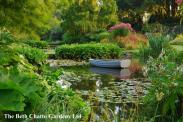
GULLY TRANSFORMED The water garden at The Beth Chatto Gardens (Photo: The Beth Chatto Gardens).

The best thing I could think to do was simply to start. A cameraman, Alan James (another Essex gardener in his own right), and me, just filmed as the seasons cycled, as they do so dramatically in England. Along the way, I felt sure I would find a way to make the project work for all the stakeholders.

Beth Chatto’s ornamental garden is just one part of her work. Situated at the end of a farm lane, not far from the Essex town of Colchester, it occupies a small gully between working farm fields which Beth and her husband Andrew transformed into their world famous garden.

A commercial nursery makes up almost half of the property, and much of that is taken up by large-scale compost production. I recall Beth’s delight when we proved ourselves willing to film tractors at work on steaming piles of leaf litter. Her approach to our company, with its track record for making programs about farm machinery, was paying off.

On one day’s filming in winter, a quiet, well-dressed man (who looked a bit like I’d imagine a Russian philosopher would) was seated on the other side of the fire in the garden office when I arrived. Rosie asked me to take a seat to warm myself, and Andrew Chatto gently introduced himself.

Beth credits her husband Andrew with the original inspiration behind their garden for one very simple reason. It was he who came up with the idea of finding plants from across the temperate world, and to grow them in England under conditions that were suited to their needs. This was Beth Chatto’s ‘right plant, right place’ concept in a nutshell.

To explain why such a basic philosophy became so revolutionary, you’d need to tackle centuries of horticultural collecting conducted by the great botanists who accompanied Britain’s explorers on dangerous voyages to bring seeds and cuttings back home.

The famous glasshouses of Kew were built to house this booty, and to keep it alive against the cold climate. The movement eventually encouraged generations of ordinary gardeners to buy whatever plants we liked, stick them in our back yards, and hope for the best.

Beth and Andrew were every bit as exploratory, not just because of their plant-inspired travels, but also because the climate and soil in Essex are not what you’d call typically English. Certainly the annual rainfall is not what other counties enjoy. The Chattos were also not afraid to wait many years to see what happened.

Garden Edge

And what happened speaks for itself … the scrubby gully is now a stunning series of gardens that descend almost imperceptibly along a natural water-course. Preceding Beth’s well-loved books on water and shade gardening, these immaculate green spaces were her laboratory in an ongoing love affair with plants.

DROUGHT CONDITIONS Beth Chatto's Gravel Garden.
DROUGHT CONDITIONS Beth Chatto’s Gravel Garden (Photo: Alamy)

Our filming coincided with the peak early years of Beth’s latest project at the time: her gravel garden. In an ongoing experiment, quite ahead of its time, she vowed to never irrigate this garden, to test the boundaries of gardening under drought conditions, well aware of the tussle to come between farmers and gardeners over access to water.

Here was something an Australian could really get his head around – the gravel garden at the Beth Chatto Gardens reminded me of home, with its sparse, elemental feel and the heat that emanated from the ground, literally inches thick with small stones and filled with plants familiar to me from roadsides in the Outback.

As the months passed we got to know Beth’s staff quite well. I would often catch a glimpse of her observing our filming processes from a distance, and once she saw her gardeners chatting with us and surrendering to the often annoying process of, “Now, could you just do that again, and we’ll film it from this angle …” she would disappear into the house to get on with other work.

As an interviewee on camera Beth Chatto proved a natural. I realised very quickly that I’d only need to capture her in conversation and get Alan to just turn the camera on. Years of communicating her story had given her an edge that needed no other commentary.

In the last few months of filming, Beth kept gently reminding me that she’d like some group shots of the staff, and on one day in the Summer of 1997 we got everyone to down tools and take part in a photo shoot that we committed to tape. As the centrepiece to those moments, I saw Beth about the happiest I’d ever witnessed.

She also understood innately what I was doing when I asked one of our execs to be an extra in a whole day’s filming, our one ‘big budget’ spend, working with a crane to capture high-angle motion shots. Beth guided my boss through the highly repetitious process of take after take, until we had it just right.

I became a gardener as a result of my year with Beth Chatto. What I know about gardens I learned from her, particularly about how to live in a garden and not be too precious about the life that runs through it: pets, visiting wildlife, and people who like to take cuttings.
Dearborn, death & American dreams

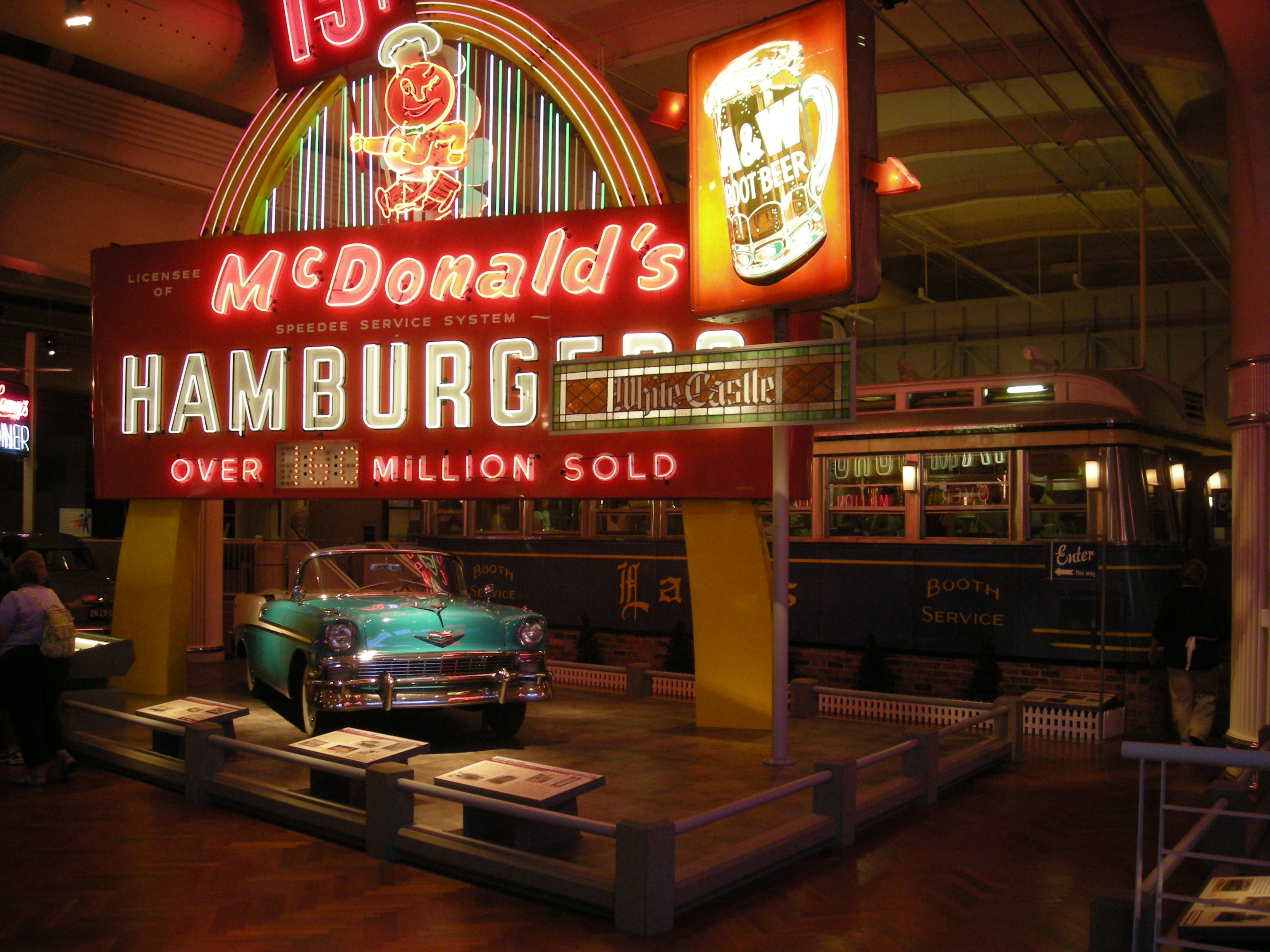
NEON DREAMS The Henry Ford Museum, Detroit.

A Writer’s Midwestern adventure.

SEEKING the childhood haunts of farming icon Henry Ford, on arrival in the great city of Detroit, we (me, a cameraman and a presenter) headed not for Motown (unfortunately) but to the city fringe and the Dearborn area.

There, the Motor City puts on a veneer of rural respectability, but on the many occasions we got lost in our hired Buick, street upon street of homely clapboard stoops in everyday neighbourhoods revealed themselves, where no-one cared much for Ford and the quiet revolutions he spearheaded.

All that is on ostentatious display at the Henry Ford Museum, our first port of call.

It would be hard to name a more complete exhibition anywhere in the world. As an entrée to life in the American heartland, this place is the veritable cherry on the pie.

Acres of halls burst with memorabilia on a huge scale – the neon sign display must be the world’s best, and there’s an entire Holiday Inn which was moved brick-by-brick as an homage to the original American road trip.

A Museum staffer showed us to another building on the far side of the exterior exhibition (filled with entire villages – Ford loved the whole brick-by-brick thing), where he pulled-up a garage door and trundled a rather strange looking machine into the daylight.

This was Henry Ford’s 1907 ‘Automotive Plow’ – the prototype for the mass-produced Fordson tractor.

This tractor changed farming practices dramatically after centuries of hard labour and heavy horses. Ford didn’t invent it, but he made it affordable for most.

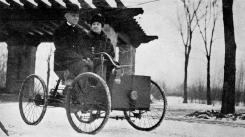
MAN OF EXTREMES Henry Ford and his wife in his first car.

A documentary shown at the Museum detailed Ford’s deep regret that his vehicle production technologies helped inspire the military tank, which tore through troops in the slaughter that was WW1.

Turns out Henry Ford (1863-1947) was not just a farmer and industrialist – he was also a pacifist and a vegetarian. Now that got me interested.

As we left the Museum, a formal line of Presidential vehicles revealed itself, from beautiful carriages to limousines. The last one was roped-off, because people respectfully leant across to touch the rear right passenger door.

I wanted to see why, but the sign explained the patently obvious – this was the car in which President John F. Kennedy was killed. Surprisingly, it had been remodelled and used by other presidents for many years after the assassination.

Quite close by, the upholstered chair in which President Abraham Lincoln was shot to death is also on display.

Such a strange, endearing collection of dreams, death and the pinnacle of farming achievements. The dichotomy says much about the man behind the collection, loved and reviled in equal measure. Say what you want about Henry Ford: he was a collector like no other.

Ford’s early tractors were manufactured the world over, and many have become collectors’ items, so we hit the road in search of them, heading south into the great farming state of Ohio, on the very edge of America’s Midwest.

As we embarked, another journey was just beginning in California. Young high flier, 7-year-old student pilot Jessica Dubroff’s ‘Sea to Shining Sea’ flight was going to rewrite history and make her the youngest person to fly across the United States, assisted by her pilot trainer and her father. The Ohio and Michigan media were anticipating seeing Jessica cross their skies any day now.

Passing through the endless city limits of mighty Cleveland, I checked our itinerary, and realised a colleague back in Suffolk, England, had booked us to do an interview in east Ohio, then travel a day and a half back to Michigan, only to turn around and drive back south into Ohio again. The English have no idea about distances! I grumbled, before calling and asking for the dates to be changed.

Meanwhile, we visited affluent farms where Ford tractors that had not tilled the soil for decades were stored like precious objects in huge, pristine sheds.

We interviewed farmers who ran thousands of head of cattle on prairie-like pastures. Here, my vegetarianism was something even I questioned, since these cows lived a life of liberty, with just their ears tagged before they were set free to graze the hills until it was time to bring them in for slaughter.

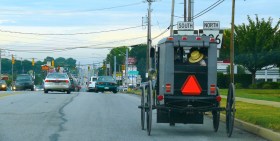
We met an Amish man who ran a sawmill entirely without electricity, just a pair of heavy horses who he treated like the precious commodity they were.

LAND OF EXTREMES A traditional Amish buggy makes its way into town (Photo: Ad Meskens).

The sight of Amish carriages crossing the landscape in the distance was an eerie link with America’s past. The culture of the Plain People contains the last vestiges of a rural romanticism that every country child can relate to.

In Ohio’s land of abundance, everything was larger than I had ever experienced. To reach the arms of the chairs in restaurants, you needed to put your arms out wide!

Then the nation awoke to terrible news that Jessica Dubroff’s plane had gone down shortly after takeoff from Cheyenne in the state of Wyoming. A brief life cut short. A dream broken in this land of big, record-breaking dreams.

Thankfully our itinerary had been adjusted, but we were asked not to delay – the subjects of our interview back in Michigan were heavily pregnant, due any day now. They couldn’t guarantee what we’d be greeted with. So we completed a long night drive across the border into Portland, Indiana, then back up to Michigan to the city of Flint, home of another great American, film maker Michael Moore.

Flint, and in fact that whole section of Michigan, was emerging from a harsh winter. Nevertheless it’s not just the climate that caused a certain down-at-heel quality.

Unlike the vasty fields of Ohio, that part of Michigan seemed rather poverty-stricken. The farmers were less welcoming and more suspicious of travellers. We got lost a few times, and the idea of knocking on doors and asking for directions was more than a little frightening.

This was long before Michael Moore’s films pricked the conscience of the western world – we were only there to interview a goat breeder.

Her flock of Boer goats was in the process of birthing its next generation, so we waited patiently while the mothers bleated. New life within a toughened landscape brought all the cheer we needed to feel better about Henry Ford’s macabre collection, about Jessica Dubroff’s life cut short, and about ourselves in the midst of a thawing state of disbelief … and more beautiful footage of brand new kids has rarely been captured, I’m sure.

© Michael Burge, all rights reserved.

The black soil in my blood

A Writer’s birthright.

I WAS born in the Northern Tablelands of New South Wales and I spent the first years of my life living on my parents’ farm between the crossroads village of Delungra and the town of Bingara.

The countryside consisted of rolling uplands, the last vestiges of the black soil country before they give way to Queensland’s Darling Downs.

Some of my earliest memories are of the soil, often baked hard into cracked clay beds, or sluiced with water into acres of mud, but always black. Black against the yellow straw grass that covered the hills.

‘Paxton’, the property where I spent my childhood, was salvaged by my parents from a derelict state. Despite a few years of success, death and divorce saw my rural childhood disappear like spinifex on the wind.

Nights of blazing stars. Days of grey skies over blue hills. Hailstorms and wind that blew the corrugated sheds around like leaves… all were replaced by the disturbing lights of cars in urban streets crossing my bedroom wall in town, of houses that seemed insanely close together, and people living right up against one another.

My family bridged a great divide. The country half were tall, Germanic, Presbyterian stock in great numbers, who, by the time I was born, lived with a fading sense of entitlement based on achievements past.

The other half were a small band of establishment city dwellers with a dose of very English mores.

An attempt was made to combine these energies in my parents’ marriage, but it failed miserably.

I left the country, and in many ways I have been running from it my whole life.

But when I left London to take up a job offer in Suffolk, barely an hour from the city, it was to work for a rural media company.

In my application, I evoked the country of my childhood to get the job. I didn’t need to pretend, I’d lived in and around a mixed crop and stock farm, and I knew a bit about how they operated.

Despite feeling like a complete sellout, I used my trump card – being of strong country bloodlines – and I could see the eyes of one of my interviewers misting over. There is a great camaraderie, and a willingness to help-out their own, amongst families who have worked the land.

I was a farm boy who had video production and communication skills, and I got the job.

Forget that I thought agriculture in general had lost its way, that I was vegetarian, and an animal liberationist who had little interest in farm machinery. I needed a good income, and an opportunity. Farming Press offered me that, and I took it, wondering when my secrets would be discovered.

BURGE'S BURGH The windmill tower on the hillside of the hamlet of Burgh, Suffolk (photo: Barry Hughes www.geograph.org.uk/photo/41986).
BURGE’S BURGH The windmill tower on the hillside of the hamlet of Burgh, Suffolk (Photo: Barry Hughes).

So I packed-up my room in a shared flat in London’s leafy Lewisham Park, and rented another in a tiny row of cottages in the charming little hamlet of Burgh, up a hill past a windmill from the even more charming village of Grundisburgh, just north of Ipswich, Suffolk’s historic county town.

With barely three days to prepare myself, I had to pack for a flight to Detroit, Michigan, to document the traditional skills of farming people across three states.

In the rush I didn’t get much of a chance to meet my new colleagues or my housemate, or settle into the Farming Press offices on the edge of Ipswich, a typical English company with some friendly faces, wanting to know this Australian who was going to work in the video department downstairs.

My first week’s pay was more than I would have earned in a month of cinema shifts. The Suffolk countryside was blossoming into a gorgeous spring. I got a touch of hay fever. I became lost on country lanes trying to find my way home. I was cornered by inquisitive cows. I bought my first ever car and was able to traverse the country without the crippling cost of train travel.

England had opened itself to me a little… and then I had to leave her in a rush of camera equipment and travelling instructions. America’s rural heartland was waiting.

© Michael Burge, all rights reserved.