Category Archives: My Story

A waiter’s revenge tragedy

220px-Waiter!THERE isn’t much to write about waitering that hasn’t already been covered brilliantly by Steve Dublanica in his blog and book Waiter Rant, but if I might add my own perspective…

I waitered throughout the first four of my five tertiary education years. During that time I wasn’t eligible for government support or scholarships. One of my parents couldn’t assist in supporting me financially, while the other one just wouldn’t.

A bad lot? Not really, but with six 12-hour days of coursework, there wasn’t much time left for earning an income to cover the costs of leaving home.

Café waitering wasn’t rocket science, but food experiences were very different two decades ago.

Coffee making wasn’t the exact and particular science fretted over by millions every morning across the world these days. A caffè latte had no froth (or coffee art on top), just plenty of hot milk. Soy milk was a gluggy, grey substance which you wouldn’t want to drink with coffee. Baby-cinos were just the sparkle in someone’s eye.

There was also a new bread on the scene: Focaccia. I fondly remember the year when diners couldn’t say the word. “Fossa-see-a”, “Fark-arr-chee”, and “Fock-akki” are three of my favourite mis-pronunciations of the Italian flatbread that was being filled and toasted like it was going out of style.

Yet the differences in cuisine back then did not mean people were less demanding. Not in the least.

FOCC-UP Could you pronounce the name of the new bread which hit Australian cafes in the late 1980s?

Every eating destination has its regulars, ready to pounce at the slightest change in serving size or ingredient. I got to know a few people like this in my waitering years, the kind who’d make your teeth gnash, the kind you’d like to suggest just go to the nearest supermarket and spend $10 on ingredients, go home, and make their own damned meal for once.

But my real hatred was birthed by those I’ll call the food pedants, those for whom nothing is ever good enough. “Please ask the chef to…”, or “my coffee is not hot enough”, “can I use my own tea bag?”, “I’m only paying for half the coffee because I only drank half”, and all manner of pinickerty requests. The kind of people who don’t know they’re alive unless they’re getting someone else to do something for them.

Such folk were a great source of inspiration for a story I called A Waiter’s Revenge Tragedy, one which I formulated in my left brain in order to escape the piles of washing-up along the floor and down the stairs, because there was no dishwasher and only one small sink in that particular establishment.

In this never-written story, a Waiter was pushed so far by a difficult customer that he plotted the man’s death in an elaborate and long-term strategy, culminating in what appeared to be suicide, after the customer’s attempts to get his way became so extreme that he faked a bout of food poisoning. Of course, the noble waiter would also need to perish at the end of the story to make it a true ‘tragedy’.

It was convoluted, sure, but planning this magnum opus brought me great delight. Each new encounter with a food pedant fed the story arc, until I’d made myself immune to them through the sheer delight of encountering more material.

Perhaps other people just switch off under these circumstances, but not this writer. Imaginary revenge was simply too delicious. A Waiter is only one letter away from being a Writer anyway.

The best part about being a waiter was working for a supportive boss. My last café manager was an ex-boxer who once removed a complainer through the front door by the scruff of his neck and the seat of his pants for querying the bill. He always said he’d support his staff against any customer complaint, even if we were in the wrong. The result? Excellent staff who did their job with energy and without fail. These days, that boss would probably end up in jail.

I now share meals with plenty of hospitality workers, and the stories they come out with would curl your toes. All I would advise readers is this:  respect your waiter, and never be a pedant. If you ignore this simple advice, you’ll never be able to trust anyone serving you…

© Michael Burge, all rights reserved.

The prophet Elijah got me published

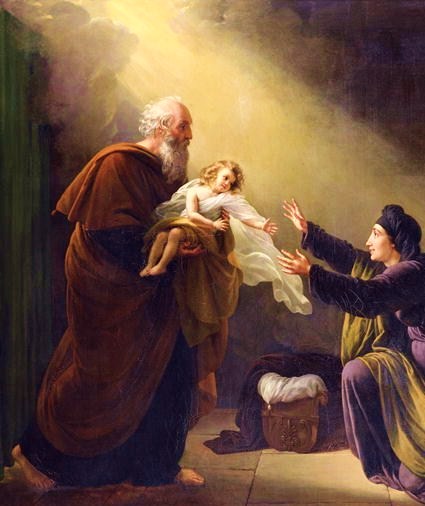
ACADEMIC PROPHECY ‘Elijah reviving the Son of the Widow of Zarephath’ by Louis Hersent.

A Writer’s narrow escape.

BY the time I got to Sydney University to start my Arts degree, I was so sick and tired of essays, studying, research, and examinations that I pretty-much floated my way through the whole year.

Thrust into enormous lecture halls, everyone seemed to be getting the jokes, was cooler, better connected, more studious, more artful and more alive than I was.

So I spent a lot of my time skulking the Fisher Library, reading titles that were not on my reading lists and going to the movies in the city during the afternoon.

My results reflected this malaise, but I didn’t care. Years of academic competition at school had rendered any desire for tertiary achievement completely impotent.

I lived on campus in an all-male college, which was a total shock to the system, although escaping the ritual humiliation inflicted on new students wasn’t difficult, since the older students doing the shaming really only wanted willing participants in their ridiculous ceremonies. I hid in the cafeteria of the neighbouring hospital.

In terms of essay writing, I learned quickly how emotion and opinion were to be stripped-away. This made academic sense but put my enjoyment levels into the negative. I couldn’t see why the words on the page had to be so damned boring, if all the professors and tutors were having so much fun.

The one area I excelled was ancient history, by default. At school, the chaplain had been the ancient history teacher, so we’d studied minimal ancient Greece and even less Rome. Instead, we’d gone through the history of ancient Israel in enormous detail.

The Old Testament had come alive in those classes, not in a religious sense, but as documentary evidence of societies long gone. This working knowledge of texts that have become so influential to modern thinking would prove invaluable in years to come, particularly as I joined the groups sidelined by Levitical laws.

So it was a case of laziness when I selected an essay topic right in my field of knowledge – to examine another scholar’s views on the prophet Elijah. I can’t recall the scholar or his views, but I brought the prophet alive using neither emotion nor opinion. The trick was quoting far and wide, from dialogues full of religious fervour, to soundly trounce my academic colleague for his lack of imagination.

The effectiveness of my argument was undoubtedly the way I suggested that in ancient Israel, blind faith conquered rational thought each and every time. I probably also felt that in three thousand years, not much had changed.

Prophets were always more three-dimensional than other biblical figures. They were cantankerous, usually because they worked hard at day jobs and resented the holy spirit taking them away from the basics of regular life. And they were funny – some of the only classic humour in the old testament appears in Elijah’s challenge to the high priests of Ba’al, when he heckles them into throwing more sacrifices onto their altars, shouting ‘Where is your God? Where is your God?’

Juxtaposition is everything, even, it seemed, in academic writing. For my word tricks, I got a high distinction, and an invitation to my professor’s office one afternoon.

The thought that I’d been caught out as a complete fraud did occur to me, but as I sat down in this man’s office, after he’d cleared a chair for me from underneath the layers of dusty papers and books and blinked at me through his thick glasses in the half-light, he said: “And what are you going to do with this high distinction?”

HALLOWED HALLS The very English quadrangle of Sydney University.

Nothing crossed my mind, except what a strange question it was. “Do better next time…?” I muttered.

“No!” the Professor boomed, banging his hand Elijah-like onto the desk. “You’re going to do honours, and I shall help you. First, we are going to publish this paper of yours.”

Being published sounded like fun, and in due course, my fervour-filled evocation of the prophet took its place in the front of that year’s edition of Edubba, the Ancient History and Classics Department’s undergraduate journal.

But becoming an acolyte of this professor did not sound like fun at all. Any chance of his fervent prophecy about me coming to pass was all the fuel I needed to get out of university by applying to drama school.

I completed my final exams, including one in which I answered questions about Roman writers whom I had read not one word of. I passed, miraculously, and waited for my escape plan to come to fruition.

That one essay is all I have left of my sole university year. I don’t have a copy, but it will be there in the Fisher Library somewhere, testament to my ability in writing to a prescribed, academic formula; but with a flame of life burning within.

E. M. Forster – literature’s god of love

BARED IT ALL Edward Morgan Forster, 1911 portrait by Roger Fry.

A Writer’s first hero.

FROM the moment I saw the trailer for David Lean’s 1984 adaptation of his A Passage to India during an English class, I became a sucker for the literature of Edward Morgan Forster (1879-1970).

I’d been ambivalent about the drab Penguin Modern Classics edition, but the sight of Judy Davis as Adela Quested, scrambling down the dry slopes of the Marabar Caves, bloodied by thorns, pith helmet rolling in her wake, dislodging rocks (and an ensuing British panic) gripped me into attention.

We had our toes dipped into the ideas of Bloomsbury and the racial overtones and class structure of Empire.

Merchant Ivory did the rest, with their iconic production of A Room with a View in 1985. Through their lens Forster’s English hypocrites and heroes came to life.

“Forster had a greater vision of love between two men than his contemporaries. One or two of them may well have been jealous.”

The icing on the cake was the word which I spied in the blurb of the edition of Maurice that my enthusiasm for Forster had garnered me at Christmas. The word, of course, was inescapable when describing that work.

I wonder now if it was the first time I ever saw the word in print? Only whispered around the schoolyard, it had, by that time, been uttered louder at the peak of the AIDS crisis in the mid 1980s.

But here, on the reverse of Forster’s posthumously published story of Maurice Hall and his gay sexual awakening, it brought a wave of validation.

I recall waiting for my family to register the word. Had my mother seen it when she purchased the book? Had my brother sneered about it when she gave it to him to wrap up for me?

When nobody mentioned “homosexual”, I took that as tacit approval.

I subsequently devoured all Forster’s novels. My favourite moment was starting Where Angels Fear to Tread when boarding my train to university, only to be flawed by a classic Forsterian surprise death before reaching the next station, just six minutes down the track. What great ignition for a story!

On summer holiday, during my first year in the United Kingdom, I came across a collection of Forster’s short stories at a hostel in Cornwall.

The inclement weather saw me feast on them, immediately hit by one in particular – Other Kingdom. The Irish Home Rule theme of this story went right over my head, but the gusto of the young Irish protagonist (Evelyn Beaumont), brought my consciousness to a standstill, while I tried to capture her, as did all the other characters in this shining example of Forster’s storytelling skill.

I agreed with Iris Murdoch, in that, “I loved Miss Beaumont, because she bamboozled a pack of boors.”

Being a film school student, I had big plans. The biggest became my obsession to bring Other Kingdom to the screen.

I adapted it into an approved screenplay at the behest of the owners of Forster’s work (King’s College Cambridge) and tried for some years to tout it around the funding bodies, to no avail.

The central mystery of what happens to Evelyn Beaumont when she escapes from an ill-fated marriage into a dour English family could not be explained even by Forster himself, let alone by a potential screenwriter in a pitching session.

It wasn’t for another decade that I really understood my attraction to the story, when I realised a deep-seated wish for a solution just like Evelyn’s. I admired her escape in the light of my own need to find a way out of the life I was leading.

In the wake of my coming out, Forster continued to deliver. My second reading of Maurice brought the searing grief and triumph of his gay protagonists back to haunt my recovery from the death of my partner five years later, because Maurice Hall and Alec Scudder loved, no less ordinarily than any other couple.

Forster’s long-unpublished epilogue to Maurice was the heartbreaker. Anyone seeking to understand this novel should read Forster’s exploration of what happened to his characters, for it is no elemental conundrum like that of Miss Beaumont in Other Kingdom.

Forster’s trusted friends who read the drafts prior to 1933 suggested the epilogue be cut from the final manuscript, but I get the distinct impression they were baffled by Forster’s unsullied vision of Maurice and Alec happily ensconced as woodsmen, living rough, fused by the heart, and happy, despite their accidental discovery by Maurice’s unsettled sister Kitty.

Forster had a greater vision of love between two men than his contemporaries. One or two of them may well have been jealous.

Forster left as much written material about his childhood, his career, and his relationships as any biographer would ever need. Trouble is, few have used this resource – the ‘sexuality issue’ undoubtedly the main obstacle.

The finest work on Forster is Wendy Moffat’s A Great Unrecorded History. This study has done more to debunk the myth of Forster as simply a class-conscious comic novelist who stopped writing in 1924, than anything which came before.

PERFECT PANIC Adela Quested (Judy Davis) flees in David Lean’s screen adaptation of Forster’s ‘A Passage to India’.

Forster earns hero status from this writer for protecting his great love, policeman Bob Buckingham, from the criminal courts while he, Bob and Bob’s wife May lived-out a three-way relationship from 1930 until Forster’s death in 1970.

He earns it for politely, and with humour, pointing out the hypocrisy of those in positions of power and privilege in his literature.

He earns it for writing himself onto Hitler’s ‘hit list’ of authors with his WWII broadcasts exploring the axe of Nazism as it threatened to fall onto the neck of civilisation.

He earns it for not killing himself, despite as much cause for depression, isolation and marginalisation as Virginia Woolf cited.

He earns it for creating the archetype of the lusty English Gamekeeper. Long before D.H. Lawrence’s Oliver Mellors’ trysts with Lady Chatterley, Forster’s Alec Scudder hunted his way into Maurice Hall’s bed, and his heart.

And he earns it for diarising himself as he was, warts and all, and sometimes that meant writing about actual bodily warts.

For gay men, Forster’s humanist document on the entire life of a homosexual man will endure as a record of emerging and practical homosexuality which may well come to eclipse his novels.

E.M. Forster might not have physically embodied a Love God, but with his pen, in the shadow of the Oscar Wilde trials, he carved a place in history as a Titan who turned from the affairs of men and women, to those between men and men. His publishers must have hated him for it.