Category Archives: Performers

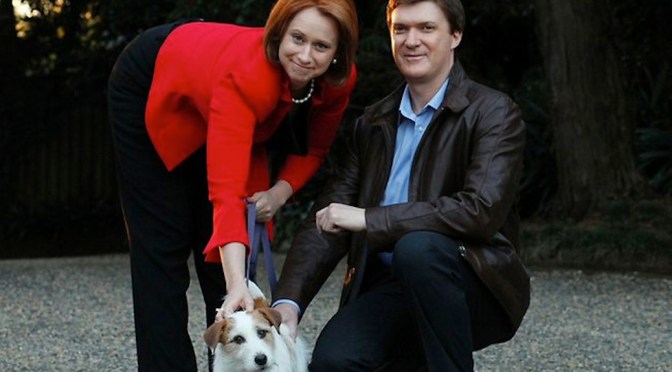
Amanda Bishop – the UnReal Julia Gillard

REAL JULIA? Amanda Bishop performs The Habanera, as Australia's first female prime minister.
REAL JULIA? Amanda Bishop performs The Habanera, as Australia’s first female prime minister.

A Writer’s encounter with a political impersonator.

AS Julia Gillard made her way through parliamentary ranks before, during and after Kevin07, the political satirists of Sydney Theatre Company’s Wharf Revue recognised they’d need to find an actress to portray the woman who would become Australia’s first female prime minister.

From her knockout live performances, to her starring and co-writing roles in the controversial At Home With Julia on the ABC, actress Amanda Bishop has become synonymous with the role of Julia Gillard.

Bishop spoke with No Fibs this week about what it takes to succeed in satire, and the consequences of your subject being a politician, prone to the whims of voters and internal party tactics.

“Audiences would cheer at the first two spoken words!” Bishop said of her early stints as Julia Gillard for the 2008 Wharf Revue. “They seemed to both delight and cringe at the sound, and we knew we were onto something. They enjoyed her humour”.

“When I auditioned for the revue, Julia was the Deputy Leader of the Labor Party and Kevin Rudd had just won the election for Labor. The female in the revue plays many roles and the writer/directors (Jonathan Biggins, Drew Forsythe and Philip Scott) had their eyes on the lady with the interesting voice, coming up through the ranks of the ALP.

“The Revue that year was called Waiting For Garnaut and Julia appeared as ‘Sister Gillard’ a novice of the abbey, in a musical scene called ‘The Sound Of Rudd’. She sang her version of ‘The Lonely Goatherd’, all on one note.”

Amanda Bishop as Julia Gillard.

So what was it like to impersonate a politician who’s in power?

“I love this question because it has never happened for a female in the European history of Australia,” Bishop says. “It was exhilarating to play a female who had to be listened to by, well, by the country, for three years, and her male colleagues. It was genuinely interesting because the real Julia endured so much criticism with grace”.

“In the Wharf Revue, both sides of politics are covered, so I still play her now, I’m lucky. It’s only when that ‘character’ leaves politics altogether that an actor needs to let go!”

What kind of loyalty does Bishop feel towards Julia Gillard when portraying her?

“I have great respect for her, and I probably feel warmer about her than if I hadn’t played her, but not because of what she did. Rather, I think I got to see just how thick-skinned she was to have continued serving while dealing with undesirable media attention, public criticism and being the first female in the position.

“Naturally, she confronted many sensibilities, whether we wish to admit it or not.

“Every time something happened that was all over the media, we’d put it in the show, such as the shoe coming off outside the Parliament House café when she was whisked away by the security guards. Such a small thing, publicised ridiculously.

“That was a gift in the end, we often highlighted the triviality that characterised her treatment and juxtaposed it with her seriously heavy hitting political mind and activities, and her sense of calm.

Has Bishop ever met her subject?

“Many journalists attempted to organise it, but apparently she was busy running the country or something. I certainly don’t demand attention on that front, and I’d love to meet her if the opportunity arose. In a strange way it feels like we’ve already met.”

Over its ten years, The Wharf Revue at the Sydney Theatre company has become a theatrical institution which has satirised four Prime Ministers and five cabinets (when we count KRudd twice). Amanda Bishop has been an integral part of that team for six years.

“I enjoy working with the Revue creators. I learn enormous amounts from them, as they’ve been doing it for longer than me. They are hilarious to work with too, a mix of the cerebral and the silly,” she says. “When I first get their scripts, I’m googling madly in my lunch breaks to understand the many, many, well-informed historical and current references, be they political, cultural or just downright funny.”

What preparation did Bishop undertake to nail such a pivotal role in her career?

“Lots of watching her in question time, I find it’s where we see our politicians at their most theatrical. I drew her, I also listened to her a great deal.
JULIA
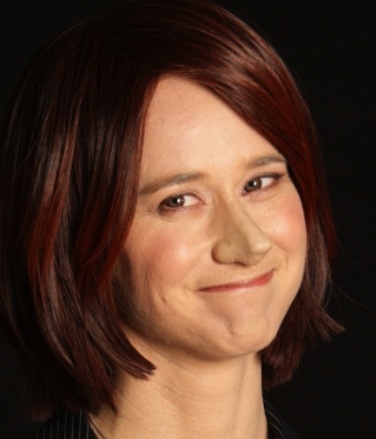
Amanda Bishop as Julia Gillard.

“We can do an exact replica, or we can take elements of ‘impersonation’ and then build a character from there,” Bishop says, explaining the basic challenge of satire.

“The reason we build a character is because often we actors play a real person in situations they may not normally be in.

“For example, Julia sings Carmen’s ‘Habanera’ in this year’s revue, so we have to transition from a typical press conference situation, and, using the elements that are most strongly recognised (voice, hand gestures, stance, costume) take them into the world of make believe.”

Bishop’s work as Julia Gillard has also translated to the small screen in a number of incarnations.

“In television, I learnt a great deal from Paul McCarthy, who played Kevin Rudd, Tony Abbott, and Malcolm Turnbull in the series we did called Wednesday Night Fever recently on the ABC. He is an incredibly generous peer and his transformations are exquisite.”

Now that Julia Gillard has moved on from politics, what does Bishop think is in store for satirists?

“I actually think it’s another interesting time. We have Tony Abbott, who’s been in the public eye for some time now, but with him on his front bench, there’s much newer blood: Joe Hockey and Christopher Pyne, and in Labor, well, there’s been so many changes, they’re all new. There’s so much fun to be had, discovering the politicians through art as much as we discover them through their own work.

And what’s next for Amanda?

“I’m still performing Julia until Christmas. Then I’m going to New York to work, and so is Julia, apparently. Poor thing, I hope I don’t bump into her in a bad mood! I hope I get to thank her for the education she gave us.”
Thanks to Lisa Mann Creative Management and Sydney Theatre Company for their assistance in facilitating this interview and images.

This article appears in Michael’s eBook Creating Waves: Critical takes on culture and politics.

© Michael Burge, all rights reserved.

Jonathan Rosten – spirited dancer

DANCER Jonathan Rosten rehearsing for Song and Dance (Photo: Branco Gaica).
LANGUAGE OF DANCE Jonathan Rosten rehearsing for Song and Dance (Photo: Branco Gaica).

Jonathan Rosten (1960-2004).

JONATHAN Rosten knew how to dance – it was the language he expressed himself best in. His dance career included some magnificent highlights – solo parts for The Australian Ballet Company, and roles in Andrew Lloyd Webber’s Song and Dance (Cameron Mackintosh) and An Evening (Sydney Dance Company).

Jono also made his mark in commercial dance, from variety television appearances, to iconic dance-based commercials, and his various spots in the opening of the NSW Royal Bicentennial Concert.

After 20 years as a dancer, Jono began a new career path when he found himself writing, directing and choreographing his first show – A Really Off Off Broadway Show. Jono’s program notes for this end-of-year student performance at Jester’s Acting School in 1986 describe himself as, “One who has been thrust into directing and is better equipped to handle toasted cheese sandwiches”.

Just why he made this move seemed to be a combination of things – too many hours spent bitching about the quality of productions on offer at the time; a desire to turn his burgeoning ideas into reality; and seeing a now renowned production of an entire musical in a garage in North Sydney, which inspired Jono with it’s ‘Let’s Just Do It’ approach to entertainment.

Once this door was open, Jono spent the next ten years in a showbiz no-man’s-land, taking dance work where it paid well in order to finance his writing. Moving from mainstream to independent theatre also saw him work with and be inspired by some early mavericks, including choreographer John O’Connell on Mr. Cha Cha Says Dance.

An early unproduced work he created was And Then God Created Showbiz!, beginning a tradition of exclamation marks in his show titles. This was a comic exploration of the history of showbiz in a biblical and new age context. Ideas for numbers included The Ten Commandments in the style of The Ziegfeld Follies; a Fonteyn and Nureyev duet with a wheelchair-bound Fonteyn; and a climactic Xanadu-inspired number with Jesus on roller-skates.

Suffice to say the humour was subversive. The vaudevillian line-up of showgirls, drag-queens, biblical characters and historical showbiz luminaries would have made this show highly expensive and a copyright nightmare.

For Jono, it was a fantastic experiment he worked on for a decade, a place where all that seemed ‘unacceptable’ in his world (homosexuality, cross-dressing and new age spirituality) could be placed centre-stage. These were recurring themes in all his work, taken from his own life journey and stories he’d encountered along the way.

It took another ten years before Jono found someone out there like him. At the end of a trip across America, in which he took-in the heights of Broadway, Jono happened upon a small theatre company in Los Angeles holding a retrospective of the collected works of Justin Tanner, a self-made theatre man who created shows like Zombies Attack and Pot Mom. He went to see a new work every night of his stay in LA, and the impression it left on him lasted for the rest of his life.

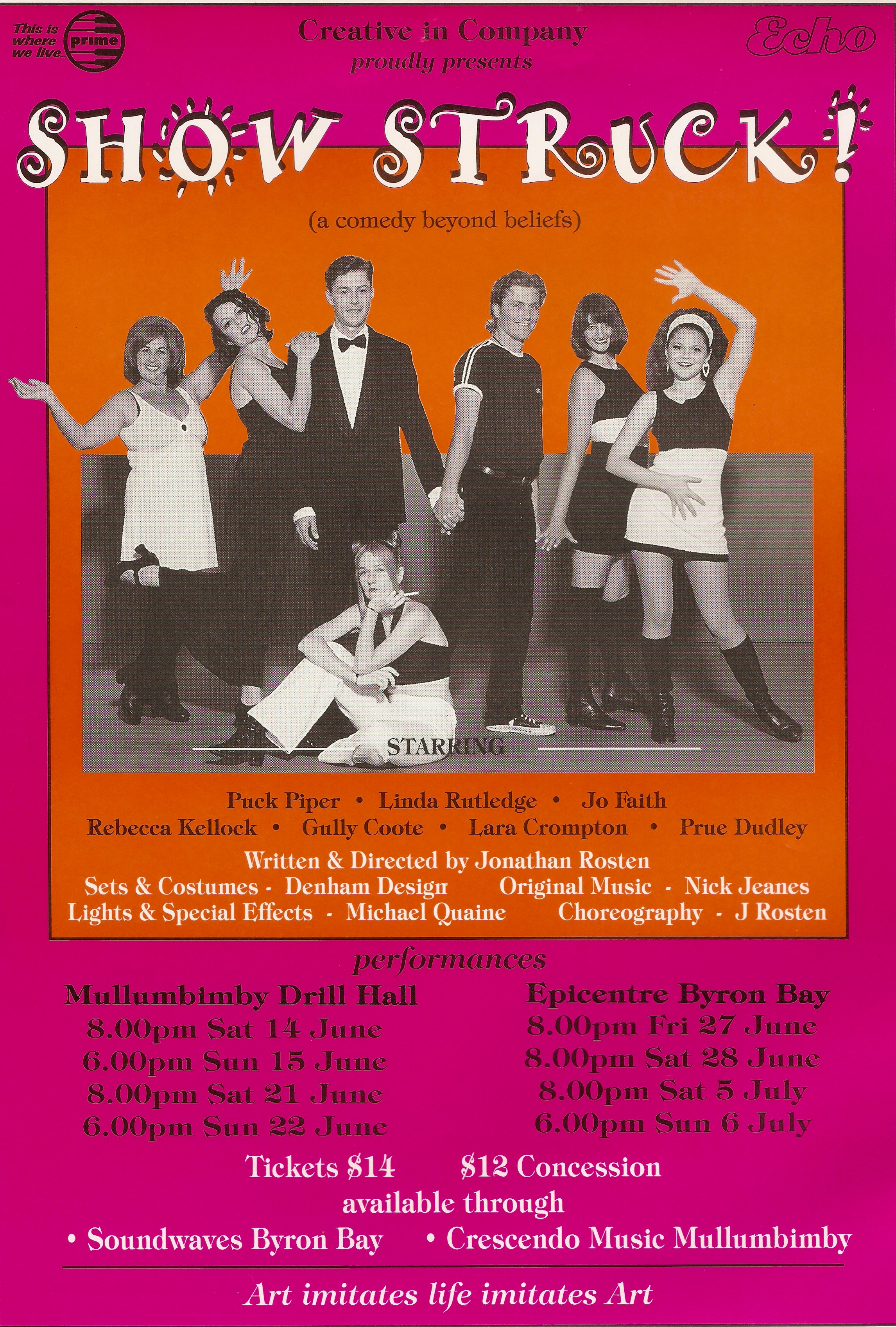
SHOWSTRUCK

He knew he had no time to waste. He knew he could be to Australia what Tanner was for Tinseltown, and shelved a host of stymied and incomplete works, including And Then God Created Showbiz! to embark on an entirely new piece called Show Struck!

Produced in the Northern Rivers area by Jono’s fledging theatre company Creative in Company, this new show was popular with audiences and was well-reviewed.

Jono created a show where the vaudevillian and alternative concepts were well within the context of a strong plot – one man’s journey through contemporary Australian show business, his desire to integrate spiritually in a spiritual vacuum, and to express his sexuality as a gay man. He wrote the show’s lyrics and produced, directed, choreographed and also acted in the show when one of the cast was injured.

Tired of endless touring to regional RSL’s, Daniel, the hero of Show Struck! is in creative limbo with his friend, mentor and bete-noire, Sherri, a showbiz survivor who has nurtured Daniel creatively and spiritually but will not let him flourish in the face of her own failures.

His journey takes him from also feeling like a failure in life, career and love to a state of limitless potential, having exorcised his demons – Sherri, his agent, and creative and sexual guilt within himself. Comically and beautifully, this journey is made in the form of an original show within a show.

One of Jono’s favourite real-life showbiz characters was Ed Wood of Plan 9 From Outer Space and Glen or Glenda fame. In the same spirit of this Hollywood maverick, Jono had big dreams to realise.

LOST SOULS The Lost Brother, Bondi Ballet, 2002.
LOST SOULS The Lost Brother, choreographed by Jonathan Rosten for Bondi Ballet, 2002.

He left Byron Bay for the Blue Mountains in 1999 and found himself in a new creative community where he quickly made his presence felt.

He began working with other maverick producers, like Out of the Blue, a community theatre group who through sheer hard work and self-belief staged the electrifying Australian Premiere of The Who’s Rock Opera Tommy at Parramatta Riverside Theatres in 2003, choreographed by Jono. Bondi Ballet gave Jono the chance to write and choreograph Lost Brother in 2002, a highly personal dance-multimedia work about the drowning death of his older brother Peter.

His dream now was to live close to the city and take original shows into Sydney after out-of-town tryouts in Katoomba. The Clarendon Dinner Theatre was the perfect venue for this plan, having birthed many successful productions over the years, and Jono approached the venue with a new show She Males from Outer Space!

Like all Jono’s shows She Males was purposely derivative. He dubbed it ‘Scooby Doo meets Plan Nine from Outer Space’. A gang of kids lost in the Australian bush encounter two strangely attired women who look like they’re from a science fiction movie, but claim to be collecting minerals at midnight. Before the kids know it they’re trapped in an intergalactic breeding program when one of them – Anne, a devout Brethren girl – is kidnapped. The gang must get her back and face their own shortcomings and lack-of-acceptance in the process.

SHE MALES

This show made it to Sydney in February 2004 as part of the Mardi Gras Cultural Festival, and had a 4-week season at The Edge Theatre in Newtown.

Jono injected this classic story of opposites with some of his best choreography. There were cheerleading sequences, mesmerising alien dance-moves and a continual comic through-line involving movement and lines inspired by old movies and television.

Deep in the plot was another of Jono’s appeals for acceptance when the hermaphrodite alien she-males explain to the younger gang that they are “Perfectly balanced in our male and female parts”, a beautiful piece of writing which challenges the gang (and us) to accept themselves, each other, and ultimately Anne’s alien she-male baby who was born during the curtain call.

Jono had succeeded in a long-held ambition to carry a weighty political message with a light comic touch, and reviewers and audiences responded. He had also discovered where his greatest talent lay – in storytelling using movement, dance and comic juxtaposition.

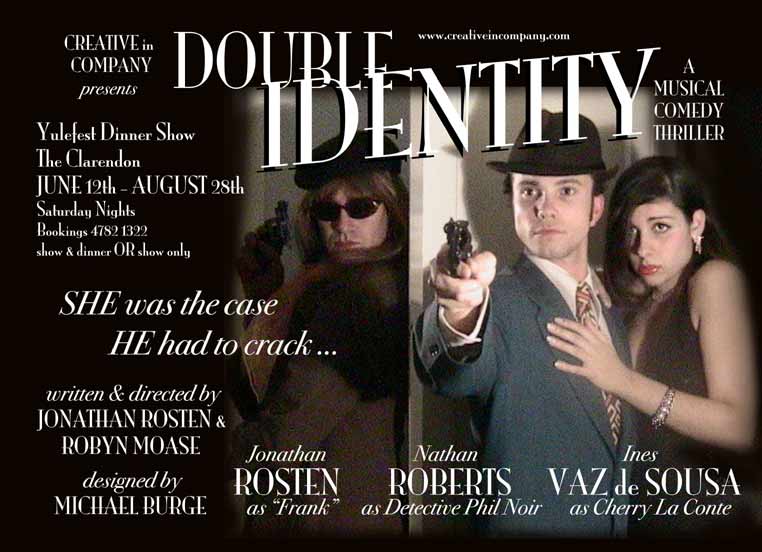
The Clarendon immediately asked for another show and Jono responded with his last unproduced show Double Identity (strangely there was no exclamation mark in this one). This show was again highly derivative, taking the film noir world and turning it on its head.

Inspired by audience reactions to the comic dance and movement styles in She Males, Jono created a series of dance/movement numbers and then built a plot around these. He also planned to return to the stage in a number of small crazy parts, including Frank the club owner who cross-dresses.

To date this show has had one performance only, two days before Jono died suddenly in rehearsal. Harking back to the garage-show in the 1980s, this performance was in the studio at the back of our home. I was the only member of the audience and the young leads – Nathan Roberts and Ines Vas De Sousa, were obviously going to be fantastic in the run. Jono was in there too – I had rarely seen him perform, and he sparkled with a glint in his eye, even when things went wrong and they had to do numbers from the top.

The man who started out as Buckingham in The Australian Ballet’s Three Musketeers, who danced for the Prince and Princess of Wales at Australia’s Bicentenary, who was The Milka Boy in the Swiss Alps with purple cows, was now integrating again in his newest incarnation as a singer-dancer-actor-writer-choreographer-director-producer.

Little did he or we know that the integration was so complete that only 48 hours later he would make the ultimate transition into death.

POSTER_email

Double Identity did not have its 3-month season at The Clarendon.

I can imagine Jono changing the name of this production to The Show Must Not Go On! (and scoring an exclamation!) because showbiz seems all too superficial without him.

Reality of his absence has kicked-in and Creative in Company has dissipated with the understandable shock.

The irony is that while his company was called ‘Creative in Company’ it really was just Jono instigating the work and driving it forwards, like Daniel in Show Struck!, helped and supported by a lot of talented people, but it was always Jono driving the bus.

“Don’t worry about being famous,” was one of the last things he ever said to me, in a way which told me he had once cared about fame, but had certainly let go of it and become much happier as a result.

I knew then why I loved him so much, and will never forget my years in the presence of this cheeky showbiz original who achieved his life’s ambition to understand himself, well out of the spotlight.

For this I am sure he would be happy to be remembered in the AussieTheatre.com Hall of Fame.

Published by AussieTheatre.com in 2004.

Lottie Lyell – the sentimental girl

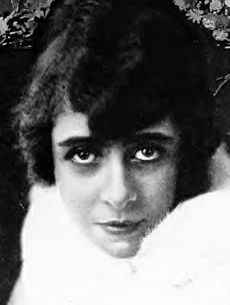
SENTIMENTAL FAVOURITE Silent screen star Lottie Lyall (1890-1925).
SENTIMENTAL FAVOURITE Silent screen star Lottie Lyell (1890-1925). (Photo: ScreenSound Australia).

A Writer explores an untimely death.

LIVING in Australia’s Blue Mountains, it’s hard to ignore one tragic element of the locality’s heritage – the tuberculosis epidemic.

Situated at almost 1000 metres above sea level, the area spawned an industry of public and private sanatoria for countless people who retreated from Sydney in an attempt to recover from this infectious disease in the years before antibiotics provided an effective cure.

Previously unexplored insights into the tale of one tuberculosis patient who convalesced in the Blue Mountains – Australia’s great silent film actress Lottie Lyell – formed part of this feature about her story, published in Blue Mountains Life in 2011.

The sentimental girl

Unravelling the Blue Mountains Mystery of film maker Lottie Lyell.

Widely regarded as Australia’s first international film actor, Lottie Lyell had been a star for a decade by the time The Picture Show of February 1921 revealed she was recovering from “A serious illness”, but that she would: “… appear on the screen again.”

Convalescing in the Blue Mountains in the same month, Lottie had a very good reason for keeping the true nature of her condition from the press.

Since her 1890 birth in the working class suburb of Balmain, Lottie had been in the path of one of the most serious illnesses of her age – tuberculosis (TB).

The tuberculosis industry of the Blue Mountains is the subject of two new books which shed light on how TB defined family fortunes and caused social stigma.

When considering the case of Lottie’s family, author Dr. Brian Craven says that on the basis of her sister Rita’s death of TB in 1911, they would have been “In serious trouble”. Due to TB’s chronic nature, Brian suggests Rita might have carried infectious TB bacteria for a considerable period of time.

“In a community where TB was rife, you could get it from anywhere,” Brian outlines, explaining how Balmain’s colliery would have added to the risk of contracting the disease. “One group who got TB was coal miners of any sort. Once you got silicosis, your lungs were stuffed up and it was very easy for TB to take over.”

385px-TB_poster

Brian proposes that since Lottie’s father Joseph Cox was a real estate agent, collecting rents in a close-knit community, he would have been in regular proximity to TB sufferers.

Valerie Craven (research assistant to her husband Brian) explains why many sufferers kept their illness a secret – “TB was socially unacceptable in the sense that it was considered something the underprivileged got. If the family was poor, they usually couldn’t afford to do anything about it.”

Charlotte Cox took elocution and acting lessons in her mid teens. By nineteen she was in regular paid acting work onstage using her stage name Lottie Lyell.

Her meeting with Raymond Longford has become the stuff of legend. They were colleagues in the 1909 theatrical tour of An Englishman’s Home in which Lottie played his daughter, despite being only 12 years his junior.

Longford and Lyell probably began their relationship then. He was a married father, but divorce was not an option.

The stage careers of both actors dwindled once they embraced the opportunity and innovation of film production. Longford acted in and directed movies from 1911, creating a spectacular lead role for Lottie with The Romantic Story of Margaret Catchpole in the same year.

“For picture work you must be pretty good at all sorts of athletic sports,” Lottie recounted of the shoot to The Theatre magazine. “I had, in the depth of winter to jump into the water from a cliff thirty feet high, and then swim some distance out of range of the camera … handicapped by old period, masculine attire.”

The movie was praised for its unique Australian qualities, and its home-grown production team.

The deaths of Lottie’s sister and father at the time her screen career took off must have had a tempering effect on a close family who accepted Lottie’s unorthodox lifestyle.

The survivors moved by 1913 to Sydney’s Eastern Suburbs, where Longford moved in with Lottie and her mother. The relocation suggests an attempt to escape the risks of TB in Balmain.

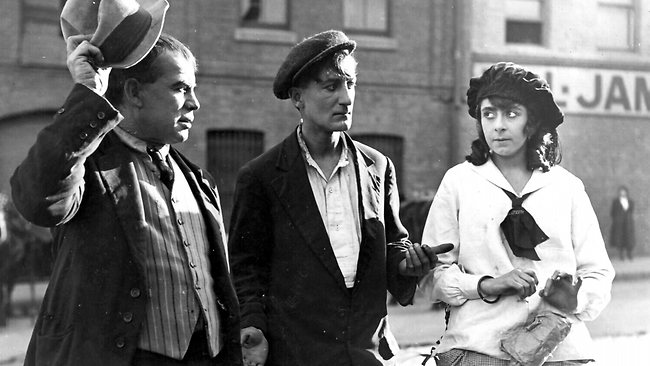
SCREEN CLASSIC Lottie Lyall in Raymond Longford's The Sentimental Bloke (1919).
SCREEN CLASSIC Lottie Lyell as Doreen in Raymond Longford’s The Sentimental Bloke (Photo: ScreenSound Australia).

Lyell and Longford worked together on a string of films over the next decade. Their greatest surviving collaboration was The Sentimental Bloke, released in 1919.

Based on C.J Dennis’ best-selling poem, directed by Raymond and filmed on the streets of Sydney’s dockside Woolloomooloo, the film tells the romantic comedy of Bill, a larrikin who falls for Doreen, a working class girl (played by Lottie).

The movie set box office records in Australia and was distributed in Britain, New Zealand and the United States.

Lottie must surely have been Raymond’s choice for a lead role in his next production, an adaptation of Steele Rudd’s Dad & Dave comedy On Our Selection (1920). But she didn’t appear before the camera, she co-wrote the screenplay. The explanation given was her “serious illness”.

Brian Craven’s book reveals that symptoms of TB meant compulsory notification to health authorities in NSW at this time. The persistent cough, and the coughing-up of blood, would have been very hard for Lottie to conceal.

“You were never cured of TB,” Brian outlines. “The disease was only arrested, encapsulated in the lungs. Life was not too hard. Rest and good food, the removal of worry, light duties. These were important factors in your survival.”

“If you were a poor person you had to wait, wait and wait on someone’s death to obtain a place in a TB asylum,” Valerie adds.

There is little doubt Lottie convalesced in a private hospital – an option providing more anonymity to those who could afford it. A telegram from the Melbourne premiere of On Our Selection in February 1920 was sent to Lottie at a private address in Katoomba.

Far from the favourable response to Lottie’s newest movies (including her reprisal as Doreen in Ginger Mick), she seems not to have dwelt on what TB kept her from. Instead, what happened next suggests Lottie saw great possibilities in being holed up in Katoomba.

While convalescing throughout 1920, Lottie probably adapted her next screenplay The Blue Mountains Mystery from a novel (The Mount Marunga Mystery by Harrison Owen). Raymond and Lottie directed it together in 1921.

The Cravens explain that TB sufferers were advised to recover at a high altitude, allowing less atmospheric pressure to work on their lungs. It might have been for this reason that the movie wasn’t shot at a studio in Sydney, but entirely on location one thousand metres above sea level at Katoomba. The Blue Mountains were a stand-in for Harrison’s fictitious rural setting.

Key scenes for the murder mystery were filmed at the Carrington Hotel, including the iconic ballroom. Production stills show the studio-like scale of the rooms, allowing heavy-duty film lighting and a sizeable crew.

Apart from production stills, The Blue Mountains Mystery does not survive, unless, like The Sentimental Bloke (mis-labelled The Sentimental Blonde in the United States until 1973), a surviving reel comes to light.

Lottie’s appearance in these stills show a healthy-looking woman very much at the heart of the action. One journalist (writing in The Picture Show) pondered why she was co-directing and not acting.”I love the acting,” Lottie said, “but I was too interested in the directing work to get in front of the cameras myself.”

Despite her condition, Lottie was not pessimistic about her chances. “Ten years I have been in pictures … and I hope to be always connected to them in some way or another”. An admission of the need to slow down, or the desire to embrace her skills as a writer-director?

STUNT WOMAN Did Lottie Lyell's stunt performances contribute to her untimely death?
SKILLED HORSEWOMAN Did Lottie Lyell’s stunt performances contribute to her untimely death?

Production remained at high altitude in the Megalong Valley for the filming of Rudd’s New Selection. Lottie played Nell Garvin, working stunts for the camera on horseback.

There was a saying about surviving TB – “If you can sit down don’t stand. If you can lie down don’t sit.” Brian Craven agrees – “If you didn’t do anything stressful, then you could recover, otherwise, you’d go down with the symptoms.”

Lottie explained what horseback stunts required for her earlier role as Margaret Catchpole – “It is not simply a matter of sitting a trot or a canter … I have often had to take a three feet hurdle.”

Her return to acting took its toll. Stills from Rudd’s New Selection show her appearance had dramatically worsened.

The Cox family’s 1921 move to Roseville on the bushy outskirts of Sydney suggests another attempt to accommodate Lottie in a place better suited to worsening TB.

Far from avoiding stress, she and Longford embarked on an ambitious business plan with the Longford-Lyell Picture company, for which Lottie wrote more screenplays and acted in The Dinkum Bloke (1923). There were no stunts this time, only the supporting role of Nell Garvin, for which Lottie played a deathbed scene.

Life imitated art two years later. Only months after her younger sister Linda succumbed to TB, Lottie also died in December 1925. Her death certificate revealed she suffered from pulmonary and laryngeal tuberculosis. She was 35.

Tragically, Longford’s divorce was finally granted just weeks later. Lottie had appointed him her executor and primary benefactor. His later career never re-captured the prolific years of collaboration with Lottie, and over three decades later he was buried beside her.

Lottie Lyell defined the roles of women in Australia’s film industry very early – as actors, but also as writers, directors and producers. She was one example amongst thousands of TB sufferers who convalesced in the Blue Mountains, but did not allow chronic illness to define them.

pluck-cover
BUY NOW

Sources and further reading:

Photo Play Artiste by Marilyn Dooley.
The Shoulders of Giants by Dr. Brian Craven.
The Healing Mountains by Gwen Silvey. 

© Michael Burge, all rights reserved.
This article appears in Michael’s eBook Pluck: Exploits of the single-minded.