Category Archives: Reviews

Carol out in the cold

WITH nothing more complex than a series of firmly closed doors, the film Carol takes a powerful dramatic turn that subtly gives two women the space to explore their attraction.

“The wait for enlightenment will be long, and the darkest, pre-dawn hour lies ahead.”

When Therese (Rooney Mara) slips into the passenger seat beside Carol (Cate Blanchett) and shuts out her fiancé, they leave him blinking on the kerbside. Soon after, Carol’s old flame Abby (Sarah Paulson) firmly shuts her front door on Carol’s estranged husband (Kyle Chandler), leaving him awkwardly framed through a small window.

But it is the shutting of the door between the two protagonists – closed by Carol against Therese at the height of an argument – which makes forbidden fruit all the more potent for both women.

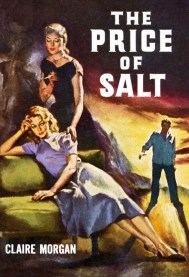
Phyllis Nagy’s screenplay (based on Patricia Highsmith’s 1952 novel The Price of Salt) uses these pivotal separations to mark out the territory of a love story that breaks several taboos.

The shutting-out of men has been a powerful literary force ever since Anne Brontë’s The Tenant of Wildfell Hall (1848) in which Helen Graham dramatically slams her bedroom door in her husband’s face and created what many credit as the first feminist novel.

CAROL
CHRISTMAS CAROL Cate Blanchett as Carol and Rooney Mara as Therese.

Published a century later, and phenomenally successful in its day, The Price of Salt disappeared from mainstream lists until Highsmith came out as its author in the 1980s and changed the book’s title. Plans were made in the 1990s to adapt it for the screen, and almost twenty years on – surely one of the film industry’s greatest examples of persistence – the story has been thrust into mainstream consciousness.

And its arrival pulls few punches. The unstable yearnings of unfolding passion will be familiar and understandable to anyone who has ever fallen in love, but emotional and sexual lust between two women is rarely seen on the big screen across suburban cinemas.

Carol contains several quite inadvertent similarities to other stories. When Carol and Therese take to the road, the story has strong echoes of Thelma and Louise. The escapist quality of that journey also speaks to the kind of concealed passion explored in Brokeback Mountain.

Highsmith’s novel traverses similar tragic precipices, yet its originality lies in the choices Carol and Therese make when their love is swiftly and coldly thwarted. Far from home, in a frozen place ironically called Waterloo, they have the door to their world cruelly wrenched open for the very worst of reasons – a blow that lands right in Carol’s weak spot.

It is from this point in the story, the final act of Carol, that Phyllis Nagy has done greatest service to Highsmith, but don’t be fooled by the alleged ‘happy ending’ tag this story has garnered. While it doesn’t have the shock ending of Thelma and Louise or the tragedy of Brokeback Mountain, the denoument of Carol comes with a level of compromise and risk that could never be defined as a positive outcome.

Cate-Blanchett-Fur-Coat-Carol-Movie
COLD COMFORT The original novel takes its characters on a road trip into America’s heartland.

Cate Blanchett portrays Carol as glamorous and anaesthetised, at times a sheer minx and at others world-weary, as though every stroke of make-up and hair product in the high-fashion front is only just managing to hold her upright. She inhabits Highsmith’s title role with a languid style that is never more poignant than when Carol is required to behave.

The slow burn of Therese’s story is given a sparse amount of dialogue, since her passion must remain internal until it is safe to express. Rooney Mara gives Therese the perfect hyper self-awareness in the role that is closest to Highsmith herself, who revealed in the book’s 1989 re-release that she’d encountered a woman like Carol while working in a department store as a youth. Despite finding out where she lived, Highsmith never made contact.

Knowing the fully fledged rage with which Highsmith went on to live and write by, it’s impossible to watch Rooney Mara’s performance without the sense that Therese would eventually give Carol a run for her money as a self-determined woman.

Haynes has been praised for the visual style of Carol, yet it has nothing like the luminous, throbbing-with-colour quality of his other 1950s-era film Far From Heaven (2002).

Carol and Therese inhabit a darkened, soft-focus, wintry world. Glimpses of sun show themselves at the edges, but remain out of reach, as though the wait for enlightenment will be long, and the darkest, pre-dawn hour lies ahead.

static1.squarespace
CLAIRE’S CAROL Highsmith’s book was originally published with a different title, under a pseudonym.

Nagy’s screenplay achieves far more with the story’s dramatic turns than Highsmith’s novel, which was her second and suffers a little from not knowing what to do with these characters before she sets them on the road.

Nagy knew Highsmith and drew on her friend’s experience of what it was like to be a lesbian in the 1940s and 1950s by adding detail on the legal and psychological challenges faced by same sex-attracted women in the United States.

But Highsmith’s novel sends Carol and Therese on a journey through America’s road culture, beyond the restrictions of their lives and dangerously oblivious to the ramifications of their journey, that is not fully realised on the screen.

“A mesmerising, disturbing film about unearthing passion and controlling rage.”

The scale of the route rivals that of Thelma and Louise, yet the cinematic potential of vast landscapes is not captured in the film. When the city-dwelling protagonists emerge in an expansive, elemental space they are unlocked from the world that confined them, and their enemies are required to do far more work to rein them in. In this, Carol is a precursor to Highsmith’s best-known works, the Tom Ripley series of thrillers, and leaves the novel worth reading for its own sake.

A mesmerising, disturbing film about unearthing passion and controlling rage for the sake of relationships, Carol explores the limits of what people will accept and the territory they will not negotiate.

creating-waves-cover
BUY NOW

The right to evade capture, to avoid being shut out emotionally, are portrayed as loudly as the sexual criminality of the era, and make a universal story out of what might otherwise have remained a period piece. 

© Michael Burge, all rights reserved.

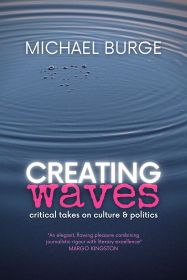
This article appears in Michael’s eBook Creating Waves: Critical takes on culture and politics.

Hanging half a century on a solution

FORTY years since the premier of the Peter Weir film, it’s time for Australians to realise that Picnic at Hanging Rock has kept us completely fooled for five decades.

This evocative screen mystery burst into our consciousness the same spring that the constitutional crisis of the last months of the Whitlam government left Australians in an altered state.

“Australian cinema’s ‘new wave’ success story rose on the back of a terrible cultural lie.”

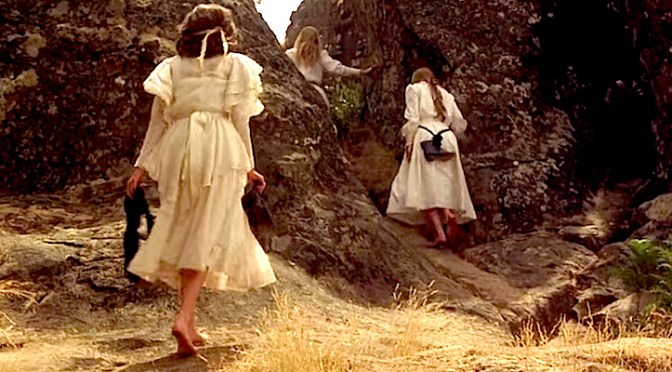
The original novel by Joan Lindsay was similarly about the impact of sudden change. When three schoolgirls and a governess do not return from a commonplace picnic at a local beauty spot in 1900, the mechanics of shock and denial challenge the very foundation of knowledge.

WHAT DO YOU KNOW? Helen Morse as Mlle de Poitiers and Vivean Gray as Miss McGraw in Peter Weir’s 1975 film Picnic at Hanging Rock.

As French governess Mademoiselle de Poitiers farewells four of her charges wanting to explore the base of Hanging Rock, seeing Miranda turn away, she asserts: “Now I know”. The only one who hears is mathematics teacher Greta McGraw, who replies: “What do you know?”

Mlle de Poitiers is happy to believe she has seen an angel by an old master, although Miss McGraw appears to have her eye on something far more attractive.

Minutes earlier, this rational, scientific 45-year-old noticed her watch, like everyone else’s, had stopped, right on midday. The picnickers are suddenly, and literally, out of time.

This fictitious pre-Federation mystery perfectly captures modern Australia’s struggle to form an identity, because the answer to what drew Miss McGraw to follow the girls up the rock that timeless afternoon was always there, it’s just that others decided we were not prepared for it.

A real-life disappearance occurred at another famous rock and challenged Australian identity all over again, when, on the night of August 17, 1980, baby Azaria Chamberlain was taken from her tent by a dingo at a campground near the base of Uluru – at that time known by its European name Ayer’s Rock.

EVILANGELSIt did not take long for the majority of Australians to decide this event was nothing more than a fanciful story, sprung from the imagination of Lindy, Azaria’s mother, who was jailed for life for her daughter’s murder.

We were far more willing to cry murder than countenance the reality of predators in our landscape.

Fred Schepisi’s film of John Bryson’s book on the Chamberlain case – Evil Angels – outlined the dingo story and subsequently bombed at the Australian box office.

We could barely look at the Evil Angels, whereas the romantic never-to-return ‘angels’ of Picnic at Hanging Rock we took to our hearts; but Australian cinema’s ‘new wave’ success story rose on the back of a terrible cultural lie.

Joan Lindsay complained of endless fan mail asking whether her story was based on fact, although I call her annoyance a dodge, because she brought all the attention on herself as soon as she allowed her publishers to lop off the last chapter of Picnic at Hanging Rock before it was published in 1967.

But her original Chapter Eighteen survived the butchering of editors: she entrusted it to her literary agent John Taylor in 1972, with strict instructions to publish it after her death.

This he did in 1987, by which time a cult had grown around Lindsay’s ruse. The twelve pages of Chapter Eighteen published in the booklet The Secret of Hanging Rock were framed by tongue-in-cheek essays by Taylor (claiming that Lindsay’s solution was “unfilmable”) and Yvonne Rousseau, a writer who’d spent years sleuthing Lindsay’s oeuvre.

Despite the attention Lindsay’s ‘solution’ received, it was not enough to challenge the trajectory of the film’s success. A director’s cut was released theatrically and on DVD, including a documentary in which not a single mention was made of Lindsay’s Chapter Eighteen.

“They were happy to escape a life of corseting, cosseting and control.”

Her long-concealed dénouement quite matter-of-factly revealed the missing schoolgirls and their governess had undergone the kind of transformation common in Classical legends, although Lindsay had created a credible bridge between European myth and Aboriginal Dreaming.

Other writers had attempted this earlier. Arguably the most famous was the fake Aboriginal Legend of the Three Sisters, the story of three Aboriginal women transformed into the famous rock formation by their ‘witchdoctor’ father, written by Sydney schoolgirl Patricia Stone in the 1930s and subsequently sold by Katoomba’s tourist industry as genuine Aboriginal legend.

DREAMING WITHIN A DREAM Seeking the solution to what happened.

But Joan Lindsay avoided cultural appropriation. Instead, she allowed her large cast of European women to be themselves appropriated by a Dreaming entirely appropriate for an Australian story.

Picnic at Hanging Rock screenwriter Cliff Green identified one of the major themes in Lindsay’s story as child abuse, and once the women do not return, the checks and balances of a ‘proper’ education gradually do reveal the physical and emotional weaponry of British headmistress Mrs Appleyard.

The missing schoolgirls and their governess, then, were not victims of crime or whisked away unwillingly. They were happy to escape a life of corseting, cosseting and control.

“I can hardly wait,” star maths student Marion Quade says in Chapter Eighteen, anticipating her chance to shuffle off the twentieth century and follow her transformed maths teacher Miss McGraw “without a backward glance”.

Marion’s escape route comes straight out of 1960s notions of Aboriginal Dreaming, atmosphere that undoubtedly challenged the original publishers into such a severe deletion. Far more preferable for daughters of the Empire to disappear into thin air than be seen to delight in a spiritual transition well-known by the nation’s first people.

The edit allowed Joan Lindsay’s fact-fiction flim-flam to become the focus of the book and film’s success, and even though all along she knew she’d not written a mysterious disappearance, she played her part very well by suggesting the audience decide what was true and what wasn’t.

Fans and detractors rushed to pore over the archives and trample across Hanging Rock, well off the scent of a simple look into Lindsay’s education at a Melbourne ladies’ boarding school.

LADY LINDSAY Joan Lindsay (1896-1984).
LADY LINDSAY Joan, Lady Lindsay (1896-1984).

It was Terence O’Neill in a 2009 La Trobe Journal essay Joan Lindsay: A time for everything who proposed that Lindsay can hardly have been unaware of her alma mater’s move from Melbourne to Woodend, close to Hanging Rock, in 1919, after her graduation; and, far more interestingly, the account in the school magazine of a Miss McGraw, teacher at the school in Lindsay’s time, who led the twilight expedition to Hanging Rock that inspired forty years of annual picnics and the telling of ghost stories on the way home. 

It’s also enlightening to analyse the corporal punishments Lindsay portrayed in detail – those that inspire adolescent fantasies about escaping the control of disciplinary adult paradigms – when seeking the real seeds of Picnic at Hanging Rock.

Missing corsets and stockings, a maths governess seen climbing Hanging Rock availed of her skirt, and the discovery of one of the missing girls, are all clues in both book and film, but they remain the worst kind of red herrings without Chapter Eighteen.

Another red herring is the sound of Pan pipes played by Gheorghe Zamfi on the soundtrack, evoking the old Greco-Roman gods of different land altogether.

It’s probably un-Australian of me, but I call for a remake. 

PANIC
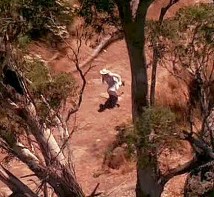
MUCH TO LEARN Edith runs from the top of Hanging Rock.

Pan pipes would easily be replaced by a well-known Aboriginal wind instrument; and doubtless there is much to learn from the Wurundjeri nation, traditional owners of Hanging Rock, the rock formation they were dispossessed of in the 1840s.

Joan Lindsay’s literary stock-in-trade was time. I can’t imagine her not approving of a reappearance of Miranda, Marion and Miss McGraw in an episode of Doctor Who, or at least a mash-up adaptation like Pride and Prejudice and Zombies.

The Northern Territory legal system took thirty years to come to terms with the facts about the dingoes that preyed on Azaria Chamberlain. Surely in that time we have grown enough to cope with Aboriginal Dreaming in one of our greatest novels?

creating-waves-cover
BUY NOW

As Gough Whitlam famously affirmed in 1972, ushering in the government that would transform the lifeless Australian film industry, led by Lindsay’s big-screen icon: “It’s time”.

© Michael Burge, all rights reserved.

This article appears in Michael’s eBook Creating Waves: Critical takes on culture and politics.

Heartbreaking enigma of The Imitation Game

CODEBREAKING ENIGMA Alan Turing (1912-1954).

THE first time I tried to see The Imitation Game with my husband, the session was solidly booked out.

On the surface I was annoyed, but deep down I was incredibly pleased, knowing that a full house of holidaying Australians was being exposed to the story of Alan Turing, code-breaker, computer innovator and gay man now transfigured by time into an unassailable hero.

At our second attempt, we booked but ended up in seats down the front. Craning my neck up at the enormous screen, I realised something in me still could not quite come to terms with how this film’s gay protagonist garners such excellent box office.

I’ve known Turing’s story for many years – I feel his tragedy keenly as one of the first generation that missed out on electro aversion therapy and chemical castration by a fraction of time.

“When you have to wait more than 20 years between screen heroes, you realise how straight audiences take theirs for granted.”

Seeing the way he trounced the entrenched straight male fraternity at Bletchley Park, as his keen mind turned the tide of a terrible war, all the while knowing how betrayed he would be by those he saved… well, it was heartbreaking.

His legacy was all the fuel I would have ever needed to overcome fear and just be myself as a teenager, standing on Turing’s shoulders.

Yet the very nature of his achievement – hidden and classified – took him from my generation until it was too late. So many of us slipped easily and quietly into our own closets and codes, fashioned in the shadows of sodomy laws and HIV/AIDS.

We silently air-punched for our beloved Alan Turing from our ridiculous seats. We lionised him, raised him up without hesitation, even though we knew we weren’t seeing the whole truth in Graham Moore’s excellent debut screenplay.

Plenty has already been written about the inaccuracies of The Imitation Game – you’ve got the usual casting concerns, like Keira Knightley not being a plain enough Joan Clarke; the wrong name for Turing’s Enigma-breaking machine; spurious spies and an exaggerated antagonist in Commander Alastair Denniston.

But to focus on all that is just so much dissembling avoidance.

Not since Tom Hanks’ performance in Philadelphia (1993) have screen audiences been exposed to a three-dimensional gay protagonist in a mainstream drama. I don’t count Brokeback Mountain – those cowboys were not even out to themselves.

Why is this so important? Well, because when you have to wait more than 20 years between screen heroes, you realise how straight audiences take theirs for granted.

It wouldn’t matter how much they altered the margins of Alan Turing’s life story, or shuffled facts to make a workable three-act plot structure, the fundamentals are not up for debate and need little embellishment. The Imitation Game is true to the man’s core experience. His tale follows the very equation of heroism.

Yet the film has its detractors. Films with gay heroes will inspire unsettled, contrary resentment until all the fairytales behind the great archetypal stories and their happy ever afters get rewritten and rediscovered, until they allow for all human experiences.

BROTHERLY LOVE Tom Hanks in Philadelphia.

Also preying on peoples’ enjoyment levels is the fact that The Imitation Game is a tragedy. Like Philadelphia, there is no other possible outcome for the protagonist than one in which Turing is worse off than where his story started.

But this is not Hollywood killing off the queer to make a point: it’s the truth. The untimely death of anyone, even gay geniuses and HIV/AIDS sufferers, hurts like hell, and most of us are only just letting such feelings in.

To fully understand it, this film is best compared with Fred Schepisi’s A Cry in the Dark – the story of Lindy and Michael Chamberlain, accused of killing their baby daughter Azaria at Uluru in 1980. Another relentless real life miscarriage of justice that made audiences finally look at the awful truth via nothing more complex than a recreation of the salient facts.

These stories cannot be assimilated in a two-hour cinema experience. They are in our minds before we buy our tickets and they linger long after our popcorn is finished. They are bigger than whether we like the movie or not.

The cause for hope is that the Chamberlain’s complete exoneration was due, in part, to writers and artists adapting their story and exploring it in multiple forms, just as Alan Turing’s WWII service was rediscovered by writers and artists long before the British establishment posthumously overturned his gross indecency conviction.

creating-waves-cover
BUY NOW

And now the push has begun in Britain for the pardoning of the tens of thousands of similarly convicted gay men.

© Michael Burge, all rights reserved.

This article appears in Michael’s eBook Creating Waves: Critical takes on culture and politics.