Category Archives: Write regardless!

The truth about writing commercials

TURN IT ON But don't throw the baby out with the bathwater.
TURN IT ON But don’t throw the baby out with the bath water.

THERE once was a time when I wrote corporate fantasies and advertising bumph with the best of them. Heck, I even won an award for one of the television commercials I wrote, and I learned a few tricks along the way which made the process easier on my artist’s soul.

Here’s my tips for writers in the advertising and corporate world …

Nobody really knows what makes some products sell

Advertising is all experimentation, and good products sell themselves, but no ad rep, account manager or spin doctor will ever admit that to a writer. Coming up with a brilliant advertising concept is more akin to creating the world’s best joke or ghost story in mixed company: it only relies on making the most people laugh (or feel afraid) at the same time, and it’s got to be so good that it makes people tell and re-tell the story to all their friends.

Word of mouth is the only effective form of marketing

And it’s a free distribution network once it’s been accessed. The key word here is: ‘word’. A creator of words is a: ‘writer’, the designer of the message, but also the least influential player in the advertising business. Work out why that is and you’ll earn yourself millions. Meanwhile, just write stuff that real people can talk about, and you won’t go far wrong.

Ad writers need to be great actors

You’ve got to sell your ideas. Be brave, be enthusiastic. Stand in front of the board and sock it to ’em. Shrinking violets need not apply for ad writing positions.

Write flexibly

Always ensure you have a few ideas in the air, because no final decision on wording or dialogue will be made until broadcast day of a television commercial, or publishing deadline day. Keep slogans fluid with multiple options that will work in the ad’s design. Ensure all your ideas are those you’d be happy to occupy the final spot in the ad, and make it look like you came up with the alternatives on the spot. That’ll get you rehired.

Play the accountability game

Fact is, no-one really wants to claim they had the idea behind an advertising campaign until it sells product and wins an award, and if that happens, suddenly it’s everyones! If you want to claim ownership of your ideas (and I assure you, you won’t always want to), make sure that your name is attached to the earliest appearance of the idea, in an email, or in the minutes of a meeting. That way, when it comes to award time, you’ll have proof, but be warned: claiming ownership before an idea floats is fraught with danger.

Nobody reads

This assertion is going to make some people very angry, but it’s certainly true in advertising. Every one of the players in an ad campaign will wait for the writer to write the ad and put it in the mouths of actors on set, or in the hands of a designer, long before reading it. Even then, they may only be scanning the words. First time ad writers are fooled into thinking they’re having a dream run because nobody is giving them any feedback, then, in the studio, they’ll hit a wall as all the stakeholders suddenly see how to ‘make it right’. That’s where the writer needs to have written flexibly (see above).

The client is always right

Even when they’re wrong, even when they’re very, very wrong, they’re right. It’s always best to get a client’s decisions in writing for this reason. Many will try to avoid this moment of accountability, but it’s essential that you get it. It’s called ‘sign-off’. If they waver at sign-off, you’ll know that they know they’re not right, and they’re about to change their minds. Back to your suite of excellent alternative ideas.

The account manager is always right

See above. Seeing a pattern here?

The writer is always wrong

Even when they’re very, very right. The best thing to do with your total lack of currency is to make allies along the production chain. There are plenty of other players with a bit of currency they can trade with you: designers who can tweak your ideas to make them outstanding; and video and audio editors who can give you more options than you thought you had. You’ll find these players working late in editing suites and darkened offices, and they’re usually happy to hear from the writer. Foster such alliances like war comrades, and buy them lots of drinks.

WRITE REGARDLESSDon’t stay too long in advertising

Unless you think you can maintain being right for your entire career.

© Michael Burge, all rights reserved.

An extract from Write, Regardless!

Great stories come in threes

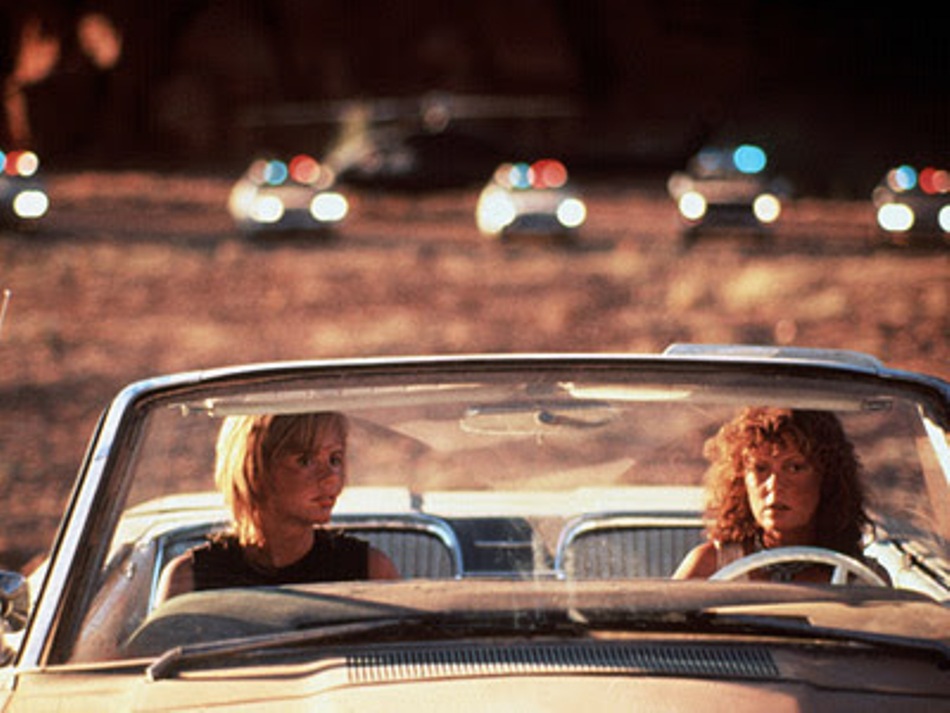
THREE'S A CROWD The climactic scene of Thelma & Louise (Production stills: Roland Neveu).
THREE’S A CROWD Thelma & Louise (Photo: Roland Neveu).

THE three-act structure is essential to the toolkit for that great misunderstood 20th century phenomenon: the screenwriter.

Truncated to suit a 90- 120-minute session at a cineplex, the three-act storyline is undoubtedly the one most people are most accustomed to, so it’s probably in a writer’s interests to know how it works.

The good news is that it’s simpler in one way, because there is less to it. The bad news is that it’s reportedly much harder to get right, but we’ll look at why.

Act One

Broadly, this act must encompass an exposition (explaining who is who, particularly the relationship between the protagonist, or ‘hero’, and the antagonist, or ‘villain’), remembering that with screenwriting, dialogue must work effectively alongside onscreen action. Film is a visual and aural medium, so screenwriters must write what the viewer will see and hear.

This act generally also contains a point of no return, which propels the characters forward on their journey. Here’s where the 3-act structure differs from the five-act structure more commonly employed in novels, where the point of no return is generally in the second half of the story.

TURNING POINT Things escalate quickly in Thelma & Louise.

You can see where this difference arose – producers sitting in screening rooms, shouting: “Get to the point faster!” Think Louise (played by Susan Sarandon) gunning down the rapist in the car park in Callie Kouri’s screenplay for Thelma and Louise, around 15 minutes into the movie.

Act Two

This act is the longest in the three-act structure, akin to the rising action of the five-act structure, where the protagonist struggles to rise above the point of no return, but often digs their way deeper into challenges set up by the antagonist.

Around the halfway point, or ‘midpoint’, something significant happens to the protagonist, which might be so sudden as to change the course of the story. In Thelma and Louise, this occurs with the appearance of Louise’s boyfriend, who might just convince her to give herself up, especially when he asks her to marry him. The protagonist’s response to the midpoint decides what happens for the rest of the story.

WHERE TO FROM HERE? One of the finest movie examples of a surprise ending.
WHERE TO FROM HERE? One of the finest examples of a surprise ending.

Act Three

Purportedly the hardest-fought scenes of every successful Hollywood screenplay, and the most difficult for writers to get right, this act contains the climax of the storyline, at a point significantly later than the five-act structure, where the tension comes to a head.

In Thelma and Louise, the climax is the most visually and emotionally dramatic scene of the movie, and the one where the protagonists commit their first willful crime – blowing up the truck driven by a hapless and offensive driver who has bothered them along their journey. Previously, they had committed crimes out of self defence or need. The climactic truck explosion signals their graduation into true outlaws.

No movie executive wants much time between the climax and the end of the film – everything has been said, seen and felt, and so the storyline must wrap up pronto. True criminals by then, Thelma and Louise drive to a speedy conclusion which could never be defined as a denouement, but rather a surprise ending.

The Verdict

Screenwriter Callie Khouri, who won an Oscar for her first screenplay, got it so right that the studio: “Didn’t come in and re-shoot four times” (Susan Sarandon, in a 1991 interview).

Khouri set this up with a coincidental moment, when Louise waits for Thelma to rob another gas station, and sees an old woman sitting at a window, a bundle of contained compromise and regret. In that fleeting moment, the writer foreshadows her ending without the need for a single word of dialogue. Another reading of the dramatic structure might place this moment as the climax.

Thelma and Louise works in three acts, and it works in five, depending on how deeply you want to analyse it. The three-act structure is, to me, just nifty shorthand for non-writers (e.g. producers) to define the ‘big moments’ they feel all scripts need.

If a writer can craft a five-act storyline, which hits these ‘big moments’ of the three-act structure, they’ll probably have an excellent script.

© Michael Burge, all rights reserved.

An extract from Write, Regardless!

Short Cuts

Shortstory

EVERY writer I know has written at least one short story in their time. As I writer, I don’t think there’s any mystery as to why: the short story medium provides an accessible, immediate writing experience.

And so it was for me. After fifteen years’ ‘writing’ myself off for having any fiction writing abilities, I eventually found my voice and pumped out ten rather long short stories in late 2009.

I’ve been editing them ever since, primarily by reading them and researching what makes a great plot structure. As a result, I’ve observed a few interesting things about how to effectively edit short stories.

Read it

Sure, there are editors in the world (I am one by trade), many of them highly skilled and ready to edit any writer’s material. Take it from me, every editor will know when you haven’t read your own work. They’ll accept your money (they’ll deserve it, as your first audience), but things could get very sticky between you, and it won’t be all the editor’s fault. Print out your story, sit with it as you would a published title, and read it from beginning to end. Your gut will tell you where to start reshaping your story into what you envisaged when you first began to write it.

Don’t delete, adjust

It’s my assertion that editing is like a multiple choice examination: the answer is somewhere on the page. It’s tempting but dangerous to start ad-hoc cutting. After you’ve read, and reread your own work, decide on some method of ruminating on it. Take a long walk, do your exercise session, use your commuting time. As you turn your characters and plot over, ideas will come to you. You may find yourself writing more instead of cutting. If you do cut (and there is nothing wrong with cutting), always keep what you cut somewhere where you can retrieve it if needed.

Size might matter

Everyone will tell you what the word length of a short story is. A rule of thumb suggests that if your reader can complete your story in one sitting, it’s a short story. If you’re entering a competition, stick to their guidelines, but if you have more to say than 1000-1500 words allow, you can generally call your story short if its upper word length is anywhere between 7500 and 20,000 words. Longer than that and you’ve written a novella or a long story. Flash Fiction is generally anything under 1000 words.

The dramatic arc still applies

The good news about short story plotting is that you can land your reader right in the climax of your storyline! However, plotting a short story does not mean dispensing with a dramatic arc, rather, it’s about framing parts of your plot with windows that focus the reader on certain sections: the rest of the plot should still be there, it’s just not seen from your windows. Many short stories have gone on to become great novels, once the author expands on their existing storyline, but the short story version often remains the punchier experience of the writer’s inspiration.

Rule benders

I’ve already written about the five-act dramatic structure widely purported to be the benchmark for good writing, but in my short story editing process I’ve discovered the ways I’ve bent these rules for the sake of the short story medium. The antagonist of one story was born moments before its exposition ended, for example. The protagonist of another story did not ‘win’ the battle of the story’s climax, the antagonist conceded victory: turns out there’s a big difference. If, like me, you find a
‘rule’ missing, have fun working it back in. I added a three-line climax which made a problem story work in just five minutes, preceded by years of rumination, of course, but who’s counting?

Keep it simple

Although a dramatic arc is needed for a short story, it’s probably unwise to layer it too much. Subplots are not a common ingredient in short story plots, there’s often just no time. Short stories, by their succinct nature, generally limit character numbers, locations, time periods, and other ‘luxuries’ that longer formats allow, but don’t let that prevent you writing Gone With the Wind in 1500 words.

An extract from Write, Regardless!

© Michael Burge, all rights reserved.