All posts by Michael Burge

Journalist, author, artist

Blessed are the rural makers, for we rise above the cultural cringe 

THE ARTISANS OF the New England region in northern inland New South Wales recently rallied to defend ourselves against the myth that we weren’t worth one local shopkeeper’s time.

It was a cultural cringe-worthy episode, because our experience at The Makers Shed, Glen Innes, has been the polar opposite: the artisanal economy of New England is thriving.

When we opened in 2018, my husband Richard Moon was ready to take his jewellery making business onto the high street. His first workspace had been the laundry at our outer Brisbane home. We’d traded at markets and festivals with his handmade designs for long enough to realise how market customers view your business as a little itinerant.

“We’ll be here next month,” was our constant reassurance while selling under canvas, but nothing says permanence and reliability quite the same way as bricks and mortar. 

CREATIVE CENTRAL: The Makers Shed, 123 Grey Street Glen Innes

The Makers Shed is a smallish corrugated iron shop at the very southern end of the Glen Innes town centre, at the furthest reach of the council banners and the Christmas lights. Buying the place stretched our resources to the limit, so we did almost all the renovation on a place that had been a pet shop, church and a beloved secondhand shop.

It was my job to plan and launch our website and see to all marketing and social media. I thought it would be a cinch, but the work required to map out what our operation would actually do was huge. This process meant I’d unwittingly spent more than a month creating our business strategy.  

Richard’s commitment to the place was to staff it religiously Wednesdays to Saturdays. He’d spent years running cafés and knew what a killer inconsistency can be on your customer base; but we knew we needed to ensure his significant time commitment had a concrete outcome, and that forged the idea of an open studio.

With a clientele garnered from years doing markets in Brisbane and across the New England region, Richard simply started commuting to the shed from our home at Deepwater to work on his constant list of commissions. 

That he was able to staff our handmade gallery and independent bookshop at the same time was simply a bonus. Working on his pieces in front of customers also embedded the message that The Makers Shed is the destination to confidently buy genuinely handmade products.

Artisans in business

I was pessimistic that a small rural town would have space in its economy for an artisanal business, but shoppers began to come through our red doors almost immediately. To date, we’ve traded on despite the varied challenges of two Covid lockdowns, drought, mouse plague and bushfires. 

We didn’t invent the open studio model, but we’ve certainly proven its merits. Business expanded when we started stocking the work of other local artisans in addition to our own. Customers expect a bit of a treasure trove they can disappear into. If your shop is too sterile, they can feel under pressure, so we started by taking work on consignment. Now we purchase almost all our stock wholesale from artisans in business in New England.

Such creatives are not dabblers or dilettantes, they are actually extremely rare, highly motivated and reliant on sales, so they bend over backwards to make great product customers are drawn to. We’ve also had a sales rep for mass-produced wares through the doors, swearing we’ll break our handmade standards and stock his stuff. When he came back six months later with his cheap, imported trinkets, we were still doing very well in the locally handmade economy. He’s never returned.

The challenge is that an artisan in residence needs time to work in addition to maintaining good customer service. We’ve had to become masters at this delicate art, since we have bills to pay like everyone else, and conversations in shops need to be managed, particularly if someone is waiting to be served.
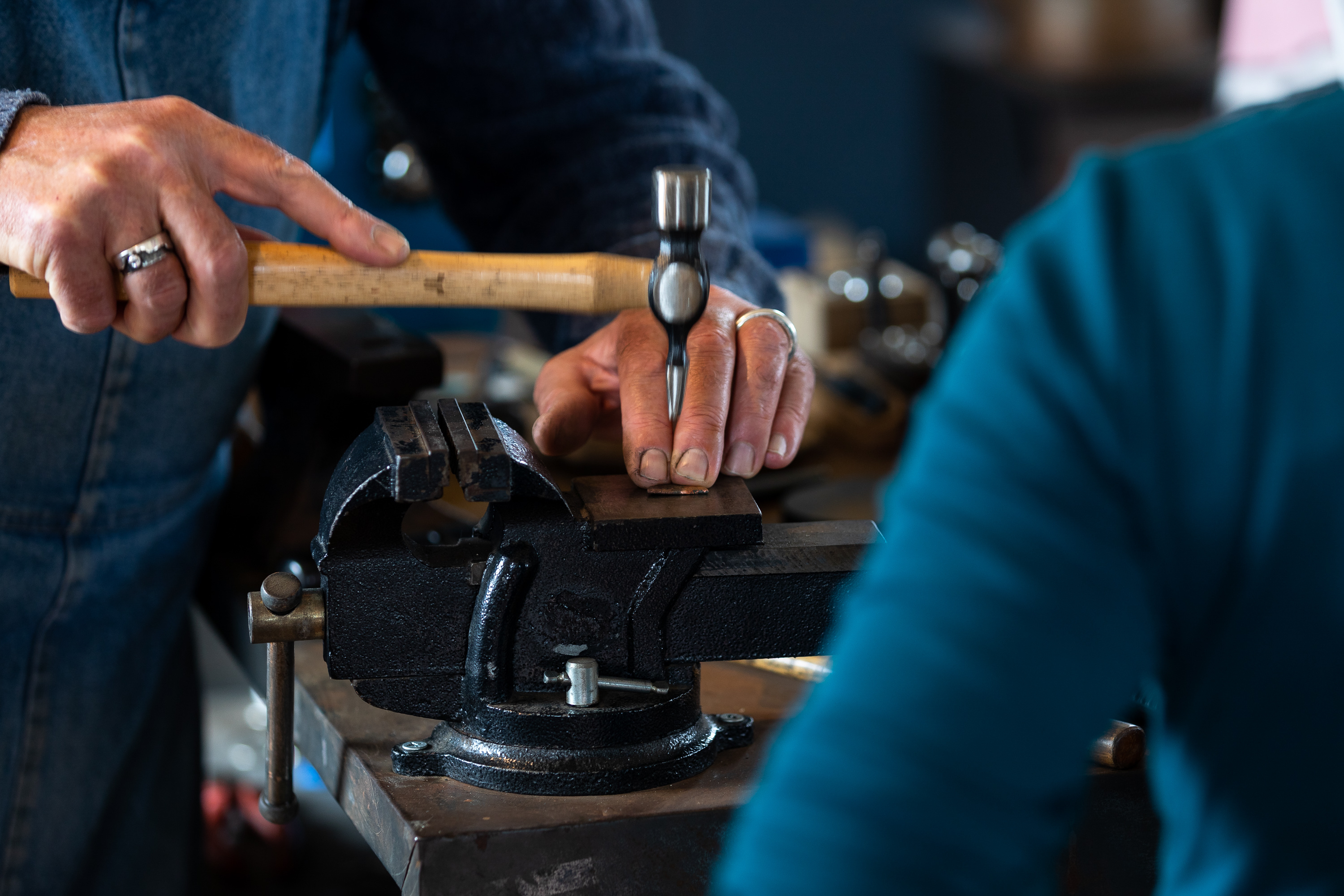
FORGING ON: Richard Moon working at the anvil

After a few months’ trading, Richard came home agitated about having his work flow interrupted. Commissions are important too, they serve customers who have found us on social media and may never come to Glen Innes. So I suggested that he learn to assertively return to his work after engaging in the conversation for a short time. Forging metal can be loud, so only the really determined will talk over it.

Local manufacturing

We joke about my husband being a bit of a counsellor at times, but in many ways it’s true. Shopkeepers serve a critical purpose, particularly in country towns, and particularly in creative businesses. They come face-to-face with the dreams and hopes of people who seek ways to realise their own creativity. Many times Richard has encountered people on the verge of tears, experiencing a blend of admiration and frustration at not having the time or resources to pursue their creative dreams. 

He listens because he knows that heartbreaking state; then he picks up a hammer and gets back to tapping away at the anvil, showing that it is possible to just make stuff. Without that fundamental act of creation, nothing can happen for artisans.

When they attain a business flow, artisans are local manufacturers in a nation that has given up on making just about everything. In country towns, we trade side-by-side with primary producers, and we have much in common. We all get our hands dirty, and while they feed the body, we feed the mind and soul.

So I want to send a message to anyone inspired by the new year to start their creative business. You might need to begin in the laundry, but one day it could be the right time to take on a fantastic shop on a rural high street.

When it comes, trust that your creative abilities can make not just your product, but also your business plan; and when you meet other artisans, don’t hide. If they’re serious about what they create, they may provide the new energy you need to keep going. 

If they’re coming in for reassurance, gently show them how to just keep making. 

The (lost) road to Sheep Station Creek

THERE MUST BE a hundred or more Sheep Station Creeks in Australia. The one I know is in Kamilaroi Country, and I recently went back to find it because I’m working on a novel about a town that disappeared.

My exploration was a reminder of just how quickly such a thing can happen.

As a kid I regularly traversed the black soil lands west of Delungra, and I recall being told that Dufty’s Lane, on which our farm ‘Paxton’ stood, once ran between the Bingara Road and another place deeper in these blue hills, decades before we moved in.

That destination was Sheep Station Creek, a generous watercourse that often flooded, according to the oral history, cutting off residents of the village with the same name once too often.

Their solution was to head up into our valley along Dufty’s Lane, which runs straight to the Bingara Road crossing creeks close enough to their source to let most of the water get away. From there, it’s a short run into Delungra where there was a railway station, school and post office.

Armed with a map and memories of landmarks (there’s no phone signal out there) I headed west from Delungra to Kaloona. Here, I turned south onto Reserve Creek Road where Gragin Peak sits distinctly almost directly to the north.

After slowly and subtly dropping into a valley, a crusty signpost pointing to Sheep Station Creek greeted me not far south of where Reserve Creek flows into it. The water was flowing beautifully, creating wide, shaded pools as it winds through the district. With plenty of properties along the way, it seems the perfect place to put down roots; but there’s little sign this was once a place with a name.

‘This little spot’

It seems the closest Sheep Station Creek ever got to being recognised was in century-old reports. One, published in The Inverell Times three weeks after the Australian Imperial Forces’ landing at Gallipoli in 1915, called the region “this little spot” in “the corners of Inverell, Warialda and Bingara districts”.

The write up reads as though it was penned by a local, speaking of a rifle club and tennis meets; and thousands of sheep, cattle and horses agisted in the valley during a “recent dry spell”.

The annual minutes of the local “F&S Club” branch were reported, mentioning the arrival of the telephone service, a rise in rates, the plan for a local polling booth, and various road repairs.

“The Shire Council has effected an agreement with St Clair Bros, in regard to the road through their properly, which, though not final, puts residents, on a more satisfactory footing,” the report reads.

The St Clairs were Percival and Harold, second joint owners of Paxton. A 1916 report in the Tamworth Daily Observer mentions the success the brothers were having in the cultivation of various grains on Paxton, with a particular focus on Sudan Grass, a highly nutritious fodder sorghum they were selling as seed. Harold was also doing well out of breeding horses for the track.

The writer of that report didn’t mention Dufty’s Lane by name. They called it “the Road to Sheep Station Creek”.

It certainly sounded like a place that was burgeoning, so what happened?

A changed world

The day I passed though. the weather-beaten pointer to Sheep Station Creek was hidden in the shadow of a signpost to a place with a more notorious name.

I followed it and soon ended up at the old Myall Creek Hall, where, with my siblings and friends, we once played on the swings and performed on the raked wooden stage at Christmas. I’d arrived at this place by another route in 2015 for the annual memorial of the Myall Creek Massacre.

A local volunteer was mowing the lawns, so I got to have a slow look inside.

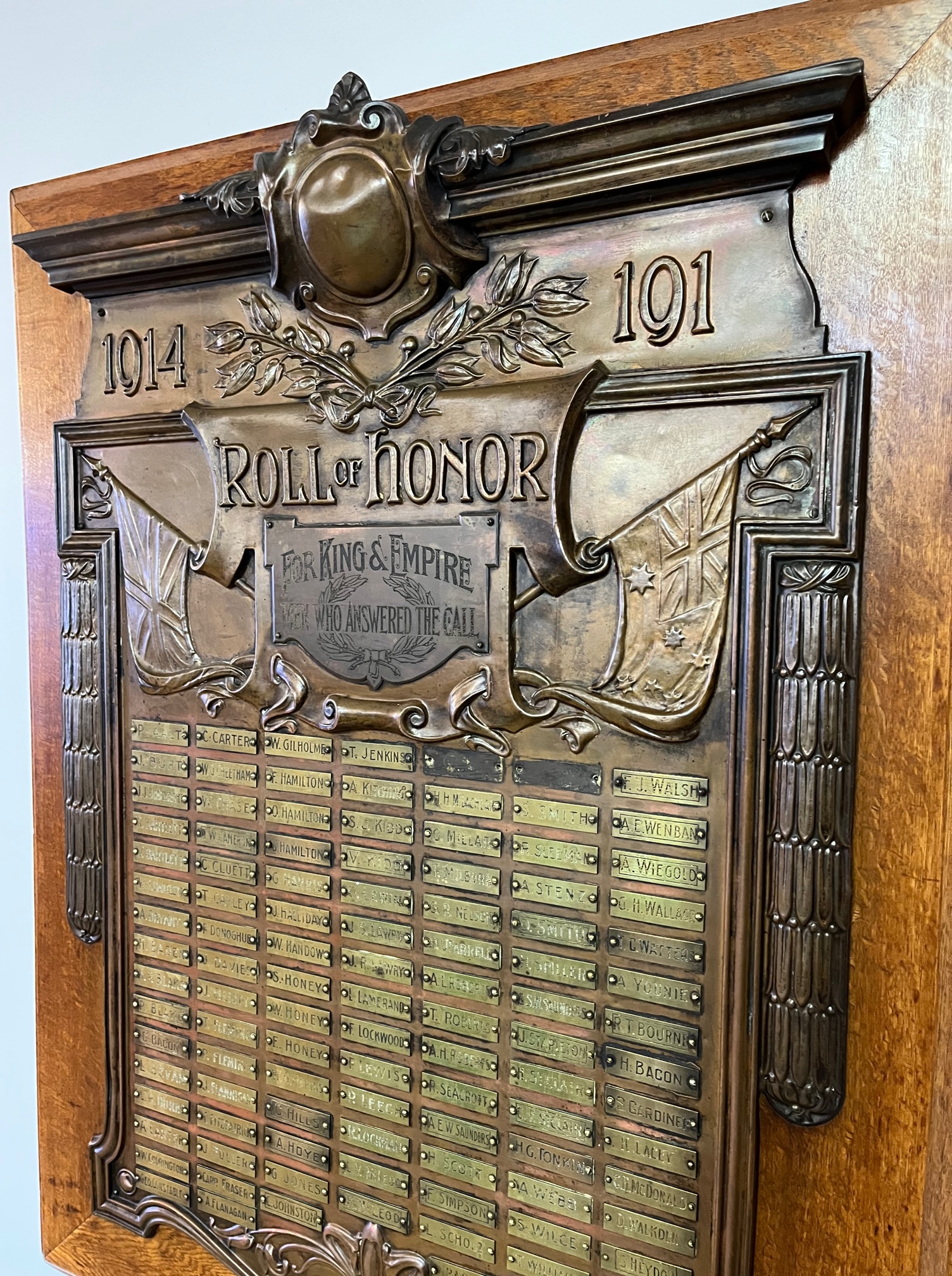
In the dusty light, I noticed an honour roll, which likely goes some way to explaining the disappearance of Sheep Station Creek. Two of the four St Clair brothers – Harold and Christoper – appear on it. After enlisting late in a war that no-one knew would end soon (a similar board at Delungra was embossed “1914-191_‘), Harold returned but his younger brother did not.

The weekly papers of the New England region are filled with the lists of the war dead and wounded across these years. Harold St Clair’s bushman’s skills were exploited in Palestine, not the racetrack. He returned to a changed world in 1919.

If the residents of Sheep Station Creek – just getting a foothold on their lands in 1916 – were impacted at the same rate of loss as the rest of the New England community, is it any wonder the hopes in those branch minutes were blown away like sorghum seeds no-one was around to harvest?

Out of place

I continued on the Myall Creek Massacre memorial site, taking the short walk to remind myself of the story of the Wirrayaraay women, children and old men whose lives ended so brutally at the hands of colonial settlers in 1838.

The Wirrayarray’s custodianship of Myall Creek was forever interrupted by this episode of Australia’s Frontier Wars. It’s not clear what the residents of Sheep Station Creek knew or understood of the massacre, although I was told about it as a child while playing at the Myall Creek Hall in the 1970s.

War stories tend to get handed down the generations. The loss of large parts of some generations due to conflict is something all cultures have in common. Hopefully we can remember all the fallen on the one honour board before long, by including the Frontier Wars in our ceremonies.

Despite my hunt along every rut, track and open gate, the road down to Sheep Station Creek from Dufty’s Lane appears to be long gone.

Perhaps Sheep Station Creek survives in other memories and family stories? These remote hills and valleys are filled with place names that exist only on maps, or remnant signposts standing by old roads to nowhere, travelled by dreamers like me who are drawn by legends and century-old meeting news clippings.

In that sense, the fictitious town that disappears in the manuscript I’m currently reworking is hardly out of place. It’s just another bend in another creek somewhere.

Reading a lot into homophobia

IT’S NOT THE most pleasant of subjects, but when you’ve written a crime thriller about homophobia, it’s likely that you’ve done your research about this insidious form of discrimination.

Heck, you’ve probably even been on the receiving end!

When I was approached to nominate five Australian books related to the theme of my novel Tank Water, it was hard to go past the critical plot driver in my debut piece long-form fiction.

This novel was a deep dive into prejudice, which often took me into some pretty grisly territory, and even put me on the trail of a real-life suspected gay-hate crime in my home town.

One guiding light for me with this book was to never try to analyse what lies behind the ill will towards same sex-attracted people, but to explore how families and individuals so often dig very deep to overcome it.

So when self-described “bootstrapped underdog” international book site Shepherd offered to platform my choice of five books, it was the conquering of homophobia in Australia that informed my list.

“A century of prejudice is laid bare in these books, but within their pages are countless subtle and overt ways that gay Australian men have given homophobes the big middle finger,” I wrote in my introduction.

“We may not always have thrived, but through resistance, migration, verbal agility, notoriety, and sheer resilience, collectively we have conquered.”

Click through to Shepherd to read my selection, including Indigenous, migrant and pioneering gay voices, and check out their growing list of gay-themed books while you’re at it.