All posts by Michael Burge

Journalist, author, artist

Ban the Bard if Safe Schools scares you

WESTERNERS have lived through many periods in which extreme Christians distributed anti-gay propaganda and thereby got the ear of authorities, and this month’s spat from Australia’s hard, religious right shows not much has changed in four hundred years.

It’s an old war, that between conservatives wanting to put the brakes on equality, and progressives trying to touch the accelerator.

During the reign of James I (1603-1625) in England, the fires of Puritanism were well on their way to blazing a lasting wound through societies in many continents, burning until well after the Salem Witch Trials in New England at the end of the century.

The Puritans were antsy about anything showy. They railed against the Elizabethan and Jacobean playhouses as much as they did the Roman Catholic church, with its theatre-like ceremonies and costumes.

One of their main bugbears was gender. At its very core, Puritanism called for men to be men and women to be women. Any variation was seen as a threat to stable society.

So it’s fascinating, and a little alarming, to see modern-day politicians using similar fear-mongering language.

When Senator Cory Bernardi complains about the very idea that children role-play in an attempt to teach them empathy for same sex-attracted teenagers in the Safe Schools program, he could be accused of overreacting.

When columnists like News Corp’s Angela Shanahan labels Safe Schools a “radical form of sex education that promotes a fluid gender ideology,” she’s probably venting her spleen a bit much.

prynn-sm
PURITAN POLEMIC Cover of William Prynne’s Histrio-Mastix (1633).

But when these and others, like MP George Christensen and Lyle Shelton (MD of the Australian Christian Lobby) deliberately obfuscate the program, muddying its concepts with pornography and what they label “disturbing” behaviours like penis tucking and breast-binding, the pack invective calls to mind one of the great forefathers of postmodern gender panic, William Prynne (1600-1669).

Prynne encapsulated every Puritan complaint of the millennium in his polemic Histrio-mastix: The Player’s Scourge, published in 1633 as an argument to close the playhouses of Britain.

“…sundry common Actors do usually once a day, at leastwise twice or thrice a week, attire themselves in women’s array to act their female parts; yea, they make a daily practice of it to put on women’s attire, it being inseparably incident to their lewd profession,” is just one mild quote from this extremist manifesto.

And it worked. By the English Civil War, the Puritans got their way and Britain’s playhouses were closed in 1642.

But one popular publication survived this century of censorship. First printed in 1623, and hated by the Puritans, the complete works of William Shakespeare was firmly entrenched in the Australian school syllabus decades ago.

So if the Safe Schools program is questionable to neo-Puritans like Bernardi et al., let’s put Shakespeare to the test and see if he should stay on the curriculum.

Well, on gender fluidity, Shakespeare gets knocked out straight away. Cross-dressing takes place in one-fifth of his works. Enduring crowd pleasers such as Twelfth Night, As You Like It and The Merchant of Venice see the playwright’s heroines in male attire for the bulk of the play, masquerading as young men who find themselves in comic sticky situations with heroes who are fooled into homoerotic attractions to them.
Twelfth-Nigh-portfolio
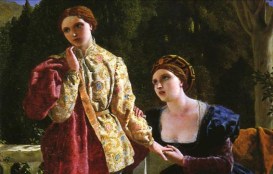
GIRL ON GIRL Lady Olivia wooing Viola in ‘Twelfth Night’.

Viola, the protagonist of Twelfth Night, even goes so far as to ask a sailor to secretly loan her clothes and present her to the local Duke as a eunuch.

Presumably this entails binding any breasts that might give her disguise away once Viola discards her “women’s weeds”.

When learning about the early production of Shakespeare’s plays, students will invariably come across a great reality: all the female roles were originally played by men.

But the end of that tradition in the 1660s didn’t end the fun. For centuries, whenever women played Viola, and these actresses dressed as a young man and encountered Lady Olivia who falls for ‘him’, endless girl-on-girl innuendo has entertained many a theatre and classroom.

Yet we do not hear the neo-Puritans within government crowing about these ‘gender-bending’ Shakespeare texts on the school curriculum, and no complaints about the 80,000 school students a year exposed to Shakespeare at the hands of the Bell Shakespeare Company, in receipt of $1.28 million in federal funding announced by George Brandis in the 2015 budget.

The neo-Puritans had their chance to rid Australian schools of Shakespeare, as part of a searching and robust review into the national curriculum by the Abbott government, reported under Turnbull in January, 2016.

But the Bard survived: “…drama, its different varieties, in tragedy, comedy, romance and historical plays, from Shakespeare (as a recurring presence) to the present will be represented,” the report confirmed.

I found one submission that called for more Shakespeare, but none that alerted the inquiry to the possibility that students might encounter all manner of sexual references in Shakespeare’s plays.
tumblr_noepfqqP7s1u44afdo1_540
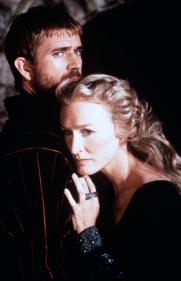
SEXY SCENE Mel Gibson and Glenn Close in ‘Hamlet’ (1991)

“To live in the rank sweat of an enseamèd bed, stewed in corruption, honeying and making love over the nasty sty,” says Hamlet to his mother, accusing her of adultery and not washing the sheets.

“Come, you spirits that tend on mortal thoughts, unsex me here, and fill me from the crown to the toe top-full of direst cruelty,” prays Lady Macbeth to deities that are not the Christian God, explicitly requesting gender reassignment and a nasty streak.

Like most of my generation, I studied Hamlet and Macbeth at school and was taken to many productions. We read and role-played scenes from Shakespeare, but we were left to interpret the diversity for ourselves, probably out of prudishness more than any Puritanism.

“All Australian students deserve access to a world-class curriculum that encourages diversity and which allows schools flexibility over how it is taught,” the curriculum inquiry website leads off with, like an over-arching mission statement.

With Safe Schools now under serious attack, it seems the very meaning of ‘diversity’ and ‘flexibility’ is also up for grabs.

But William Shakespeare, creator of more than 1700 words in the English language, and many a figure of speech, left us with a saying that can be used when answering over-zealous critics of sexual diversity.

Play | COMING SOON
BUY NOW
eBook | Paperback

It’s a line from Hamlet, perfect for when someone vehemently attempts to convince about something where the opposite is true.

About your trashing of LGBTI dignity, Cory, George, Lyle and your chums, I say: “The lady doth protest too much, methinks.”

Michael’s literary non-fiction debut Merely Players: Acting like Shakespeare really matters is available in paperback and as an eBook. 

© Michael Burge, all rights reserved. 

This article appears in Michael’s eBook Creating Waves: Critical takes on culture and politics.

Writer, are you ready to publish?

“Is that quiet, ‘nice’ person who writes like an angel ready to become a marketing demon?”

FOR the first time, a Write, Regardless! article has a question in the title not an exclamation mark. If you’ve done the work on your manuscript, sent it off to publishers for a minimum of six months and heard nothing back, you don’t need a call to action, you need to give some serious thought about where to from here. Here are some of the major questions to ask yourself before leaping into independent publishing.

Can you meet your own expectations?

So your manuscript has been rejected by multiple publishers. As Julia Child said in Nora Ephron’s screenplay, Julie & Julia: “Boo-hoo…” (spoken with Julia Child-like hooting). Don’t let anyone tell you your hurt is invalid. Rejection sucks. When you’ve come out of your shell, it’s time to ask yourself if your writing journey is over, or if it’s only just beginning? If you envisaged your book would be published one day, it’s now up to you to see it done.

Can you be a publisher?

Although it creates books, publishing is not a particularly creative process, it’s a form of business. I suggest you read the Wikipedia entry on publishing and come to terms with the industry’s two-pronged nature: production and distribution. One process does not stand separately from the other. It doesn’t need to be a book-trade behemoth, but if you want to publish your book, you’re going to need to start, and operate, an independent publishing business.

haters-nounCan you meet reader expectations?

Publishing is a business because millions of readers consume books. Standing on the brink of a publishing venture, ask yourself whether you can meet their needs. This means researching publishing genres and finding where your titles fit in, which requires the ability to be objective about your work. Publishing your own books will bring you face to face with hungry, experienced, critical, opinionated, readers across the world. Are you ready to meet their energy with confidence in your quality books, books and more books? Many of them will hate you for having the courage to self publish, are you ready for that?

Can you meet buyer expectations?

Books are a consumable commodity, sold in units. It sounds obvious, but people part with money to get them. Publishers, and all the operators in the book trade, from publishing platforms to book distributors and bookshops (online and bricks-and-mortar shops on the high street) all deservedly take a cut of the ever-changing unit price of books. Positioning yourself at one end of this competitive chain requires meeting the expectation of the buying public and booksellers. It means providing high-quality book elements: great covers, memorable titles, sensible use of word length and serialisation, and providing books in what publishers call ‘lines’ – that is, a range of titles on an annual basis. No publisher in the world publishes just one book.

Can you work the marketing machine?

I’m really going to cut the crap and ask if you’re prepared to be a pushy arsehole at times? Marketing your books will take persistence, guts, working the room, pressure, stress and being annoying. It will keep you awake at night and take time away from your writing and your family. There are millions of books out there. You are going to have to grab and hold peoples’ attention through an ongoing marketing campaign that, for as long as you want readers for your brainchildren, will never end. Is that quiet, ‘nice’ person who writes like an angel ready to become a marketing demon?

Can you take it up to booksellers?

The book trade is enormous, a place where the agenda is dominated by the need to make money. How will you react when a bookshop hasn’t paid you for those copies of your book a year after they’ve been sold? How will you respond when a bookseller calls for in-store publicity materials, and they want them yesterday or your book won’t be in the shop window? When your publishing platform is tardy in passing on your royalties, who do you talk to, and what do you say? Booksellers are businesspeople, some are jaded as all get out, and others are too enthusiastic for words. Are you ready?

Can you meet media expectations?

The media, as we knew it, is gone. Social media is where the bulk of communication is happening, with the average Facebook account holder operating as a free distributor for the mainstream (or ‘traditional’) media’s stories. In this frenetic, limitless arena, publishers are promoting and selling books in ways that evolve every week. For independent publishers, savvy use of the social media in not an option, it’s a necessity. If you choose to become a publisher, you need to be presentable, professional, and immune to a certain degree of negative feedback about what you’re doing. Lucky you’ve already built that social media platform, right? (Or are you still thinking it’s not necessary? LOL!).

Can you work the system?

Independent publishing requires the use of multiple online platforms to produce printed books and eBooks. Many of these do not differentiate between established book publishers and independent operators. The systems are often complicated and frustrating for beginners, but they are designed to publish and distribute quality books that would not look out of place on a high-street bookshop shelf. Are you ready for episodes of tearing your hair out and throwing things at the computer when it says no?

Are you up for joint-venture publishing?

“Readers are not easily fooled by bad product.”

For many writers, the answers to many of these questions is no. Lack of time and skills means a better option is to seek out a joint-venture publisher, one of the fastest-growing arms of the book trade. Many large and small publishing houses have joint-venture imprints, providing publishing and marketing services to writers, for a fee, often with a spirit of ‘sharing the risk’. As with all products and services, working with a joint-venture publisher means negotiating a sound contract with all parameters agreed before setting out. There is currently no standard of fees, but if you’re seeking to hand the entire process over to someone else, you’re looking at thousands of dollars.

Is a joint-venture all that?

Many joint-venture publishers provide individual services (proofreading, for example), while others seek to stream writers into buying their entire suite of services. If joint-venture publishing is more your thing, there’s plenty of choice out there, but be aware that independent publishers have exactly the same access to the global publishing industry as joint-venture publishers. While it can be a great relief to benefit from the support on the nitty-gritty of publishing processes, don’t be under the impression that a joint-venture publisher can deliver anything independent publishing can’t in terms of getting your book in front of readers.

Are you up for vanity publishing?

Many writers seek only to publish a book for friends and family, not a role in the international book trade. This process is called vanity publishing and has been around for decades, delivering quality books for happy customers. Don’t conflate vanity publishing and joint-venture publishing. Vanity publishers have garnered a questionable reputation for high fees, sometimes very high, so be cautious when negotiating the details of your contract. Never hand over money before agreeing on all the terms of the process, and certainly don’t pay the entire fee before seeing results – part payments are best when working with vanity publishers.

Recap

write-regardless-cover
BUY NOW

The publishing industry, from the largest publishing houses to the smallest independent presses, uses the same publishing platforms as self publishers, and it’s become harder to tell the difference when you see books on shop shelves. This increase in access only works for consumers when the highest standard of publishing is pursued – readers are not easily fooled by bad product. If you want to become an independent publisher, be ready for a journey that demands the highest quality work, attention to detail, and marketing energy. There are no more publishing secrets in the book trade – they’re all freely available to everyone who wants to produce a book and find readers, but they must be used wisely and well.

An extract from Write, Regardless!

© Michael Burge, all rights reserved.

Christianity vs. LGBTI, an unnecessary war

“This is not a suffering competition for martyrs, it’s a legislative process taking place in a secular nation.”

THE Turnbull government has no firm plans for a public vote on marriage equality. We only know it’ll be ‘after the election’, an Abbott three-word slogan for ‘on the never-never’; and that it will be a non-binding, $160-million-dollar opinion poll that won’t be compulsory for any Australian voter or politician to participate in.

But that doesn’t really matter. While Malcolm Turnbull wasn’t watching, a war cabinet has been plotting against LGBTI dignity from the Coalition backbench, spilling from the party room into the media this week when the Safe Schools program came under attack.

Now is not the time to be under any illusions: Australians in every community are coming under pressure to take a position on whether Lesbian, Gay, Bisexual, Transgender and Intersex people (LGBTI) have the right to equal marriage and if the parliament should attempt to ensure LGBTI children are no longer alienated and bullied at school.

From many right-wing MPs and senators, and at least one on the left, this program generated hate speech that was about as unparliamentary and dishonourable as it gets, from representatives who bear the word ‘honourable’ in their formal titles.

The Safe Schools program was always going to come under unjustifiable attack. Every LGBTI project I have ever been involved with has become a target if it even hinted at the possibility of going anywhere near a school.

God forbid adults who have lived through the profound lack of in-school protection for LGBTIs seek to ensure young people receive a shred of information, before they start learning myths about diversity from those who would seek to indoctrinate their children against us and the LGBTI students and teachers among them.

Yet the multi-party state- and federally-funded program has revealed deep phobias, from the parliament to my neighbourhood and on social media. The reaction has been so strong it’s become hard to pick the real victims.

Quite rightly, LGBTI groups cited the National School Chaplaincy Program as meeting every one of the accusations levelled at Safe Schools.

12496322_10153958480562813_111425310789912770_oMemes showing the huge disparity between Safe Schools and School Chaplain funding left many people of faith feeling under fire.

I get why – it smarts when you’re made to feel you have to justify your existence.

But this is not a suffering competition for martyrs, it’s a legislative process taking place in a secular nation. While your repression might feel like my oppression, they are certainly far from the same phenomenon, and only one of us is being legislated against.

Whichever citizens can be bothered voting in the never-never plebiscite do not need the distraction of false victims when it comes to exactly who is being oppressed by inequality.

Coming so soon after the Australian Christian Lobby’s call to hit the pause button on anti-discrimination laws so they can hate their way through the marriage equality debate, we’ve woken up in the middle of a war: Christians versus LGBTI.

Bill Shorten called-out Cory Bernardi on his homophobia this week, while Malcolm Turnbull called for measured language, preferring to avoid labelling the hate that dare not speak its name.

I wish it wasn’t happening, I wish our parliament would simply vote on the matter, because in absolving itself of guiding a parliamentary free vote, the Coalition is leading this country to tear itself asunder.

“Bringing homophobia and transphobia into the light will be an ugly process for an ugly energy.”

The marriage equality plebiscite is already causing damage. The debate has become a base numbers game between LGBTI and Christians, so vociferous so early that many voters will simply stay away.

Once we see yes/no campaigns in communities, such as the small island where I live with my husband among a population of around 600, I predict the Coalition’s plan will cause great division.

Homophobia, in my experience, always polarises between two extremes. There are the unacceptable and illegal gay bashings and overt violence, while at the other end of the spectrum are the silent, insidious processes of exclusion that occur right under the nose and invariably go unchallenged.

Gradually, our friends have started to witness attempts to make us invisible in certain conversations, because it’s noticeable when a homophobe addresses someone we’re standing with, but not us.

When we were new to this place, few were aware of this subtle discrimination, but about a year ago, making new friends brought with it the realisation that some of the so-called ‘great people’ living here, who are also incredibly homophobic, would gradually make themselves apparent to anyone paying attention.

As the plebiscite approaches, all this covert behaviour is being forced into the open. Election campaigns in my part of the world take place on the road, where there’ll be no hiding for anyone.

Bringing homophobia and transphobia into the light will be an ugly process for an ugly energy, and where my husband and I might have flown under the radar in certain quarters of our community, we’ll be outed far more than we realise. It’s already started to happen, and we’ve been on the receiving end of verbal homophobia only a few steps from our front door since the Coalition’s plebiscite plan was announced, after not being the target of anything remotely homophobic for more than a decade.

I have never felt the wish to avoid witnessing my own times, but if I could safely opt out of this era, I probably would. I can’t afford a world cruise until marriage equality is delivered, so it’s time to stand visibly, primarily on the home front.

For a generation of LGBTI on the brink of coming out, this period in Australia’s history has the potential to create a similar level of confusion and despair as the AIDS crisis did for my generation, putting nails in closet doors, not removing them.

For that reason I will participate in a long and relentless yes campaign in my community, unapologetic and vocal. They’ll need to face plenty of questions and cut through some uncomfortable moments, but there is room on the yes team for moderate and progressive Christians and people of other faiths.

The reality of picketing the island’s only polling booth, handing out yes material with a bunch of naysayers across the driveway doesn’t fill me with pride, not yet, but at least the homophobes will be as out as the homosexuals in this community, and when we finally have marriage equality, years from today, we’ll know who to hold hands in front of as a reminder of exactly who the oppressed ones were.

Michael’s book Questionable Deeds: Making a stand for equal love is out now. This article was first published on NoFibs.

© Michael Burge, all rights reserved.