All posts by Michael Burge

Journalist, author, artist

Writer, you’re a journalist!

“We can no longer rely on paid journalism to get our messages out there, we simply need to start doing it ourselves.”

THE international media industry is in free-fall with the continued sacking and redundancy of journalists. I wrote about the social media’s impact on the media in 2014, and things have only gotten worse since. Our newspapers, magazines and television programs are full of what is known as paid content. This advertising vs. editorial battle is as old as the media itself, but when the boards of media companies no longer have one experienced news person in their ranks, it could be said the newsmakers have completely lost any control over editorial content. Even public news services are being paid to host advertising as news. It’s for this reason writers need to start behaving like journalists. We can no longer rely on paid journalism to get our messages out there, we simply need to start doing it ourselves.
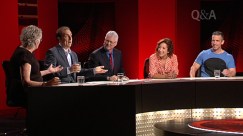
PROFESSIONAL PANEL Panellists on ABC's QandA.
PROFESSIONAL PANEL Experts on ABC’s QandA.

Be an expert

There are many names for ‘experts’ in fields, influencers, for example, operating predominantly in the marketing sphere, but increasingly impacting the editorial content of the media. These are the people called upon to sit on panel shows or provide expert opinion in sections of the media. They often operate as brands – a marketing-oriented phenomenon designed to create awareness of themes, words, images and products. As writers in today’s media and publishing landscape, it is essential we take elements of these processes and turn them to our advantage. If you write a lot about the environment, for example, you can adopt branding strategies to focus your output in that field. Tweet and Facebook on environmental issues to your audience. Write articles about the environment on your website. Tag and categorise your metadata with environmental keywords, but know exactly why you’re doing it: you are on your way to becoming an influencer in that field.

Keep it real

Influencers and brand adopters are not required to be shallow, purely commercial types. If you are writing and researching subjects that you love, becoming an expert in those fields will come naturally. Write opinion pieces about current events related to your work. Publish reviews about new publications related to your expertise. This is all great fodder for your writing program.

“You don’t need a degree, permission or professional qualifications, you only need journalism skills and consistency.”

Share the love

When you’re ready, start to connect with other online writers and journalists – start with me, if you like – and talk about your work and where it’s taking you. Be prepared to be asked to contribute to other sites – this is a brilliant way to spread your metadata around and can be achieved in a number of ways. Other sites can reblog your posts directly from your site (and you can reciprocate), or you may be asked if you’d like a user profile for another blog, to upload and publish your own contribution – a very common way websites accept contributions. Don’t expect to be paid for much of this output, rather, come to accept it as excellent distribution for your work that will generate followers on social media, which increases your reach as an expert in your field.

Citizen journalism is not for the faint of heart

One of the most effective strategies I adopted as an online publisher was becoming a citizen journalist. I wrote about the process in two parts – Voyage to the new news world – a process which not only led to increasing my readership but to paid work as an online journalist. I offer a gentle warning about citizen journalism – it’s very accessible, but also highly contentious, because it’s being relied on more and more by established media networks as a way to attract free content, and professional journalists can be very wary of citizen journalists. I wrote about this phenomenon in Stand up, citizen journalists. Citizen journalism is a minefield for writers who are also activists (or become activists over time, through their writing, like I did), so it’s helpful to ponder the fine line between reporting and activism, and freedom of speech. I wrote about this in You cannot burn a mummy blog.

Journalism standards

Adhering to some kind of personal or professional standards as a journalist is not compulsory, but in the online sphere, where readers lay waiting to catch every typo and piece of plagiarism, it’s wise to follow some basics if you’re just starting out. Here’s my best tips for anyone embarking on their own journalism.

Say no to naysayers

Large sections of the international media readership remain under the illusion that the content they read is created by newsrooms full of busy journalists poring over editorial schedules. The reality could not be further from the truth – newsrooms are mainly empty, solo journalists are juggling the jobs that entire teams once did, their hours taken up with meeting the advertorial agenda of management to produce the paid content in their masthead. Citizen journalists are filling the gaps, although whenever the readership complains, they often let off steam about media conspiracies and lazy journalism. Don’t let any of that stop you writing as an expert in your field. You don’t need a degree, permission or professional qualifications, you only need journalism skills, consistency and guts. Check my article on How to write wrong.

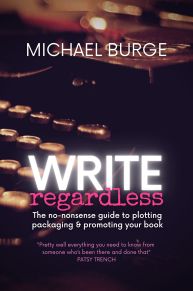
write-regardless-cover
BUY NOW

Recap

As a writer and published author, you’re going to need to forge relationships with journalists. The best place to start is by becoming a journalist yourself. Work out what you’re expert in, and publish quality journalism on that. Keep an eye out for other journalists wanting to connect with you – these are invaluable future connections.

An extract from Write, regardless!

© Michael Burge, all rights reserved.
Writer, find your style!

HOPEFULLY by now you have started a regular online publishing schedule. If not, scoot over to Writer, start online publishing! and get up to speed. In this session, you’ll probably be pleased to read we’re going to start getting to grips with some writing technique.

What kind of writer are you?

If, like me, you started regular online publishing without much direction, it’s time to start refining your style. To achieve this, analyse what you’ve written to date on your site, and the work you have written in the past. What does this work have in common? Is there a theme, or several themes? If someone were to ask you what you write about, what is your answer? If you don’t have a response, it’s time to work it out. After publishing online regularly for a few months, I realised I was writing about writers, performers, artists and others who took risks. When asked, I said I wrote about creative rebels.

Check the menu

When you have isolated your writing themes, ensure you include these in your site menu (if you have created one. If not, you’ll want to consider at least one site menu). Menu ‘buttons’ give readers a guide to what kind of writer you are. Most websites have a ‘home’ button (navigating the reader back to your home page), an ‘about’ button (telling readers about you, the writer) and a ‘contact’ button (allowing readers to get in touch with you). Most WordPress themes will allow extra menu buttons, so use these to tell readers what themes they can explore in your online work. In order to achieve the best SEO (‘search engine optimisation’) ensure these themes are listed in your site menu buttons and your site categories and tags, as this will guide the internet to make your name synonymous with certain subjects, genres and styles. Your site buttons can be the same as your tags and categories, allowing readers to aggregate and read your articles in the same theme. Over time, I have become synonymous with LGBTIQA+ equality, writing, politics and the arts, all through my site menu, tags and categories.

imgresKeep yourself nice

As an independent online publisher, regardless of what you write about, you are now in the driver’s seat of you own publishing empire. The buck stops with you. If you doubt this, have a read of my article The Publish Button killed the media. It’s important that you take on board the level of responsibility you have in ensuring not only good quality writing, but staying out of trouble when it comes to publishing work in the public domain. Think of the internet and social media as an international noticeboard, and ensure everything you publish there is ethical in addition to being entertaining.

Tips on writing and publishing style

I have written a series of articles on different online publishing genres. If you’re interested in writing general news and lifestyle articles, check out How to write excellent articles. If you’re interested in writing reviews and critiques, check out Critiquing guide for armchair critics. If you’re interested in writing food-related articles, check out Eating your words. If you’re writing under commercial agreements, or you’re planning to, check out The truth about writing advertorial. If you’re planning to write commercials or commercial material, check out The truth about writing commercials.

The big picture about images

WordPress has sophisticated image publishing components that allow online publishers to illustrate articles in a variety of ways. Featured Images are those that illustrate an article on your home page and stay with the story’s URL as you distribute it through the social media, but images can be inserted throughout an online article. Copyright governs the use of other people’s written content, but it also protects the use of their images, so be careful about using images that are not yours, or not in the public domain. Wikipedia and its arm Wikimedia Commons are a great source of copyright-free images (those that are in the public domain). Click on images in Wikipedia to check their copyright status, and use the image search facility in Wikimedia Commons – you’ll be surprised what is free for you to use. Often, you’ll need to attribute the photographer or the owner of images. Do this with a hyperlink from your article, and/or a caption. Adding your own photographs is best done with a watermarked caption/copyright statement to ensure others know it belongs to you.

Publisher levelling off

How are you going with your regular online writing schedule? Did you try to be too prolific, or weren’t you prolific enough? When I started, I posted one online article every week. That worked for me. Adjust your schedule to make it achievable for you and consistent for your readers. When I am pushed for time, I dig into my body of work from the print media and publish something from years ago to give it new life.

googling-myselfGoogle yourself

Here’s the fun part! It’s time to check on how well your metadata is working for you, and what position your website comes in at on a Google search. After a few weeks of online publishing, I appeared on page 47 of a Google search of my name. After another few weeks, I was in the top ten. After a few more weeks, I appeared on the first page every time, and have stayed there ever since through sheer prolificacy.

WARNING: Computer algorithms are so sophisticated that your device will start to put you in the No.1 spot as a matter of course. This does not mean everyone is seeing you in that place on every computer. Try googling yourself from another computer for a clearer picture of where your SEO is at. Remember, publish consistently, ensure your online articles are posted to Twitter, Facebook and your other social media assets (your ‘Web of Fabulousness’). For a reminder about the importance of this cluster of online accounts, skip back to Writer, show off your assets!

Recap

write-regardless-cover
BUY NOW

Analyse your writing to date. What kind of writer are you? What subjects do you write about? Isolate your themes and ensure they are reflected in the menu buttons of your site and the tags and categories of each of your online articles. If that means adjusting your site content, take the time to revisit and reset all your metadata. Google yourself to see how well your SEO is working, and ensure you’re using copyright-free images.

An extract from Write, regardless!

© Michael Burge, all rights reserved.

Hanging half a century on a solution

FORTY years since the premier of the Peter Weir film, it’s time for Australians to realise that Picnic at Hanging Rock has kept us completely fooled for five decades.

This evocative screen mystery burst into our consciousness the same spring that the constitutional crisis of the last months of the Whitlam government left Australians in an altered state.

“Australian cinema’s ‘new wave’ success story rose on the back of a terrible cultural lie.”

The original novel by Joan Lindsay was similarly about the impact of sudden change. When three schoolgirls and a governess do not return from a commonplace picnic at a local beauty spot in 1900, the mechanics of shock and denial challenge the very foundation of knowledge.

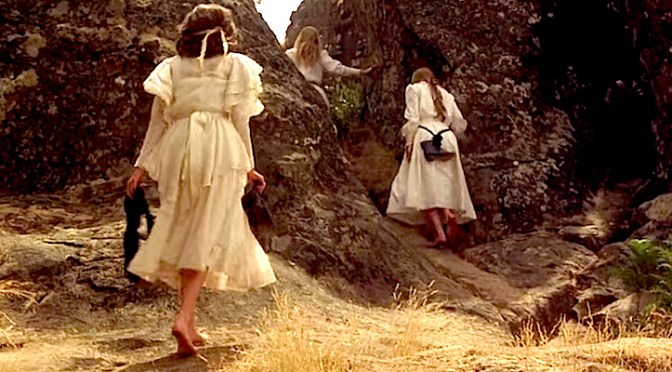
WHAT DO YOU KNOW? Helen Morse as Mlle de Poitiers and Vivean Gray as Miss McGraw in Peter Weir’s 1975 film Picnic at Hanging Rock.

As French governess Mademoiselle de Poitiers farewells four of her charges wanting to explore the base of Hanging Rock, seeing Miranda turn away, she asserts: “Now I know”. The only one who hears is mathematics teacher Greta McGraw, who replies: “What do you know?”

Mlle de Poitiers is happy to believe she has seen an angel by an old master, although Miss McGraw appears to have her eye on something far more attractive.

Minutes earlier, this rational, scientific 45-year-old noticed her watch, like everyone else’s, had stopped, right on midday. The picnickers are suddenly, and literally, out of time.

This fictitious pre-Federation mystery perfectly captures modern Australia’s struggle to form an identity, because the answer to what drew Miss McGraw to follow the girls up the rock that timeless afternoon was always there, it’s just that others decided we were not prepared for it.

A real-life disappearance occurred at another famous rock and challenged Australian identity all over again, when, on the night of August 17, 1980, baby Azaria Chamberlain was taken from her tent by a dingo at a campground near the base of Uluru – at that time known by its European name Ayer’s Rock.

EVILANGELSIt did not take long for the majority of Australians to decide this event was nothing more than a fanciful story, sprung from the imagination of Lindy, Azaria’s mother, who was jailed for life for her daughter’s murder.

We were far more willing to cry murder than countenance the reality of predators in our landscape.

Fred Schepisi’s film of John Bryson’s book on the Chamberlain case – Evil Angels – outlined the dingo story and subsequently bombed at the Australian box office.

We could barely look at the Evil Angels, whereas the romantic never-to-return ‘angels’ of Picnic at Hanging Rock we took to our hearts; but Australian cinema’s ‘new wave’ success story rose on the back of a terrible cultural lie.

Joan Lindsay complained of endless fan mail asking whether her story was based on fact, although I call her annoyance a dodge, because she brought all the attention on herself as soon as she allowed her publishers to lop off the last chapter of Picnic at Hanging Rock before it was published in 1967.

But her original Chapter Eighteen survived the butchering of editors: she entrusted it to her literary agent John Taylor in 1972, with strict instructions to publish it after her death.

This he did in 1987, by which time a cult had grown around Lindsay’s ruse. The twelve pages of Chapter Eighteen published in the booklet The Secret of Hanging Rock were framed by tongue-in-cheek essays by Taylor (claiming that Lindsay’s solution was “unfilmable”) and Yvonne Rousseau, a writer who’d spent years sleuthing Lindsay’s oeuvre.

Despite the attention Lindsay’s ‘solution’ received, it was not enough to challenge the trajectory of the film’s success. A director’s cut was released theatrically and on DVD, including a documentary in which not a single mention was made of Lindsay’s Chapter Eighteen.

“They were happy to escape a life of corseting, cosseting and control.”

Her long-concealed dénouement quite matter-of-factly revealed the missing schoolgirls and their governess had undergone the kind of transformation common in Classical legends, although Lindsay had created a credible bridge between European myth and Aboriginal Dreaming.

Other writers had attempted this earlier. Arguably the most famous was the fake Aboriginal Legend of the Three Sisters, the story of three Aboriginal women transformed into the famous rock formation by their ‘witchdoctor’ father, written by Sydney schoolgirl Patricia Stone in the 1930s and subsequently sold by Katoomba’s tourist industry as genuine Aboriginal legend.

DREAMING WITHIN A DREAM Seeking the solution to what happened.

But Joan Lindsay avoided cultural appropriation. Instead, she allowed her large cast of European women to be themselves appropriated by a Dreaming entirely appropriate for an Australian story.

Picnic at Hanging Rock screenwriter Cliff Green identified one of the major themes in Lindsay’s story as child abuse, and once the women do not return, the checks and balances of a ‘proper’ education gradually do reveal the physical and emotional weaponry of British headmistress Mrs Appleyard.

The missing schoolgirls and their governess, then, were not victims of crime or whisked away unwillingly. They were happy to escape a life of corseting, cosseting and control.

“I can hardly wait,” star maths student Marion Quade says in Chapter Eighteen, anticipating her chance to shuffle off the twentieth century and follow her transformed maths teacher Miss McGraw “without a backward glance”.

Marion’s escape route comes straight out of 1960s notions of Aboriginal Dreaming, atmosphere that undoubtedly challenged the original publishers into such a severe deletion. Far more preferable for daughters of the Empire to disappear into thin air than be seen to delight in a spiritual transition well-known by the nation’s first people.

The edit allowed Joan Lindsay’s fact-fiction flim-flam to become the focus of the book and film’s success, and even though all along she knew she’d not written a mysterious disappearance, she played her part very well by suggesting the audience decide what was true and what wasn’t.

Fans and detractors rushed to pore over the archives and trample across Hanging Rock, well off the scent of a simple look into Lindsay’s education at a Melbourne ladies’ boarding school.

LADY LINDSAY Joan Lindsay (1896-1984).
LADY LINDSAY Joan, Lady Lindsay (1896-1984).

It was Terence O’Neill in a 2009 La Trobe Journal essay Joan Lindsay: A time for everything who proposed that Lindsay can hardly have been unaware of her alma mater’s move from Melbourne to Woodend, close to Hanging Rock, in 1919, after her graduation; and, far more interestingly, the account in the school magazine of a Miss McGraw, teacher at the school in Lindsay’s time, who led the twilight expedition to Hanging Rock that inspired forty years of annual picnics and the telling of ghost stories on the way home. 

It’s also enlightening to analyse the corporal punishments Lindsay portrayed in detail – those that inspire adolescent fantasies about escaping the control of disciplinary adult paradigms – when seeking the real seeds of Picnic at Hanging Rock.

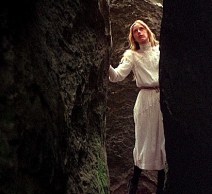
Missing corsets and stockings, a maths governess seen climbing Hanging Rock availed of her skirt, and the discovery of one of the missing girls, are all clues in both book and film, but they remain the worst kind of red herrings without Chapter Eighteen.

Another red herring is the sound of Pan pipes played by Gheorghe Zamfi on the soundtrack, evoking the old Greco-Roman gods of different land altogether.

It’s probably un-Australian of me, but I call for a remake. 

PANIC
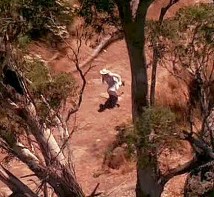
MUCH TO LEARN Edith runs from the top of Hanging Rock.

Pan pipes would easily be replaced by a well-known Aboriginal wind instrument; and doubtless there is much to learn from the Wurundjeri nation, traditional owners of Hanging Rock, the rock formation they were dispossessed of in the 1840s.

Joan Lindsay’s literary stock-in-trade was time. I can’t imagine her not approving of a reappearance of Miranda, Marion and Miss McGraw in an episode of Doctor Who, or at least a mash-up adaptation like Pride and Prejudice and Zombies.

The Northern Territory legal system took thirty years to come to terms with the facts about the dingoes that preyed on Azaria Chamberlain. Surely in that time we have grown enough to cope with Aboriginal Dreaming in one of our greatest novels?

creating-waves-cover
BUY NOW

As Gough Whitlam famously affirmed in 1972, ushering in the government that would transform the lifeless Australian film industry, led by Lindsay’s big-screen icon: “It’s time”.

© Michael Burge, all rights reserved.

This article appears in Michael’s eBook Creating Waves: Critical takes on culture and politics.