
 IN every writer’s life there comes a time when a piece written by someone else renders our own contribution unnecessary. After exploring the issue of marriage equality in my country for more than a decade, Rodney Croome’s new book has finally done this for me.
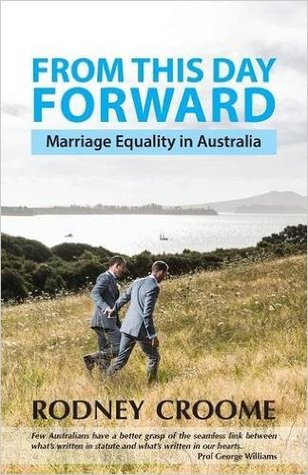
From This Day Forward: Marriage Equality in Australia is an aggregation of Croome’s major writing on the marriage equality debate to date, including updates on his 2010 contribution to Why Vs. Why: Bill Muehlenberg and Rodney Croome debate Gay Marriage (Pantera Press).
But Croome’s collection is much more that; it’s the best document Australia has to move the debate – finally – into legislation.
The only possible rebuttal to From This Day Forward is religious ranting or political belligerence, because, as Croome puts it: “The critics of marriage equality are trapped in an intellectual cul-de-sac.”
I had a particular interest in reading this book: I was keen to fact-check my own publication Questionable Deeds: Making a stand for equal love against a more comprehensive document covering the story of Australia’s legislative failure, but I was unaware of Croome’s book until it was launched in Brisbane last week.
“A well-articulated exploration of the total lack of arguments left for opposing marriage equality. It stands like a boundary, behind which the debate will retreat no longer.”
It’s a great year for books by same-sex attracted writers. With Magda Szubanski’s memoir Reckoning, and the rerelease of Timothy Conigrave’s Holding the Man off the back of the movie release, gay and lesbian writing is getting a great run.
Although like my title, From This Day Forward does not have a huge marketing machine behind it. This makes for a hard sell at a time when readers and audiences are at marriage equality saturation point, there’s an overbearing unwillingness to just get it done, and the mainstream media seems incapable of selling a story of what it sees as a dead horse, slaughtered by both sides of parliament.
Croome’s book is a well-articulated exploration of the total lack of arguments left for opposing marriage equality. It stands like a boundary, behind which the debate will retreat no longer. For someone who has heard and endured all the classic approaches (he was confronted by one at his launch – the old ‘why call it marriage?’ chestnut), in person and in his book, Croome – the national convenor of Australian Marriage Equality – maintains the neutrality of an activist prepared to go on calmly answering loaded questions forever.

I admire such public strength. My own book reveals my inability to be as dispassionate. Driven by grief, fear and pain, I wrote the awful truth about the depth of my disenfranchisement in Questionable Deeds, revealing how prejudice and lax laws robbed me of self determination as a surviving spouse.
Although I was relieved my research stood up without the benefit of reading Croome’s book, what encouraged me more was his call to action from the LGBTI community to share our experiences.
“Whatever lies behind the power of personal stories, they are immensely effective in showing how marriage inequality affects ordinary people day-to-day. They tap into our desire to understand the ideas and feeling of others,” Croome writes.
Our stories are most effective for the cause when we manage to bend the ear of our federal MPs, Croome writes. Mine is Andrew Laming, federal member for the Queensland electorate of Bowman, a regular flip-flopper on marriage equality.
At his launch, Croome paid tribute to Queensland’s major contribution to the legislative push. It’s here that Warren Entsch (Liberal federal member for Leichhardt), and Teresa Gambaro (Liberal federal member for Brisbane, who launched Croome’s book last week), joined forces with Terri Butler (Labor federal member for Griffith) to co-sponsor a cross-party bill on marriage equality.
Since the entire house of representatives owned the bill, this was a unique moment in the journey, and a shining example of politicians getting their heads around the positive impact of equality on the mental health and wellbeing of their constituents. Andrew Laming would do well to watch and learn, and he could start by buying Croome’s book, and mine. He was invited to my book launch, but did not respond.
Croome also gets to the heart of the current plan for a marriage equality referendum or plebiscite.
“Human rights defenders are rightly concerned about putting inalienable rights to equality and personal autonomy to a show of hands,” he writes, underlining how there’s no constitutional requirement to ask the people on marriage when it was parliament that autonomously altered its definition in the first place.
I support Croome’s view that a national vote on marriage equality would pass the law. Even if the regular polls are significantly wrong, the majority of Australians would say yes.
“My concern is with the process, not the outcome,” Croome writes, referring to the high price that would be paid by the LGBTI community in terms of our mental health.
It’s in this zone that Croome’s book and mine intersect. Croome quotes statistics gathered in the wake of the banning of marriage equality in 2004 – the year my partner died – which showed a sudden increase in mental health challenges for LGBTI.
Of the 2004 ban, I wrote: “It would have passed through my consciousness in my deepest grief and registered only as another reason to feel dreadfully unsafe about being same-sex attracted in my own country.”
I recall the sadness that went into writing that sentence, and nearly deleting it from subsequent drafts because I’d kept such deep-seated emotions in check while remembering the daily struggle of grief and depression in that terrible year. Croome’s book has finally put my struggle to process my disenfranchisement in context.
A major new element of From This Day Forward is an essay ‘Flight from the gilded cage: addressing criticism of marriage equality from the left’.
It’s an area of great interest, not just for those of us who are shocked at how the marginalised seek to marginalise others, but also for anyone wanting to advance their knowledge on the last bastions of objection.

At my own book launch, in conversation with No Fibs’ editor Margo Kingston, she expressed a wish that I’d written more on marriage equality opposition that didn’t stem from homophobia.
I touched on it in my afterword, but Croome’s essay is the most comprehensive and timely argument taken up to several high-profile commentators who have provided great fodder for the religious right over the years.
Croome confronts them all – from former Prime Minister Julia Gillard and her feminist arguments, to author Robert Dessaix and historian Dennis Altman, who have long argued that same-sex attracted people should not need such a heteronormative institution as marriage (although Altman began shifting his stance this year).
This essay validated all the times I’d thrown stuff at the television seeing these commentators failing the entire LGBTI community with their frivolous, often under-researched naysaying.

If you’ve endured the years of debate, From This Day Forward is worth reading for this boost alone.
From This Day Forward: Marriage Equality in Australia (Walleah Press) and Questionable Deeds: Making stand for equal love are out now.
© Michael Burge, all rights reserved.
This article appears in Michael’s eBook Creating Waves: Critical takes on culture and politics.


 Michael Burge Media