Category Archives: My Story

Me and my crazy

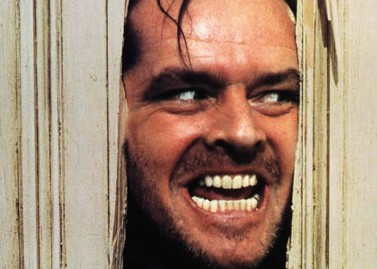
HERE'S JOHNNY! Crazymakers are skilled break-in-artists.
HERE’S JOHNNY! Crazymakers are skilled break-in-artists.

IF Writers got medals for creative courage, I’d have received one this week, for surviving my summer with a crazymaker.

It was the author of The Artist’s Way, Julia Cameron, who introduced me to the playful poison of crazymakers.

These are the chaotic spirits who swan into town and demand three nights on your sofa bed, just as you’re starting that dream job and need calm nights at home with your loved ones to be at your best.

Or the drama queens who recruit you into their grand schemes, but won’t answer the call to action when you suggest they lead the way.

My latest crazymaker arrived on the scene just as I was ascending the Everest of playwriting – executing the latest draft of a ten-year project.

It had been years since I’d had a crazy around my neck, and I didn’t see it coming. Time for a reminder about how to spot ’em.

Crazymaking clue: If someone asks for too much information at first meeting, they’re a crazymaker.

We met through writing, theirs so beautifully expressed that I decided the person behind it was worth meeting. Apart from the slightest scent of networking at our first meeting on neutral territory, and their propensity for over-apologetic texts, all seemed well.

We staffed the same project from different territories, me and my latest crazymaker. I’d started a lot earlier, enjoyed the exploration and the calm group achievement, but when they began, so too did the turbulence.

Crazymaking writers can present as brilliant communicators, until they meet their equals.

Then, despite a lifetime working with words, they profess a sudden inability to interpret emails when they just don’t like their contents.

Next, they command that phone calls and meetings are the only way to have dealings with them, yet they’ll rarely pick up the phone and instigate a conversation.

Prolific use of “I did this” manifests in their expression of group projects, leaving others to amend to the truth of: “We”.

They have no time for a project’s first draft, but want to change everything once it’s done.

And they demand to be paid, even when everyone else is volunteering.

My role was suddenly called off. It was the crazymaker who informed me. They’d swung the drama in another direction which benefited them.

Crazymaking clue: If someone on equal footing tells you what the status quo of your contribution is, they’re a crazymaker.

I write to a very strict schedule, every weekday. The world of my characters and their stories is my solace when turbulence hits in the ‘real world’ of group projects, day jobs and financial survival.

I have one foot in the economy, and one foot in art, so it’s a delight to dive into my creative space: an old desk on a breezy enclosed verandah, down a quiet street at one end of an invisible island.

Here, I can lose myself in a world I have spent many years making. Through loss, difficult choices, honesty with loved ones, ignoring bad advice and relying on my gut feelings, I have earned my creative space. Creative cards very close to my chest, I use my space wisely, and I protect it well.

Crazymaking clue: If they follow you into your creative space, they’re a crazymaker.

POOR PUSS Wants in, but don't be fooled!
POOR PUSS Wants in, but don’t be fooled!

Retreating into your creative space can trigger a crazymaker’s attack.

Like a cat at the door, my crazymaker yowled for creative shelter and soul food, and worked on my sympathy buttons with well-rehearsed moves.

But I kept my head down and wrote, despite the storm brewing outside.

With sudden, pesky emails, harping on about work already done, the crazy cat tried to claw a hole through. I stomped and boarded up the breach.

A few days later, it returned and professed angrily that a phrase I had published caused the world pain, and, caring fool that I am, I bought the lie.

I hit ‘pause’ on my climb, and opened the door. Like a bear woken from hibernation, I growled: “Show me, where is this pain of yours?”

The cat mewed that it had none. I cross-examined it for signs of suffering, but there were no wounds offered for healing, and no grievances uttered for salvation.

Puss dodged solutions to its imaginary issues left and right, and made a crazy offer: now that it had disturbed me, this crazymaker wanted us to work together, and they would take care of everything.

Call me crazy, but I said: “Yes, I’ll collaborate with you, pussycat.”

My lie bought me peace.

Thank you.

I returned to the summit. I’ve walked that country so often I could get there blindfolded. At base camp, I was concerned the conditions up on the mountain were not as good as they had been before I came down, but I bravely set off.

I declined that easy, feline yowl of failure that I had at my disposal if I too were tempted to self destruct, and on a beautiful island day, later than planned, I reached the summit.

Crazymaking clue: If they start your association with an apologetic tone, which is gradually replaced by a suggestion that you need to apologise, they’re a crazymaker.

I deserve my medal because I’ve fought-off crazymakers before, but it’s taken years to have the strength of character to name one and hold it to account so speedily.

Far from my island, the crazymaker went silent (as they do); built boundaries of their own (about time); broke them with high drama (go figure); told the world that I’d destroyed them (so schoolyard); and sent me an email as though nothing had ever happened (seriously?).

Crazymaking clue: If you come to realise you’ve allowed a crazymaker into your life, you’ve been a bit crazy too.

I’ve grown.

© Michael Burge, all rights reserved.

Human rights of reply

FIGHTING DISCRIMINATION Andreas Ohm and Jim Woulfe, Michelle McCormack and Lynne Martin with son Tom, Michael Burge, Maria Vidal and Susan Everingham with daughter Antonia, and Jiro Takamisawa. (Photo: Sahlan Hayes).
FIGHTING DISCRIMINATION Andreas Ohm and Jim Woulfe, Michelle McCormack and Lynne Martin with son Tom, Michael Burge, Maria Vidal and Susan Everingham with daughter Antonia, and Jiro Takamisawa.
(Photo: Sahlan Hayes)

A Writer discovers his voice.

SOMEONE once said: “Don’t get mad, get even”, which must have been on my counsellor’s mind when he suggested something towards the end of my two years of grief counselling after the death of my partner, Jono.

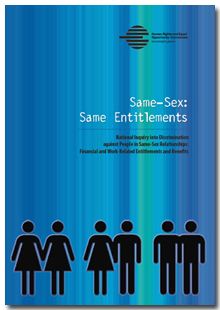
The Australian Human Rights and Equal Opportunity Commission (HREOC), now the Human Rights Commission, were looking for people to make submissions to illustrate various aspects of their Same Sex: Same Entitlements investigation into financial discrimination against same-sex couples in Australia.

“Why not think about writing your experiences?” he put to me.

I said I’d think about it, although my first thought was that my experiences were somehow not relevant. Then I thought deeper.

The death of my partner, with whom I cohabited, ran a business, and had joint financial affairs, had cost me dearly emotionally, but it had also cost me economically.

Unlike straight people in my situation, Centrelink did not recognise the validity of my relationship in any way. I was unable to claim any kind of support linked to my grief or my monetary losses when I had to move house three times in one year, and take time off work.

Centrelink staff had been quite defensive about their organisation’s shortcomings, and told me to apply for Newstart (Newspeak for ‘the dole’) which came with the requirement to be seen to be seeking work and attending mind-numbing ‘how to write a resume’ courses.

I’d taken things into my own hands and gotten a part-time job in aged care, which I happily did for a few months until my car blew a gasket, and needed thousands of dollars for a new engine. I sold it as scrap, had to quit my job (for which I needed a car), and proceeded to hunker down in my cheap accommodation, a granny flat, until I had to move because the property was sold.

I headed back to Sydney and city rent, and tried to speed up my application for Jono’s superannuation, which was slowed by the machinations of his family. They threatened to apply for it in its entirety, then didn’t apply for it at all. None of them were in any way financially dependent on Jono when he died, so none of them were eligible.

I was, but, thanks to all the unwelcome nonsense, it was months before Jono’s super fund could simply do what the law required of them and send me a cheque.

I endured financial discrimination because my country had nothing for me by way of support. What was slightly galling was that certain demographics – straight divorcees over the age of 50, for example – were allowed to access the ‘widow’s pension’ automatically. No job-seeking or resume classes for them.

Me, a genuine widow, could get nothing.

ACTU-Worksite-Australian-Human-Rights-Commission

I didn’t feel like entering into a sob story, but when I contacted HREOC, they encouraged me to submit a written document on these experiences, because they had not received any accounts of people in my particular position, and many of the unequal laws applied to the circumstances of being widowed.

Like my affidavit to the Supreme Court of NSW, my submission to HREOC was easy to put together. They have strict guidelines, I couldn’t just cry: “It wasn’t fair!” and let them sort it out, I had to show where I fell between the cracks because I had lived in a same-sex de-facto relationship.

Part of the deal was the delivery of a live submission to the Commission, and a willingness to submit to media interviews afterwards. I agreed without thinking, because, when the day came, I had a plan to follow the contents of my written submission, but completely overlooked the possibility that emotions would take over.

I watched as other gay and lesbian people expressed their experiences, and, when my turn came, I forced my story out from beneath an aching heart.

Expressing the inexpressible about death is one thing. Defining negative behaviour by other people around that death is another. I struggled my way through my submission, masking hurt with the kind of plosives that hit the microphone with the cut-glass anger that is entirely suitable for such occasions.

As I exited the hearing I forgot about the media, and had more microphones shoved in my face to elaborate further. The interviews went live at midday, and many of my family and friends, and my counsellor, heard me explain the disenfranchisement to a State that finally seemed to be listening.

report_cover

Adele Horin, formerly of Fairfax Media, interviewed me at length on the phone after my HREOC submission, for an article which appeared in the Sydney Morning Herald.

It took her a few attempts to fully understand my position, and with hindsight I understood her difficulty was the same obstacle that many people encountered when coming to terms with my experience, because they simply could not understand why Jono’s mother and brother would do what they did, it was such an aberration.

In the end, I suggested she ask them directly for their reasons, to secure the ultimate right of reply, although I suggested she’d need to be tactful – their son and brother had died, after all, and the illegal actions they’d taken made them vulnerable to heavy fines and/or jail terms, had anyone really wanted to “get even”.

Somewhere in her research, Horin came to realise that my experience went way beyond financial discrimination and spoke to one of the final frontiers of same-sex equality in this country: marriage.

The last twelve months of the Howard government needed to pass before anyone in power was willing to read the Same Sex: Same Entitlements report.

So it was with great delight that many in the LGBTI community watched 11 years of conservative government swept away by KevinO7 and the ALP, who’d made the implementation of the Same Sex: Same Entitlements recommendations an election promise, and finally altered almost 100 pieces of discriminatory federal legislation in 2009.

The fight for full equality continues.

Michael’s story is published as Questionable Deeds.

© Michael Burge, all rights reserved.


I fought the law

BOB'S WAY Attorney General of NSW until 2007, the Hon. Bob Debus.
BOB’S WAY Attorney-General of NSW until 2007, the Hon. Bob Debus.

A Writer takes on an Attorney-General.

NINETEEN months after the death of my long-term partner Jonathan Rosten, I received an email out of the blue via the Sydney Star Observer, one of Australia’s gay and lesbian news sources.

Weeks before I’d shared my story in an interview with a journalist from that paper, detailing the precarious legal and financial deadlock I had been subjected to by Jono’s family, their denial of our relationship, and their illegal actions which prevented me from accessing his death certificate.

I’d spoken about my experience to warn other gay couples in Australia, particularly in the city I lived in (‘gay friendly’ Sydney), that it was still a political act for two people of the same gender to live together, because they were not afforded the full protection of the law.

The email was from a man whose name I will not write here – we’ll call him Wayne – because what he told me could have gotten him sacked.

He worked within the Registry of Births, Deaths and Marriages, presided over by State Attorney-General, The Hon. Bob Debus.

Wayne’s email was friendly, letting me know he’d read about my experience in the SSO, and wasn’t it great that the laws had recently been relaxed, meaning I could now get a copy of Jono’s death certificate with my name on it?

This was news to me.

I contacted the SSO and got Wayne’s number. He confirmed for me that, yes, working within the Registry, he’d witnessed directives that same-sex spouses were now to be granted access to their deceased partner’s death certificates. He wanted to remain anonymous because there were homophobes in very high positions within the department he worked in.

I rang the Registry, fobbing off the typical bureaucratic nonsense the telephonists engaged in. I already knew nobody but a top shit-kicker could help me, got put through, stated my case, and booked an appointment the next day.

The first thing that shocked me about the NSW Registry of Births, Deaths and Marriages was the level of security. Bouncers, thick glass screens, metal detecting barriers, and an air of protection pervaded the place.

That’s when I realised why I’d had such a tough time with these bastards: they control access to some of the most important life decisions we enter into as citizens, so they expect problems, and they’re in a permanent state of lock-down.

Upstairs, the chief shit-kicker invited me to show him the documentation in my possession: statutory declarations, bank accounts, rental contracts, personal items, Jono’s journal; in all some sixty documents which proved various parts of our relationship.

His eyes widened, and he went to stand, saying he just needed to photocopy the first three. But I didn’t, couldn’t, let him go.

I got extremely angry and emotional at having to wait for this moment much longer than a straight spouse in my position would have had to. In the nineteen months prior I’d been brought to my knees emotionally, financially, and spiritually. I’d survived suicidal thoughts, processed deep shame, lost friends, and had to move far too often because I’d been forced to become a ball of unmanageable humanity by the shortcomings of one family and the internal regulations of this man’s department.

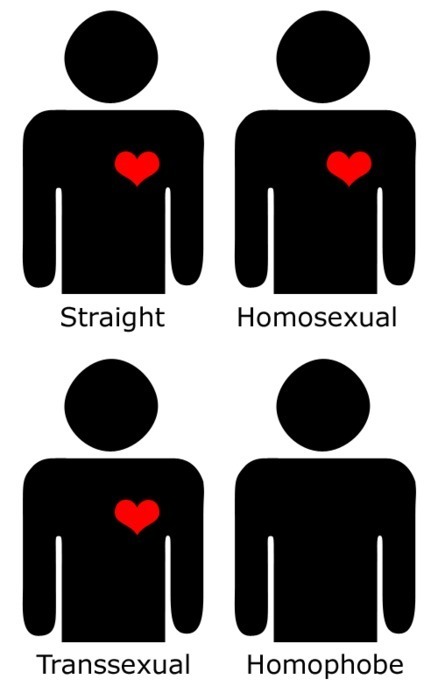
FINDING A PULSE in a homophobe can take some work.

He was not getting away with just copying a few documents, this guy. I already sensed he was trapped between his feelings of homophobia and the new regulations which now required him to treat me equally, a full seven years after the NSW laws had changed.

He managed to squeeze out that he reckoned I had a very good case, and that if a new certificate were to be issued, all the old copies would be recalled for destruction.

Did he need the details of exactly where those fraudulent copies were now?

Yes, he mumbled, shame-faced.

I handed over the names and addresses for him to request the return of the death certificate which had been created for me, long withheld by the funeral director I’d contracted and held in their safe behind a wall of defensiveness and avoidance; and the other at Jono’s family’s disposal, already widely distributed to claim that I, Jono’s surviving spouse, did not exist.

At that, the shit-kicker looked as though he’d shit his pants.

Ironically, it was just a week later, after attending Sydney’s first screening of Brokeback Mountain (the story of two men who could barely come out to one another, let alone live as a couple, the way Jono and I had), that I arrived home to a letter inviting me to collect Jono’s death certificate from the Registry, whenever I was ready.

I could have gotten it from the front desk, but I booked an appointment with the shit-kicker and I made him give it to me, right into my hand.

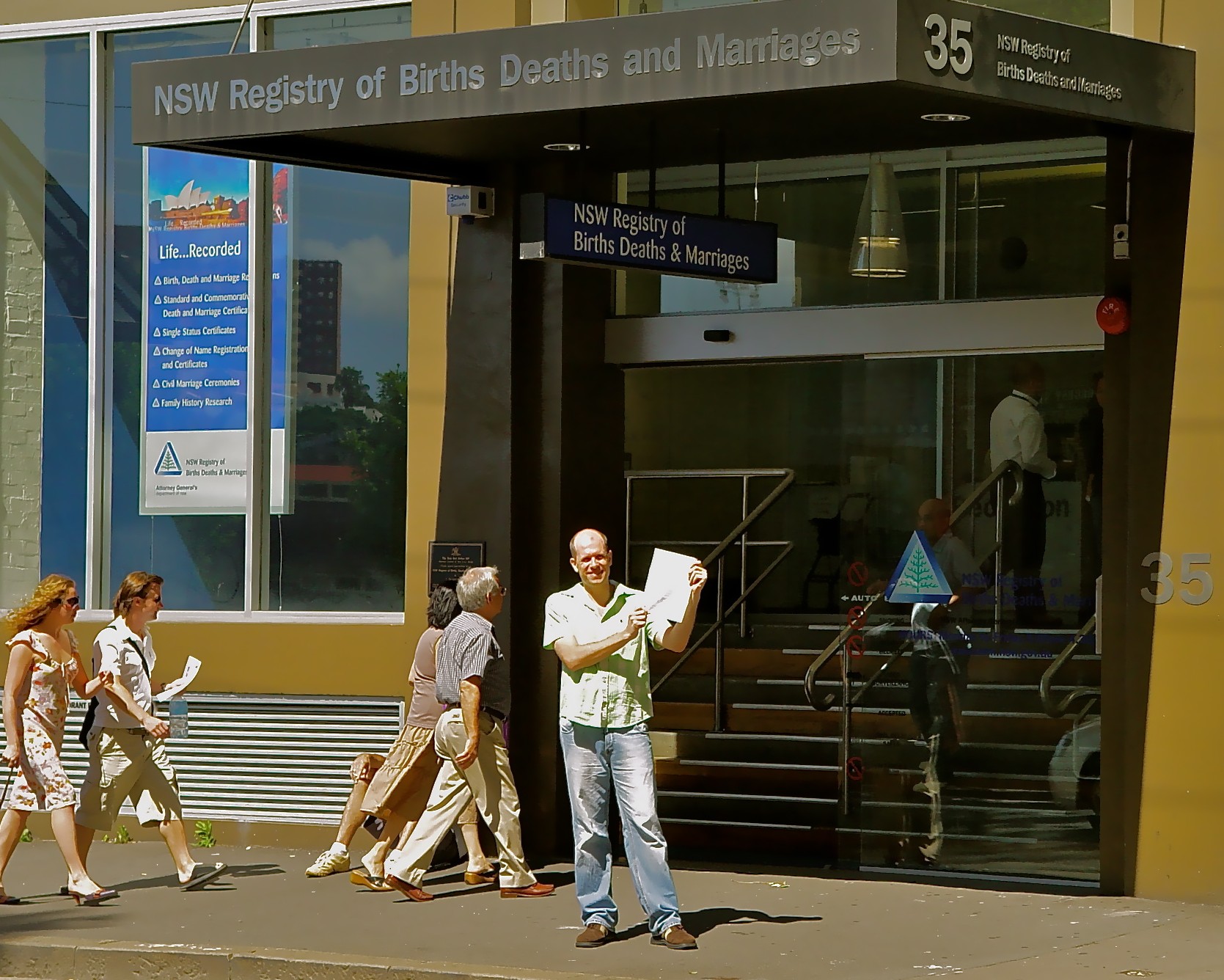
IN HIS OWN HANDS My friend Prue took this shot of me, Jono's death certificate hot off the press.
IN HIS OWN HANDS My friend Prue took this shot of me, with Jono’s death certificate hot off the press.

There, on the same page, was Jono’s name, and mine, a record of the exact number of years we had been together, and the address we shared on the day he died: the truth which had frightened the homophobes in our lives, finally laid bare in paper form more indelible than any gravestone.

I cried a little, and then I went downstairs to apply for another original of the certificate by filling a form and passing it across the desk with the thick glass screen.

The young woman took the form and immediately shook her head, tapped her finger on my name and Jono’s, and said: “You can’t get this, not when you’re the same gender.”

I was not surprised. I said to her, calmly so as not to set off any security screens or draw the attention of the bouncers, that she was incorrect and needed to ask her manager for some training on this issue. The jaw, that had been munching so enthusiastically on chewing gum, went motionless.

I went upstairs and saw the shit-kicker’s distorted face through the glass as I made the same demand of the managers. Not one of them would come out of their office to meet me.

So I went to the top. I wrote to the NSW Attorney-General, and made a formal request for him to ensure all staff in his department were now made aware, ideally through some kind of training, that same-sex couples were able to apply for their deceased spouses’ death certificates without recourse to anyone.

Perhaps, I suggested, some media releases to the same effect would be an idea?

When his reply was tardy, I went to NSW’s best shit-kicker, Independent MP Clover Moore, who hurried the Honorable Mr. Debus along a little.

We never received more than a staffer’s reply. I guess Attorney-Generals hate to be reminded they need to catch up with the law.

© Michael Burge, all rights reserved.
Michael’s story is published as Questionable Deeds.