Category Archives: Politics

‘All hands to cease work!’: Unearthing Deepwater’s forgotten railway strike

THE AUSTRALIAN LABOR movement cites the 1891 Queensland Shearers’ Strike as a milestone in its establishment, giving credit to the thousands of shearers who marched for fair wages and conditions at Barcaldine that year. Yet an earlier industrial dispute in the New England region showed that signs of unrest were stirring a decade prior.

Apart from mentions in contemporary reports from the 1880s, there is little evidence of this strike that impacted the building of the Great Northern Railway line between Deepwater and Bolivia, ten kilometres to the north.

There, on Ngoorabul Country, a significant town was raised at the foot of Bolivia Hill to house the people who built the railway line. Thanks to journalists, we can glimpse the life that once buzzed around Bolivia, get details about the construction of an engineering feat, and understand the tenuous nature of the workplace at the peak of the Victorian era.

‘Hopeless bogs and gluepots

Even before the Great Northern Railway reached Glen Innes in 1884, construction of the line northwards to Tenterfield had been contracted to Cobb and Co, the renowned coaching business that had foreseen the end of its core business with the spread of the railways, and diversified into building transport infrastructure. 

The carriage of passengers on daily coach runs north and south through this difficult stretch of country meant the company can have been under no illusions about the terrain of Bolivia Hill:

“The hill is very steep, and though the road is good, it is dreaded by teamsters, for the pull up the ascent is long and heavy.”
Australian Town and Country Journal, September 1883

COACH CROWD: Cobb & Co coach in Castlemaine, Victoria

A Cobb & Co traveller ‘EJW’ provided the perspective of a coach passenger:

“From Bolivia to Glen Innes the road was a sore one to travel. Continuous and heavy rains had fallen for weeks, and the traffic incidental to railway construction had cut up the track in every direction – so much so that the coaches on each daily trip are compelled to make a new one through the bush, only to find on returning that teams have followed them and dotted it with hopeless bogs and gluepots.”
The Queenslander, March 1883

The railway was going to conquer this arduous incline, but it would take an army of navvies, the much-demonised brawn of the Industrial Revolution.

‘This sylvan village’

VERDANT VALLEY: The Bolivia region, NSW

Thought to be a shortening of ‘navigator’, navvies were manual labourers who built canals, railways and roads from the 18th to the 20th centuries across Britain and its colonies. Much of the media coverage and literature from this era treats this class of men with a patrician disdain, assuming drunkenness, laziness and questionable morals around sly grog-filled shanty towns. Despite reports of some ruffians, travellers would have received a warm welcome in Bolivia, which from multiple eyewitness accounts was much more than a temporary community by 1883:

“Here, on the eastern side of the railway line, the company [Cobb & Co] have erected their offices, workshops, and stables; there is also in the camp a post and telegraph office. On the opposite side of the line is the township, extending along the gully at the foot of Bolivia hill. Through the township, and over Bolivia hill runs the main road from Glen Innes to Tenterfield… The township is formed on either side of the road for about a quarter of a mile.”
Australian Town and Country Journal, September 1883

The same article lists two hotels, two bakeries, two butcher’s shops, two general stores, two produce stores, two tobacconists, multiple “fancy goods” businesses, a saddler, a bootmaker, “half a dozen or so” boarding houses, and one barber’s shop run by a man who might have been Indigenous judging by the archaic description. 

The use of the word “township” is a clue that this place was much more than a navvies’ camp, and the writer of this article goes into great detail about other signs of permanence:

“Some 50 or 60 private dwellings, some of canvas, and others constructed of bark, complete the village; certainly the inhabitants cannot complain of an absence of business houses at which all their wants may be supplied. Contentment seems to reign in this sylvan village and many of the men, knowing that the work to be had would last some time, have made their wives and families as comfortable as circumstances permit, and through the open door one may see the prosperous navvy (a navvy may be prosperous if he doesn’t drink, for he is in receipt of good wages) taking his noonday meal off a clean table cloth covering a substantially laden board; or after the meal taking his smoke before assuming work for the afternoon, and beguiling the time with fondling the baby while his wife clears away the dishes.”
Australian Town and Country Journal, September 1883

Two months later, another un-named journalist visited Bolivia and observed Chinese migrants growing vegetables, “right in the centre of the township”, and interviewed residents who were looking to their town’s future:

“The principal grievance of parents is the absence of schooling for the children. We trust, however, that the steps now being taken by the inhabitants in this direction will result in attainment of the desired object shortly.”
The Armidale Express, November 1883

A school did indeed get raised, although life in Bolivia came with a constant reminder of the town’s purpose.

‘Debris hurled into the air’
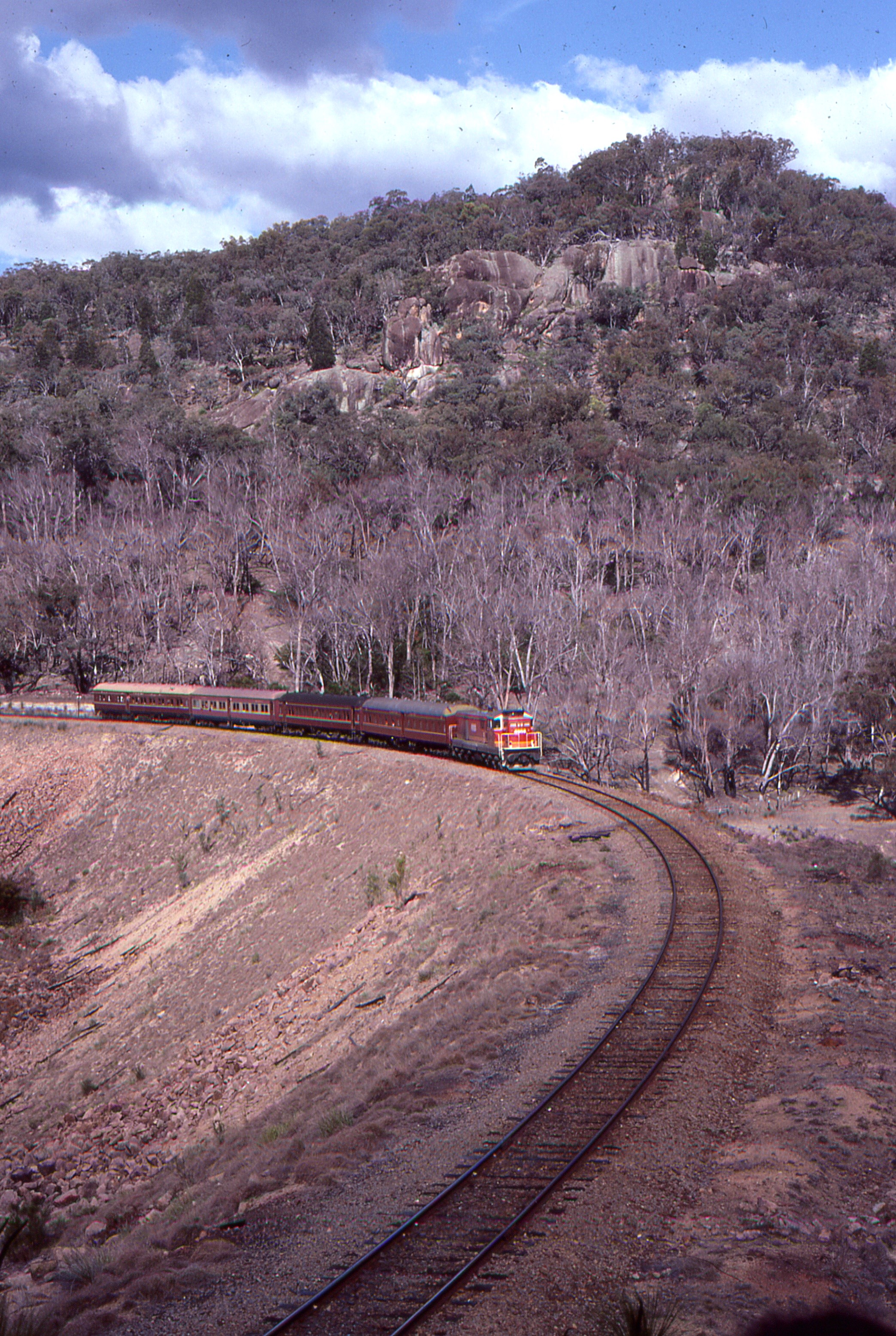
BOLIVIA BUILD: Train on Bolivia Hill in 1985.

Constructing the railway line from Glen Innes to Deepwater was a relatively easy process compared to the cutting of the corridor through and down Bolivia Hill. The Australian Town and Country Journal reporter (September 8, 1883) indicated that just one of the cuttings required the removal of “75,000 cubic yards of granite”:

“Beyond this is the spot known as the Horse-shoo Bend, where the line is compelled by the nature of the country to take a sweep round half a circle on the sides of the hills, forming the shape as described in the name given the place.”

Then there was the startling use of blasting powder, usually at noon or at five o’clock in the afternoon when the navvies downed tools:

“By this arrangement no time is lost in stopping the work to enable the men to get out of the way of the falling stones and debris hurled into the air by the force of the discharges. When, as frequently happens, a number of these shots take place in succession, one can almost imagine the reports are from heavy cannon, so great is the shock. Then the sound is taken up by the surrounding hills and goes echoing off from crag to crag, producing an effect as impressive as it is startling to the unwary.”

Such accounts give a sense of structure in the demarcation of work hours, although there were signs of mounting pressure, with work on the line being “pushed”: 

“The difficulties to be overcome are of no ordinary character. The cartage and haulage can be but slowly performed, owing to the steepness of the road in places; it is no uncommon sight to see as many as 14 or even 18 horses drawing a load that on roads in ordinary country might be taken by six. Under these circumstances work is necessarily slower than it would be with more favourable conditions.”

Christmas and New Year came and went in the ‘sylvan village’, but before Easter, it was feared that all hell might break loose.

‘The Mob’
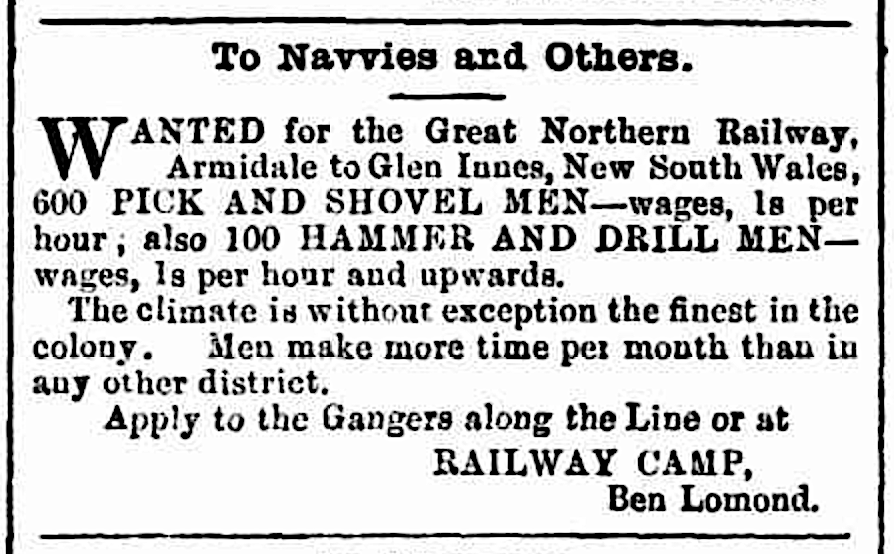
A navvy’s pay on the Great Northern Railway construction from Armidale to Glen Innes was advertised as a shilling an hour for 600 “pick and shovel men”, and 100 “hammer and drill men” earned that as a minimum.

Years of construction work had cost the New South Wales colonial government so much that by the time the final northern sections of the corridor were built, ironbark and brick bridges and viaducts were raised instead of the iron structures more common to the south. 

But the biggest explosion heard around Bolivia in February 1884 came with the sudden upsetting of the status quo.

“On Tuesday the Hill was in rather unusual commotion, when, about 11 o’clock, the noise and shouting of a large body of men and boys was heard coming up along the line from the Horseshoe Bend. It was, however, soon apparent what was the matter, when the workmen in the neighbouring cuttings were seen to knock off. It was the mob, most of whom had come along from Tenterfield way, calling at every cutting and demanding all hands to cease work and ‘go on strike’ for higher wages.”
Glen Innes Examiner, February 1884

This wasn’t quite the whole story, which would become apparent a fortnight later. The navvies had, in fact, mobilised swiftly to meet publicly and spread the word to the media about a proposed cut in their wages.

The Bolivia section manager since early 1883 was a Mr F. Mason, who resided in the town, although the same report placed him in Sydney at the time of the industrial action. His absence possibly accounted for what took place next.

Tools were downed on Tuesday February 5, 1884 and a meeting called, to which men “marched with music”:

“An open air meeting was held at the Horseshoe Bend on Wednesday night, when a committee was formed and members deputed to traverse the section north and south for the purpose of preventing a resumption of operations until the demands of the navvies are acceded to.”
The Armidale Express, February 1884

By Saturday February 9, the local media reported, “all work between Tenterfield and Deepwater is at a standstill”.

Navvies’ pay day was Saturdays, and since most reports predicted, “an extensive exodus of employees for ‘fresh fields and pastures new’,” there was a sense that when the pay cart arrived from Glen Innes it would be bearing less wages for an angry crowd.

To see for themselves, the mob walked from Bolivia to Deepwater.

‘As silent as the grave in the cuttings’

“So far, every thing has been carried on quietly, and no depredations of importance committed,” the Tenterfield Star reported of the strike’s first Saturday payday, but a week later, with tools still down, news of the strike had reached Sydney, with a significantly different account of the pay issue:

“Matters along the railway line during the past week have been rendered very lively by a strike amongst the navvies. It was intimated by Messrs. Cobb and Co. that the wages would be reduced from 8s. per diem to 7s. 6d, on Monday… all is silent as the grave in the cuttings; but not so at the public-houses, where high revel is held, and will be until all money is spent. That will not take long, so that most of the men will, it is thought, accept the lower rate and resume work, especially as work is not quite so plentiful as it has been, and numbers of men are prepared to come over from Queensland and fill the vacant places.”
The Sydney Mail February 1884

A week later, Deepwater’s pubs were still busy ahead of the next paycart:

“The navvies on strike on Messrs. Cobb and Co’s contract were very quiet until today. Some however: have now begun drinking, and it is feared that they will start damaging property. A telegram was received from Bolivia, applying for an additional number of policemen to accompany the paycart, which is leaving Glen Innes tonight.”
Australian Town and Country Journal, March 1884

According to the The Sydney Mail and New South Wales Advertiser report, Cobb & Co was determined to make a stand, and, “a good deal of sympathy is evinced towards them.”

Just what that paycart contained by way of wages appears to be lost from the record.

MIGHTY MOB: Navvies in South Australia

‘The loquacious navvy’

By the middle of March, the media was reporting the end of Bolivia’s industrial action:

“The strike is over from here to Glen Innes; for the last fortnight all the works have been in full operation. It was a well organised affair, but it failed in its object. The contractors will suffer little, if at all. The storekeepers on the line, the business people in the townships, and the navvies themselves are the heaviest losers by the movement. Men are now plentiful, and in a very short time every gang from Glen Innes to Tenterfield will be made up to its full strength. The strike on Cobb and Co’s works will soon be but a memory of the past and theme for the loquacious navvy to dilate upon by the camp fire or the public house-bar.”
The Armidale Express, March 1884

A year later, a navvy strike in Queensland on a section of the Southern and Western railway was reported in Rockhampton’s Morning Bulletin, outlining the summons of a strike leader who was ultimately ordered to pay almost 30 pounds in fines and costs for obstructing a railway ganger, likely his boss. This was an escalation on the tactics used to break the Bolivia strike, foreshadowing the police responses that met the Queensland shearer’s strike six years later.

A snippet at the end of the same report suggests the kind of outcome that may have been brokered at Bolivia and kept out of the media so as not to inspire other strikes:

“A recent telegram mentions that the strike is at an end and we must, therefore, conclude that an amicable arrangement was arrived at.”
Morning Bulletin, Rockhampton, April 1885

Amicable outcome or not, the railway service to Tenterfield opened in 1886. At a banquet in that station’s goods shed on the afternoon of October 19, attended by several northern NSW luminaries (yet boycotted by just as many others), the responses to Governor Lord Carrington’s opening speech were peppered with bitter to-and-fro about political interference in the Great Northern Railway’s construction. 

It had been a hard-fought project, yet even with just 12 miles to connect the line to Wallangara on the Queensland border, the response of NSW Commissioner of Railways Charles Goodchap ruminated on the “extravagance” of the works:

“It was said we had too many men employed.”
The Maitland Mercury, October 1886

Lord Carrington answered the unruly dignitaries with a toast to the prosperity of Tenterfield.  Lady Carrington, the “ladies of the Colony”, and the press, also had glasses raised to them, before the gathering retired to prepare for an evening ball.

The navvies, who – according to Goodchap – had built 900 miles of railways in the state over the previous 25 years, didn’t rate a mention. 

This article was first published in the Glen Innes & District Historical Society’s annual Bulletin, 2024. 

Two decades of answers

TWENTY YEARS AGO today, not long after six o’clock in the evening, my partner Jonathan Rosten needed to take a seat during a rehearsal at a Sydney dance studio, complaining of a racing heart.

Very shortly afterwards, he collapsed. First-aid could not revive him, nor could paramedics. By the time I got to his side they’d been attempting CPR for almost thirty minutes.

He was bundled into an ambulance that rushed him away into a busy city evening at the end of a stunning autumn day, yet by the time I arrived at the hospital, he was lost to us all at the age of just 44.

Considering the fallout after one gay man’s untimely death, I’m compelled to look at what has changed since that last day of autumn in 2004.

Interrogation of a Nation

“What did they do to you?” Madeline asked me, sitting on the back deck of the house my husband Richard and I shared in Queensland.

That was the winter of 2013. By then, I was living a completely different life in a new relationship, a new state and a new profession.

I’d long tried to articulate the experience of being disenfranchised from my relationship with Jono by the very people who should have cared the most – his blood relatives – but had usually given up when people failed to understand why anyone would do such a thing.

Madeline didn’t demand an answer, she just listened.

The passage of time had ignited something in me, because hours later I still couldn’t let things go in my mind. Revisiting the worst period of my life was still a shock, and over the following weeks and months I started to piece together the awful truth.

Writing had always been my strongest suit, and for almost a year I recorded not just my experience of loss, but also the mutual gains that Jono and I had manifested in our relationship.

My memoir, Questionable Deeds: Making a stand for equal love (High Country Books, 2015 and 2021) was the long-form answer to Madeline’s question. It was an interrogation of a nation that was not acting in the best interests of same-sex attracted people, in fact it was making our lives worse; and it threw up just as many questions as it answered.

Piece of Paper

Marriage equality seemed so far off in 2004 that even significant sections of the LGBTIQA+ community didn’t get behind it. A Newspoll taken the month after Jono’s death showed support languishing at just 38 percent against 44pc opposed. The 18pc of undecideds were, ironically, deciding the status quo.

In my shock and grief that winter, it was a depressing show from my country. Even so, I became a marriage equality advocate overnight when I realised what a critical cultural statement it would make for same sex-attracted relationships to be upheld by law, whether we were married or not.

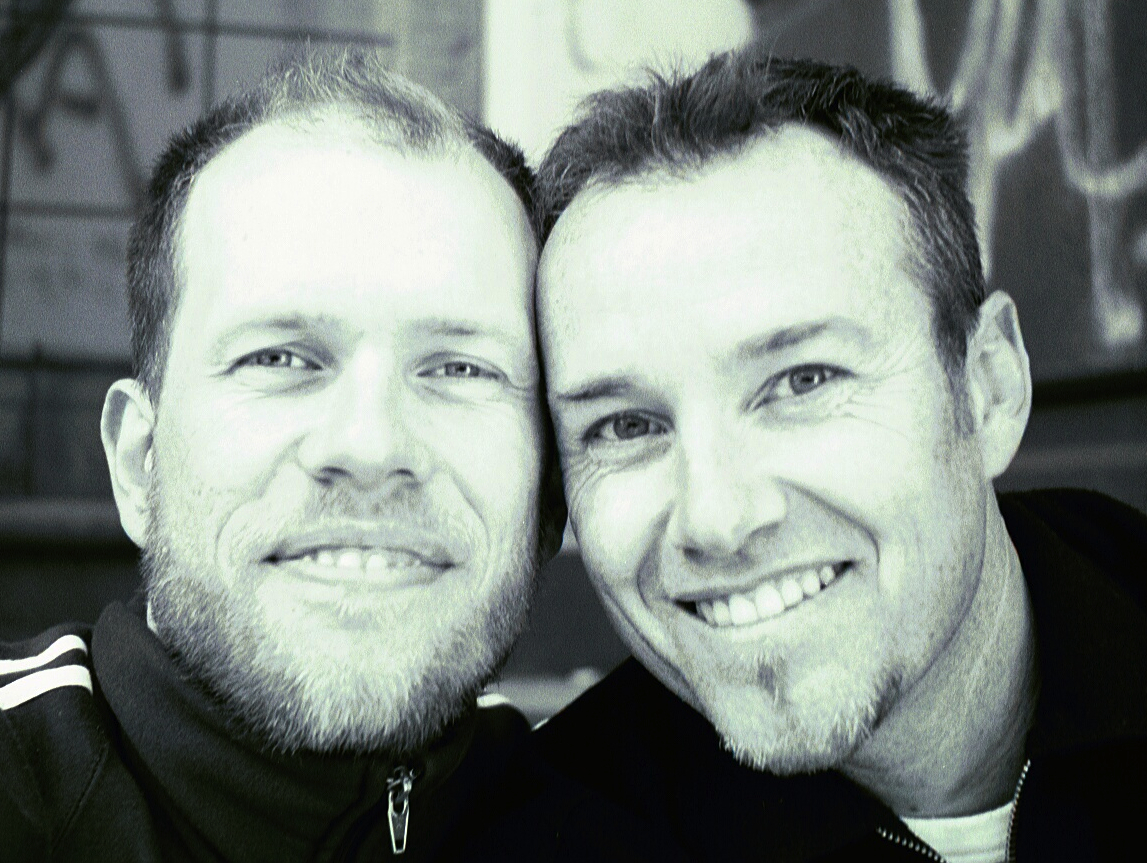
RELATIONSHIP RIGHTS: Michael Burge and Jonathan Rosten

But for years I was forced to listen to those who reckoned de-facto relationship rights were enough, that the New South Wales legislative change in 1999 was all the cultural statement required. But my experience – five years after those laws included same-sex couples – showed that anyone, from disgruntled family members, funeral directors and public servants could easily rearrange the pieces of my late partner’s life to make it appear as though he’d never been in a relationship with me, stamping all over my rights in the process.

Same-sex equality campaigning eventually became a hallmark of my new relationship, and Richard and I marched the streets, knocked on doors, collared politicians and signed petitions because we understood that this country needed marriage equality at the earliest opportunity.

It was eye-opening to hear from those who wanted to uphold ‘the good old days’ when same-sex partners hid in plain sight for all kinds of reasons. Many feminists understandably upheld their anti-marriage stance, although this was a pro-equality issue.

Australians love a numbers game, and the public-vote approach forced on the country became about much more than marriage, it was about LGBTIQA+ dignity.

Across those years, it was painful to witness similar situations to mine still happening while the nation prevaricated under conservative leadership; but since December 2017, when Australia’s Marriage Act was finally altered to include same-sex couples, I haven’t heard of another case.

That’s not to say that blood relatives won’t try. I’ve heard of a few attempts to push a same-sex surviving spouse out of their senior next-of-kin status, but the “piece of paper from the city hall” that Joni Mitchell sang about not needing has held the line again anti-queer prejudice.

Ripple Effect

In a 2022 survey by YouthSense, 1367 Australian Gen Zs aged 15-24 were canvassed about their sexual orientation, and 32 per cent responded that they identified as LGBTIQA+. 

YouthSense attributed this confidence in our queer youth in part to a ripple effect, after the majority of the Australian community got behind marriage equality.

This gives me a sense of pride, but I sometimes wonder what Jono would have thought of the person I’ve become. We often chatted about gay rights. Being a decade older, he reached his adulthood before homosexuality was legalised in NSW in 1984, and survived the frightening early years of the AIDS epidemic, but he usually took a lighter approach than I did.

After his death, I recognised his attitude in many queer campaigners who’d endured so much upheaval by the year 2000 that the idea of fighting on for marriage equality fatigued them. Jono turned forty in that year and was looking forward to a bit of peace and time to pursue his love of choreography, which is, ironically, what he was doing right up to his death.

Our case was heard by the Human Rights Commission in 2006. I spoke in front of the gathering and the media with a very wobbly voice that morning, due to lingering grief and shock, anxious because I was presenting my grief as a case study of the unnecessary extra angst that LGBTIQA+ were being put through when our loved ones died.

Subsequently, the commission produced its Same Sex, Same Entitlements report, which led to almost 100 pieces of discriminatory financial laws changing in 2010, another step in the long journey to alter the Marriage Act in 2017.

I’d made a stand, something I had never done before on such a scale and may never do again, and that was certainly worth writing about.

Creative Allies

Questionable Deeds still serves an important purpose for me. It’s re-traumatising to rake over the coals when someone asks about my experience. Being able to point them to a book means I can get on with my life while the reader’s awareness is raised through words on a page.

I’ve written since I was a teenager, although by the time I realised I was gay and entered a long period of closeting, it felt impossible to express myself in that way due to the fear of my secret being discovered.

By the late 1990s, all that changed, and I tentatively started writing more than scripts and marketing materials in my day jobs. The day that Jono died I was sitting at my computer working on a full-length play. In the fallout, it was a full year before I was able to find the peace and security to get back to work on it, but when I did, I noticed more significant changes.

No longer was I prepared to leave LGBTIQA+ at the sidelines of my subject matter. Long before the cultural shifts of marriage equality, I embarked on a journey to bringing cultural change to literature.

But literature took even longer to budge than legislation. In a skittish cultural landscape, my queer-themed play never found a producer, and Questionable Deeds did not land a book deal, although after I published it it was selected for the first LGBTIQA+ panel at the Brisbane Writers Festival in 2016 and became an Amazon bestseller.

It took many years to land my first book deal for my debut novel Tank Water (2021, MidnightSun Publishing). Because it deals with rural homophobia, I’ve been invited to literary events across the country to contribute to conversations around crime, justice and the change in LGBTIQA+ lives outside of cities.

After decades of being granted relatively easy access to jobs in rural-based media in the UK and Australia, by virtue of being born and raised in the bush, I was gobsmacked when, in 2021, the new Guardian Australia Rural Network approached me as a rural-based journalist to write and edit. The first subject matter they wanted me to generate coverage of was rural gay-hate crime.

Now, at long last, this thing called a writing career no longer feels like a solo journey, and with plenty of new projects in the pipeline I’m collaborating with more people than ever.

One of the most special aspects of my relationship with Jono was our discovery in one another of an ally for our creative endeavours. We had hours of discussion and planning for our projects, and I loved seeing the glow of inspiration rise in him.

I carry a bit of it still, because I know how such reciprocal validation feeds equality within a marriage. Perhaps that’s the ultimate lesson in marriage equality for everyone, not just LGBTIQA+.

Questionable Deeds: Making a stand for equal love is available from The Bookshop, Darlinghurst (Sydney); Hares & Hyenas (Melbourne); Shelf Lovers (Brisbane). and High Country Books.

Carol’s commonsense campaign

“There was a majority of men on the council and I really felt that women needed to have a decision-making presence.”

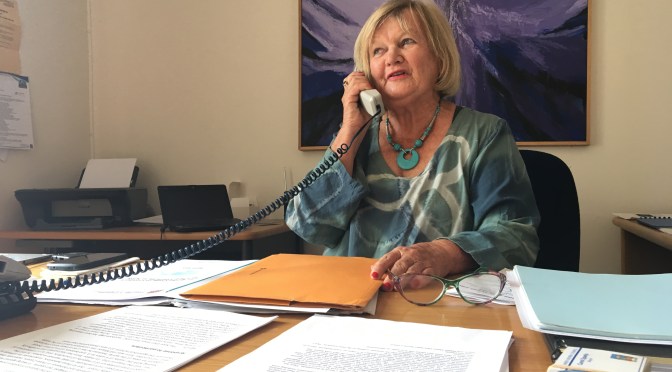
CAROL Sparks describes herself as an unlikely candidate for local government, but a desire for change in her community drove this former nurse into a political career that’s already made history in Glen Innes.

It was while co-ordinating state and federal elections for New England Greens candidate Mercurius Goldstein that Carol got a close-up look at public life.

“I went on the campaign trail and I spoke to lots of people,” she recalls.

“I realised I had a bit of a passion for it, to try and bring climate change to their attention, the problems with our waterways, and the environmental damage that was happening on the Barrier Reef.

“Then the council elections were coming up and I thought well, I could just keep talking to the people.”

Carol’s campaign for the Glen Innes Severn Council (GISC) elections in 2016 was conducted over a fortnight in a very grassroots manner.

“I just stood out on the street and said: ‘Vote me in for council’ and people liked that,” she says.

“There had been campaigning in this region in the past, but it had always been done in the newspaper.

“It was quite exciting and people were enthusiastic towards me. The community was feeling a little bit frustrated, they said we needed a change.”

A major driver for Carol was the under-representation of women in local government.

“There was a majority of men on the council and I really felt that women needed to have a decision-making presence,” she says.

“Dianne Newman was a councillor and she was feeling a bit isolated.

“I campaigned on health, women, water, and potholes. Unfortunately there’s still some potholes around, but we’re working hard on that,” she says.

Raised at Tathra on the far south coast of New South Wales, Carol’s mother’s family were dairy farmers and her painter father a Second World World veteran.

“I left school at fourteen and worked in a grocery store, before starting my nursing training at Bega,” she says.

“I went to the Keppel Islands on holiday and that’s where I met my husband, Badja.

“We sailed around the Whitsundays, got married, and lived in England for eight years where our children were born.”

After moving to the Glen Innes region in 1980, Carol and Badja established a local antiques and collectable business and a second-hand bookshop. The couple’s son Joe now owns The Book Market in central Glen Innes.

When asked about what sparked her political ambitions, Carol admits to having an internal drive that shocks a few people.

“I’m an old woman,’ she says, laughing. “And I wanted to have a change.”

“I was a registered nurse and working in palliative care here in Glen Innes for twenty years.

“There were needs in the community. We’ve got doctors on call, but it’s very different when you have a doctor right there when you present at a hospital.

“Towns in the bush tend to get poor services.”

Trial by fire

Carol served as deputy mayor from 2016 until September, 2018, when a majority of councillors elected her into the mayoral office. Looking back at her first years as a local representative, she describes the experience as a “trial by fire”.

“It still is,” she says.

“We had another lady who was president of Severn Shire Council,” Carol adds, referring to councillor Alice Clifford, who served prior to the amalgamation with Glen Innes Council.

“But we’ve never had a female mayor of the municipal council.

“That’s what women are facing all over the nation, and women are leaving politics in their droves. I suppose that’s writ small here.

“But I’ve tended to be a person who goes against the grain, and it’s been very inspiring to look at Dianne, who is now deputy mayor, and notice the changes that have happened for her whilst I’ve been on council.

“We could do with a couple more women, I reckon, just to balance it up a bit.”

When asked what she imagines her legacy will be, beyond bringing more gender equality, Carol is very clear.

“I think renewable energy, happy kids, more community gardens, and more sustainable businesses,” she says.

“We do have a tendency to be a bit old-fashioned. I’d love to bring the rail trail here, for example, with lots of backpackers coming from overseas,” she adds, referring to a proposal to alter the use of the closed rail corridor that runs from Armidale to Wallangarra.

“Volunteering is also a big thing in Glen Innes. We cannot survive without our volunteers and of course they’re all getting older, so encouraging younger volunteers is something I’ll be looking to do.”

On the issues that divide country towns along political lines, Carol is firm.

“If we care for our waterways and our creeks, we should create biodiversity and plant trees instead of cutting them down,” she says.

“To have healthy waterways is where we find most in common with farmers. They need water too, so we need to look after the environment.

“We come together though common sense.”

This article first appeared in New England Living magazine.