‘New-fangled mob’ Down Under

THOROUGHLY MODERN The interrelated Modern Family of ABC's comedy series.
THOROUGHLY MODERN The interrelated Modern Family of ABC’s comedy series.

A Writer looks at modern families.

IT was charming and kind of awkward when Australians welcomed the cast of America’s ABC comedy Modern Family (what Aussies might prefer to call a ‘new-fangled mob’) to our shores earlier this year, for the production of a special Australian ‘destination’ episode.

The series has consistently rated highly with Australian viewers and the locally filmed episode was always going to please and offend us.

Did they hit the mark and show us something about ourselves that’s not already apparent from any number of fantastic Australian television families, from The Sullivans to The Moodys?

The answer might lie in comparing the fiction with the data.

“There is simply no mainstream equivalent on Australian television.”

The first major difference is in Modern Family’s portrayal of three family units with kids – it’s simply not representative (what Aussies might prefer to call ‘average’)  of this country.

A trio of multi-generational groupings, including biological, adopted, and step-children, is not the Australian way, according to the Australian Institute of Family Studies.

Two out of three Australian families had children in the 2011 census, in fact, couples without children made up the dominant chunk of the pie chart, at 37.8 per cent of family units.

A beloved and core element to Modern Family’s make-up is the male same-sex couple (Mitch and Cam). Despite pushing boundaries in the United States for its honest (and to many, not honest enough) portrayal of the realities of same-sex families with children, this is not Australia’s reality.

The Australian Bureau of Statistics reveals that Australian same-sex couples with children are overwhelmingly female (a whopping 89 per cent).

Australia is undoubtedly ready for Mitch and Cam adopting children on our television screens, but our communities are a long way behind.

The first legal adoption by a same-sex couple in Australia took place in 2007, in Western Australia, where adoption had been legal for same-sex couples for five years prior. Currently, four Australian states and territories allow same-sex couples zero adoption rights.

Racial and cultural diversity is a core principle of Modern Family’s casting. Out of a total of twelve main characters, 33 per cent of the show’s key cast could be defined as racially diverse, including Latin-American and Asian-American representation.

There is simply no mainstream commercial equivalent on Australian television, an issue which continues to plague the industry, while a racially diverse audience of just under one-quarter of all Australians remains barely represented on our small screen.

Modern Family’s Australian episode did not hit the mark with everyone on home soil – The Guardian Australia’s review carried the headline: ‘Modern Family’s Australian episode was a cliched travelogue’.

WE'RE WAITING
WE’RE WAITING Jessie Tyler Ferguson and Eric Stonestreet (Mitch and Cam) in their Australian Marriage Equality video.

But there was one sign that the show’s content could drag Australian television content, and our nation, into the 21st century.

Jesse Tyler Ferguson and Eric Stonestreet (who play  Mitch and Cam) released a video produced by Australian Marriage Equality, comically expressing (what Aussies call ‘taking the piss’) their astonishment that same-sex marriage is not yet legal in Australia.

So, not until a racially diverse, childless lesbian couple inhabits our television comedies, will Australians become a truly ‘modern family’.

Until then we’ll need fictional outsiders to show us what we could be if we tried.

© Michael Burge, all rights reserved.
The publish button killed the media

THE cancellation of the funding behind Australia’s flagship online news source The Global Mail sent shock waves through the local media, because many journalists were watching to see if the rise of the independent online media hub was a viable career lifeboat.

The demeanour of journalist Mike Seccombe said it all, when he fronted-up for an interview on Friday’s ABC Breakfast News.

Virginia Trioli asked him whether there were other ways of funding The Global Mail. He exhaled, shrugged and replied that he is a journalist, not a money man.

I felt for him, because if 20,000 subscribers, a stable of top-notch journos, and private backing are not good enough to make The Global Mail work, what the hell is?

Before things got too depressing, technical problems meant the interview had to be wrapped-up fast, and the inexpressible did not get articulated.

The inexpressible being, of course, that the media as we know it is in its death throes. It’s on the mat. The death rattle has begun. Wake up peeps, it’s happening, it’s really happening.

WHERE IT'S AT The Publish Button, we've all got one now!
WHERE IT’S AT The Publish Button, we’ve all got one now!

I could rail at the media moguls who have sold us out, but I’m calling The Publish Button the main culprit, that powerful little hyperlink which emerged on online blogging platforms a decade ago.

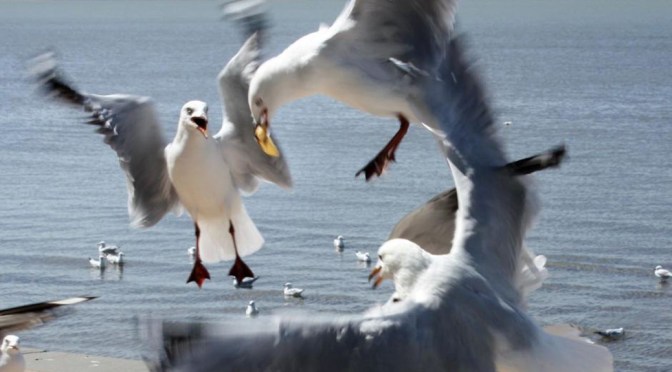
We flocked to it like gulls at a rubbish bin, and since digital technology was able to count the uptake, advertisers followed in an equally frenzied manner, until there were simply more pecks on The Publish Button than there were on all the print floors combined.

Twitter, Facebook and various forms of blogging now fulfill the very strong desire to be ‘published’ and ‘posted’, ‘liked’ and have our status ‘updated’ and ‘shared’.

Now, I’m not saying what we blog/post/tweet about is necessarily rubbish, but the bin is where it’s at peeps, the gulls are just not flocking to the mainstream media, which has been stripped, flogged and hung out to dry, journalistic job security with it.

The companies who made The Publish Button have become the new media moguls. They have no need to invest in ink, paper, print floors, newsagents, transport, and the tens of thousands of people who once staffed the media.

And without us even noticing, they have managed extremely well without journalists. A media which has no need to pay for content is every CEO’s dream.

Content flows freely to them, because The Publish Button is such effective bait.

Its lightning fast distribution is a stimulant like no other to wordsmiths. No barrier to participation, no editors to chase us, no pesky sub-editors to keep us nice, no delay in reaching our audience, and the ability to correct errors instantaneously… if we care about any of that, and there’s no requirement to.

If I StumbleUpon it I can Storify it, and I can say I’ve Reddit. I can Press my Words, I can show my Pinterest, I can Inst a Gram, I can meme like a Tumblr.

It’s all so liberating and wonderful… “Content is King!”, they say, to exhort us into creating great content, but it’s also free, and it’s left journalism with virtually no currency.

The social media’s advertising and subscription revenue, which is placing the corporations behind The Publish Button in stockmarket positions that have Rupert Murdoch worried, is not shared with the content creators of this new world media.

To complain any further about the mainstream media is just like a new government blaming the old: after a while, it just doesn’t hold true anymore.

So, where does journalism stand now the media is flatlining?

ARRESTING JOURNO Margo Kingston under arrest at the Leard Blockade. (Photo: Georgina Woods).

In February, 2014, No Fibs citizen journalist Margo Kingston showed by example what journalists can do with The Publish Button, by relocating to north-west NSW and reporting on the #leardblockade, where a group of activists held back the progress of the Maules Creek Mine.

Margo self-funded her Storify reports, put together by Tony ‘The Geek’ Yegles, which were uploaded onto No Fibs with a regularity that a mainstream news site would be envious of.

Twitter was utilised to distribute these short interviews, news items and reports to a growing audience.

What made it relevant was the depth of engagement, participation, and the provision of opportunities for the subject to contribute to the report.

This is possibly the true meaning of ‘social’ in social media, and it’s possibly what makes very tasty bits for the gulls to peck at.

If The Global Mail had attracted a few gulls to the edge of the bin they might not have reached this point. Their low-level social media engagement may well have been their Achilles heel, or was it their propensity to pay their journalists a decent salary?

I’m not in a position to answer that. What’s clear to me now is that the social media is the only media.

There, I’ve said it. As a journalist, all I have to do is find a way to come to terms with it.

An extract from Write, Regardless!

© Michael Burge, all rights reserved.


Surviving the heat while the world’s watching

A Writer on how the story often gets told regardless.

THE world will be watching Brisbane, Queensland, for the upcoming G20 economic summit in the city. For a few weeks, if they’re savvy, international media (and social media) will be capturing stories straight from the heart of the Australian state named for Queen Victoria.

The last time this heightened media attention occurred was the focus on Russia’s gay and lesbian rights track record in the lead-up to February’s Sochi 2014 winter Olympics opening ceremony.

“Once the disenfranchised have a name, they can never remain a blind spot, even for an entire nation.”

At that time, equality advocates in Australia really had nothing to crow about.

When the same inquiring analysis cast its eye over Australia’s human rights standards at the Sydney summer Olympics in 2000, we were found wanting, and I don’t believe we’ve ever really recovered.

International press attention found the majority of Australians ignorant when it came to knowledge of Aboriginal culture and politics, and with Aboriginal athletes and performers taking centre stage at the world’s largest sports carnival, there really was no excuse for us to have so little idea about even the basics.

Fourteen years ago, I doubt most Australians could name the traditional Aboriginal nation in which they resided. I thought I did, until I realised I was living right at the junction of at least six of them.

ABORIGINAL NATIONS of Australia.

I learned this not from my formal education, but from maps exhibited at Australia’s interpretive show for the world about the history of this land, once considered a ‘new’ world by European explorers, but in reality an island continent inhabited by the oldest established culture on earth.

These days, the names of Aboriginal nations are commonplace. The issue doesn’t stop there, of course, but once the disenfranchised have a name, they can never remain a blind spot, even for an entire nation.

In time, I believe an observable change in Aboriginal equality will stem from the year of the Sydney Olympics, because after the world witnessed the human face of our country, Australians had no more excuses for ignorance.

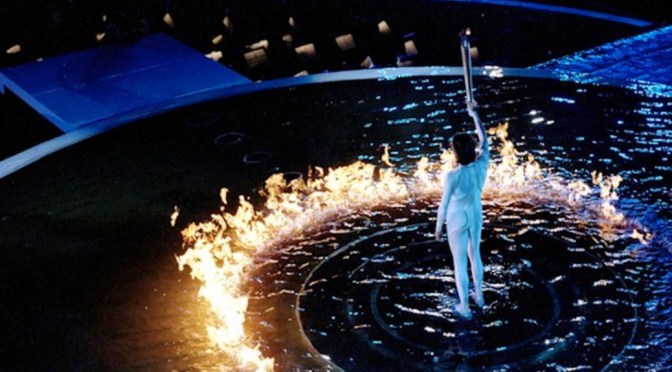
During the penultimate moments of the Olympic flame lighting, a technical glitch caused the rising movement of the cauldron structure to malfunction. It was supposed to rise around Kuku Yalanji and Birri Gubba woman of Far North Queensland, and international athlete, Cathy Freeman.

The four-minute pause allowed the world to take a longer-than-planned look at a living, breathing, self-defining Aboriginal Australian woman. Australians were in the box seat for the viewing – we probably needed to witness it more than anyone – and with the technical fault’s tinge of embarrassment, the reality of Cathy Freeman can never be extricated from the moment.

BANNED BANNER One of many which will not be seen by international delegates at the G20 in Brisbane.

Australians should consider ourselves lucky we got off very lightly compared to other Olympic human rights controversies, and we should not point the finger so quickly at others. If we do, we’re forgetting the sting of the Olympic human rights flame as it shone the light on us.

It will be interesting to see if the cream of international political conservatism is allowed to learn anything while they’re staying in Turrbal country in the place known as Meanjin since long before it was renamed Brisbane by European settlers.

Early signs from the G20 are not promising, after billboards promoting action on climate change were banned by the Brisbane Airport Corporation, and Aboriginal offices have been forcibly closed by Brisbane City Council without adequate explanation.

We can only hope for a technical glitch to get the real story to the world.

© Michael Burge, all rights reserved.