Tag Archives: Questionable Deeds

Two decades of answers

TWENTY YEARS AGO today, not long after six o’clock in the evening, my partner Jonathan Rosten needed to take a seat during a rehearsal at a Sydney dance studio, complaining of a racing heart.

Very shortly afterwards, he collapsed. First-aid could not revive him, nor could paramedics. By the time I got to his side they’d been attempting CPR for almost thirty minutes.

He was bundled into an ambulance that rushed him away into a busy city evening at the end of a stunning autumn day, yet by the time I arrived at the hospital, he was lost to us all at the age of just 44.

Considering the fallout after one gay man’s untimely death, I’m compelled to look at what has changed since that last day of autumn in 2004.

Interrogation of a Nation

“What did they do to you?” Madeline asked me, sitting on the back deck of the house my husband Richard and I shared in Queensland.

That was the winter of 2013. By then, I was living a completely different life in a new relationship, a new state and a new profession.

I’d long tried to articulate the experience of being disenfranchised from my relationship with Jono by the very people who should have cared the most – his blood relatives – but had usually given up when people failed to understand why anyone would do such a thing.

Madeline didn’t demand an answer, she just listened.

The passage of time had ignited something in me, because hours later I still couldn’t let things go in my mind. Revisiting the worst period of my life was still a shock, and over the following weeks and months I started to piece together the awful truth.

Writing had always been my strongest suit, and for almost a year I recorded not just my experience of loss, but also the mutual gains that Jono and I had manifested in our relationship.

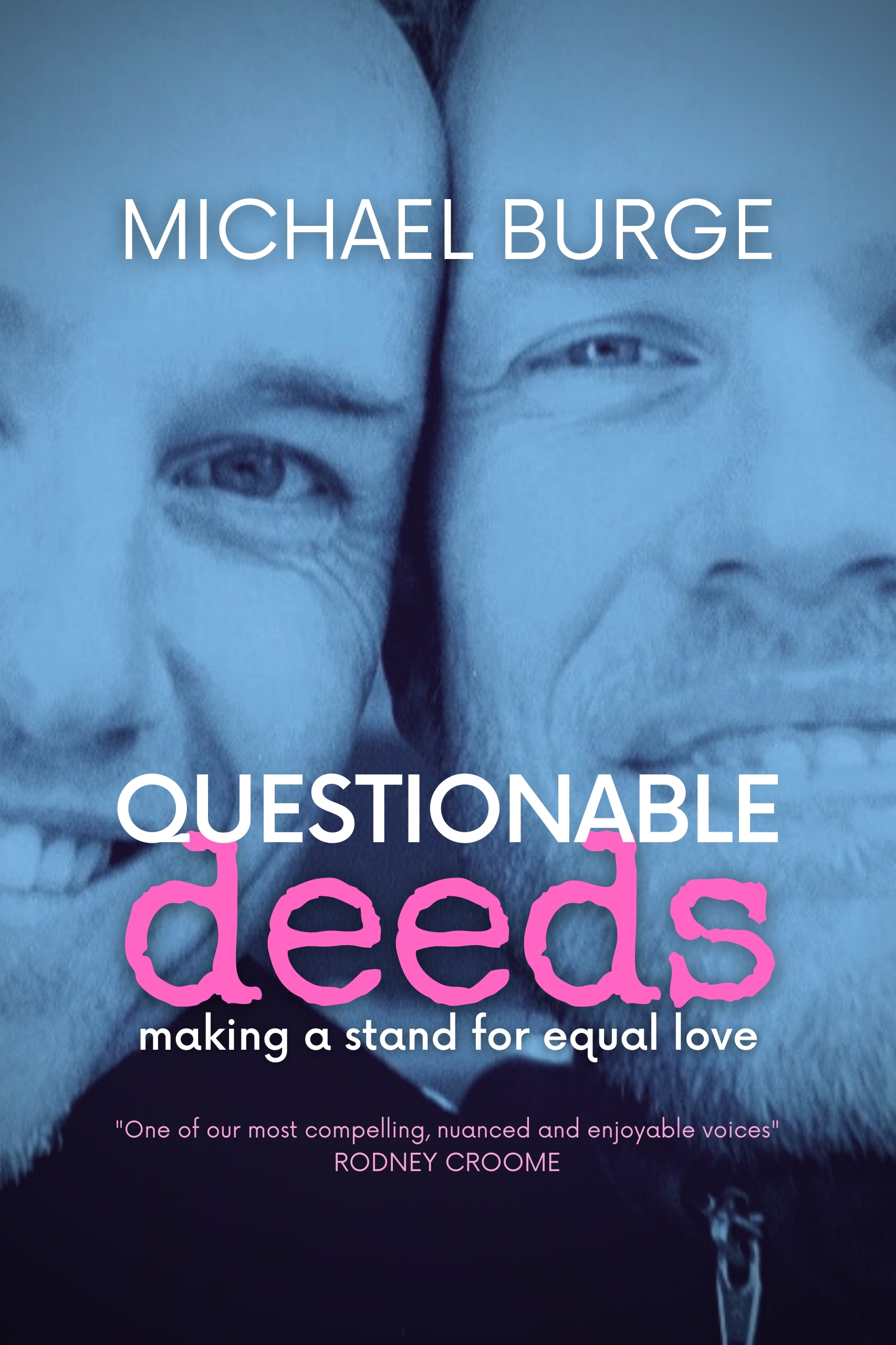
My memoir, Questionable Deeds: Making a stand for equal love (High Country Books, 2015 and 2021) was the long-form answer to Madeline’s question. It was an interrogation of a nation that was not acting in the best interests of same-sex attracted people, in fact it was making our lives worse; and it threw up just as many questions as it answered.

Piece of Paper

Marriage equality seemed so far off in 2004 that even significant sections of the LGBTIQA+ community didn’t get behind it. A Newspoll taken the month after Jono’s death showed support languishing at just 38 percent against 44pc opposed. The 18pc of undecideds were, ironically, deciding the status quo.

In my shock and grief that winter, it was a depressing show from my country. Even so, I became a marriage equality advocate overnight when I realised what a critical cultural statement it would make for same sex-attracted relationships to be upheld by law, whether we were married or not.
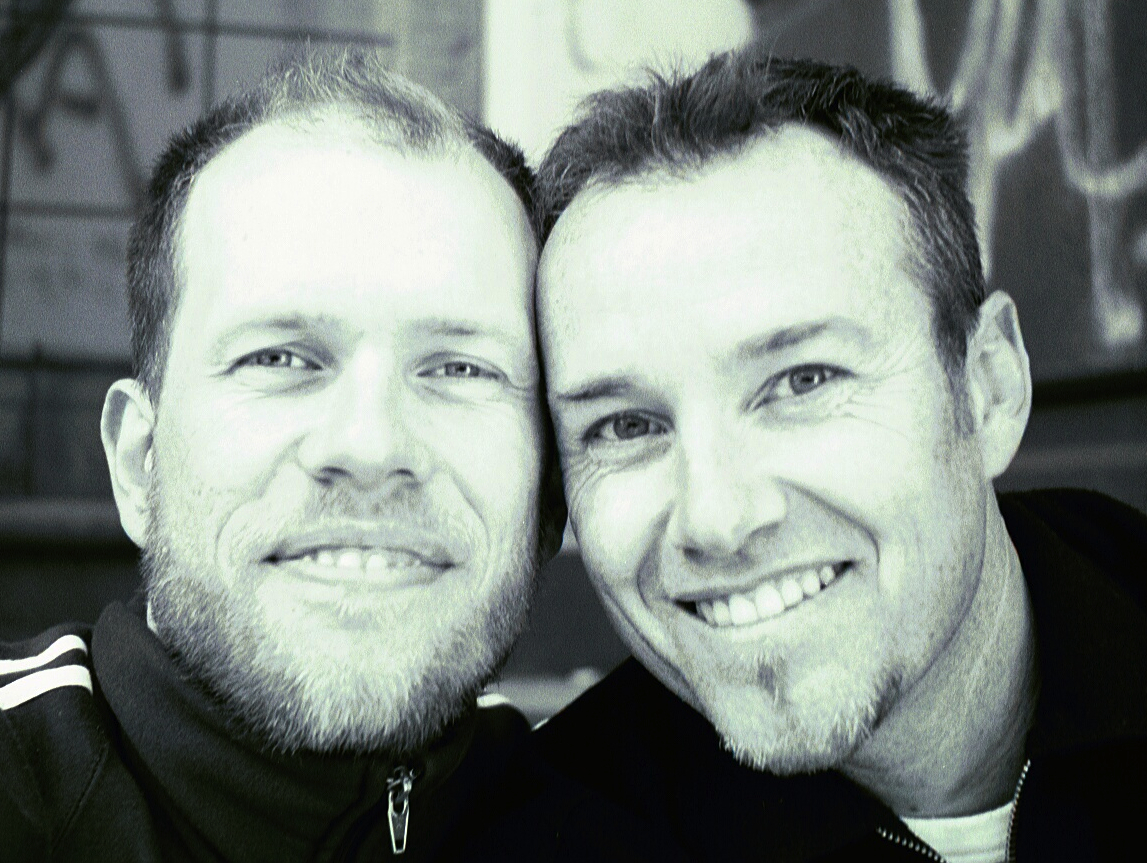
RELATIONSHIP RIGHTS: Michael Burge and Jonathan Rosten

But for years I was forced to listen to those who reckoned de-facto relationship rights were enough, that the New South Wales legislative change in 1999 was all the cultural statement required. But my experience – five years after those laws included same-sex couples – showed that anyone, from disgruntled family members, funeral directors and public servants could easily rearrange the pieces of my late partner’s life to make it appear as though he’d never been in a relationship with me, stamping all over my rights in the process.

Same-sex equality campaigning eventually became a hallmark of my new relationship, and Richard and I marched the streets, knocked on doors, collared politicians and signed petitions because we understood that this country needed marriage equality at the earliest opportunity.

It was eye-opening to hear from those who wanted to uphold ‘the good old days’ when same-sex partners hid in plain sight for all kinds of reasons. Many feminists understandably upheld their anti-marriage stance, although this was a pro-equality issue.

Australians love a numbers game, and the public-vote approach forced on the country became about much more than marriage, it was about LGBTIQA+ dignity.

Across those years, it was painful to witness similar situations to mine still happening while the nation prevaricated under conservative leadership; but since December 2017, when Australia’s Marriage Act was finally altered to include same-sex couples, I haven’t heard of another case.

That’s not to say that blood relatives won’t try. I’ve heard of a few attempts to push a same-sex surviving spouse out of their senior next-of-kin status, but the “piece of paper from the city hall” that Joni Mitchell sang about not needing has held the line again anti-queer prejudice.

Ripple Effect

In a 2022 survey by YouthSense, 1367 Australian Gen Zs aged 15-24 were canvassed about their sexual orientation, and 32 per cent responded that they identified as LGBTIQA+. 

YouthSense attributed this confidence in our queer youth in part to a ripple effect, after the majority of the Australian community got behind marriage equality.

This gives me a sense of pride, but I sometimes wonder what Jono would have thought of the person I’ve become. We often chatted about gay rights. Being a decade older, he reached his adulthood before homosexuality was legalised in NSW in 1984, and survived the frightening early years of the AIDS epidemic, but he usually took a lighter approach than I did.

After his death, I recognised his attitude in many queer campaigners who’d endured so much upheaval by the year 2000 that the idea of fighting on for marriage equality fatigued them. Jono turned forty in that year and was looking forward to a bit of peace and time to pursue his love of choreography, which is, ironically, what he was doing right up to his death.

Our case was heard by the Human Rights Commission in 2006. I spoke in front of the gathering and the media with a very wobbly voice that morning, due to lingering grief and shock, anxious because I was presenting my grief as a case study of the unnecessary extra angst that LGBTIQA+ were being put through when our loved ones died.

Subsequently, the commission produced its Same Sex, Same Entitlements report, which led to almost 100 pieces of discriminatory financial laws changing in 2010, another step in the long journey to alter the Marriage Act in 2017.

I’d made a stand, something I had never done before on such a scale and may never do again, and that was certainly worth writing about.

Creative Allies

Questionable Deeds still serves an important purpose for me. It’s re-traumatising to rake over the coals when someone asks about my experience. Being able to point them to a book means I can get on with my life while the reader’s awareness is raised through words on a page.

I’ve written since I was a teenager, although by the time I realised I was gay and entered a long period of closeting, it felt impossible to express myself in that way due to the fear of my secret being discovered.

By the late 1990s, all that changed, and I tentatively started writing more than scripts and marketing materials in my day jobs. The day that Jono died I was sitting at my computer working on a full-length play. In the fallout, it was a full year before I was able to find the peace and security to get back to work on it, but when I did, I noticed more significant changes.

No longer was I prepared to leave LGBTIQA+ at the sidelines of my subject matter. Long before the cultural shifts of marriage equality, I embarked on a journey to bringing cultural change to literature.

But literature took even longer to budge than legislation. In a skittish cultural landscape, my queer-themed play never found a producer, and Questionable Deeds did not land a book deal, although after I published it it was selected for the first LGBTIQA+ panel at the Brisbane Writers Festival in 2016 and became an Amazon bestseller.

It took many years to land my first book deal for my debut novel Tank Water (2021, MidnightSun Publishing). Because it deals with rural homophobia, I’ve been invited to literary events across the country to contribute to conversations around crime, justice and the change in LGBTIQA+ lives outside of cities.

After decades of being granted relatively easy access to jobs in rural-based media in the UK and Australia, by virtue of being born and raised in the bush, I was gobsmacked when, in 2021, the new Guardian Australia Rural Network approached me as a rural-based journalist to write and edit. The first subject matter they wanted me to generate coverage of was rural gay-hate crime.

Now, at long last, this thing called a writing career no longer feels like a solo journey, and with plenty of new projects in the pipeline I’m collaborating with more people than ever.

One of the most special aspects of my relationship with Jono was our discovery in one another of an ally for our creative endeavours. We had hours of discussion and planning for our projects, and I loved seeing the glow of inspiration rise in him.
I carry a bit of it still, because I know how such reciprocal validation feeds equality within a marriage. Perhaps that’s the ultimate lesson in marriage equality for everyone, not just LGBTIQA+.

Questionable Deeds: Making a stand for equal love is available from The Bookshop, Darlinghurst (Sydney); Hares & Hyenas (Melbourne); Shelf Lovers (Brisbane). and High Country Books.

Divorced from reality: the Coalition’s marital problems

“The Coalition will just have to take care of itself, because the political wedge has finally hit its target.”

AFTER the Coalition’s narrow win, the plebiscite on Marriage Equality should be getting ready to kick off, yet the same election promise has been blamed for the major swing against Malcolm Turnbull.

And the paradox has all the hallmarks of failure. In one of his delayed post-victory interviews, Malcolm Turnbull conceded the plebiscite would have to be pushed ahead to 2017.

His reason: “My commitment to have it dealt with as soon as practicable is there, but we… have to obtain the support of the Senate,” Mr Turnbull told Leigh Sales on the ABC’s 7.30 program.

This rhetoric is in stark contrast to Mr Turnbull’s pre-election claim that a guaranteed ‘yes’ plebiscite result would “sail through the parliament” under his leadership. 

At the dawn of a more diverse Senate than the one Turnbull tried to shift with his double-dissolution election, another narrative swiftly emerged this week that throws even more doubt on the PM’s grasp of the reins.

A Galaxy poll commission by PFLAG (Parents and Friends of Lesbians and Gays) conducted after the election indicates less than half of voters want a marriage equality plebiscite.

So the promise Mr Turnbull campaigned on – majority community support for asking the people by the end of 2016 – has fallen flat.

This is not a surprise. Equality campaigners not only saw it coming, we made it happen.

Marital problems

In my electorate – the division of Bowman in South East Queensland – a small team of us started door-knocking the neighbours of our federal MP Andrew Laming in March.

It proved to be a confronting process – knocking on doors asking for your human rights is not always fun – but we were already angry at how the mainstream media had given the Coalition’s Mr Laming a free kick in 2015.

Screen shot 2016-07-22 at 10.59.10 AM
LAMING’S PROJECT Federal Member for Bowman, Andrew Laming, interviewed by Waleed Aly.

When he appeared on Network Ten’s The Project Mr Laming claimed to be conducting a “scientific survey” of his constituents on Marriage Equality, and committed to vote in Canberra based on the results. Waleed Aly, Carrie Bickmore and the program’s producers let his claims go live to air completely un-analysed.

Mr Laming’s annual information-gathering session in his electorate gave voters one say per household on issues like live export and sand mining in addition to “gay marriage”, as though LGBTI want something special, like gay supermarkets, or gay sports fields. It came back – unsurprisingly – with 58 per cent against “gay marriage”.

So we sorely needed data of our own. Working with national lobby group Australian Marriage Equality, a unique petition was devised in which we offered a ‘yes’ or a ‘no’ option to anyone registered to vote in this electorate who had a firm view either way on altering the Marriage Act to allow same-sex couple equal access.

Instead of Mr Laming’s claim that Marriage Equality was a 50-50, “red-hot issue” across our community, what we found after months of cold-calling voters in their homes, at public transport hubs, shopping and at local markets, was more like the national trend in support for marriage equality: that is, overwhelming support.

Our petition proved to be an incredible experience. On several occasions we had people lining up to sign ‘yes’ to Marriage Equality, and locals engaged in many conversations about their LGBTI family members. If there was anything ‘red hot’ it was their anger that it was way past time for reform to be put in place by our elected representatives.

On social media threads we dealt with all the usual naysayers, accusing us of only petitioning at ‘gay discos’, but most people got the message – we were open to anyone with a firm view either way, and our percentage of ‘no’ signatures became strangely validating.

COULDN'T CARE Andrew Laming's initial response to a marriage equality petition.
COULDN’T CARE Andrew Laming’s initial response to a marriage equality petition.

Fairfax Media picked up our data and put it to Mr Laming, who said he: “Couldn’t care less”, which ran as a headline for 24 hours until the MP’s office hosed it down and reclaimed his first response as off the record. He subsequently apologised to petitioners and professed to be in support of our work.

But when we delivered the petition results to Mr Laming at a meet-the-candidates event run by the local chamber of commerce, his rhetoric changed again.

For the first time, the federal Member for Bowman indicated he’d vote with the majority of this electorate’s result at a national Marriage Equality plebiscite.

Nowhere in Turnbull’s plebiscite enthusiasm had there ever been a hint that the national result could be impacted by a rogue electorate. There had been talk from Senators and MPs about ignoring the nation and voting against Marriage Equality despite the plebiscite outcome, but that was written off as simply the hard-right rabble. We’d sprung a backbencher toeing the same line.

On social media, other campaigners were reporting similar language at meet-the-candidates events across the country. The dots were connected and the Coalition’s new plan became clear: a marriage equality plebiscite would only pass a yes vote if it was carried by a majority of electorates.

Questions were put into the laps of journalists. A record number posed them, and Turnbull was forced to admit he had no control over how his MPs would vote on the issue.

The Coalition countered with its last-minute claim that there was majority support nationally for the plebiscite, but the media smelled a rat and hammered Turnbull and other MPs throughout the last week of the campaign.

If the PM was not being upfront about the plebiscite, what else was on the nose?

The stink nearly lost Turnbull the election.

Coalition in splitsville

So the timetable has altered and now there’s evidence that voters don’t like the idea, yet Turnbull is sticking to his plebiscite plan. 

“Marriage Equality activists are match fit and we’ve built an ongoing connection with Australian voters.”

But the election produced another result. The majority of federal MPs who support changing the Marriage Act to allow equal access to same-sex couples increased to a record majority.

If a parliamentary free vote was held now, it would easily pass. 

One of the best headlines of the election campaign described Malcolm Turnbull’s plebiscite deal with the National Party as a ‘Faustian pact’. Now the dust has settled, the Coalition’s betrothal on Marriage Equality will soon start to look more like the kind of stranglehold common in domestic violence.

If Turnbull approaches the Senate with the plebiscite, it’ll likely never pass. If he tries to seek refuge in a parliamentary free vote, he’s likely to be rolled by the man who foisted the plebiscite nonsense on the Coalition with his last captain’s pick: Tony Abbott.

The Coalition’s response is to lead people to think it’s a case of plebiscite or nothing, but despite some commentators suggesting campaigners just submit to the public vote for the Coalition’s sake – in case it breaks apart – we are capable of multi-tasking around any of the Coalition’s plans for our equality.

We’ve had plenty of practice. The Coalition will just have to take care of itself, because the political wedge hit its target regardless of the election result. Other parties and lobby groups have started driving it in.

For Malcolm Turnbull, there’s simply no more hiding from the albatross he voluntarily tied to his own neck; yet he expects to resolve the marital problems the Coalition has always had around LGBTI relationship equality with $160-million dollar pretty lies about ‘asking the people’.

Blaming campaigners is like pointing at your spouse’s best friend over your own divorce. Marriage Equality activists are match fit and we’ve built an ongoing connection with Australian voters by having the important conversations. Trigger a fairly posed, timely, compulsory, binding, public vote and we’ll be there.

9780645270532

Michael Burge’s book Questionable Deeds: Making a stand for equal love traces marriage equality in Australia through one man’s battle to maintain his rights in the wake of his same-sex partner’s death. It’s available to buy in paperback and eBook.

© Michael Burge, all rights reserved.

This article also appears on NoFibs.

Australia’s marriage equality in chains

After many years trying to interest the Australian media in my story, particularly the LGBTI media, it was only in the wake of another tragedy that a European mainstream media source published this op-ed on Australia Day. 

AUSTRALIA has long traded on its relaxed ‘fair go’ approach when spinning friendly, down-to-earth slogans to sell our easy-going holiday locations to the world.

But for one pair of British newlyweds who recently honeymooned in South Australia, a crucial danger lay completely hidden.

Why would the same-sex legislation of South Australia be of any concern to David and Marco Bulmer-Rizzi when they planned their romantic getaway?

“Between all the wine tasting and surfing, it’s easy to miss the inequality of this sun-soaked nation.”

We’re an enlightened, first-world society, aren’t we? Neighbours and Home and Away have their share of same-sex attracted characters; South Australia even has a proud record of LGBTI equality, being the first state in Australia to decriminalise homosexuality in 1975. It’s all good, right?

Wrong. Between all the wine tasting and surfing, it’s easy to miss the inequality of this sun-soaked nation.

Hearing about the South Australian legal system’s treatment of Marco Bulmer-Rizzi, who was subjected to the indignity of seeing his husband’s relationship status recorded as ‘never married’ in the wake of David’s accidental death in that state last week, I felt a familiar and frustrating pang of grief.

The international outrage was loud and justified. South Australia’s Premier Jay Weatherill quickly apologised, offering a guarantee that South Australian law would be changed to amend David’s death certificate. In an acute state of grief, Marco gave an interview, expressing his ardent hope that this kind of thing never happens again in Australia.

At that point I got very angry, because I have wanted exactly that ever since my partner Jono died in New South Wales more than a decade ago.

MIKEY:JONO
LIFE PARTNERS Michael Burge and Jonathan Rosten in 2002.

In 2004, despite NSW’s same-sex de-facto laws having been in place for five years, my deceased partner’s death certificate was issued to his blood relatives without my name on it or any reference to our relationship.

You read that right: Sydney’s Registry of Births, Deaths and Marriages broke the state law to disenfranchise me.

The complicity of the funeral company I’d contracted meant the illegally issued document took me two years to fix. Despite lobbying the NSW Attorney-General, no apology was issued by the state government, and no assurances were given that training would be put in place to prevent anything similar happening to others.

For 12 years, I’ve been communicating the dangers for LGBTI couples and death certification to anyone who would listen. In 2015, I wrote a book about my experience – Questionable Deeds: Making a stand for equal love. My motivation was to increase our awareness about how vulnerable LGBTIs are in Australia, with inconsistent state and federal laws that allow surviving same-sex spouses to fall between the cracks.

But death is a hard sell. Same-sex death is even harder. Too many Australians are unwilling to believe such unfairness and homophobia in our organisations and government departments.

Even more difficult to communicate is the homophobia that leads some families to deny the existence of same-sex spouses. At least Marco Bulmer-Rizzi was spared discrimination at the hands of homophobic in-laws, who were the driving force behind my disenfranchisement.

Whatever the reason behind the silence about my story, right now, there are generations of LGBTI in Australia who remain completely invisible on their deceased partner’s death certificates and were thereby blocked from their spouses’ estates.

Who is to blame for this legal lottery that has been erasing LGBTI stories in Australia for decades?

Politicians, sure, but it has long been painful and depressing to me how slow Australia’s media and publishing industries have been to recognize and disseminate the message about this disconnect. It’s impossible to argue they’re reflecting audience sentiment, when all polling on marriage equality places community support at over 70 per cent.

The solution is staring Australians in the face: a free vote of federal ministers on the floor of the nation’s parliament could enact marriage equality here in less than a week.

Yet national legislation that would sweep aside state anomalies is considered so controversial it put us in a holding pattern on marriage equality years ago.

“There has just never been enough outrage about marriage equality in this country.”

We have a sitting prime minister – Malcolm Turnbull – who supports marriage equality, but the political deal-making when he ousted Tony Abbott saw him sign away the parliamentary vote he once publicly backed. Instead, he has a plan for a divisive referendum at a time and in a manner he’s reluctant to reveal.

In the fallout of the Bulmer-Rizzi case, South Australia’s highest-profile conservative politician, Christopher Pyne, was quick to call for overseas same-sex marriages to be recognized in Australian states and territories.

But his approach illustrates the problem in a nutshell. Although he is a supporter of marriage equality, Pyne would rather advocate for a piecemeal solution that would protect visiting international LGBTI couples long before Australians.

When our leaders start to campaign for the human rights of guests instead of residents, they have lost touch with exactly who they represent in parliament.

Pyne’s words also imply he thinks marriage equality in Australia is so far away we’d best jet off to countries that support our relationships and benefit from a legal loophole.

MARCO BULMER-RIZZI
DISENFRANCHISED SPOUSE British citizen Marco Bulmer-Rizzi.

This behavior is far from isolated in Australia. Our tendency to overlook our creatives in favour of international artists – our ‘cultural cringe’ – is cast into the shade by this even stronger legislative blind spot for all domestic human rights. It’s only ‘bad’ if it makes world news. It only warrants a state premier’s apology when it happens to a foreign national. Fix it by sorting out the laws that the world is watching.

We were caught out treating Marco Bulmer-Rizzi with the heartlessness of our penal-colony roots, and, putting his confidence aside, Jay Weatherill will come up against plenty of homophobic politicians and public servants in his journey to amend David Bulmer-Rizzi’s death certificate. I’m anticipating the British media will track this Australian story closest.

creating-waves-cover
BUY NOW

Despite all our ‘fair go’ slogans – or perhaps because of them – there has just never been enough outrage about marriage equality in this country to drive the issue from a statistic into a legal reality. That we got a kick along only as the result of the untimely death of a young gay tourist is shameful.

This op-ed was first published by Gay Star News.  

It also appears in Michael’s eBook Creating Waves: Critical takes on culture and politics.